
Show the formula and working
This free gas m3 to kWh converter turns the units on your gas meter into kilowatt hours, the unit your supplier charges for, and turns kWh back into meter units, for households in the UK and Ireland and anyone in Europe with a gas meter in cubic metres. It handles metric meters in cubic metres and older imperial meters in hundreds of cubic feet, using the calorific value printed on your bill.
Quick answer: To convert gas m3 to kWh, multiply the cubic metres by 1.02264, then by the calorific value on your bill, then divide by 3.6. At a calorific value of 39.5 MJ/m3, 1 m3 of gas is 11.22 kWh, so 100 m3 is 1,122 kWh. One imperial unit of 100 cubic feet is 31.75 kWh.

What Is a Gas m3 to kWh Converter?
A gas m3 to kWh converter is a tool that changes the volume of gas your meter records into the energy it contains, measured in kilowatt hours. The formula in plain words is: kWh = cubic metres x volume correction factor (1.02264) x calorific value (MJ/m3) / 3.6. If your meter is imperial, first multiply the units by 2.83 to get cubic metres. To go from kWh back to meter units, multiply by 3.6 and divide by the calorific value and by 1.02264.
Each figure has a job. The volume correction factor of 1.02264 adjusts the measured volume for the temperature and pressure of gas in a typical home. The calorific value is the energy in each cubic metre, in megajoules, and it varies slightly with the gas in the network. Dividing by 3.6 turns megajoules into kWh, because 1 kWh is exactly 3.6 MJ. The gov.uk guidance on gas meter readings and bill calculation sets out the same steps.
How Do You Use the Gas m3 to kWh Converter?
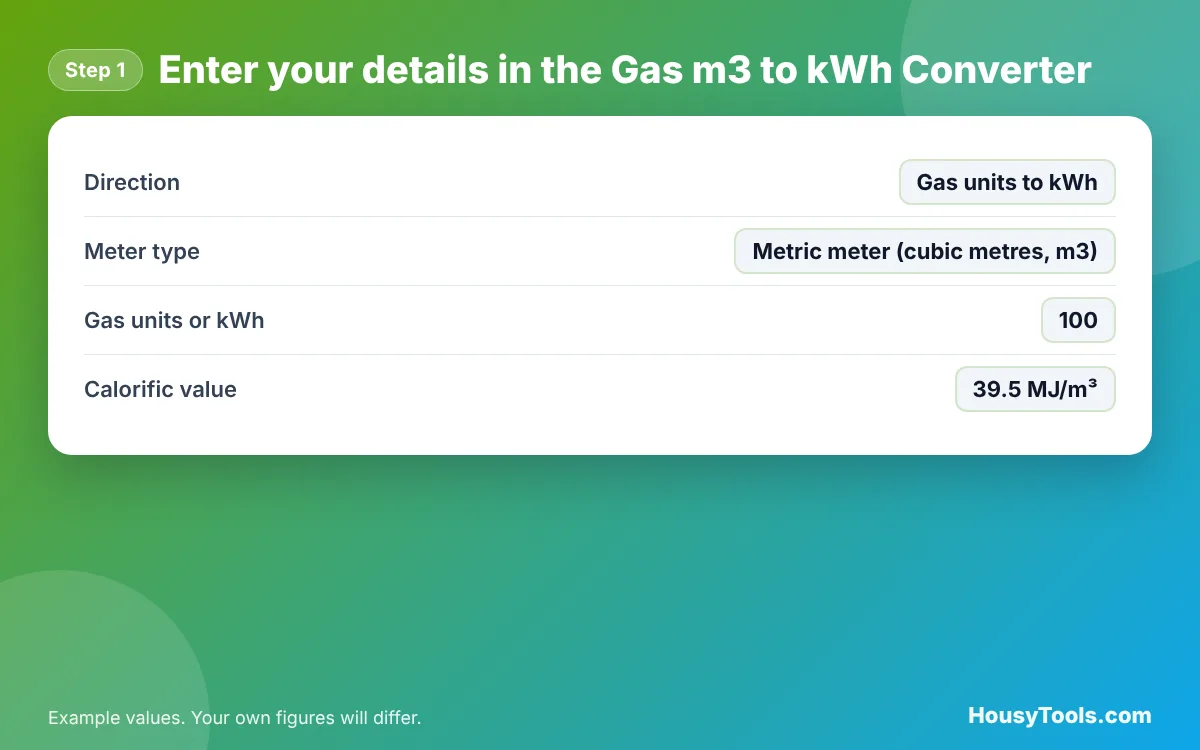
- Choose the Direction: “Gas units to kWh” or “kWh to gas units”.
- Pick the Meter type: “Metric meter (cubic metres, m3)” if the meter shows M3 or has five numbers before the decimal point, or “Imperial meter (hundreds of cubic feet)” if it shows FT3 or four numbers.
- Enter Gas units or kWh. For units, subtract your previous reading from your current reading and enter the difference, ignoring the red numbers after the decimal point.
- Enter the Calorific value from your gas bill, or leave the example of 39.5 MJ/m3.
- Read the result, then open “Show the formula and working” to see each step, the kWh per unit and the energy in megajoules.


How Many kWh Are in 1 m3 of Gas?
One cubic metre of natural gas contains about 11.22 kWh at a calorific value of 39.5 MJ/m3, after the 1.02264 volume correction. Each change of 1 MJ/m3 in the calorific value moves this by about 0.28 kWh, so 38.5 MJ/m3 gives 10.94 kWh and 40.5 MJ/m3 gives 11.50 kWh. Use the calorific value on your own bill for an exact figure.
How Do I Convert Imperial Gas Units to kWh?
Multiply imperial units by 2.83 to get cubic metres, then apply the normal formula, which gives about 31.75 kWh per unit at 39.5 MJ/m3. One imperial unit is 100 cubic feet, and gov.uk sets 100 cubic feet as 2.83 m3 for billing. Imperial meters show fewer digits and each unit holds almost three times as much gas as a metric unit, so choosing the wrong meter type is the most common cause of a bill that looks far too high or too low.
Where Do I Find the Calorific Value on My Gas Bill?
The calorific value is printed on your gas bill or annual statement, usually near the meter readings, as a number such as 39.2 MJ/m3. Suppliers use the average value for your area over the billing period, which is why it can change slightly from one bill to the next. If you cannot find it, 39.5 MJ/m3 is the example the gov.uk guidance uses and gives a close estimate.
Why Is My Gas Bill in kWh and Not Units?
Gas is billed in kWh because the energy in each cubic metre varies, while a kWh is always exactly 3.6 megajoules. Converting to kWh means you pay for the energy you actually used and lets you compare gas with electricity directly. Once you have your kWh, the gas bill calculator adds the unit rate and standing charge to estimate the bill.
Gas m3 to kWh Conversion Table
| Gas used | kWh at 38.5 MJ/m3 | kWh at 39.5 MJ/m3 | kWh at 40.5 MJ/m3 | Same number of imperial units at 39.5 MJ/m3 |
|---|---|---|---|---|
| 1 | 10.94 | 11.22 | 11.50 | 31.75 |
| 10 | 109.37 | 112.21 | 115.05 | 317.54 |
| 50 | 546.83 | 561.03 | 575.24 | 1,587.72 |
| 100 | 1,093.66 | 1,122.06 | 1,150.47 | 3,175.44 |
| 250 | 2,734.14 | 2,805.16 | 2,876.17 | 7,938.60 |
| 500 | 5,468.28 | 5,610.32 | 5,752.35 | 15,877.20 |
| 1,000 | 10,936.57 | 11,220.63 | 11,504.70 | 31,754.39 |
The first three result columns are for cubic metres from a metric meter. The last column is for the same number of units read from an imperial meter.
Worked Example: A Quarterly Reading
Example: a metric gas meter read 4,210 last quarter and reads 4,295 today, so 85 m3 was used. The bill shows a calorific value of 39.1 MJ/m3. Leave the Direction on “Gas units to kWh”, keep “Metric meter (cubic metres, m3)”, enter 85 in Gas units or kWh and 39.1 in Calorific value. The converter shows 85 x 1.02264 = 86.92 m3, then 86.92 x 39.1 = 3,398.7 MJ, then 3,398.7 / 3.6 = 944.1 kWh. That is the figure the supplier should charge for.
If you are choosing a new boiler or comparing heating systems, the boiler size calculator and the other heating calculators help you use these kWh figures.
Gas m3 to kWh Converter FAQs
How do I convert gas units to kWh?
Multiply the cubic metres used by 1.02264, then by the calorific value on your bill, then divide by 3.6. For an imperial meter, multiply the units by 2.83 first. At 39.5 MJ/m3, 100 m3 gives 1,122 kWh.
What is the volume correction factor of 1.02264?
It is a fixed figure that adjusts the gas volume your meter records for typical temperature and atmospheric pressure, so every customer is billed on the same basis. It increases the measured volume by about 2.3% before the calorific value is applied.
How do I know if my gas meter is metric or imperial?
A metric meter usually shows M3 and five digits before the decimal point. An imperial meter usually shows FT3 or “hundreds of cubic feet” and four digits. If you are unsure, check the meter face or a recent bill, which states the meter type.
How many kWh is 1 unit of gas?
At a calorific value of 39.5 MJ/m3, one metric unit (1 m3) is 11.22 kWh and one imperial unit (100 cubic feet) is 31.75 kWh. The exact figure moves slightly with the calorific value shown on your bill.
Why does the calorific value change?
Natural gas is a mix of gases whose make up varies with its source and route through the network, so the energy per cubic metre changes slightly. Suppliers bill using the average value for your area during the billing period.
Can I convert kWh back to cubic metres?
Yes. Multiply the kWh by 3.6, then divide by the calorific value and by 1.02264. At 39.5 MJ/m3, 1,000 kWh is about 89.12 m3, or 31.49 imperial units. Choose “kWh to gas units” in the converter to do this.
Checked October 2026. Sources: Gas meter readings and bill calculation (gov.uk), NIST Guide to the SI, Special Publication 811 (kilowatt hour = 3.6 MJ).