
Show the formula and working
This solar export calculator works out how much you earn from the solar electricity you send to the grid, and compares two export tariffs side by side. It suits homes in Great Britain on the Smart Export Guarantee and homes elsewhere in Europe on a feed in or export tariff. Enter your system size, location, how much you use at home and two export rates.
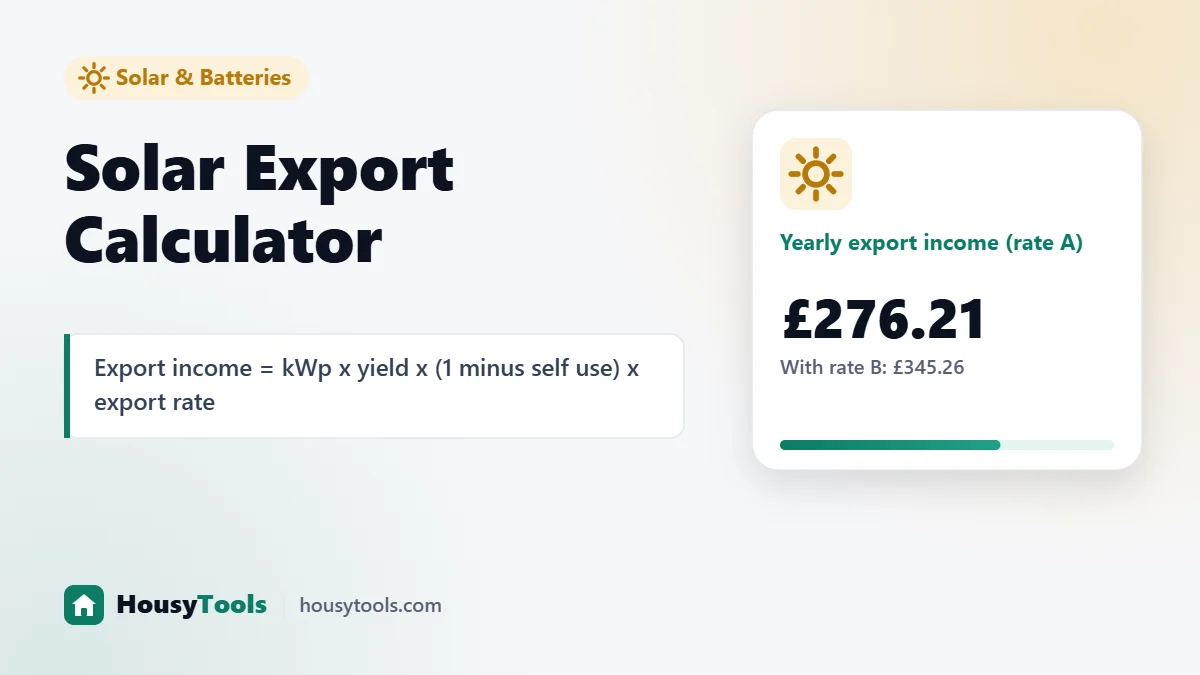
Quick answer: Solar export income equals the kWh you export times your export rate. A 4.5 kWp system in London makes about 4,604 kWh a year with PVGIS yields. If you use half at home, you export about 2,302 kWh, which earns about £276 a year at 12p per kWh or £345 at 15p.
What Is a Solar Export Calculator?
A solar export calculator is a tool that estimates the yearly payment you receive for surplus solar electricity sent to the grid.
The formula in plain words: yearly generation equals system size in kWp times the yield per kWp for your location. The exported share is one minus the share you use at home. Exported kWh times your export rate in pence or cents gives the yearly income. The calculator runs the same sum for a second rate, so you can see how much switching tariff is worth, and splits the income into a typical June and December month.
How Do You Use the Solar Export Calculator?
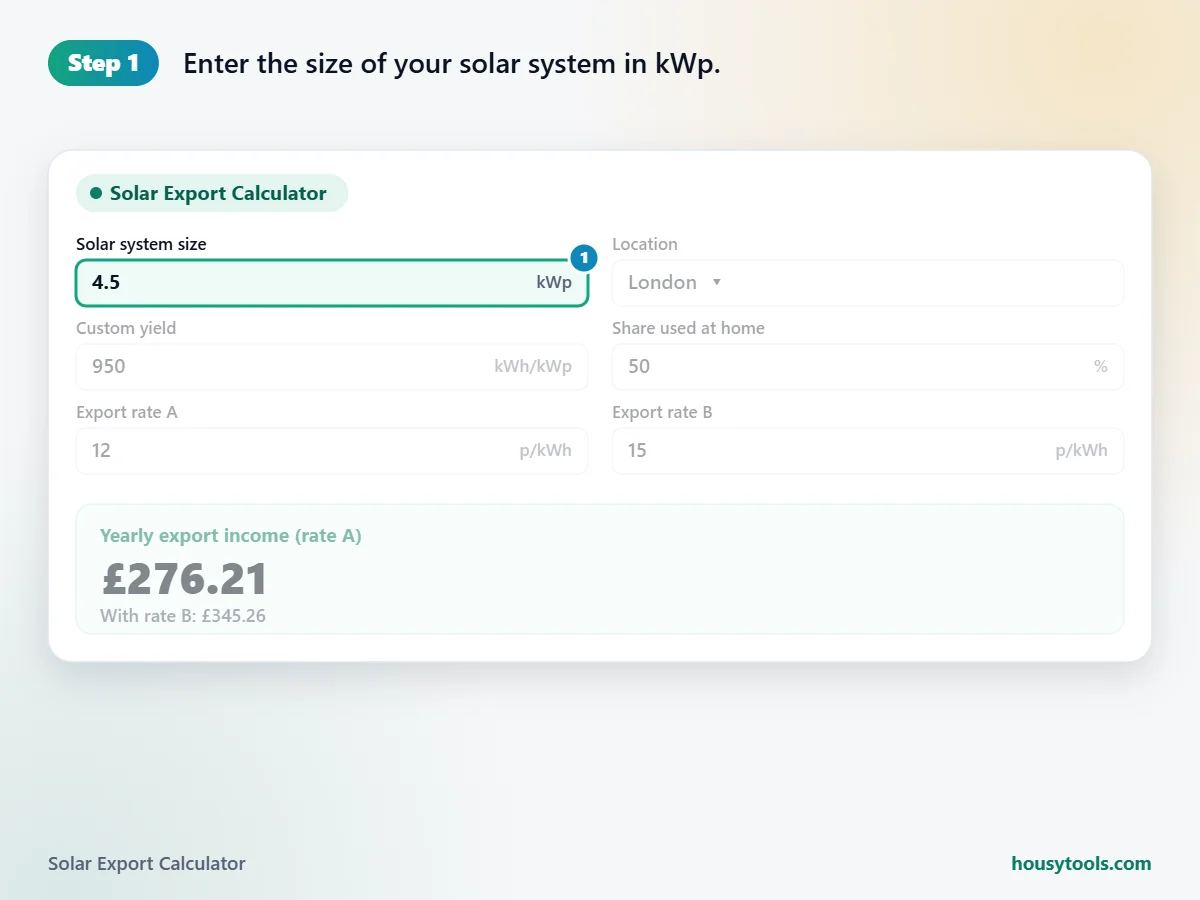
- Enter the size of your solar system in kWp.
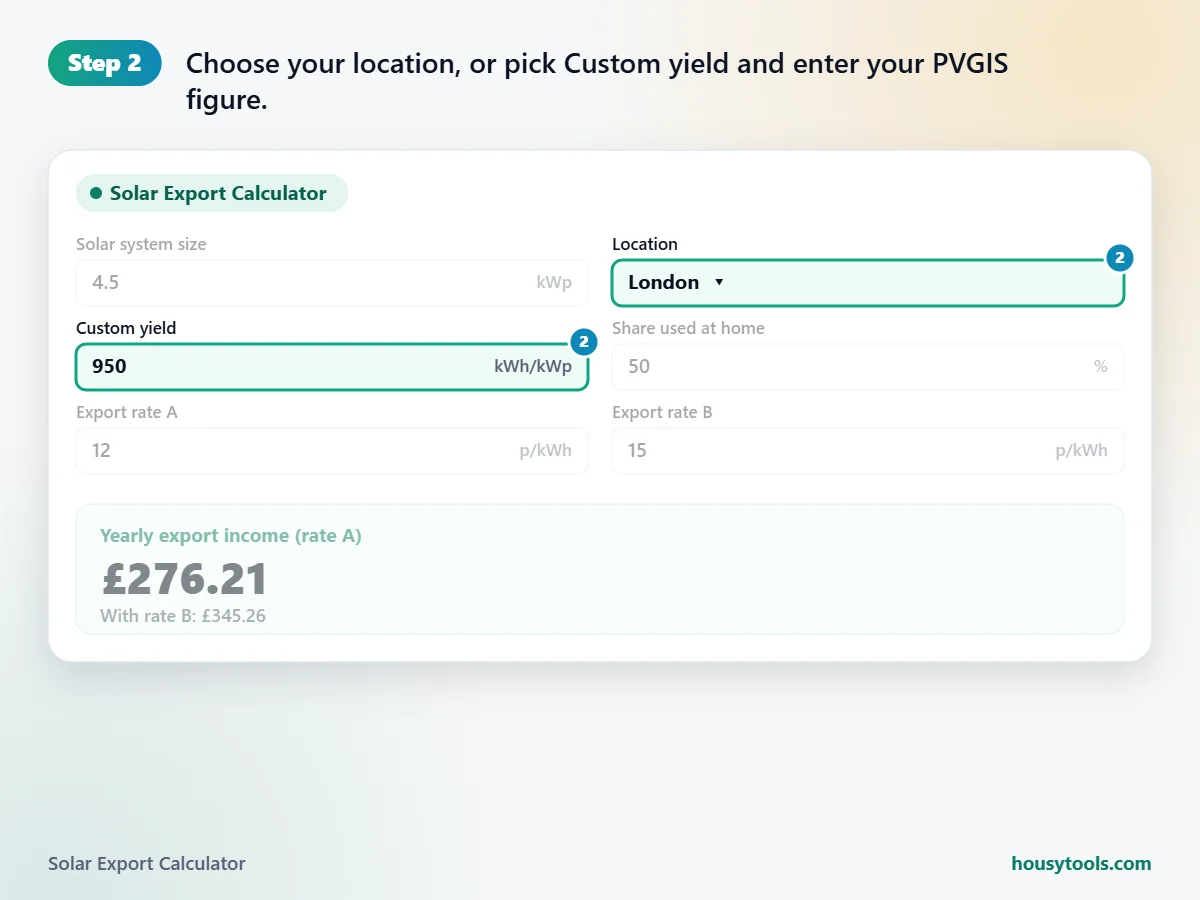
- Choose your location, or pick Custom yield and enter your PVGIS figure.
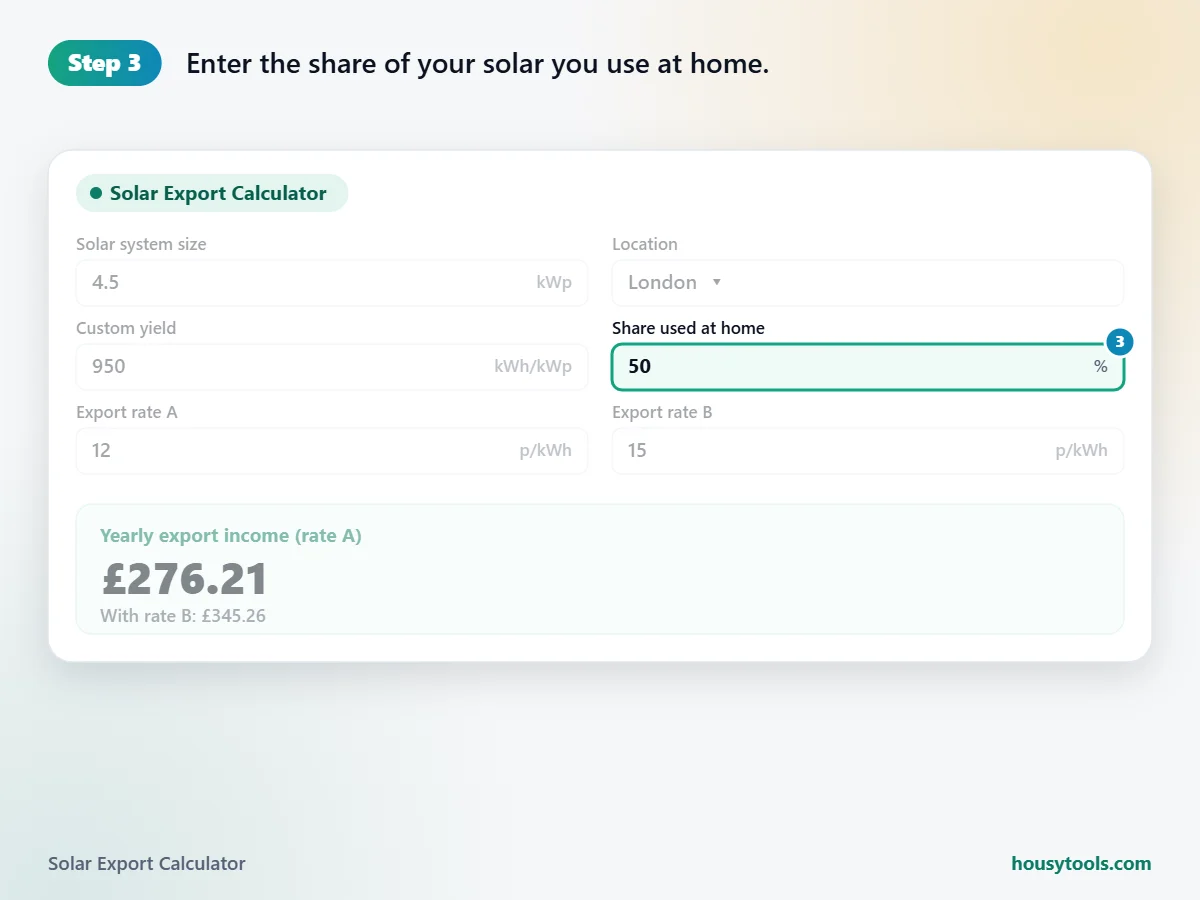
- Enter the share of your solar you use at home.
- Enter your export rate as rate A.
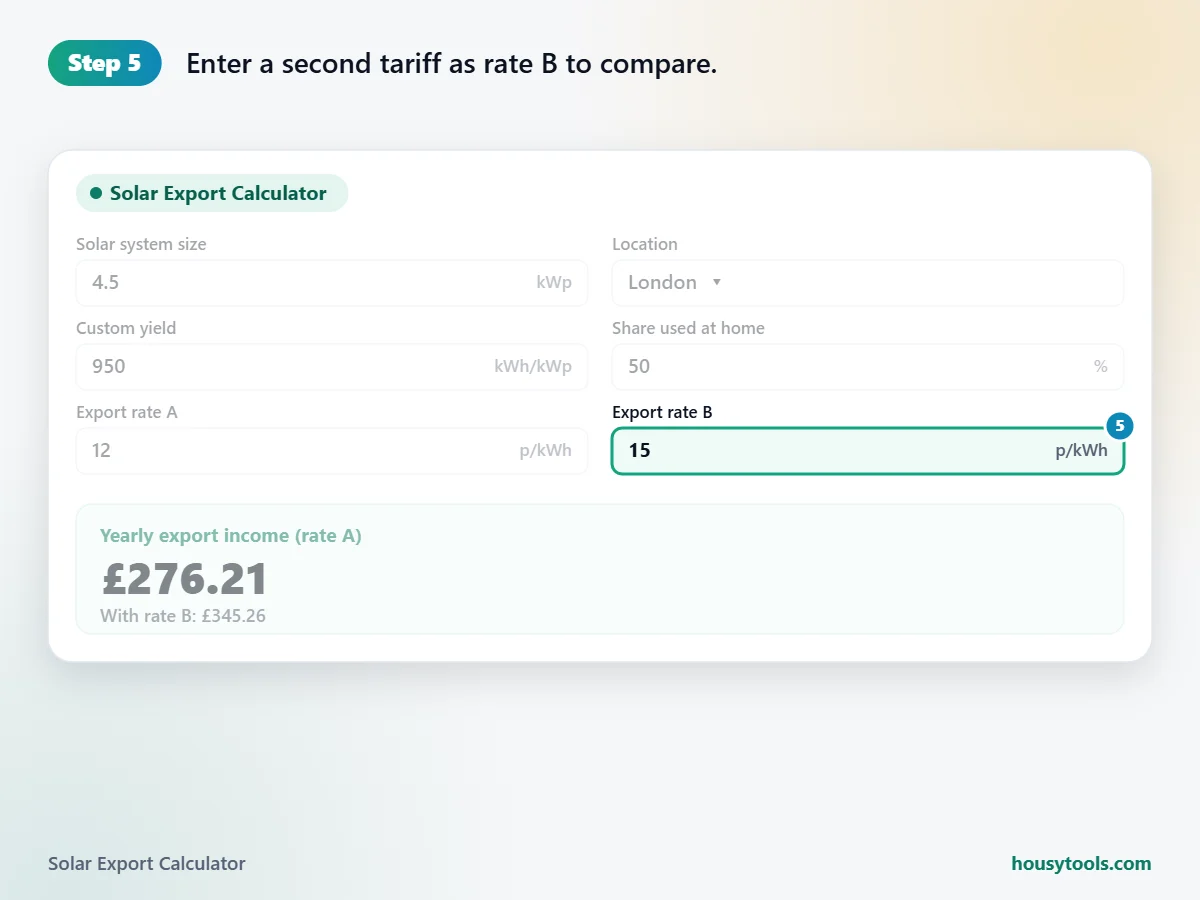
- Enter a second tariff as rate B to compare.
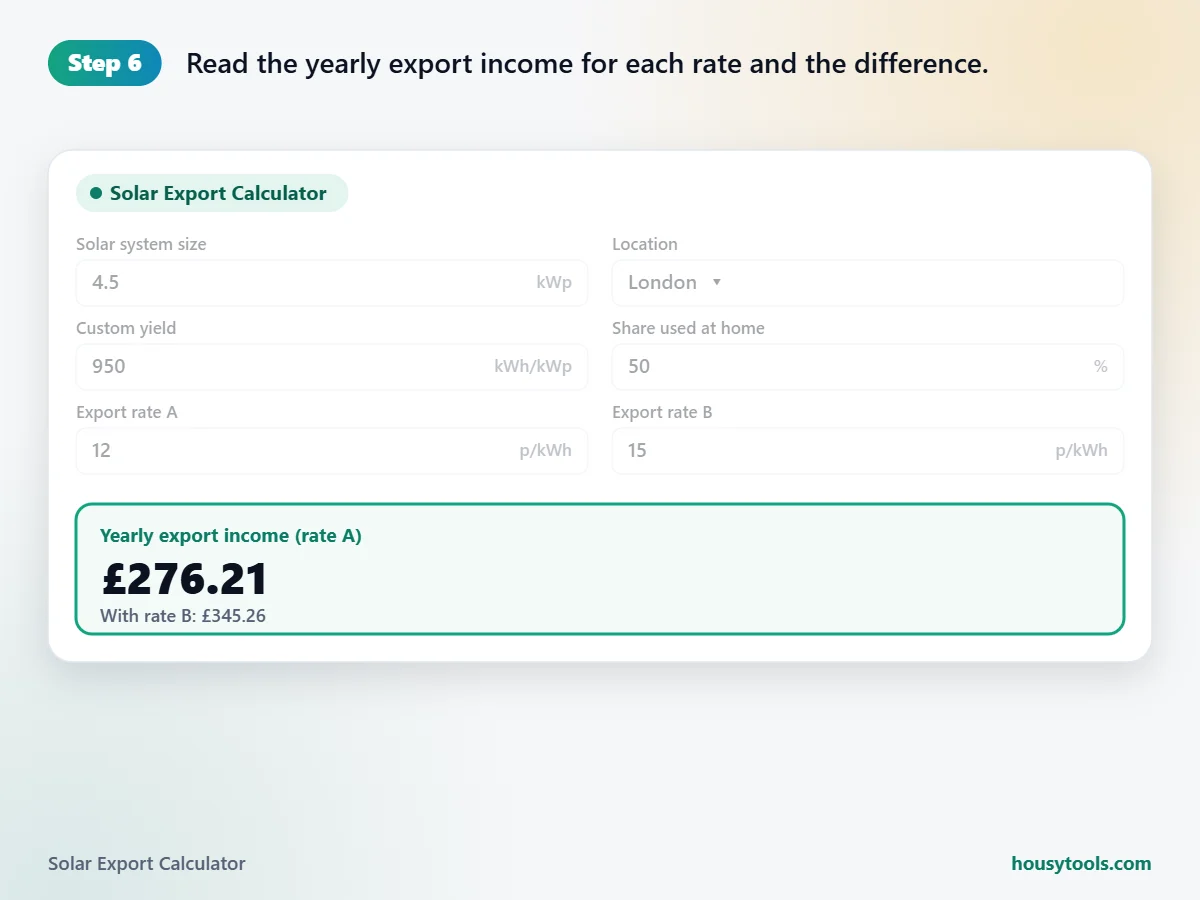
- Read the yearly export income for each rate and the difference.

What Is the Smart Export Guarantee?
The Smart Export Guarantee (SEG) is the scheme in Great Britain that requires larger electricity suppliers to offer a tariff that pays small scale generators for electricity they export.
According to the Smart Export Guarantee guidance on GOV.UK, the rate must always be above zero, but suppliers set it themselves, so rates vary widely. Systems up to 50 kW need MCS certification or an equivalent scheme, and you need a meter that can record exports every half hour, usually a smart meter. Your export supplier does not have to be the supplier you buy electricity from, so it is worth comparing.
How Much Can You Earn From Exporting Solar?
For a 4.5 kWp London system exporting 2,302 kWh a year, income ranges from about £94 at 4.1p to about £460 at 20p, so the rate you choose matters as much as the system size.
| Export rate | Yearly income | Per month on average | June | December |
|---|---|---|---|---|
| 4.1p | £94.37 | £7.86 | £11.07 | £3.51 |
| 8p | £184.14 | £15.34 | £21.60 | £6.84 |
| 12p | £276.21 | £23.02 | £32.40 | £10.26 |
| 15p | £345.26 | £28.77 | £40.50 | £12.83 |
| 20p | £460.35 | £38.36 | £54.00 | £17.10 |
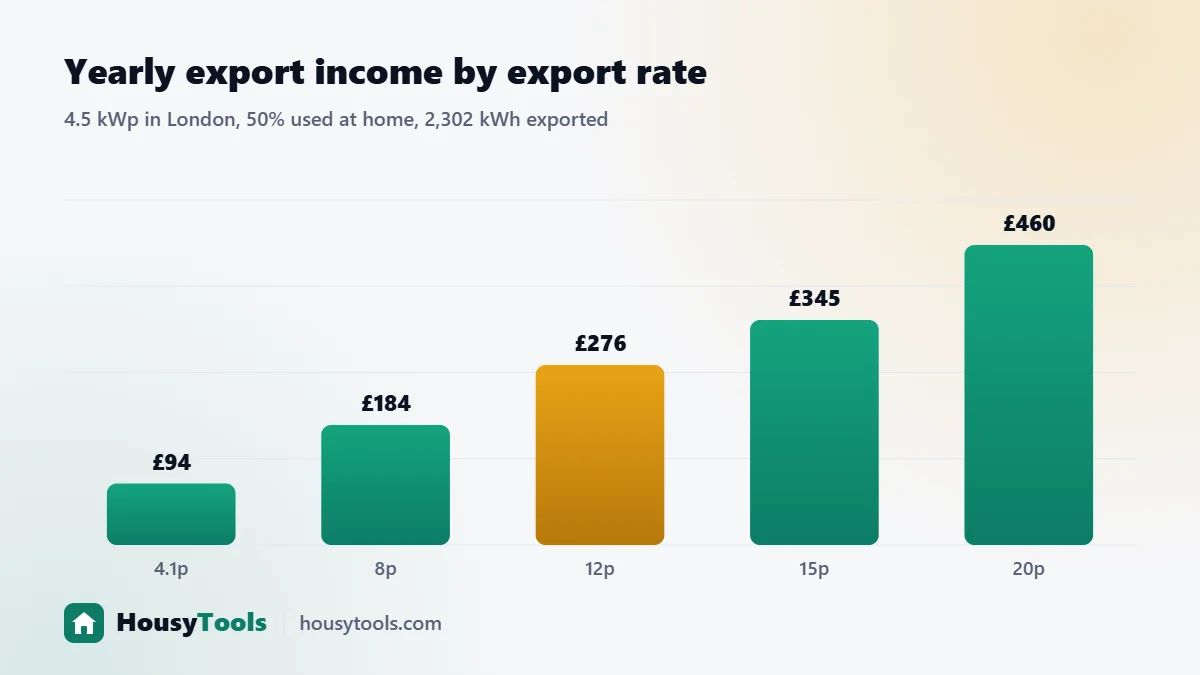
The Energy Saving Trust uses about 12p per kWh as a typical Smart Export Guarantee figure, which is why rate A defaults to 12p. Some tariffs pay more if you also buy electricity from the same supplier, and some pay a variable rate that changes with the wholesale price, so read the terms before switching.
Should You Export or Use Your Solar Power?
Using your solar power is usually worth more than exporting it, because the 26.32p price cap unit rate for October to December 2026 is more than twice a typical 12p export rate.
That is why running the washing machine or dishwasher in sunny hours often beats chasing a higher export rate. Higher export rates narrow the gap, and if a tariff pays more for exports than you pay for imports, exporting can win. To see your total benefit, enter your import and export rates in the solar panel calculator. To check whether storing surplus power would pay, use the solar battery savings calculator.
Worked Example: Comparing Two Tariffs in Edinburgh
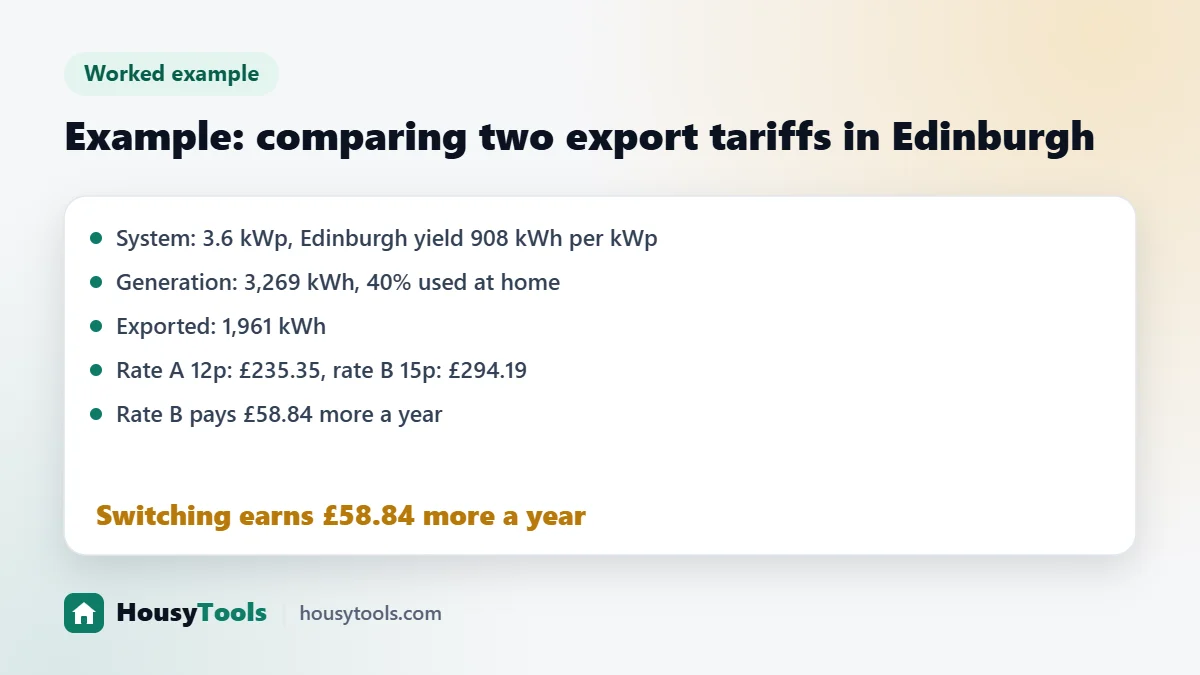
Example: a home in Edinburgh has a 3.6 kWp system and uses 40% of its solar directly. It is on a 12p export tariff and has seen a 15p offer.
- Generation: 3.6 x 908 kWh per kWp = 3,269 kWh
- Exported: 3,269 x 60% = 1,961 kWh
- Rate A at 12p: 1,961 x 12p = £235.35 a year
- Rate B at 15p: 1,961 x 15p = £294.19 a year
- Difference: £58.84 a year in favour of rate B
Before switching, the household checks whether the 15p offer requires a more expensive import tariff. If the import rate rises by more than the export gain is worth, switching could cost money overall.
How Is Export Measured and Paid?
Exports are measured by a smart or export meter in half hour periods, and suppliers pay them as a bill credit or a bank payment on their own schedule.
Without a meter that records exports, suppliers cannot pay for actual exports, so ask for a smart meter before registering. Payments start once your installer’s MCS certificate and the meter readings are accepted. Outside Great Britain, export schemes differ by country, so enter the rate from your own supplier or feed in tariff.
Solar Export Calculator FAQs
How much do you get paid for exporting solar electricity?
It depends on your tariff. At 12p per kWh, exporting 2,302 kWh a year earns about £276. Suppliers set their own Smart Export Guarantee rates, which must be above zero.
How much solar do homes export?
Homes without a battery often export around half of what their panels make, more if nobody is home in the day. Your smart meter app or supplier statements show the actual figure.
Do I need a smart meter to get export payments?
You need a meter that records exports in half hour periods, which usually means a smart meter. GOV.UK guidance also requires MCS certification or an equivalent scheme for systems up to 50 kW.
Can I export with a different supplier from my import supplier?
Yes. Under the Smart Export Guarantee your export supplier does not have to be the company that sells you electricity, though some higher export rates are only offered to their own import customers.
Is a fixed or variable export rate better?
A fixed rate is predictable. A variable rate follows wholesale prices, so it can pay more at some times and less at others. Enter the average you expect from each as rate A and rate B to compare.
Does a higher export rate change whether I should get a battery?
Yes. The higher your export rate, the less a battery saves, because each stored kWh loses its export payment. Compare both with the solar battery savings calculator.
Checked October 2026. Sources: GOV.UK Smart Export Guarantee guidance, Energy Saving Trust solar panel advice, EU Joint Research Centre PVGIS, Ofgem energy price cap.