
Show the formula and working
This heated airer running cost calculator shows what a heated clothes airer costs per load and per year, and compares it with drying the same loads in a tumble dryer. Enter the airer power in watts, how long a load takes to dry, how many loads you dry a week and your tumble dryer energy use per load. It starts with the UK price cap unit rate, has EU presets, and you can type your own tariff.
Quick answer: A heated airer costs its power in kW times the drying hours times your unit rate. A 300 W airer running for 4 hours uses 1.2 kWh, about 32p a load at 26.32p. Drying 3 loads a week costs about £49.27 a year, compared with about £184.77 for a tumble dryer using 4.5 kWh a load.

How Is Heated Airer Running Cost Calculated?
Divide the airer wattage by 1,000 to get kilowatts, multiply by the hours a load takes to dry and then by your unit rate.
Heated airers have low powered elements, usually a few hundred watts, that warm the rails. They take much longer than a tumble dryer but use far less power while running. The calculator works out the kWh per load and the cost per load. It multiplies by your loads per week and 52 weeks for the yearly cost. It then works out what the same number of loads would cost in a tumble dryer, using the kWh per load you enter, and shows the difference.
How Do You Use the Heated Airer Calculator?
- Enter the airer power from its label.
- Enter how many hours one load takes to dry.
- Enter how many loads you dry a week.
- Enter your tumble dryer energy per load to compare.
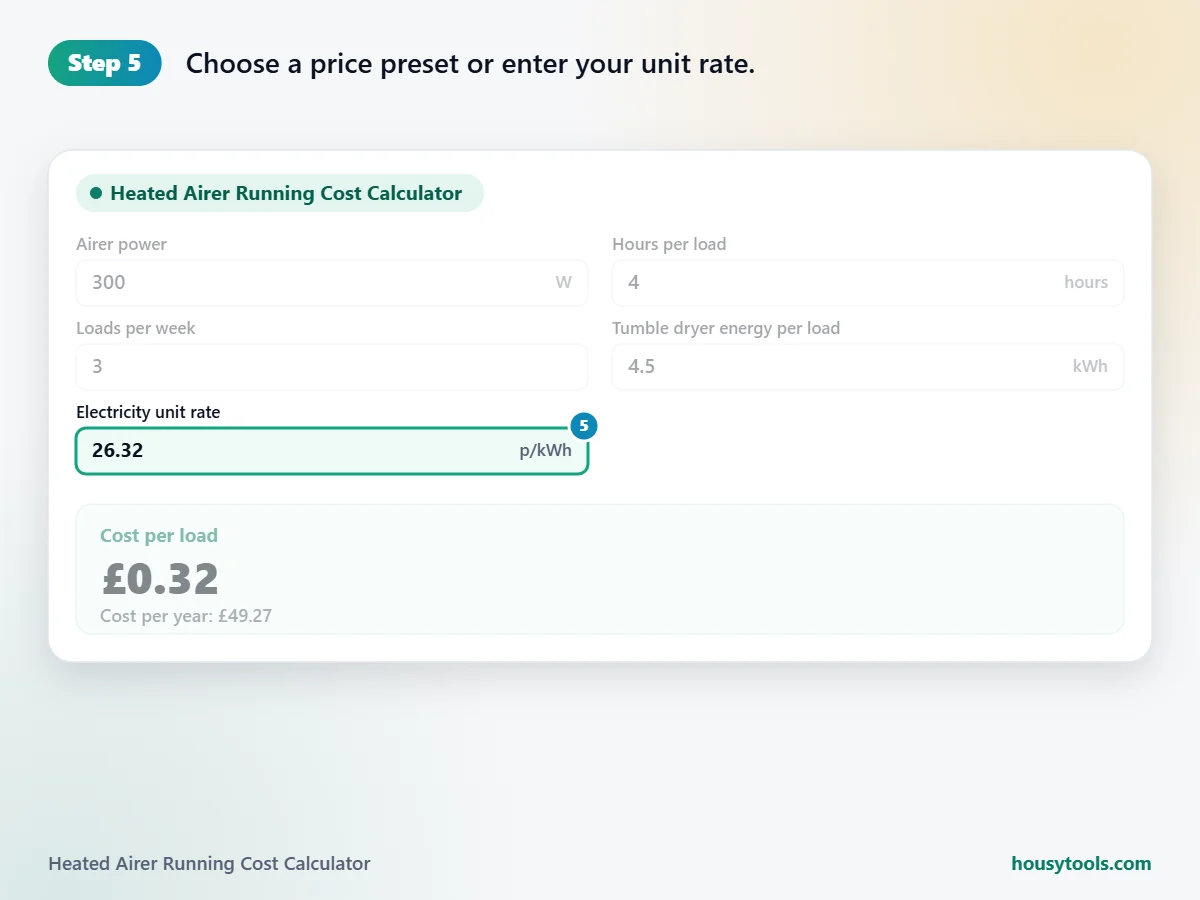
- Choose a price preset or enter your unit rate.


How Much Does a Heated Airer Cost to Run?
At 26.32p per kWh, a heated airer costs about 2.6p an hour for every 100 W, so a 300 W model is about 7.9p an hour.
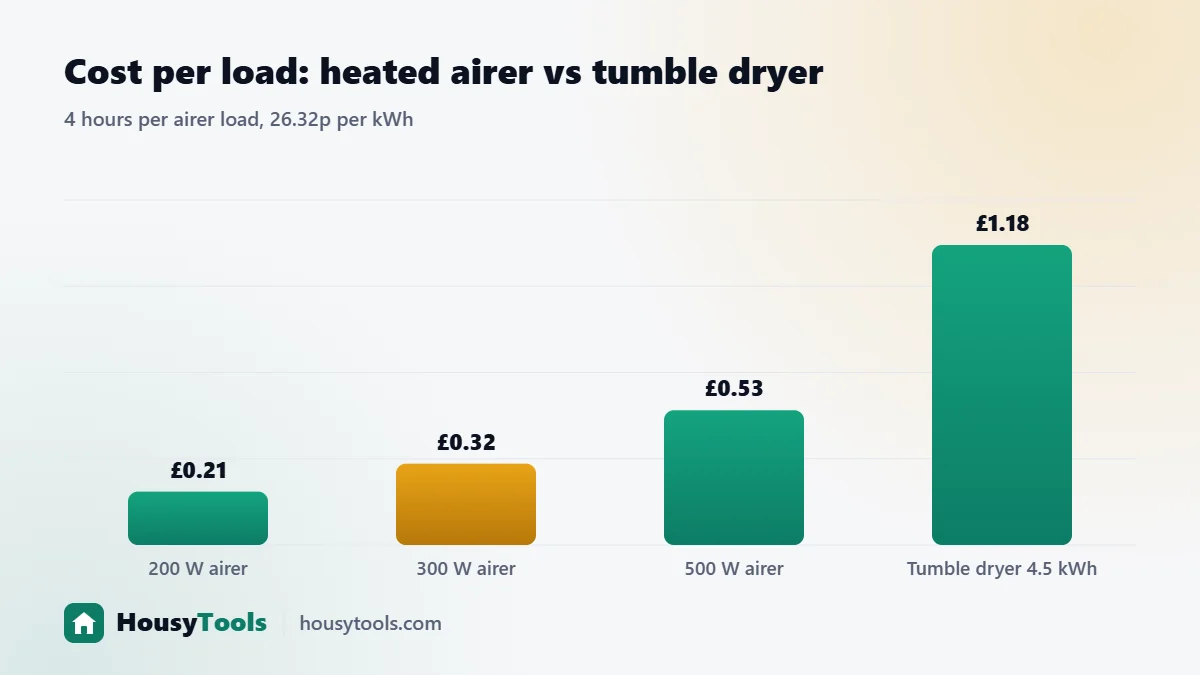
| Airer power | Cost per hour | Cost per 4 hour load | Cost per year (3 loads a week) |
|---|---|---|---|
| 200 W | 5.26p | £0.21 | £32.85 |
| 300 W | 7.9p | £0.32 | £49.27 |
| 500 W | 13.16p | £0.53 | £82.12 |
The power is printed on the label or in the instructions. Drying time depends on the fabric, how full the airer is, how well the clothes were spun and how warm and well ventilated the room is. Check today’s unit rate on the Ofgem energy price cap page.
Is a Heated Airer Cheaper Than a Tumble Dryer?
Usually yes, per load, because it draws far less power, even though it runs for longer.
With the defaults, the tumble dryer comparison uses 4.5 kWh a load, which is an example. Newer heat pump dryers can use much less than that, while older vented or condenser dryers can use more. The energy label or manual gives a figure for your dryer, and the tumble dryer running cost calculator works out its full cost. If your dryer is efficient, the saving from a heated airer shrinks, as the worked example below shows.
Does a Heated Airer Cause Damp?
Drying clothes indoors releases a lot of water into the air, whatever you dry them on.
A heated airer speeds up drying but the moisture still has to go somewhere. Opening a window a little, running an extractor fan or using a dehumidifier in the same room helps stop condensation and mould. A dehumidifier also speeds up drying, and you can work out its cost with the dehumidifier running cost calculator.
Worked Example: A 220 W Airer for a Family
Example: a family dries 5 loads a week on a 220 W heated airer, and each load takes 6 hours. Their heat pump tumble dryer uses about 2.5 kWh a load. The unit rate is 26.32p.
- Per load: 0.22 kW x 6 h = 1.32 kWh, about 35p
- Loads per year: 5 x 52 = 260
- Airer per year: 260 x 1.32 kWh = 343.2 kWh, which is £90.33
- Tumble dryer per year: 260 x 2.5 kWh = 650 kWh, which is £171.08
- Saving: £80.75 a year

The saving is real but smaller than many people expect, because this family’s dryer is fairly efficient. The longer drying time is also worth thinking about: in a busy home, a load sitting on the airer for 6 hours can be the bigger cost in convenience.
Tips for Cheaper Drying
The cheapest drying is still on a line outside when the weather allows, which costs nothing.
- Use the fastest spin your clothes can take, so less water is left to dry.
- Do not overload the airer: air needs to move between the clothes.
- Use a cover if your airer has one, as it keeps warm air around the clothes.
- Switch the airer off as soon as the load is dry.
- Run it in cheap hours if you are on a time of use tariff.
Heated Airer Running Cost FAQs
How much does a heated airer cost per hour?
A heated airer costs its power in kW times your unit rate. At 26.32p, a 300 W airer costs about 7.9p an hour and a 200 W airer about 5.3p an hour.
How much does a heated airer cost per load?
It depends on drying time. A 300 W airer running for 4 hours uses 1.2 kWh, which is about 32p a load at 26.32p.
Is it cheaper to use a heated airer or a tumble dryer?
A heated airer usually costs less per load. The saving depends on your dryer: an efficient heat pump dryer narrows the gap.
Can you leave a heated airer on overnight?
Follow the maker’s instructions. Many airers are designed for long running, but switching off when the clothes are dry saves money.
Do heated airers dry clothes fully?
Most dry thin items well. Thick towels and jeans can take much longer, especially in a cool room without air flow.
How can I make a heated airer dry faster?
Spin clothes well, spread them out, use a cover if supplied and keep the room ventilated or use a dehumidifier.
Checked October 2026. Sources: Ofgem energy price cap. Tumble dryer energy per load is an example; use your dryer’s energy label.