
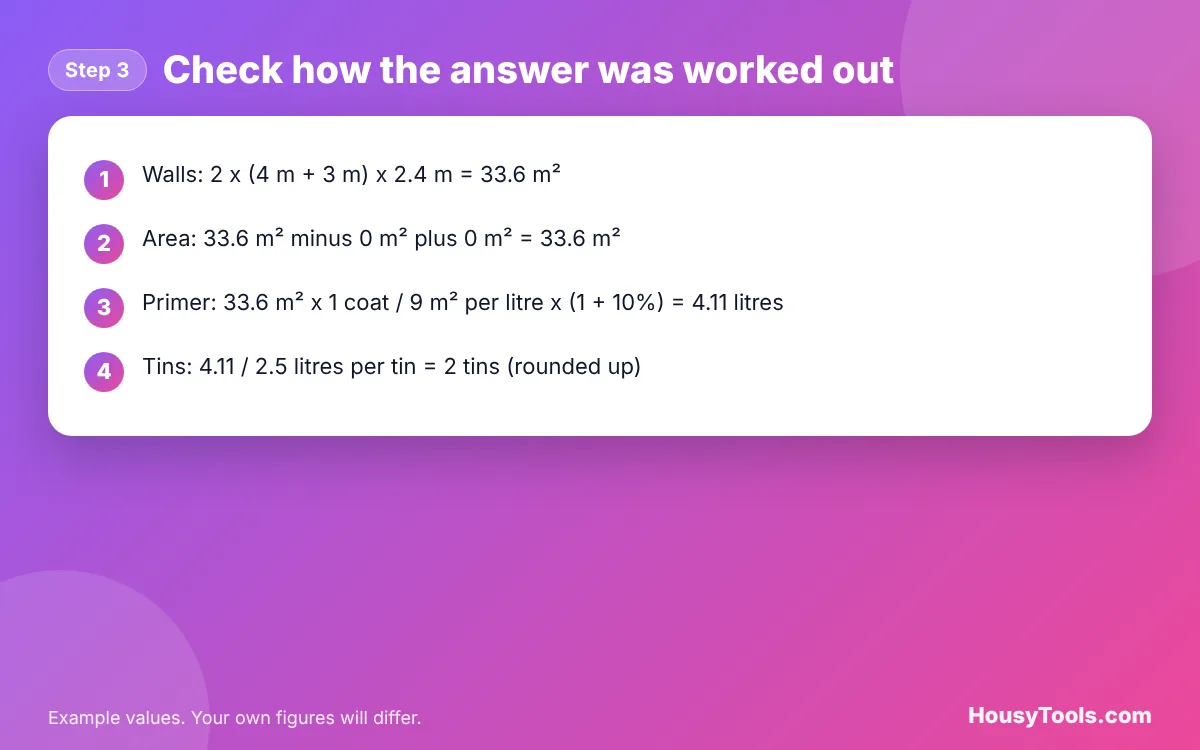
Show the formula and working
This primer calculator works out how many litres and tins of primer you need for the walls, ceiling and woodwork of a room, for decorators and homeowners in the UK and Europe working in metres. It takes away doors and windows, lets you pick a plaster and masonry primer, a wood primer undercoat or your own product, and adds an allowance for absorbent surfaces so you do not run out before the first coat is finished.
Quick answer: Multiply the area to prime in m² by the number of coats, divide by the coverage on the tin in m² per litre, then add about 10%. The walls of a 4 m by 3 m room 2.4 m high are 33.6 m², so the primer calculator gives 4.11 litres at 9 m² per litre: two 2.5 litre tins.

What Is a Primer Calculator?
A primer calculator is a tool that converts the surface area you need to seal into litres and tins of primer. The formula is: primer in litres = area in m² x number of coats / coverage in m² per litre x (1 + waste percentage). Wall area is 2 x (length + width) x height, the ceiling is length x width, and doors and windows are taken away before the litres are worked out.
Primer usually covers less than a finishing paint because bare plaster, masonry and timber soak it up. For example, the Dulux Trade Alkali Resisting Primer data gives up to 9 m² per litre, while many emulsions state well over 12 m² per litre.
How Do You Use the Primer Calculator?
- Enter Room length, Room width and Wall height in metres, or switch to feet.
- Tick Prime the walls, Prime the ceiling or both, and enter Doors and windows to leave out.
- Add Extra area such as doors or woodwork if you are priming skirting, doors or frames as well.
- Choose the Primer type. If you pick your own primer, enter Coverage of my own primer from the tin.
- Set Coats of primer, Extra for absorbent surfaces and waste and the Tin size you plan to buy.
- Read the litres and tins, then open “Show the formula and working” to check each step.


How Much Primer Do I Need for a Room?
A typical 4 m by 3 m bedroom with 2.4 m walls needs about 4.1 litres of primer for one coat on the walls at 9 m² per litre with 10% extra, or about 5.6 litres if you prime the ceiling too. Divide the area by the coverage on your tin and add 10% for rough or very porous surfaces.
Once the primer is on, our paint calculator works out the topcoat for the same room, and the paint cost calculator totals the price of primer and paint together.
How Many Coats of Primer Do You Need?
One coat of primer is usually enough on plaster and masonry, while bare wood often needs two. The Dulux Trade Quick Dry Wood Primer Undercoat specifies 2 coats on new or bare surfaces and 1 coat on previously painted surfaces. Always follow the tin, because stain blocking, metal and tile primers have their own instructions.
How Far Does a Litre of Primer Go?
A litre of primer covers roughly 9 to 13 m² for the products below, so a 2.5 litre tin covers about 22 to 32 m² in one coat. Coverage figures on tins are usually maximums on smooth surfaces, which is why the calculator adds an allowance for thirsty or textured areas.
| Primer (manufacturer data) | Stated coverage | Coats | Recoat time |
|---|---|---|---|
| Dulux Trade Alkali Resisting Primer (plaster and masonry) | Up to 9 m² per litre | 1 on bare or stained surfaces | 16 to 24 hours |
| Dulux Trade Quick Dry Wood Primer Undercoat | Up to 13 m² per litre | 2 on bare wood, 1 on painted wood | 2 to 4 hours |
| Mist coat of Dulux Trade Supermatt (new plaster) | Up to 18 m² per litre | 1 thinned coat | 2 to 4 hours |
Do You Need Primer on New Plaster?
New plaster needs sealing before it is painted, either with a primer made for plaster or with a mist coat of thinned matt emulsion. Dulux Trade gives up to 1 part water to 3 parts Supermatt for sealing new or bare surfaces. Unsealed plaster pulls the water out of the first coat, which can make the paint flake or look patchy.
Worked Example: A Spare Room
Example: the walls of a 4 m by 3 m spare room have been replastered to 2.4 m high and need one coat of plaster and masonry primer on the walls only. Leave the doors and windows in, add 10% for absorbent surfaces and buy 2.5 litre tins.
- Walls: 2 x (4 m + 3 m) x 2.4 m = 33.6 m².
- Primer: 33.6 m² x 1 coat / 9 m² per litre = 3.73 litres.
- With 10% extra: 3.73 x 1.10 = 4.11 litres.
- Tins: 4.11 / 2.5 = 2 tins of 2.5 litres, leaving about 0.89 litres spare.
The spare primer covers any patches you fill later. More decorating tools are in our paint and decorating calculators section.
Primer Calculator FAQs
How many square metres does 5 litres of primer cover?
Five litres of primer covers about 45 m² at 9 m² per litre or 65 m² at 13 m² per litre, for one coat. Rough, porous or textured surfaces take more, so allow around 10% extra.
Is primer the same as undercoat?
No. Primer seals a bare surface and helps paint stick, while undercoat builds an even base colour under gloss or eggshell. Some products, such as a primer undercoat for wood, do both jobs in one tin.
Do I need primer on previously painted walls?
Usually not, if the old paint is sound, clean and a similar type. Prime bare patches, filler, stains and any glossy surface you have sanded. A stain blocking primer helps over water marks or smoke damage.
How long should primer dry before painting?
It depends on the product: water based wood primer undercoats can often be recoated in 2 to 4 hours, while solvent based alkali resisting primers may need 16 to 24 hours. Check the recoat time on your tin.
Should I add extra primer for bare plaster?
Yes, allow at least 10% extra on bare plaster, block or timber, because these surfaces absorb more than the tin’s ideal coverage figure. For very rough masonry, increase the allowance to 20% or more.
How do I work out primer for a ceiling?
Multiply the room length by the width to get the ceiling area, then divide by the coverage. A 4 m by 3 m ceiling is 12 m², which needs about 1.47 litres of primer at 9 m² per litre with 10% extra.
Checked October 2026. Sources: Dulux Trade Alkali Resisting Primer, Dulux Trade Quick Dry Wood Primer Undercoat, Dulux Trade Supermatt.