
Show the formula and working
This oil filled radiator running cost calculator works out what a portable oil filled radiator costs to run per hour, per day and per winter, for homes in the UK, Ireland and the rest of Europe. It allows for the thermostat switching the element on and off, and compares the cost with heating the same room using gas central heating, so you can see when a plug in radiator makes sense.
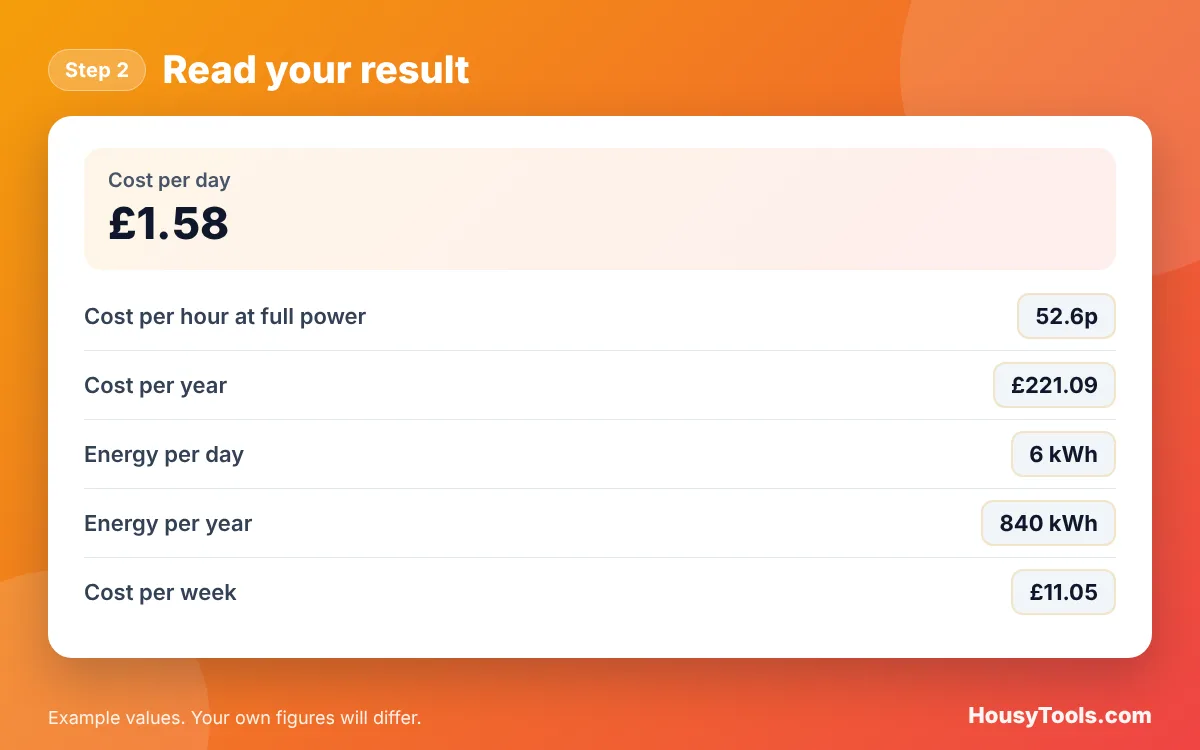
Quick answer: An oil filled radiator running cost calculator multiplies kW by hours, by thermostat on time and by your unit rate. A 2,000 W radiator costs 52.6p an hour at full power at 26.32p per kWh. Switched on for 6 hours with the element on half the time, it costs £1.58 a day.
What Is an Oil Filled Radiator Running Cost Calculator?
An oil filled radiator running cost calculator is a tool that estimates the electricity an oil filled radiator uses and what it costs, from its power setting, hours of use and thermostat cycling. In plain words: energy per day equals the power in kW multiplied by the hours it is switched on, multiplied by the share of time the element is actually heating. Cost equals that energy multiplied by your unit rate. The yearly figure multiplies by days per week and weeks per year.
Oil filled radiators are electric heaters. The oil inside is sealed in and never needs topping up; it simply stores heat from the element and releases it slowly. Like all plug in electric heaters, they turn 1 kWh of electricity into 1 kWh of heat, so a 2,000 W model gives out about 6,824 BTU/h, no more and no less than a fan heater of the same wattage.
How Do You Use the Oil Filled Radiator Running Cost Calculator?
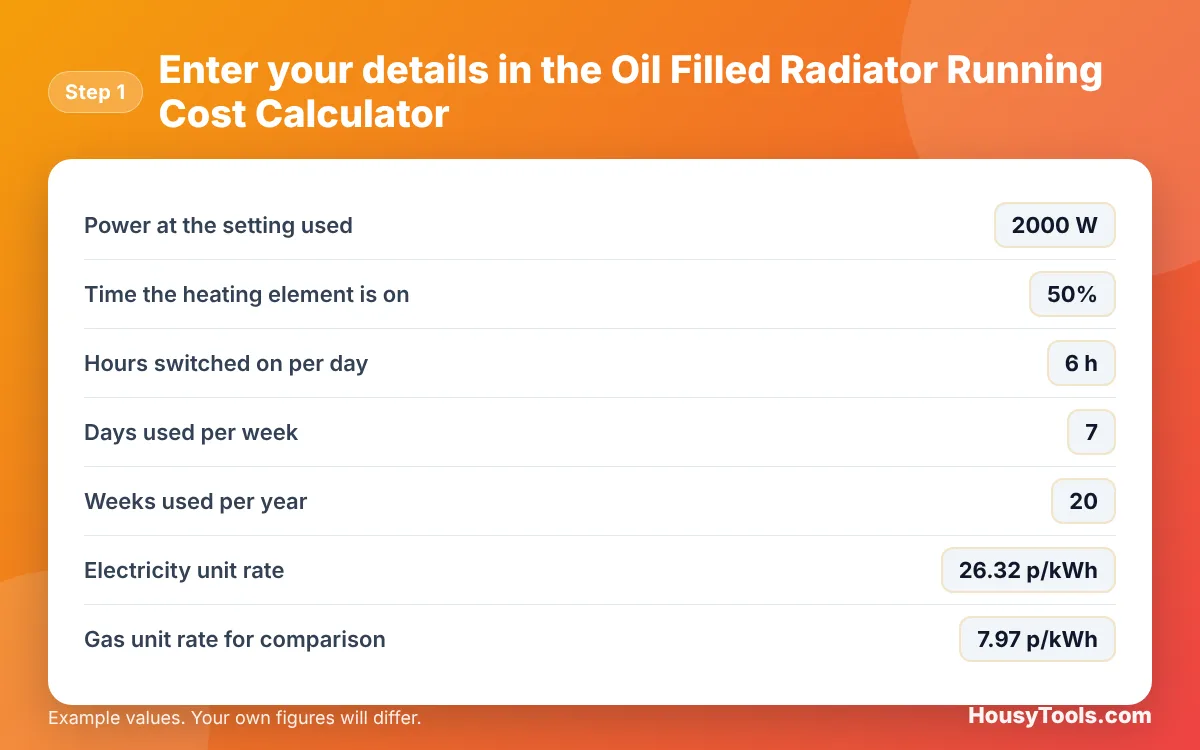
- Choose £ or € and enter the Power at the setting used, from the switch labels or manual.
- Set the Time the heating element is on. Use 100% for a cold room or a worst case, or lower once the thermostat is cycling.
- Enter the Hours switched on per day, Days used per week and Weeks used per year.
- Enter your Electricity unit rate from your bill.
- For a comparison, keep the Gas unit rate for comparison and Gas boiler efficiency, or set the gas rate to 0 to skip it.
- Read the daily, hourly and yearly cost and the gas comparison, then open “Show the formula and working” to see each step.
How Much Does an Oil Filled Radiator Cost per Hour?
A 2,000 W oil filled radiator costs 52.6p an hour at full power, and a 1,500 W model 39.5p, at the October to December 2026 cap rate of 26.32p per kWh published on the Ofgem price cap page. Real costs are usually lower once the room warms up, because the thermostat switches the element off for part of each hour. On a lower setting the cost per hour falls in proportion to the watts.
Are Oil Filled Radiators Cheaper to Run Than Other Electric Heaters?
No, an oil filled radiator uses the same electricity per unit of heat as a fan or convector heater of the same wattage, because every plug in resistive heater is close to 100% efficient. Their advantages are steadier, quieter heat and a body that keeps warming the room for a while after the element switches off, which can make the thermostat cycle less often. A good thermostat and timer save more money than the heater type. Compare other heaters with the electric heater running cost calculator.
Is an Oil Filled Radiator Cheaper Than Central Heating?
Per unit of heat, no: electricity at 26.32p per kWh costs about three times as much as gas heat at 7.97p per kWh through a 90% efficient boiler, which works out at about 8.9p per kWh of heat. An oil filled radiator can still save money if it heats one room for a few hours while the central heating stays off for the rest of the house. The Energy Saving Trust guidance on heating controls explains how zoning and timers cut waste.
Oil Filled Radiator Running Costs by Wattage
At 26.32p per kWh. The daily figure assumes 6 hours switched on with the element on half the time.
| Power setting | Per hour, full power | Per hour, element on 50% | Per day (6 h, 50%) |
|---|---|---|---|
| 500 W | 13.2p | 6.6p | £0.39 |
| 800 W | 21.1p | 10.5p | £0.63 |
| 1,000 W | 26.3p | 13.2p | £0.79 |
| 1,200 W | 31.6p | 15.8p | £0.95 |
| 1,500 W | 39.5p | 19.7p | £1.18 |
| 2,000 W | 52.6p | 26.3p | £1.58 |
| 2,500 W | 65.8p | 32.9p | £1.97 |
Worked Example: A 2 kW Radiator Through Winter
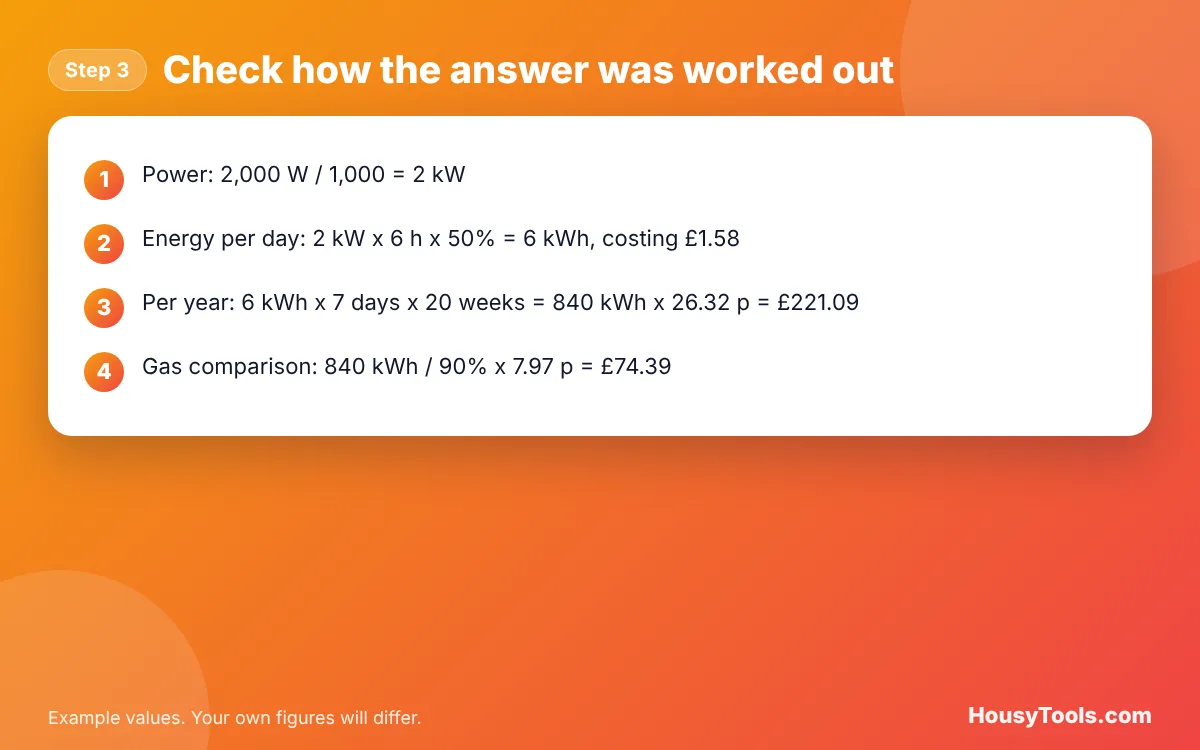
Example: a 2,000 W oil filled radiator heats a home office for 6 hours a day, 7 days a week, for 20 weeks, and the thermostat keeps the element on half the time. Energy per day is 2 kW x 6 h x 50% = 6 kWh, which costs £1.58 at 26.32p per kWh. Over the winter that is 6 x 7 x 20 = 840 kWh, costing £221.09, or about £48 a month. These are the default inputs, so the calculator shows the same figures.
The same 840 kWh of heat from a 90% efficient gas boiler would cost 840 / 0.9 x 7.97p = £74.39, so the radiator costs £146.70 more over the winter. That gap only pays off if using the radiator lets you keep the central heating off for the rest of the house. For a whole house comparison, see the heat pump vs gas boiler cost calculator.
Oil Filled Radiator Running Cost Calculator FAQs
Is it safe to leave an oil filled radiator on overnight?
Follow the maker’s manual. Many oil filled radiators have a thermostat and tip over or overheat protection, but keep them clear of curtains, bedding and clothes, plug them straight into a wall socket rather than an extension lead, and never cover them or dry laundry on them.
What setting should I use on an oil filled radiator?
Use the highest setting to warm a cold room quickly, then let the thermostat hold the temperature, or drop to a lower setting. The thermostat, not the power switch, decides how long the element runs once the room is warm, so set it to the lowest comfortable temperature.
Can I plug an oil filled radiator into an extension lead?
It is best not to. A 2,000 W radiator draws about 8.7 A, and a 13 A extension lead can only supply about 3,000 W in total. Plug heaters directly into a wall socket and never daisy chain adaptors.
Do oil filled radiators use a lot of electricity?
They use as much as any electric heater of the same wattage: 2 kWh for every hour a 2,000 W element is on. Used for a few hours in one room they are affordable, but heating a whole house with them is far dearer than gas central heating.
How do I find the thermostat on time?
Use a plug in energy monitor for a day. Divide the kWh it records by the kW rating and the hours it was switched on. For example, 6 kWh from a 2 kW radiator over 6 hours means the element was on 50% of the time.
Does the oil in the radiator ever need changing?
No. The oil is sealed in at the factory and never needs topping up or replacing. If the radiator leaks oil, stop using it and contact the maker, as a damaged unit should not be repaired at home.
Checked October 2026. Sources: Energy price cap rates (Ofgem), Heating controls (Energy Saving Trust).