
Show the formula and working
This cake tin size converter tells home bakers in the UK, Ireland and Europe how much to scale a recipe when their tin is a different size or shape from the one in the recipe. Enter both tins, round, square or rectangular, and it gives one multiplier for every ingredient, the scaled amount of any ingredient you choose, and the round and square tins that match the original.
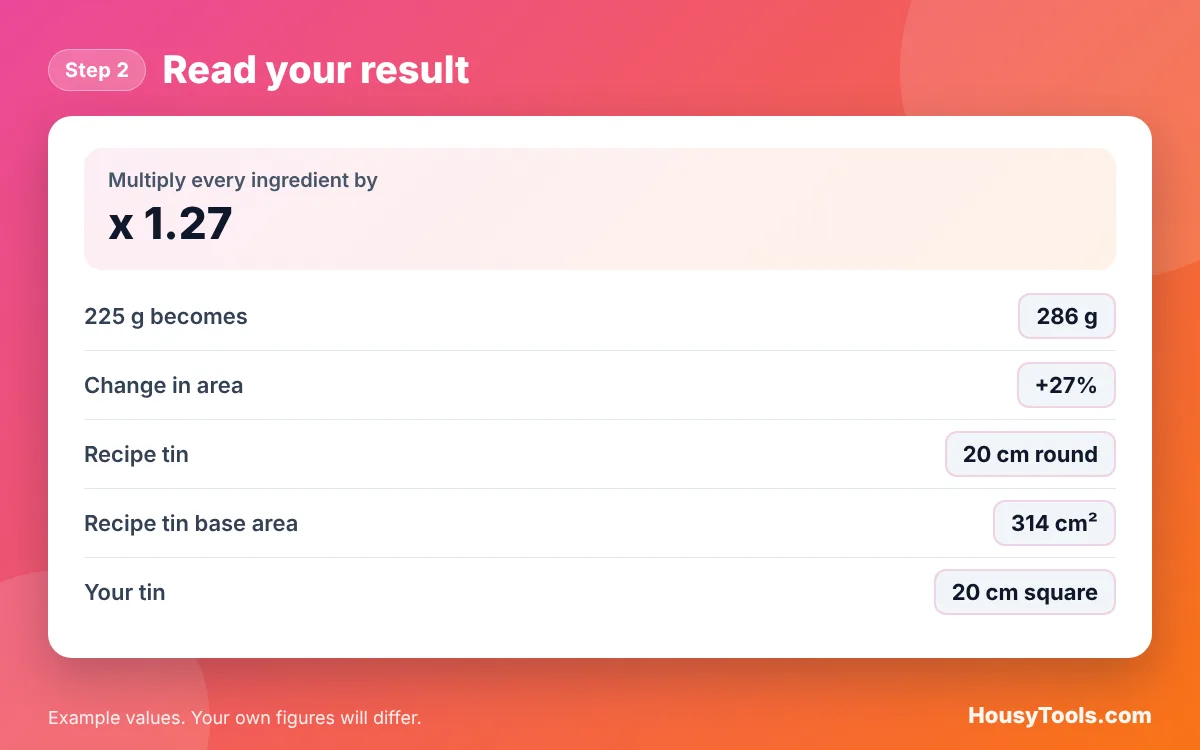
Quick answer: A cake tin size converter divides your tin’s base area by the recipe tin’s base area, and every ingredient is multiplied by the result. A 20 cm square tin has 1.27 times the area of a 20 cm round tin, so 225 g butter becomes 286 g. A 17.7 cm square matches a 20 cm round.

What Is a Cake Tin Size Converter?
A cake tin size converter is a tool that compares the base areas of two baking tins and gives the factor by which to scale a recipe so the batter sits at the same depth in the new tin. The formula in plain words: scale factor equals the area of your tin divided by the area of the recipe tin.
Areas use standard geometry. A round tin’s area is pi (3.1416) multiplied by the radius squared, where the radius is half the diameter. A square tin’s area is the side multiplied by itself, and a rectangle’s area is length multiplied by width. Because the batter depth stays the same, the cake rises and bakes in a similar way, which is why area works better than guessing from the diameter alone. The area of a circle grows with the square of the diameter, so a small change in tin size makes a big change in batter.
How Do You Use the Cake Tin Size Converter?
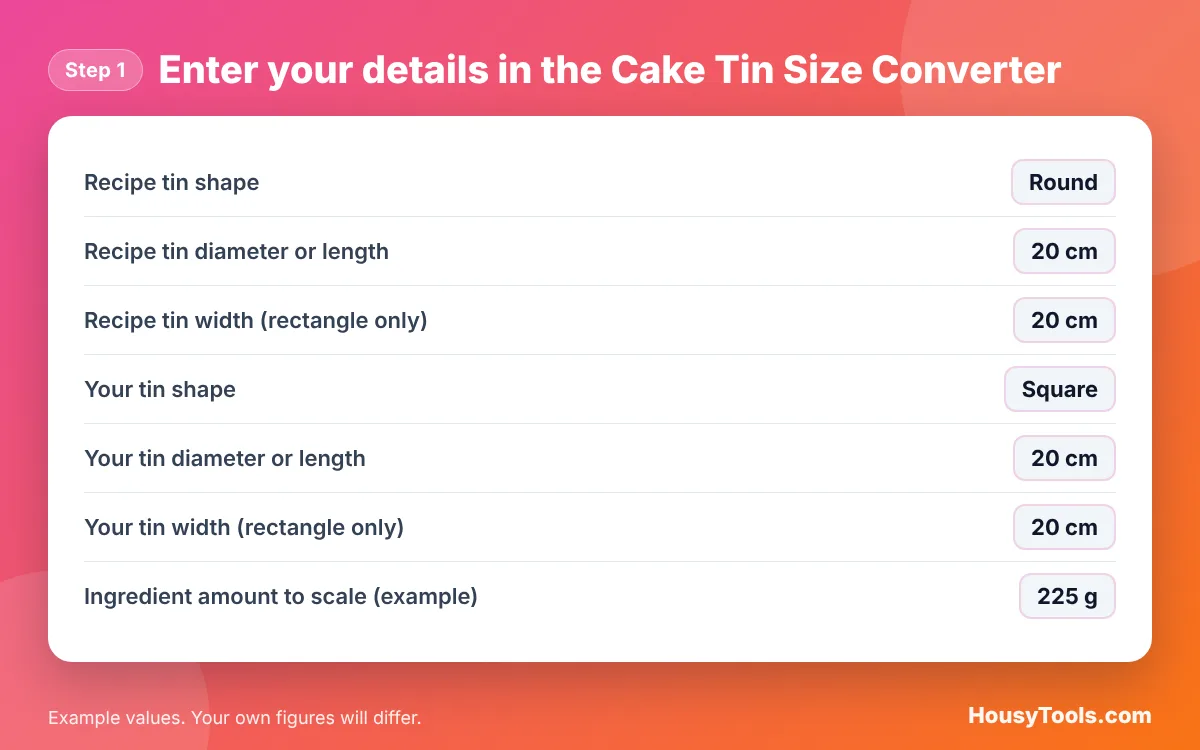
- Choose the Recipe tin shape: Round, Square or Rectangle.
- Enter the Recipe tin diameter or length, and for a rectangle also the Recipe tin width (rectangle only).
- Choose Your tin shape and enter Your tin diameter or length, plus Your tin width (rectangle only) if it is rectangular. Measure across the inside of the rim.
- Optionally type one quantity from the recipe into Ingredient amount to scale (example), such as 225 g butter.
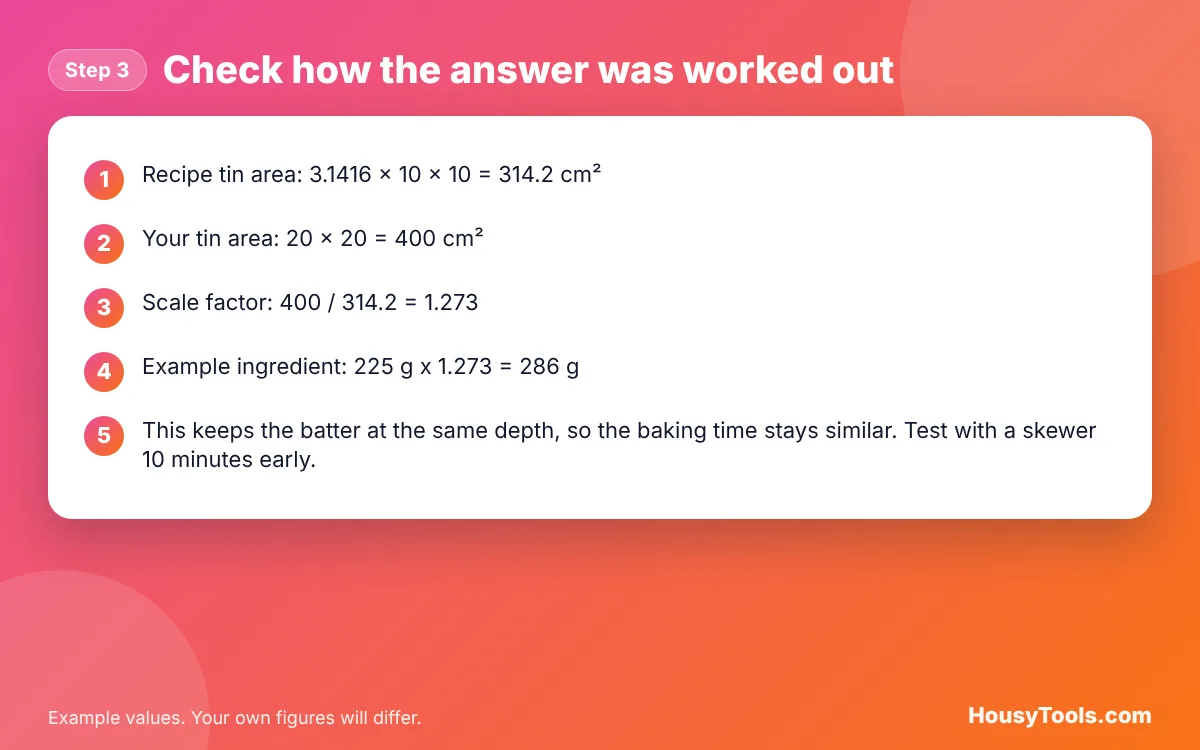
- Read the multiplier and the scaled amount, then open “Show the formula and working” to see both areas and the division.
What Size Square Tin Equals a Round Tin?
A square tin holds the same batter as a round tin when its side is about 0.89 times the round tin’s diameter, so a 17.7 cm square matches a 20 cm round. Put the other way, a square tin is roughly 2.5 cm (1 inch) smaller than the round tin it replaces at common sizes. If you swap a 20 cm round tin for a 20 cm square tin of the same depth, you need 27% more batter, or the cake will come out thinner and bake faster.
How Do You Scale a Recipe for a Bigger Cake Tin?
Multiply every ingredient by the bigger tin’s area divided by the smaller tin’s area: moving from a 20 cm round to a 23 cm round needs 1.32 times the ingredients, not 1.15 times. That is because area rises with the square of the diameter. Scale flour, sugar, fat, liquid and raising agents by the same factor so the cake keeps its texture. For eggs, round to the nearest whole egg or beat the eggs and weigh the exact amount.
Does Baking Time Change With Tin Size?
Baking time stays roughly the same when you scale the recipe by area, because the batter is the same depth, but larger cakes often need a little longer in the middle. Check the cake 10 minutes before the recipe time with a skewer pushed into the centre: it should come out clean. If you put the original amount of batter into a smaller tin, the batter is deeper and needs longer, often at a slightly lower temperature so the edges do not overbake. Our electricity cost calculator shows what the extra oven time costs.
Round and Square Cake Tin Equivalents
| Round tin diameter | Base area | Square tin with the same area |
|---|---|---|
| 15 cm (6 in) | 176.7 cm² | 13.3 cm |
| 18 cm (7 in) | 254.5 cm² | 16.0 cm |
| 20 cm (8 in) | 314.2 cm² | 17.7 cm |
| 23 cm (9 in) | 415.5 cm² | 20.4 cm |
| 25 cm (10 in) | 490.9 cm² | 22.2 cm |
| 30 cm (12 in) | 706.9 cm² | 26.6 cm |
Inch sizes are the usual shop labels, and one inch is exactly 2.54 cm. Tins sold by inch size are not always exactly the metric figure shown, so measure your own tin when it matters.
Worked Example: A Round Recipe in a Square Tin
Example: a Victoria sponge recipe is written for a 20 cm round tin and uses 225 g butter, but the only tin to hand is a 20 cm square tin. Set Recipe tin shape to Round with 20 cm, Your tin shape to Square with 20 cm, and type 225 into the ingredient amount. The round tin’s area is 3.1416 x 10 x 10 = 314.2 cm². The square tin’s area is 20 x 20 = 400 cm². The factor is 400 divided by 314.2, which is 1.273, so the converter shows x 1.27 and 225 g becomes 286 g. Multiply the sugar, flour and eggs by the same factor, so 4 eggs become about 5.
For other measuring jobs around the house, such as floor or wall areas, browse our home calculators.
Cake Tin Size Converter FAQs
How do I convert an 8 inch round tin to a square tin?
An 8 inch (20 cm) round tin has almost the same area as a 7 inch (17.8 cm) square tin, so the recipe works unchanged in a 7 inch square. In an 8 inch square tin, multiply every ingredient by 1.27.
How much bigger is a 23 cm tin than a 20 cm tin?
A 23 cm round tin has about 32% more base area than a 20 cm round tin: 415.5 cm² against 314.2 cm². Multiply the recipe by 1.32 to keep the same depth of batter, rather than by 1.15 as the diameters suggest.
Should I measure the tin inside or outside?
Measure across the inside of the top rim, because that is the space the batter fills. Many tins have sloping sides or a thick rolled edge, so an outside measurement can be noticeably too big and overstate the area.
Can I use a loaf tin instead of a round tin?
Yes, choose Rectangle and enter the loaf tin’s inside length and width. Loaf tins are much deeper than sandwich tins, so the batter will sit higher. Leave room for the cake to rise and expect a longer bake, testing the centre with a skewer.
How do I scale eggs for a different tin?
Multiply the number of eggs by the same factor as the other ingredients, then round to the nearest whole egg. For accuracy, beat the eggs together and weigh out the exact amount, or use a larger or smaller egg size.
Does tin depth matter?
Yes. This converter keeps the batter at the same depth, which assumes your tin is deep enough to hold it with room to rise. If your tin is shallower than the recipe tin, split the batter between two tins or bake the extra as cupcakes.
Checked October 2026. Sources: Area of a circle (Wikipedia), Square (Wikipedia), Inch, 25.4 mm exactly (Wikipedia).