
Show the formula and working
This free insulation board calculator works out how many rigid insulation boards you need for a wall, floor or roof, and how thick they must be to reach a target U-value, for homes in the UK and across northern Europe. It works with PIR, EPS, mineral wool or any board, using the thermal conductivity from the data sheet.
Quick answer: An insulation board calculator divides the area by the board size and works out thickness from the target U-value. For 20 m² you need 8 boards of 2400 x 1200 mm with 10% extra. Bringing a solid brick wall from U 2.1 to 0.30 needs about 63 mm of PIR at lambda 0.022.

What Is an Insulation Board Calculator?
An insulation board calculator is a tool that counts the rigid boards needed to cover an area and finds the board thickness that brings a wall, floor or roof down to a target U-value.
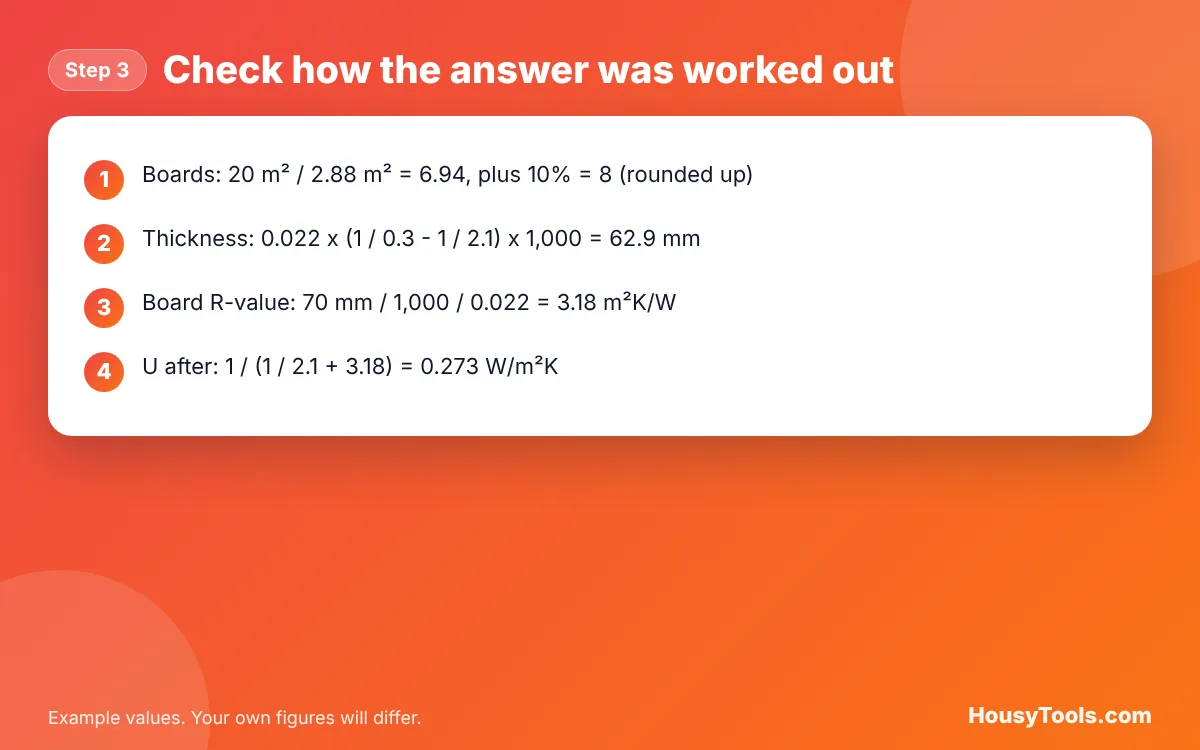
The formula in plain words: boards equal the area divided by the area of one board, plus an allowance for cuts, rounded up. A board’s thermal resistance R equals its thickness in metres divided by its lambda. The new U-value equals 1 divided by the sum of 1 over the old U-value and the board’s R. Turned around, the thickness needed equals lambda times the difference between 1 over the target U and 1 over the current U.
How Do You Use the Insulation Board Calculator?
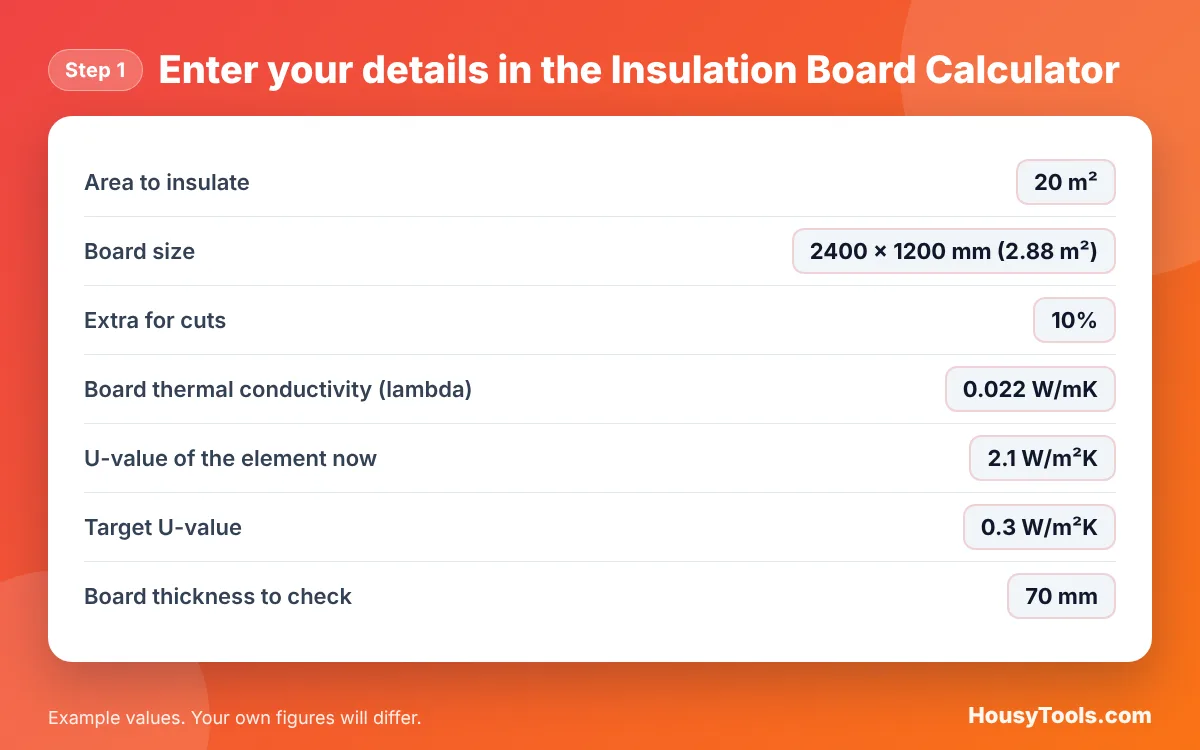
- Enter the Area to insulate and choose the Board size.
- Set the Extra for cuts.
- Enter the Board thermal conductivity (lambda) from the product data sheet.
- Enter the U-value of the element now and the Target U-value.
- Enter a Board thickness to check to see the U-value it gives.
- Read the board count, the thickness needed and the new U-value, then open “Show the formula and working” to see the sums.

How Many Insulation Boards Do I Need?
Divide the area by 2.88 m² for full 2400 x 1200 mm boards, then add about 10% for cuts. A 20 m² wall needs 6.94 boards before cutting, so order 8. Smaller 1200 x 450 mm boards, which suit floors between joists and lofts, cover 0.54 m² each, so the same area needs 41 of them with 10% extra.
What Thickness of Insulation Board Do I Need?
To bring a solid brick wall from about U 2.1 to the 0.30 that Building Regulations ask for when you insulate a wall inside or out, you need about 63 mm of PIR at lambda 0.022, rounded up to the next thickness your merchant sells. The Approved Document L renovation targets are 0.30 for walls insulated internally or externally, 0.25 for floors and 0.18 for flat roofs. Materials with a higher lambda need more thickness for the same result.
What Is Lambda on an Insulation Board?
Lambda, or thermal conductivity, is how easily heat passes through the material in W/mK, and a lower number means better insulation. PIR boards such as Celotex GA4000 declare 0.022 W/mK. EPS and mineral wool are typically 0.030 to 0.040, so they need roughly half as much thickness again, or more. Always use the declared lambda on the product’s data sheet, because it varies between brands and thicknesses.
Why Is the Real U-Value Higher Than the Calculation?
Timber battens, studs, metal fixings and gaps between boards let heat bypass the insulation, so the real U-value is a little higher than the simple layer sum. This calculator ignores those thermal bridges, as the result warning says. For a full build-up with battens and plasterboard, the U-value calculator handles each layer, and a manufacturer’s U-value service can give a certified figure.
Insulation Thickness by Material and Target
Thickness needed, in mm, before rounding up to a stock size. Lambda values are examples: PIR from Celotex GA4000, EPS and mineral wool from Wikipedia’s list of thermal conductivities.
| Board material (lambda) | Solid brick 2.1 to 0.30 | Unfilled cavity 1.6 to 0.30 | Floor 0.7 to 0.25 |
|---|---|---|---|
| PIR (0.022) | 63 mm | 60 mm | 57 mm |
| EPS (0.033) | 94 mm | 89 mm | 85 mm |
| Mineral wool (0.040) | 114 mm | 108 mm | 103 mm |
Worked Example: Internal Wall Insulation on a Solid Brick Wall
Example: 20 m² of solid brick wall at U 2.1, insulated on the inside with 2400 x 1200 mm PIR boards at lambda 0.022, 10% extra and a target of 0.30. These are the default inputs.
- Boards: 20 / 2.88 = 6.94, plus 10% = 7.64, so 8 boards.
- Thickness: 0.022 x (1 / 0.30 – 1 / 2.1) x 1,000 = 62.9 mm, so use at least 65 mm.
- Check with 70 mm: R = 0.07 / 0.022 = 3.18 m²K/W, and U = 1 / (1 / 2.1 + 3.18) = 0.273 W/m²K.
70 mm meets the 0.30 target and cuts heat loss through that wall by 87%. Boards fixed inside need a vapour control layer and are often bonded to plasterboard; the plasterboard calculator counts the sheets if you board separately.
Insulation Board Calculator FAQs
What size are insulation boards?
The most common full size is 2400 x 1200 mm, which covers 2.88 m². Many ranges also come in 1200 x 450 mm or 1200 x 600 mm packs for fitting between joists or in lofts. Check the sizes your merchant stocks before you order.
Is PIR better than EPS?
PIR insulates better per millimetre, with a lambda around 0.022 against roughly 0.030 to 0.038 for EPS and 0.032 to 0.040 for mineral wool, so you need a thinner board. EPS is usually cheaper and is often used under floors where thickness matters less. Both must suit the job and its fire rules.
How much extra should I order for cuts?
Around 10% is a sensible allowance for a simple wall or floor, and more for small rooms, sloping ceilings or areas with many pipes and openings. Offcuts can often fill small gaps, so plan the cutting to reduce waste.
Do I need Building Regulations to insulate a wall?
In England, renovating more than 50% of a wall, floor or roof element, or more than 25% of the whole building envelope, counts as renovating a thermal element, which brings in the Approved Document L targets. Check with building control before you start, especially for external wall insulation.
Can I use two thinner boards instead of one thick one?
Yes. Two layers with staggered joints reduce gaps and thermal bridging, and their R-values add together. Enter the combined thickness in Board thickness to check to see the U-value they give.
How much heat does internal wall insulation save?
Taking a solid brick wall from U 2.1 to 0.27 cuts the heat lost through it by about 87%. The money saved depends on the wall area and your heating, and the U-value calculator and room heat loss calculator can turn that into watts.
For more insulation tools, see the heating calculators, including the loft insulation calculator.
Checked October 2026. Sources: Approved Document L (GOV.UK), GA4000 PIR board (Celotex), List of thermal conductivities (Wikipedia).