
Show the formula and working
This free pipe volume calculator works out how many litres of water a length of pipe holds, for homeowners, plumbers and DIYers in the UK, Ireland and Europe working with copper or MDPE pipe. It also shows how long you wait for hot water to reach a tap and how much water runs to waste while you wait, which helps when planning pipe runs, filling a heating system or adding inhibitor.
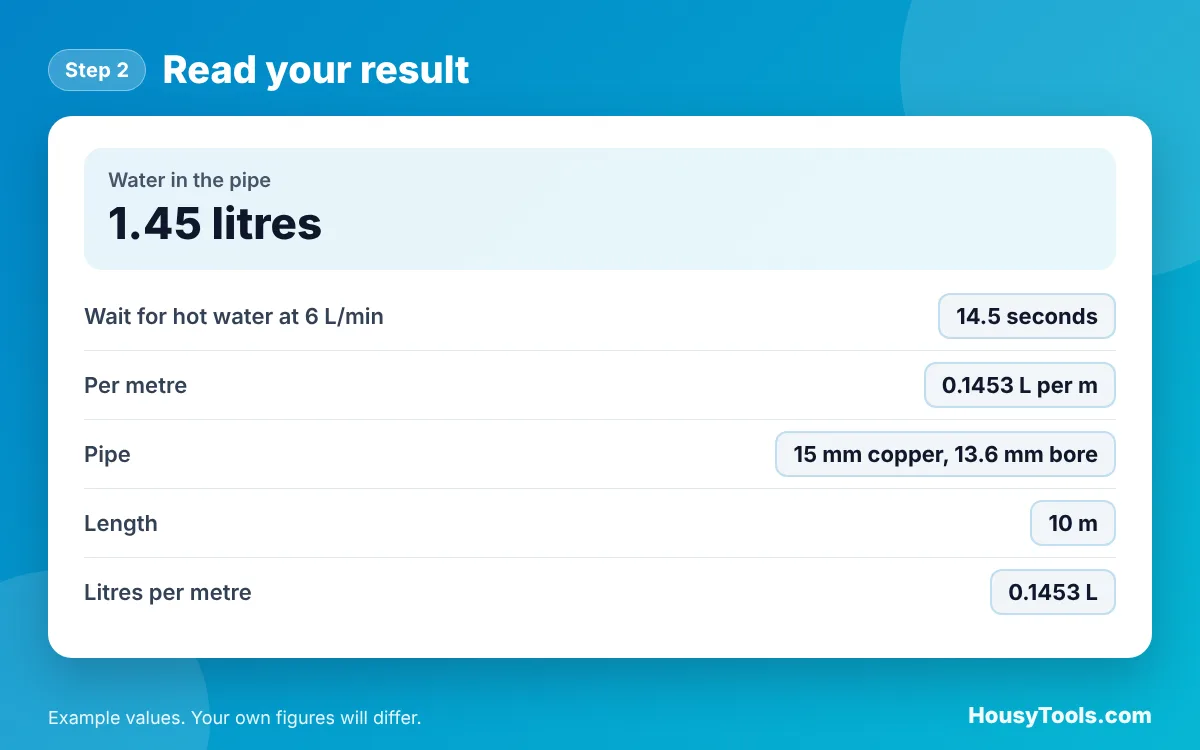
Quick answer: A pipe volume calculator multiplies the pipe’s inside area by its length. A 15 mm copper pipe with a 13.6 mm bore holds 0.1453 litres per metre, so 10 m holds 1.45 litres. At a tap flow of 6 L/min, hot water takes about 14.5 seconds to arrive.

What Is a Pipe Volume Calculator?
A pipe volume calculator is a tool that finds the volume of water inside a pipe from its bore and length, in litres, cubic metres and gallons.
The formula in plain words: a pipe is a cylinder, so its inside area is pi times the bore squared, divided by four. Multiply the area by the length for the volume. With the bore in millimetres, the area in mm² divided by 1,000 gives litres per metre. Use the inside diameter, not the outside size the pipe is sold by: 15 mm copper has a 0.7 mm wall, so its bore is 13.6 mm.
How Do You Use the Pipe Volume Calculator?
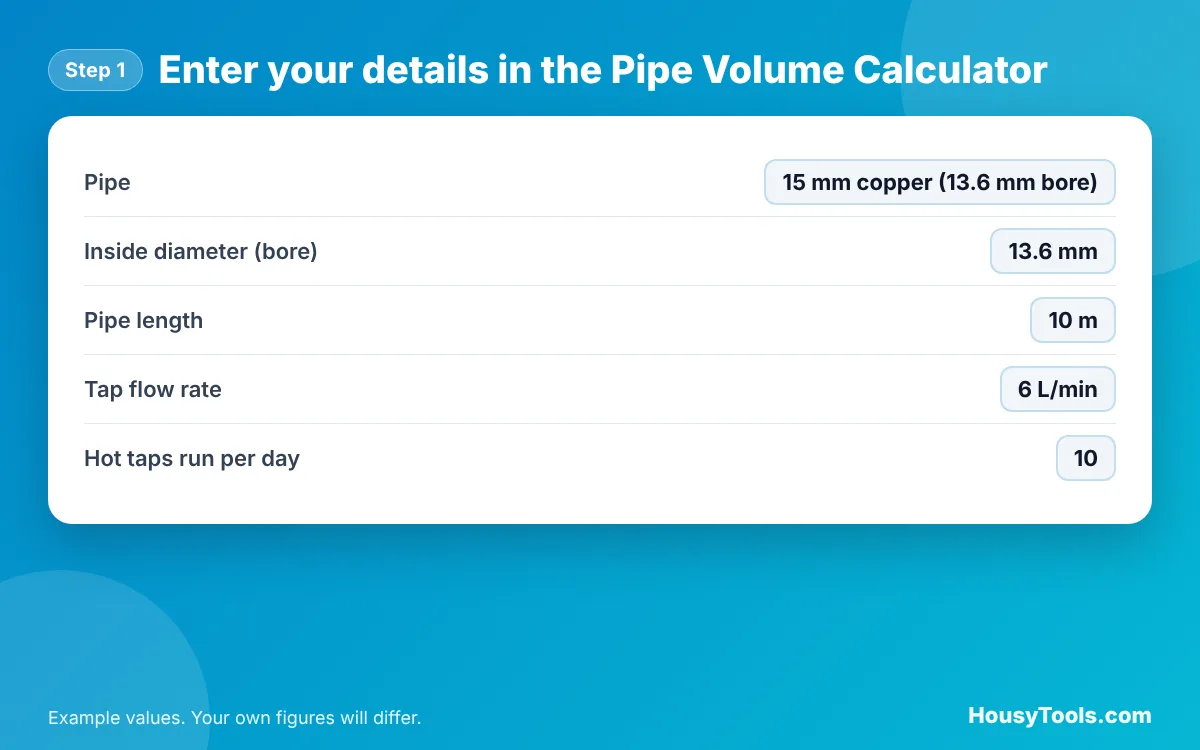
- Choose the Pipe. For any other pipe, choose “Other: enter the bore” and fill in Inside diameter (bore).
- Enter the Pipe length. Turn on the imperial switch to enter feet.
- Enter the Tap flow rate to see how long hot water takes to arrive.
- Enter Hot taps run per day to see how much water runs to waste while waiting.
- Read the result and open “Show the formula and working” to see the area, litres per metre, volume and wait time.
How Much Water Is in a Metre of Pipe?
A metre of 15 mm copper pipe holds about 0.145 litres and a metre of 22 mm copper about 0.32 litres, so 22 mm pipe holds more than twice as much. The table lists common UK pipe sizes, with the volume of a 10 m run and the wait for hot water at 6 L/min.
| Pipe | Bore | Litres per metre | Litres in 10 m | Wait at 6 L/min for 10 m |
|---|---|---|---|---|
| 8 mm copper | 6.8 mm | 0.0363 | 0.36 | 3.6 s |
| 10 mm copper | 8.8 mm | 0.0608 | 0.61 | 6.1 s |
| 15 mm copper | 13.6 mm | 0.1453 | 1.45 | 14.5 s |
| 22 mm copper | 20.2 mm | 0.3205 | 3.20 | 32.0 s |
| 28 mm copper | 26.2 mm | 0.5391 | 5.39 | 53.9 s |
| 35 mm copper | 32.6 mm | 0.8347 | 8.35 | 83.5 s |
| 20 mm MDPE | about 16 mm | 0.2011 | 2.01 | 20.1 s |
| 25 mm MDPE | about 20.4 mm | 0.3269 | 3.27 | 32.7 s |
Why Does Hot Water Take So Long to Reach the Tap?
The cold water already sitting in the pipe has to run out before hot water arrives, so the wait equals the pipe volume divided by the tap flow. A long 22 mm run to a low flow basin tap can mean half a minute or more of cold water. Shorter runs and smaller bores to outlets that do not need much flow cut the wait and the waste. Long dead legs of warm water also matter for hygiene, which the HSE Legionella guidance covers.
How Do You Work Out the Water Volume of a Heating System?
Add the pipe volume to the water in each radiator, the boiler and any cylinder coil or buffer tank. Run this calculator once for each pipe size, for example the 22 mm flow and return plus the 15 mm radiator branches, and add the results. The total helps size an expansion vessel and work out how much central heating inhibitor to add, following the inhibitor maker’s dose per litre.
Worked Example: A Hot Water Pipe to a Bathroom Basin
Example: 10 m of 15 mm copper pipe runs from the cylinder to a basin tap that flows at 6 L/min, and the hot tap is run from cold 10 times a day. These are the tool’s default inputs.
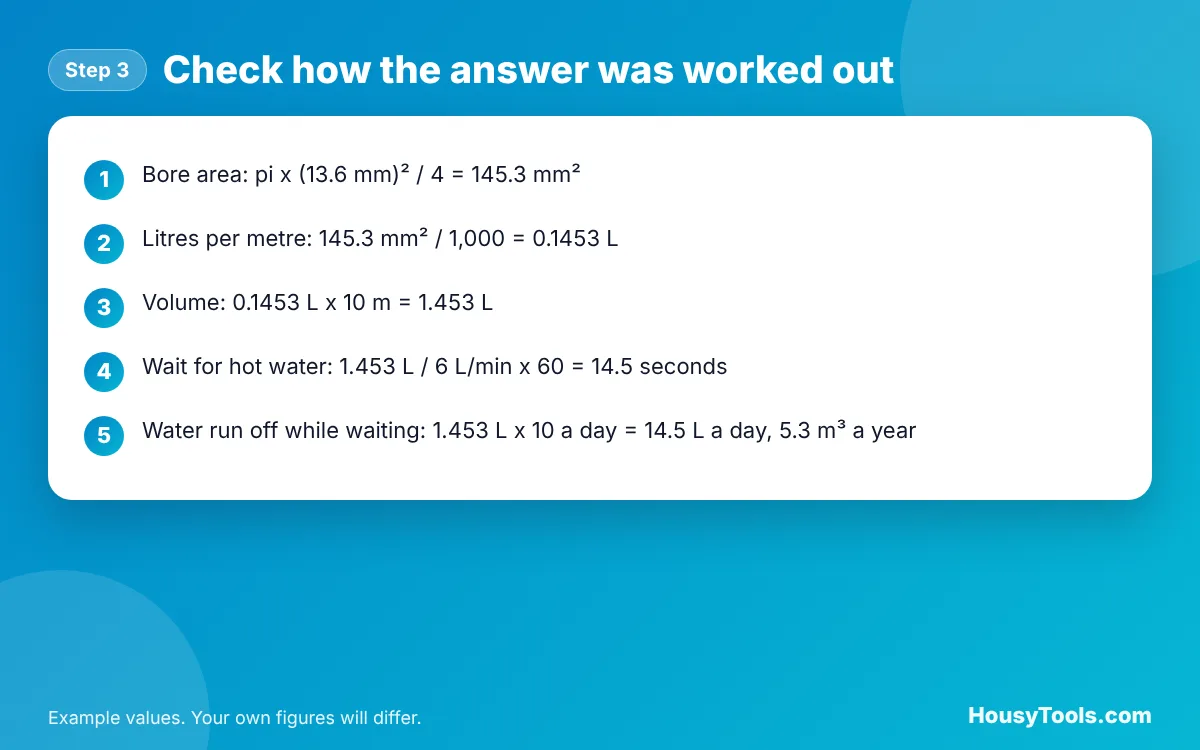
- Bore area: pi x 13.6² / 4 = 145.3 mm², so 0.1453 L per metre.
- Volume: 0.1453 x 10 = 1.45 litres, about 0.32 UK gallons.
- Wait for hot water: 1.453 / 6 x 60 = 14.5 seconds.
- Water run off while waiting: 1.453 x 10 = 14.5 L a day, about 5,302 L or 5.3 m³ a year.
To convert larger volumes, use the cubic metre calculator or the litres to gallons converter.
Pipe Volume Calculator FAQs
How do I calculate the volume of a pipe?
Multiply pi by the bore squared, divide by four, then multiply by the length. With the bore in metres and the length in metres, the answer is in cubic metres; multiply by 1,000 for litres. 10 m of 13.6 mm bore pipe holds 1.45 litres.
How many litres are in 22 mm pipe per metre?
About 0.32 litres per metre for standard 22 mm copper, which has a 20.2 mm bore. Ten metres of 22 mm pipe holds about 3.2 litres, more than twice the 1.45 litres in the same length of 15 mm pipe.
Should I use the inside or outside diameter?
Always the inside diameter, or bore, because only the space inside holds water. Copper is sold by outside diameter, so a 15 mm pipe has a 13.6 mm bore. Plastic pipes often have thicker walls and smaller bores for the same outside size.
How long should I wait for hot water?
The wait is the pipe volume divided by the tap flow. Around 10 m of 15 mm pipe at 6 L/min gives about 15 seconds. Much longer waits usually mean a long or oversized pipe run, or a slow flow at the tap.
How do I convert litres per metre to litres per foot?
Multiply by 0.3048, because a foot is exactly 0.3048 m. 15 mm copper holds 0.1453 litres per metre, which is about 0.0443 litres per foot. Turn on the imperial switch and the tool shows it directly.
Does pipe volume matter for central heating inhibitor?
Yes. Inhibitor is dosed by total system volume, so add the pipework from this calculator to the radiator, boiler and cylinder coil volumes. Then follow the dose per litre on the inhibitor bottle.
Checked October 2026. Sources: Wikipedia, Cylinder, HSE, Legionella and Legionnaires’ disease, Wikipedia, Litre, EN 1057 copper tube wall thicknesses.