
Show the formula and working
This skip size calculator tells homeowners and builders in the UK and Europe which skip to hire, by turning the size of a waste pile and a count of full bin bags into cubic metres, cubic yards and a recommended skip. It adds an allowance for awkward items, warns you when heavy waste such as soil or rubble needs a smaller skip, and gives a rough weight for heavy loads.
Quick answer: Multiply the length, width and height of your waste pile in metres, add 0.76 m³ for every 10 bin bags, then add about 10% for air gaps. Divide by 0.7646 to get cubic yards and pick the next skip size up. The skip size calculator shows a 4.14 m³ load needs a 6 yard builders skip.
What Is a Skip Size Calculator?
A skip size calculator is a tool that converts the volume of your waste into the smallest standard skip that will hold it. Volume = pile length x pile width x pile height, plus the bin bags converted to cubic metres, plus a percentage for gaps between bulky items. UK skips are sold in cubic yards, and one cubic yard is exactly 0.7646 m³ because a yard is defined as 0.9144 m, as the Wikipedia entry for the cubic yard explains. The total in cubic metres is divided by 0.7646 and rounded up to the next skip size.
How Do You Use the Skip Size Calculator?
- Choose the Type of waste: mixed household, garden or renovation waste, or heavy waste such as soil, rubble, bricks or concrete.
- Measure your heap and enter Pile length, Pile width and Pile height. Enter 0 if you only have bags.
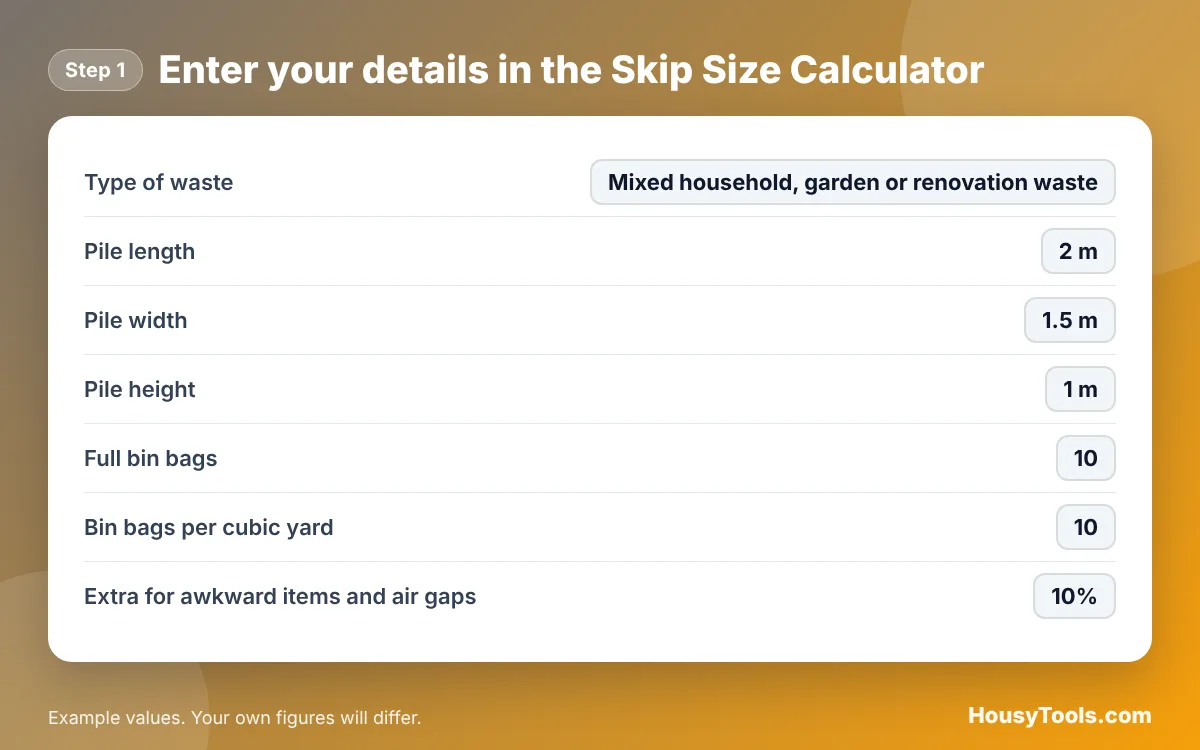
- Enter the number of Full bin bags and leave Bin bags per cubic yard at 10 unless your hire firm uses another figure.
- Set Extra for awkward items and air gaps. Use 10% for general waste and more for furniture, branches or doors that do not pack flat.
- For heavy waste, check the Heavy waste density. The 1,500 kg/m³ default is only an example.
- Read the skip size, volume and fill level, then open “Show the formula and working” to see each step.


What Size Skip Do I Need?
Most home projects need a 4 to 8 yard skip: a 4 yard skip holds about 3 m³ or 40 bin bags, a 6 yard builders skip about 4.6 m³ or 60 bags, and an 8 yard skip about 6.1 m³ or 80 bags. A small garden or bathroom clear out usually fits a 4 yard skip, while a kitchen refit or a full house clearance often fills an 8 yard skip.
Skips must not be filled above the top edge, so choose the next size up if your load comes out close to the limit. If you are clearing a loft before new insulation goes down, our loft insulation calculator helps with the next step of the job.
| Skip size | Common name | Volume | Bin bags (at 10 per yard) |
|---|---|---|---|
| 2 yards | Mini skip | 1.53 m³ | 20 |
| 3 yards | Midi skip | 2.29 m³ | 30 |
| 4 yards | 4 yard skip | 3.06 m³ | 40 |
| 6 yards | Builders skip | 4.59 m³ | 60 |
| 8 yards | 8 yard skip | 6.12 m³ | 80 |
| 12 yards | Maxi skip | 9.17 m³ | 120 |
| 16 yards | 16 yard skip | 12.23 m³ | 160 |
How Many Bin Bags Fit in a Skip?
Skip hire firms commonly rate a skip at about 10 full bin bags per cubic yard, so a 6 yard skip takes around 60 bags and an 8 yard skip around 80. Bag sizes differ, and loose items pack less tightly than bags, so treat the figure as a guide. You can change the bags per yard in the calculator if your firm quotes a different number.
What Size Skip Do I Need for Soil and Rubble?
For soil, rubble, bricks and concrete, choose a skip no bigger than 6 cubic yards, because a larger skip filled with heavy waste is usually too heavy for the lorry to lift. Loose soil often weighs 1 to 1.6 tonnes per cubic metre, so a full 6 yard skip of soil can weigh several tonnes. If you have more heavy waste than one 6 yard skip holds, hire several or ask about a grab lorry, and always confirm the weight limit with the hire firm.
Do You Need a Permit for a Skip on the Road?
Yes, in England and Wales you need a skip licence from the council to place a skip on a public road, but not if it sits entirely on private land such as your driveway. The GOV.UK skip permit page says the hire company usually applies, that skips cannot go on the pavement, and that you may need lights and reflective markings. Large skips over 8 yards are often not allowed on the road at all.
Worked Example: A Garden Clear Out
Example: an overgrown garden and an old shed are being cleared. The pile of mixed waste is 2 m long, 1.5 m wide and 1 m high, plus 10 full bin bags. Add 10% for awkward items and air gaps.
- Pile: 2 m x 1.5 m x 1 m = 3 m³.
- Bags: 10 bags / 10 per cubic yard = 1 yd³ = 0.76 m³.
- Total: 3.76 m³ x 1.10 = 4.14 m³.
- Cubic yards: 4.14 / 0.7646 = 5.42 yd³, so a 6 yard builders skip, about 90% full.
A 4 yard skip would be too small, so the 6 yard builders skip is the one to book. If you plan to treat the new fence after the clear out, the fence paint calculator works out how much you need. More project tools sit in our home calculators section.
Skip Size Calculator FAQs
How many cubic metres is a skip?
Multiply the skip size in cubic yards by 0.7646. A 4 yard skip is about 3.06 m³, a 6 yard skip about 4.59 m³ and an 8 yard skip about 6.12 m³. Skip dimensions vary a little between firms, so these are nominal volumes.
What is the most popular skip size?
The 8 yard skip is widely described by UK hire firms as the most popular size for home renovations, holding about 6.1 m³ or 80 bin bags. The 6 yard builders skip is the usual choice for heavy waste such as rubble and soil.
Can I put soil in a big skip?
Usually only skips up to 6 cubic yards can be filled entirely with soil, rubble or bricks, because heavier loads exceed what the lorry can lift safely. Choose the heavy waste option in the calculator and it will suggest several 6 yard skips for large amounts.
How do I measure my waste for a skip?
Pile the waste roughly into a box shape and measure its length, width and average height in metres. Multiply them together for cubic metres. Count bin bags separately and add about 10% for items that leave gaps, such as chairs and branches.
Can I fill a skip above the top?
No, skips should be filled only level with the top edge so the load can be carried safely and covered. Overfilled skips may be refused or charged extra. If your waste comes close to the limit, hire the next size up.
What can I not put in a skip?
Hazardous items such as asbestos, paint tins with liquid paint, gas bottles, batteries, tyres, fridges and electrical appliances are usually not accepted in a general skip. Each hire firm publishes its own list, so check it before you book.
Checked October 2026. Sources: Wikipedia: Cubic yard, GOV.UK: Apply for a skip permit, Wikipedia: Bulk density (soil 1.0 to 1.6 g/cm³), ISM Waste and Recycling skip size guide (bags per skip, heavy waste limit).