
Show the formula and working
This air conditioner BTU calculator works out how much cooling capacity a room needs, in BTU per hour and in kilowatts, for homes in the UK, Ireland and the rest of Europe. Enter the room size in metres or feet, how sunny it is and how many people use it, and it applies the ENERGY STAR sizing chart and adjustments, then suggests the next common unit size.
Quick answer: An air conditioner BTU calculator reads the cooling capacity from floor area, then adjusts for sun, people and kitchens. A 20 m² room needs about 6,000 BTU/h (1.76 kW). Add 10% for a very sunny room, take 10% off for a shaded one, and add 600 BTU/h for each person above two.
What Is an Air Conditioner BTU Calculator?
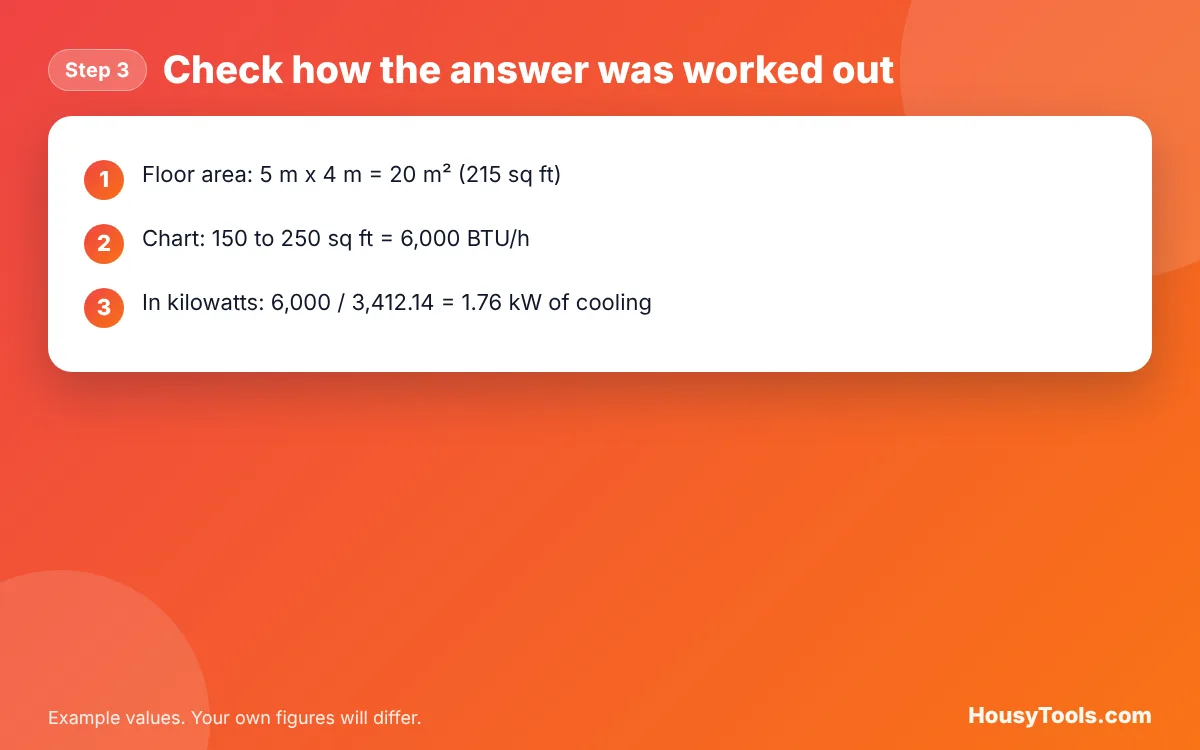
An air conditioner BTU calculator is a tool that estimates the cooling capacity, in British thermal units per hour, an air conditioner needs to cool a room. In plain words: work out the floor area, read the base capacity for that area from the sizing chart, scale it for a high ceiling, add or take off 10% for sun or shade, then add 600 BTU/h for each extra person and 4,000 BTU/h for a kitchen. Divide BTU/h by 3,412.14 to get kilowatts.
The chart and the four adjustments come from the ENERGY STAR room air conditioner guidance. The ceiling allowance is this calculator’s own simple step: the chart assumes a normal ceiling of about 2.4 m, so a higher ceiling raises the result in proportion to the extra volume.
How Do You Use the Air Conditioner BTU Calculator?
- Enter the Room length and Room width. Switch to feet if you measured in feet.
- Enter the Ceiling height. Leave 2.4 m for a normal room.
- Choose the Sun on the room: normal, heavily shaded or very sunny.
- Enter the People usually in the room and tick Room is a kitchen if it is one.
- Read the capacity in BTU/h and kW and the next common unit size, then open “Show the formula and working” to see each step.

How Many BTU Do I Need per Square Metre?
As a rule of thumb, a room needs roughly 200 to 550 BTU/h per square metre, with small rooms at the top of that range and large rooms at the bottom. For example, a 20 m² room needs 6,000 BTU/h, about 300 BTU/h per m², while a 50 m² open plan room needs 12,000 BTU/h, about 240 BTU/h per m². Use the chart band rather than a single per square metre figure for the best match.
How Do You Convert BTU to kW for an Air Conditioner?
Divide BTU per hour by 3,412.14 to get kilowatts, so 9,000 BTU/h is 2.64 kW and 12,000 BTU/h is 3.52 kW. European split systems are usually sold by kW, often as 2.5, 3.5, 5 and 7 kW units, while portable units are often sold by BTU. The factor comes from the international table BTU of 1,055.06 joules, explained on the British thermal unit page. Our kWh to BTU converter handles other conversions.
What Happens If an Air Conditioner Is Too Big or Too Small?
An undersized air conditioner runs flat out and still cannot cool the room on hot days, while an oversized one cools in short bursts and removes less moisture, so the room can feel cold and clammy. ENERGY STAR makes the same point, which is why the chart steps up gradually rather than recommending the biggest unit. Choose the next size up only when the result is close to the top of a band or the room has large south or west facing windows.
Air Conditioner Size Chart by Room Area
ENERGY STAR chart bands converted to square metres, before adjustments for sun, people or kitchens.
| Floor area | Square feet | BTU/h | kW |
|---|---|---|---|
| 9.3 to 13.9 m² | 100 to 150 | 5,000 | 1.47 |
| 13.9 to 23.2 m² | 150 to 250 | 6,000 | 1.76 |
| 23.2 to 27.9 m² | 250 to 300 | 7,000 | 2.05 |
| 27.9 to 32.5 m² | 300 to 350 | 8,000 | 2.34 |
| 32.5 to 37.2 m² | 350 to 400 | 9,000 | 2.64 |
| 37.2 to 41.8 m² | 400 to 450 | 10,000 | 2.93 |
| 41.8 to 51.1 m² | 450 to 550 | 12,000 | 3.52 |
| 51.1 to 65 m² | 550 to 700 | 14,000 | 4.10 |
| 65 to 92.9 m² | 700 to 1,000 | 18,000 | 5.28 |
Worked Example: A Sunny 6 m by 5 m Living Room
Example: a living room is 6 m by 5 m with a 2.4 m ceiling, faces the afternoon sun and usually has 4 people in it. The floor area is 30 m², or 323 sq ft, which falls in the 300 to 350 sq ft band of 8,000 BTU/h. Very sunny adds 10%: 8,000 x 1.1 = 8,800 BTU/h. Two people above the first two add 2 x 600 = 1,200 BTU/h, giving 10,000 BTU/h, or 2.93 kW. Enter Room length 6, Room width 5, Very sunny and 4 people, and the calculator shows 10,000 BTU/h and suggests a 12,000 BTU/h (3.5 kW) unit as the next common size up.
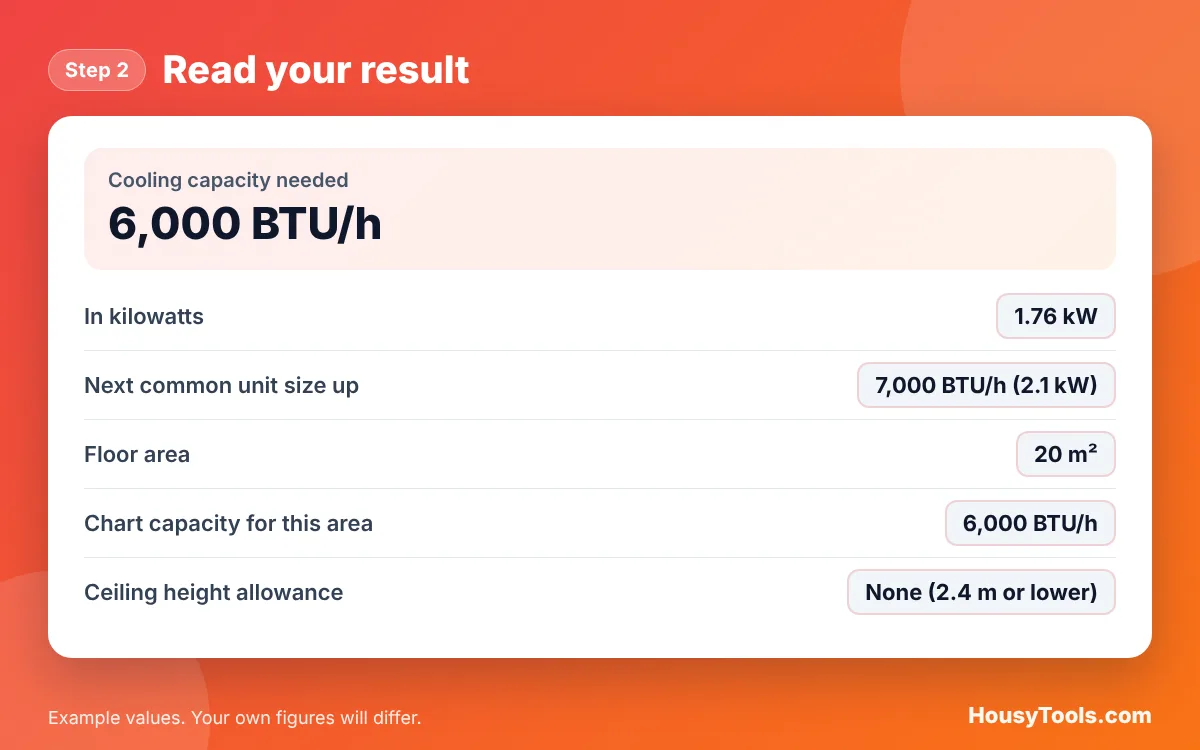
With the default inputs, a 5 m by 4 m room with normal sun and 2 people, the result is 6,000 BTU/h (1.76 kW). Air conditioners with a heat pump mode can also heat, and for heating a room through winter the BTU calculator for heating uses heat loss rather than cooling load.
Air Conditioner BTU Calculator FAQs
What size room will a 9,000 BTU air conditioner cool?
On the ENERGY STAR chart, 9,000 BTU/h suits a room of 350 to 400 sq ft, about 32.5 to 37.2 m², in normal conditions. A very sunny room or more than two people reduces that, and a shaded room increases it slightly.
How many BTU do I need for a bedroom?
A typical UK double bedroom of 10 to 14 m² needs about 5,000 to 6,000 BTU/h on the chart. Portable units usually start at around 7,000 BTU/h, which is enough for most bedrooms unless they are very sunny or in a loft conversion.
Why add 4,000 BTU for a kitchen?
Cooking appliances give off a lot of heat, so ENERGY STAR advises adding 4,000 BTU/h when the air conditioner serves a kitchen. Tick Room is a kitchen to include it. An open plan kitchen and living space should be measured as one room.
Does a loft room need a bigger air conditioner?
Often yes. Loft rooms and rooms with a flat roof or large glazed areas gain heat quickly in summer. Choose Very sunny, and if the result is near the top of a chart band, pick the next unit size up.
Is BTU the same as BTU/h?
Not strictly. A BTU is an amount of energy, and BTU/h is a rate of heat removal. Air conditioner sizes written as 9,000 BTU mean 9,000 BTU per hour, which is about 2.64 kW of cooling capacity.
Do I need an installer for a split air conditioner?
Yes. Split systems contain fluorinated refrigerant gases, and in the UK and EU the refrigerant circuit must be connected and checked by a certified technician. Electrical connections should be made by a qualified electrician. Portable units only need a socket and a window kit.
Checked October 2026. Sources: Room air conditioners sizing guidance (ENERGY STAR), British thermal unit (Wikipedia).