
Show the formula and working
This pond liner calculator works out what size pond liner and underlay you need for a garden or wildlife pond. Enter the longest length, the widest width and the depth at the deepest point, plus the overlap you want to anchor under the edging, and it gives the liner size, its area and the cost. It works in metres or feet.
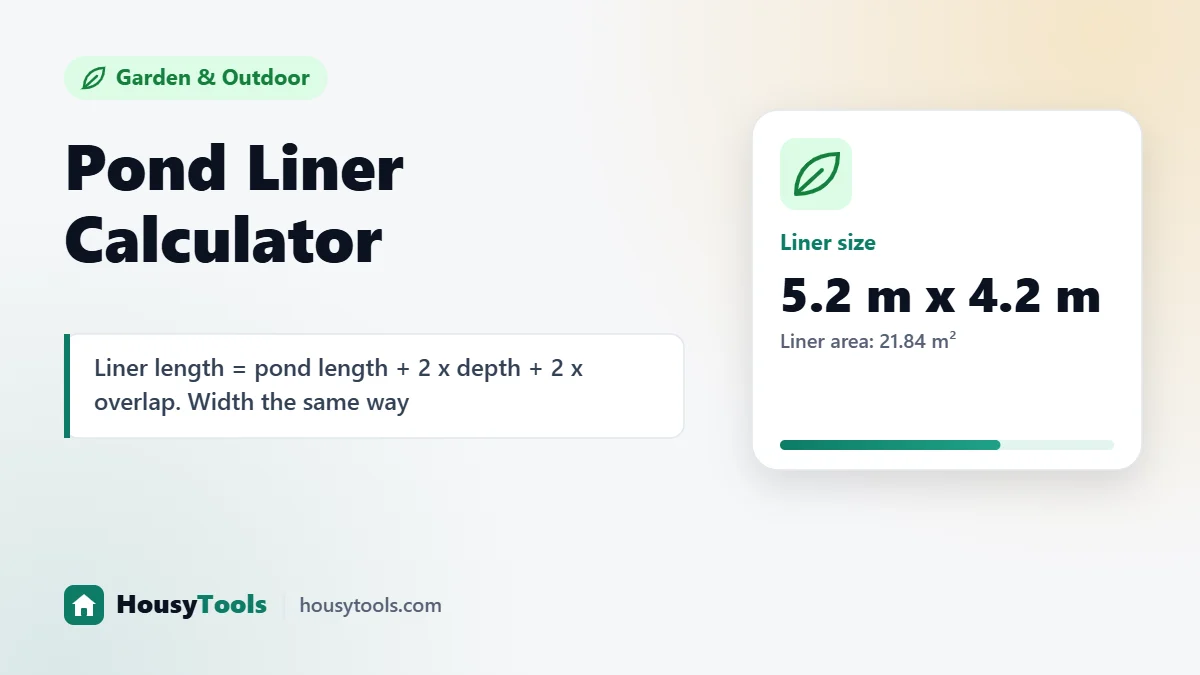
Quick answer: To work out the pond liner size, add twice the maximum depth and twice the edge overlap to the pond’s length, and do the same for the width. A 3 m by 2 m pond that is 80 cm deep, with 30 cm overlap at each edge, needs a liner of 5.2 m by 4.2 m, which is 21.84 m².
What Is a Pond Liner Calculator?
A pond liner calculator is a tool that works out the flat sheet size needed to line a pond, by adding enough material to run down both sides to the deepest point and up again, plus an overlap at the edges.
The formula in plain words: liner length equals the pond length plus two times the maximum depth plus two times the overlap. Liner width equals the pond width plus two times the maximum depth plus two times the overlap. Multiply them for the area. Underlay goes under the liner to protect it from stones and roots, so it is the same size.
How Do You Use the Pond Liner Calculator?
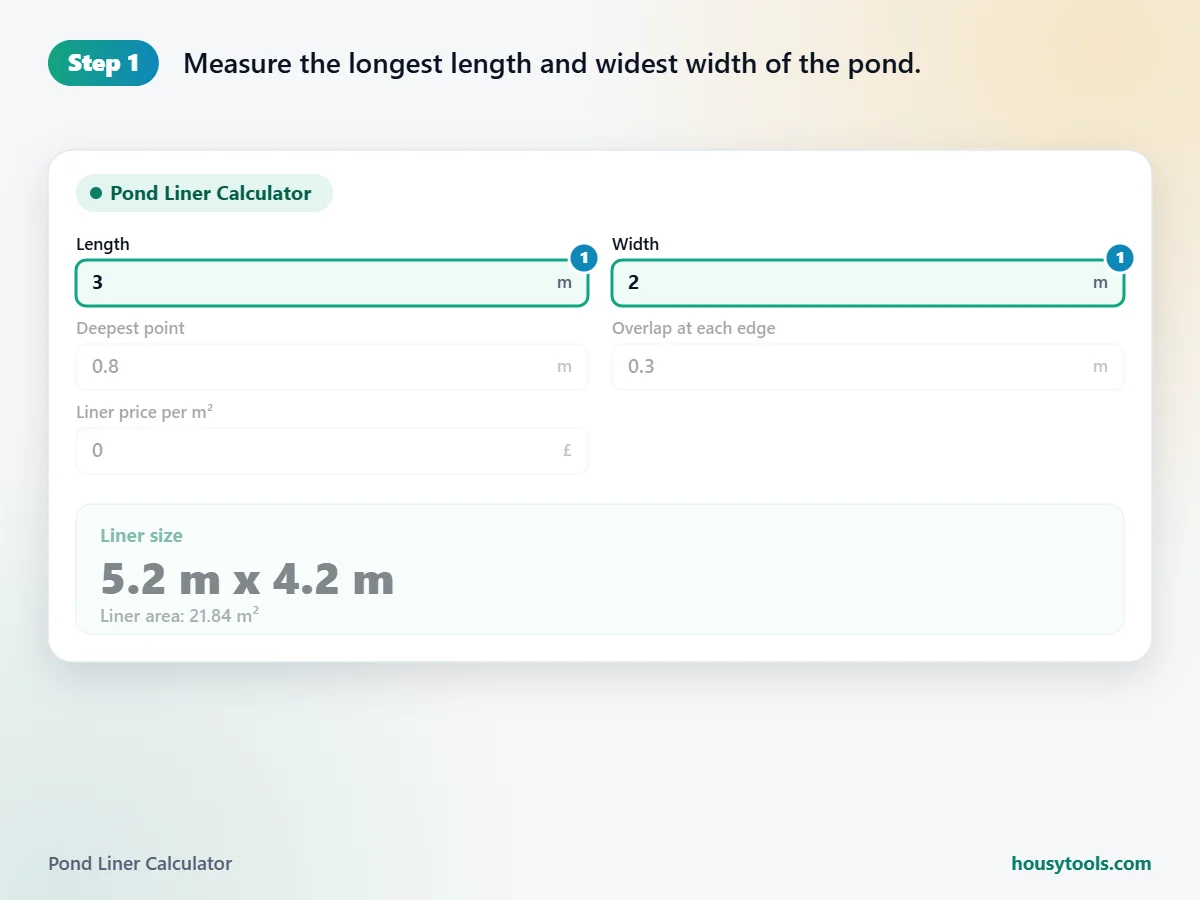
- Measure the longest length and widest width of the pond.
- Enter the depth at the deepest point.
- Enter the overlap you want at each edge.
- Add the price per m² if you want the cost.
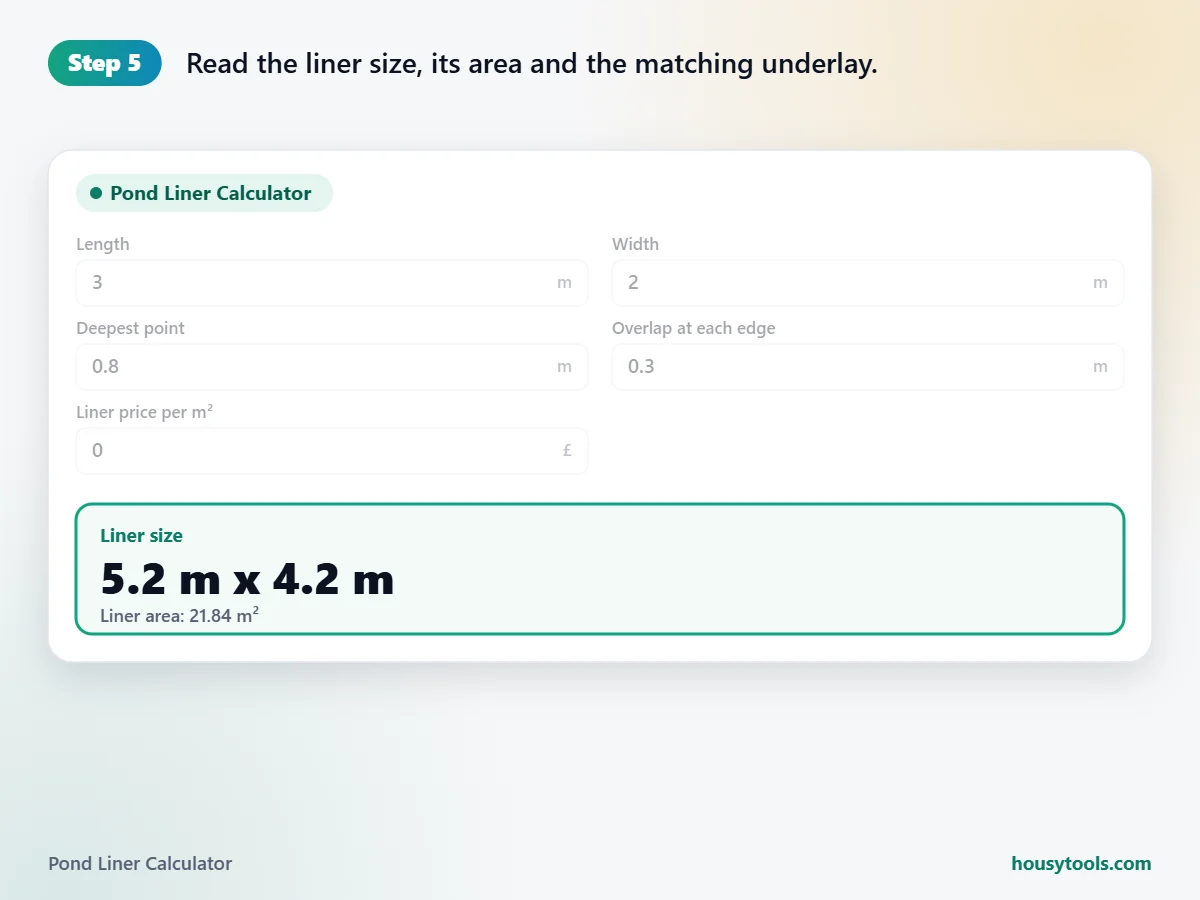
- Read the liner size, its area and the matching underlay.


What Size Pond Liner Do I Need?
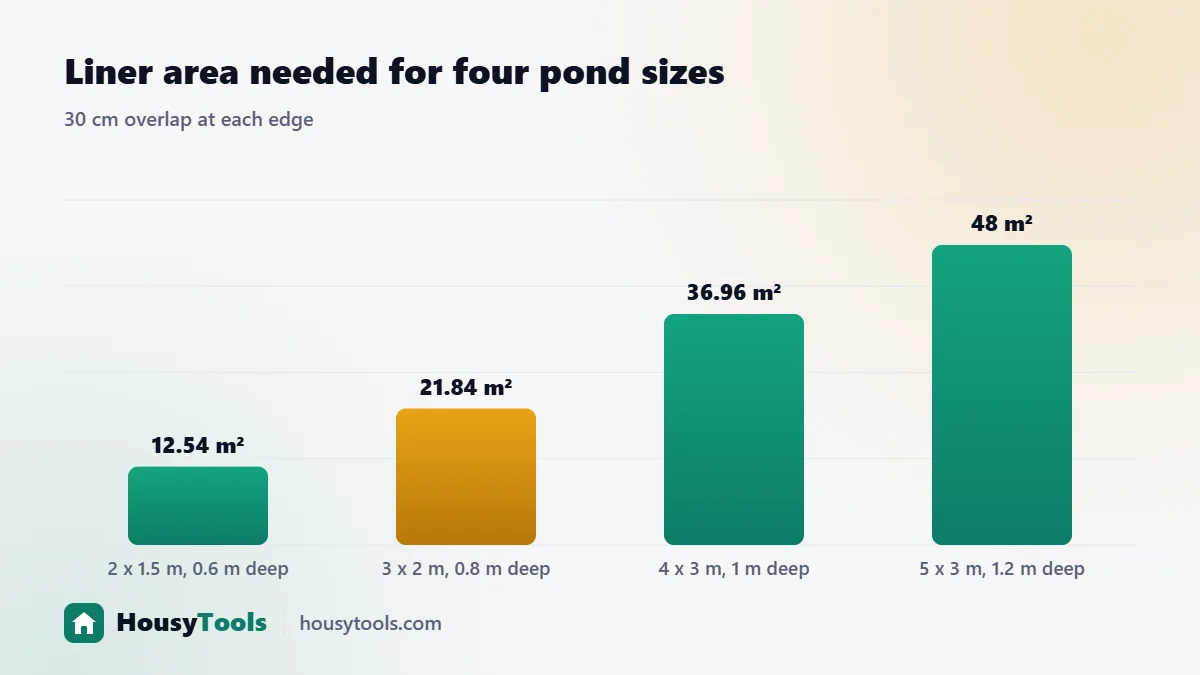
The liner is always much bigger than the pond’s surface: a 3 m by 2 m pond needs about 22 m² of liner, more than three times its 6 m² surface, because the sides and overlap use so much material.
| Pond surface | Deepest point | Liner size | Liner area |
|---|---|---|---|
| 2 m x 1.5 m | 0.6 m | 3.8 m x 3.3 m | 12.54 m² |
| 3 m x 2 m | 0.8 m | 5.2 m x 4.2 m | 21.84 m² |
| 4 m x 3 m | 1 m | 6.6 m x 5.6 m | 36.96 m² |
| 5 m x 3 m | 1.2 m | 8 m x 6 m | 48 m² |
Because the formula uses the deepest point all the way round, it automatically covers marginal shelves and sloping sides. For irregular ponds, measure the longest and widest points of the shape, so the rectangle of liner covers every curve.
How Deep Should a Garden Pond Be?
Depth depends on the purpose: wildlife ponds often have very shallow sloping edges and a deeper area, while fish ponds usually need deeper water so fish can shelter in summer and winter.
Shallow margins let frogs, birds and insects get in and out, and suit marginal plants. If you plan fish, check the depth recommended for the species. The Wikipedia article on garden ponds gives an overview of pond types and features. Remember that even shallow water is a drowning risk for young children, so think about safety grilles or fencing in family gardens.
Which Pond Liner Material Is Best?
Flexible rubber (EPDM) and PVC liners are the most common for garden ponds; rubber usually costs more but tends to stay flexible and last longer, while PVC is cheaper.
Whichever you choose, use an underlay or old carpet beneath it and remove sharp stones from the hole first. Order the liner as one piece if you can, because joins are a common source of leaks. For the stone or gravel around the edge, the gravel calculator works out the quantity.
Worked Example: A 4 m by 3 m Wildlife Pond
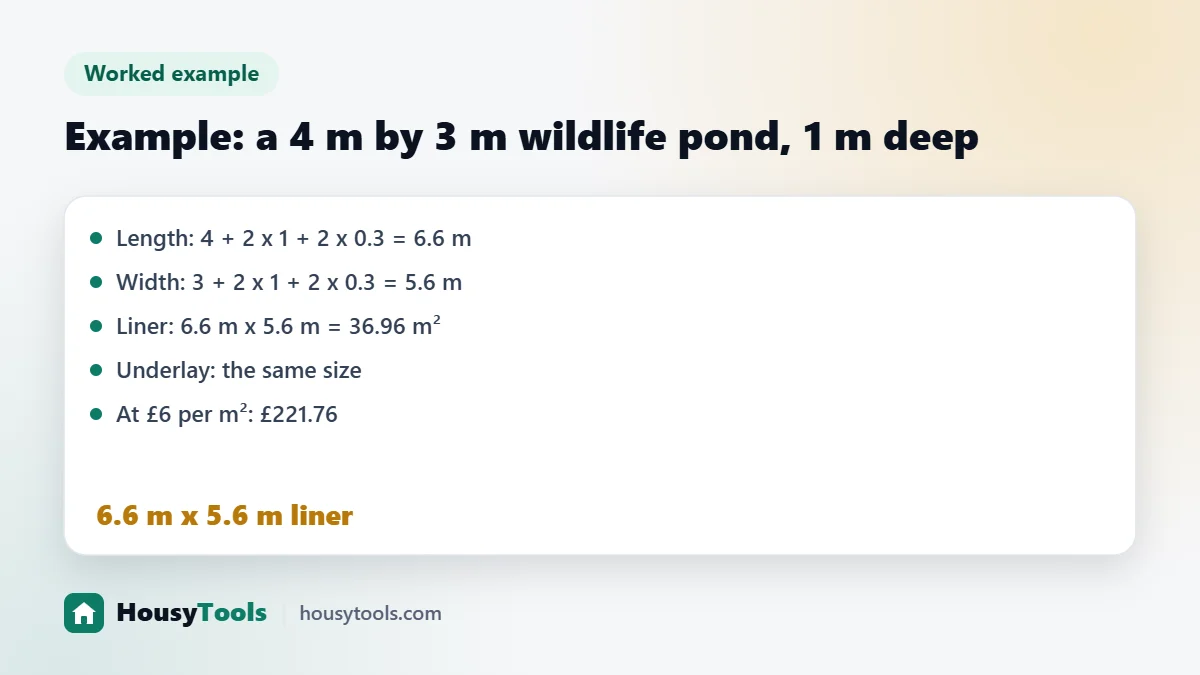
Example: a gardener digs a wildlife pond 4 m long, 3 m wide and 1 m at the deepest point, and wants 30 cm of overlap to tuck under the edging. The liner costs £6 per m² (an example price).
- Liner length: 4 + 2 x 1 + 2 x 0.3 = 6.6 m
- Liner width: 3 + 2 x 1 + 2 x 0.3 = 5.6 m
- Liner area: 6.6 x 5.6 = 36.96 m²
- Underlay: the same 6.6 m by 5.6 m
- Liner cost: 36.96 x £6 = £221.76
Liners are often sold in set widths, so the gardener rounds up to the next size available rather than cutting it fine. A practical tip: let the liner settle into the hole as you fill the pond slowly with water, smoothing creases as it goes, and trim the edge only when the pond is full.
Pond Liner Calculator FAQs
How do you calculate pond liner size?
Add twice the maximum depth and twice the overlap to the pond’s length, and do the same for the width. Multiply the two results for the area.
How much overlap should a pond liner have?
Many people allow around 30 cm at each edge so the liner can be anchored under paving or stones. Enter your own overlap in the calculator.
Do I need underlay under a pond liner?
Underlay protects the liner from stones and roots, which helps prevent punctures. It should be the same size as the liner.
Does the calculator work for irregular ponds?
Yes. Measure the longest length and widest width of the shape and the deepest point. The liner rectangle will then cover every curve and shelf.
How much water will my pond hold?
The calculator shows an upper limit assuming straight sides all the way down. Sloping sides and shelves hold less, so the real volume is lower.
Can I join two pond liners?
Some liners can be joined with special tape or seaming kits, but joins are a common source of leaks. One piece is safer where possible.
Checked October 2026. Sources: Wikipedia on garden ponds, supplier product information for liner materials.