
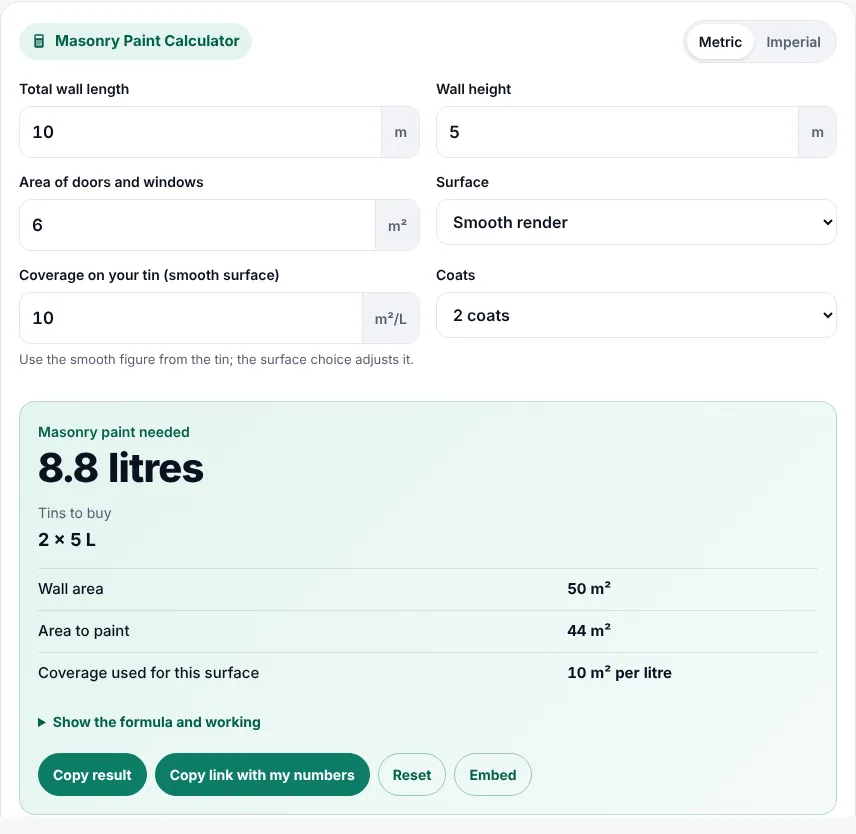
Show the formula and working
This masonry paint calculator works out how many litres of exterior masonry paint you need for render, brick or pebbledash walls, and which tins to buy, for homeowners in the UK, Ireland and Europe. Enter the total wall length and height, the area of doors and windows, your surface type, the smooth coverage from the tin and the number of coats.
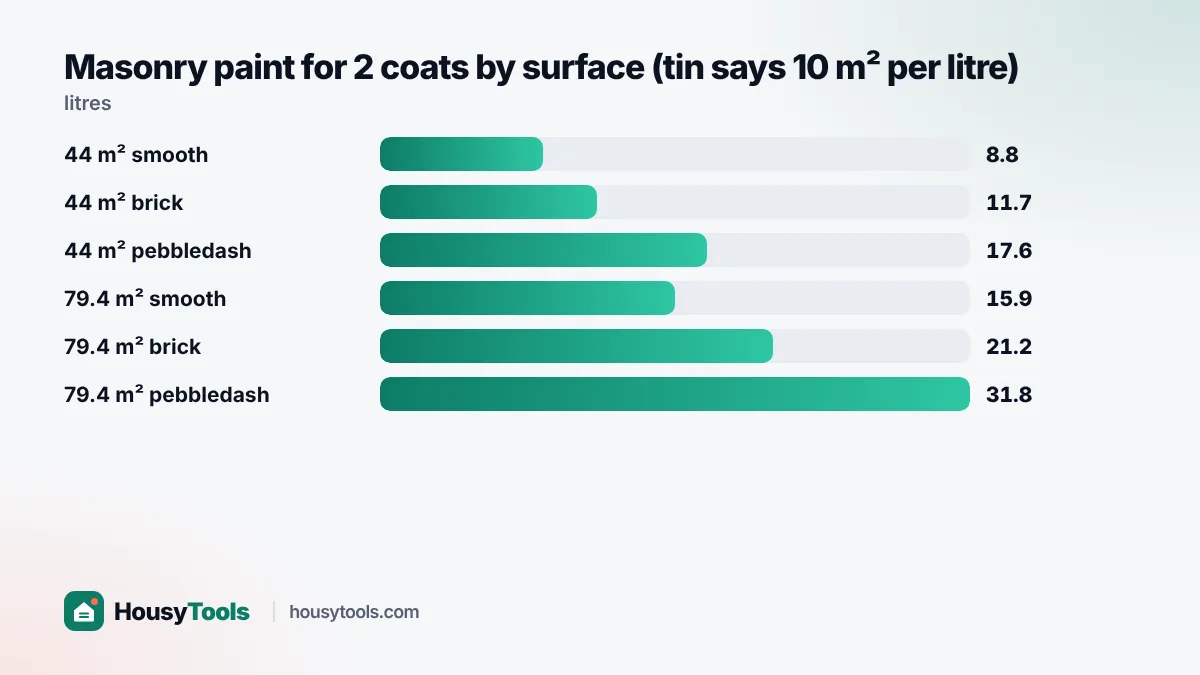
Quick answer: the masonry paint calculator multiplies wall length by height, subtracts doors and windows, then divides area times coats by the tin coverage adjusted for texture. With 10 m² per litre on the tin, 79.4 m² over two coats needs 15.9 litres on smooth render and 31.8 litres on pebbledash.
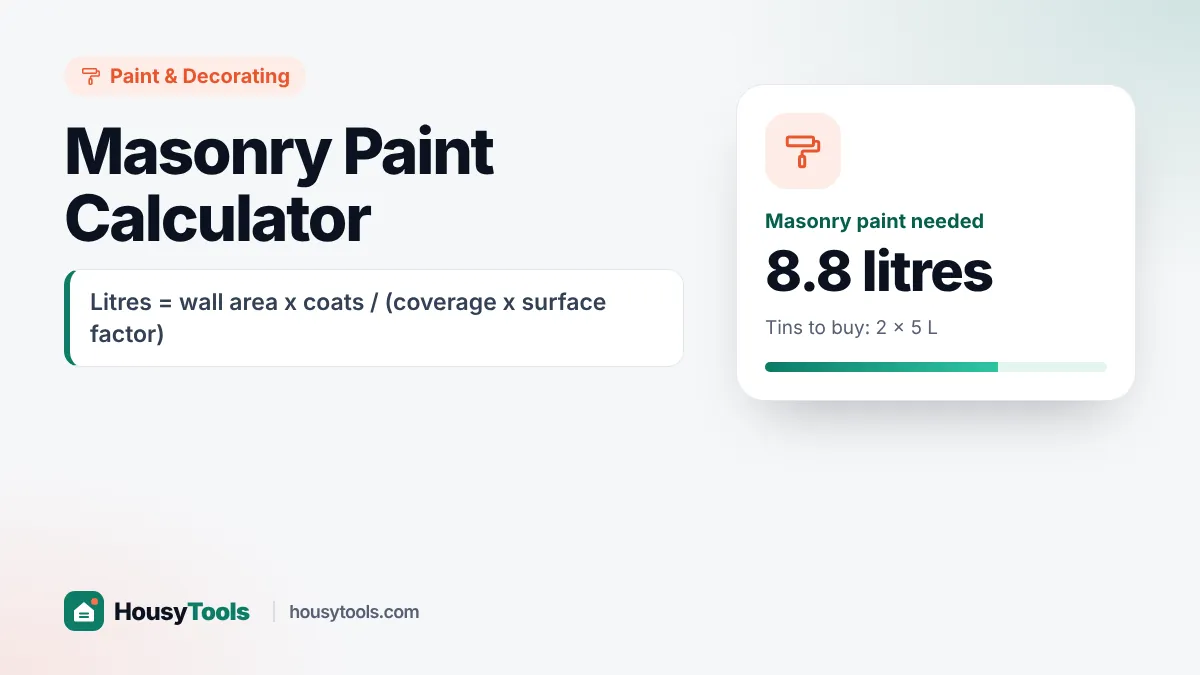
What Is a Masonry Paint Calculator?
A masonry paint calculator is a tool that estimates the litres of exterior wall paint needed for a house, adjusting the tin’s coverage for how rough the surface is.
The formula works like this. Multiply the total wall length by the wall height to get the gross area, then subtract the area of doors and windows. Take the smooth coverage printed on the tin and multiply it by a surface factor: 1 for smooth render, 0.75 for brick or fine texture, and 0.5 for pebbledash or rough cast. Finally, multiply the area by the coats and divide by that adjusted coverage.
The masonry paint calculator then suggests a mix of 5 L, 2.5 L and 1 L tins, and shows every step so you can check the surface factor it used.
How Do You Use the Masonry Paint Calculator?
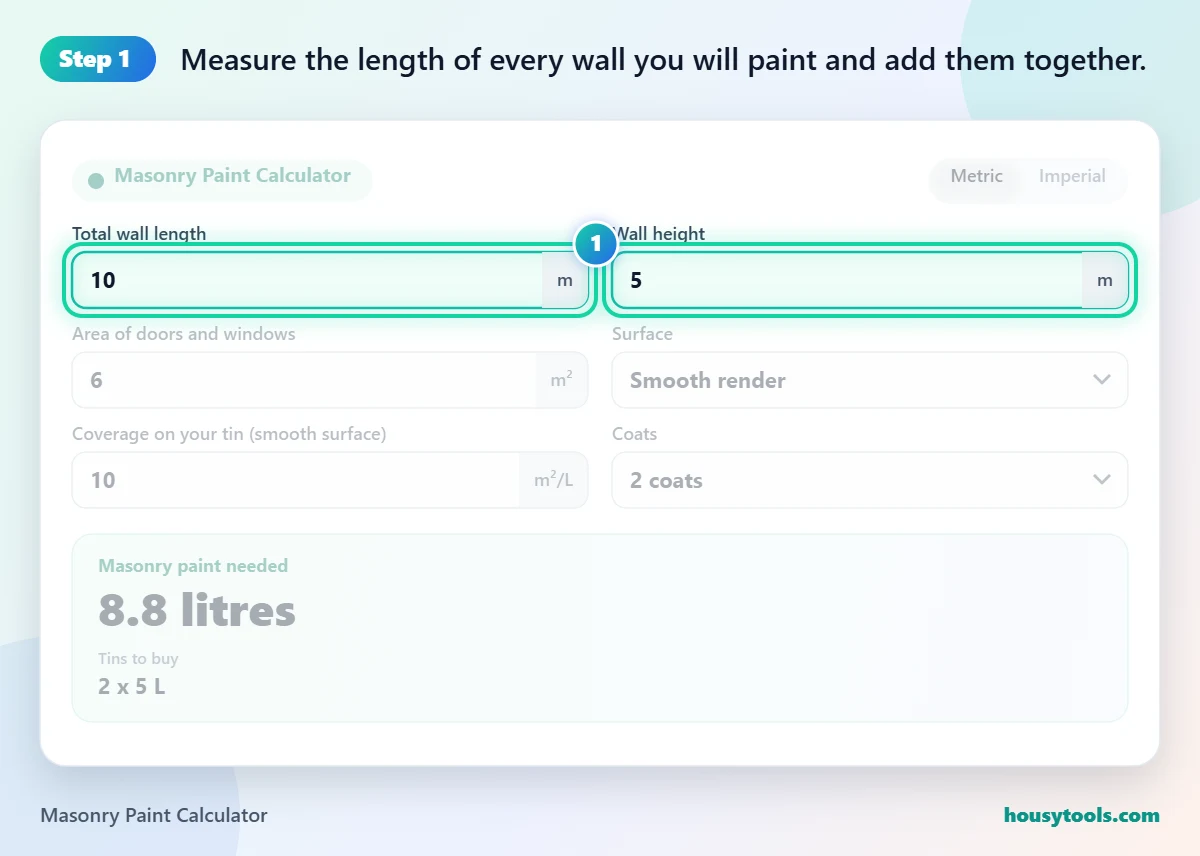
- Measure the length of every wall you will paint and add them together. For a semi, that may be the front, one side and the rear.
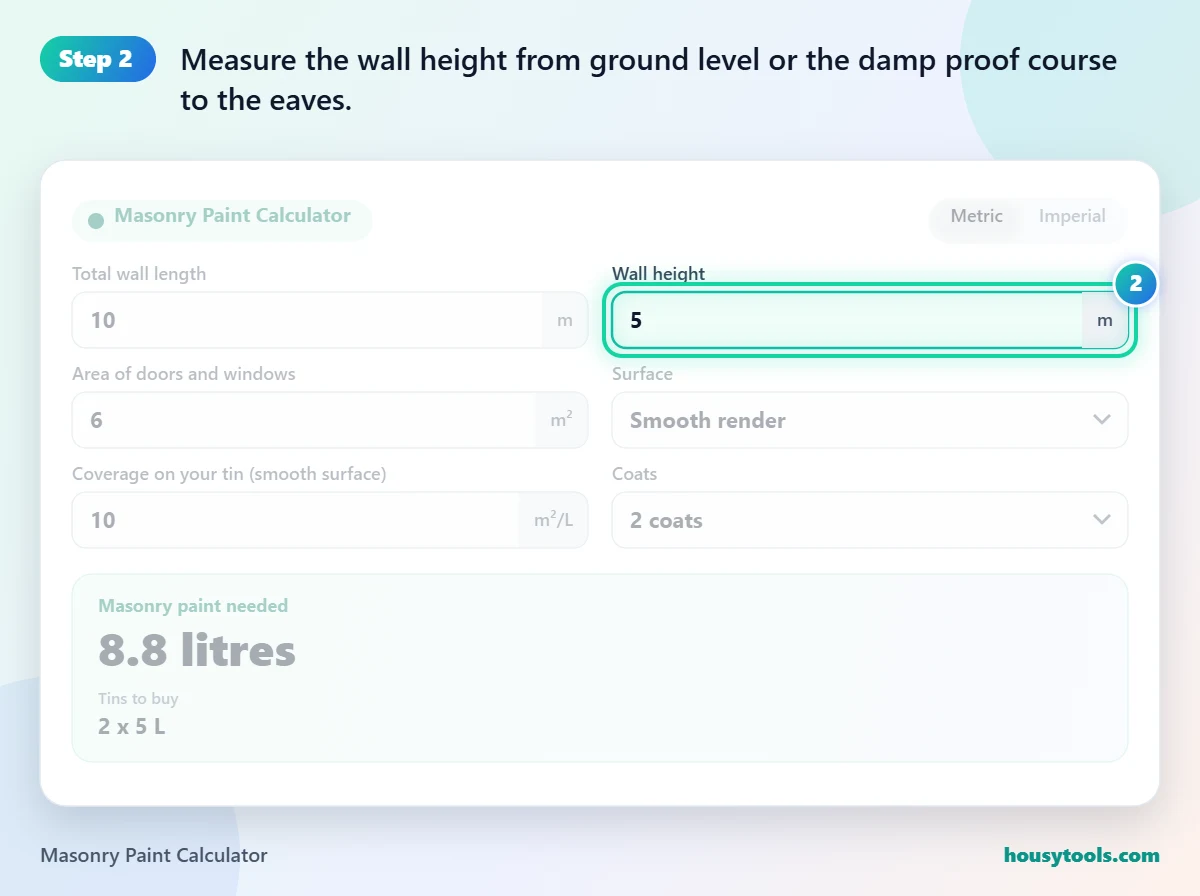
- Measure the wall height from ground level or the damp proof course to the eaves. Enter an average if the ground slopes.
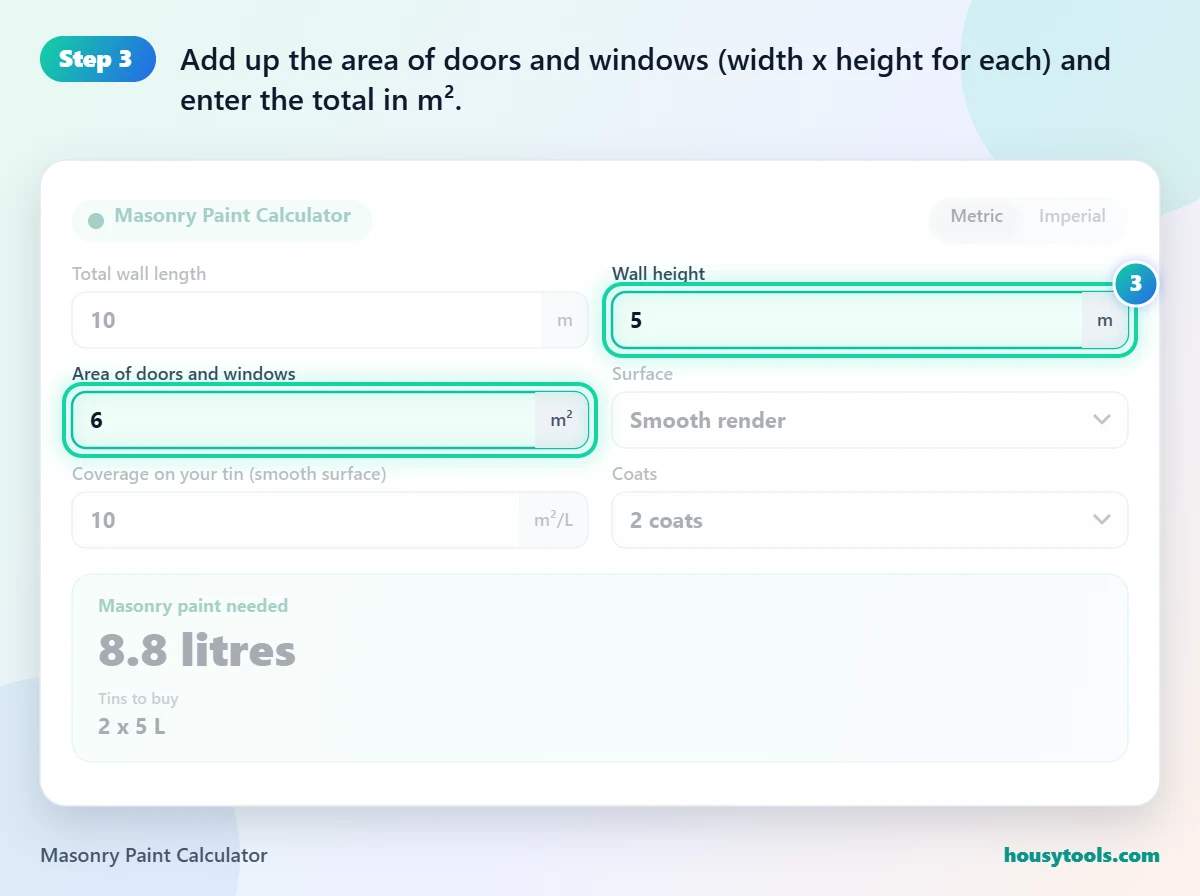
- Add up the area of doors and windows (width x height for each) and enter the total in m².
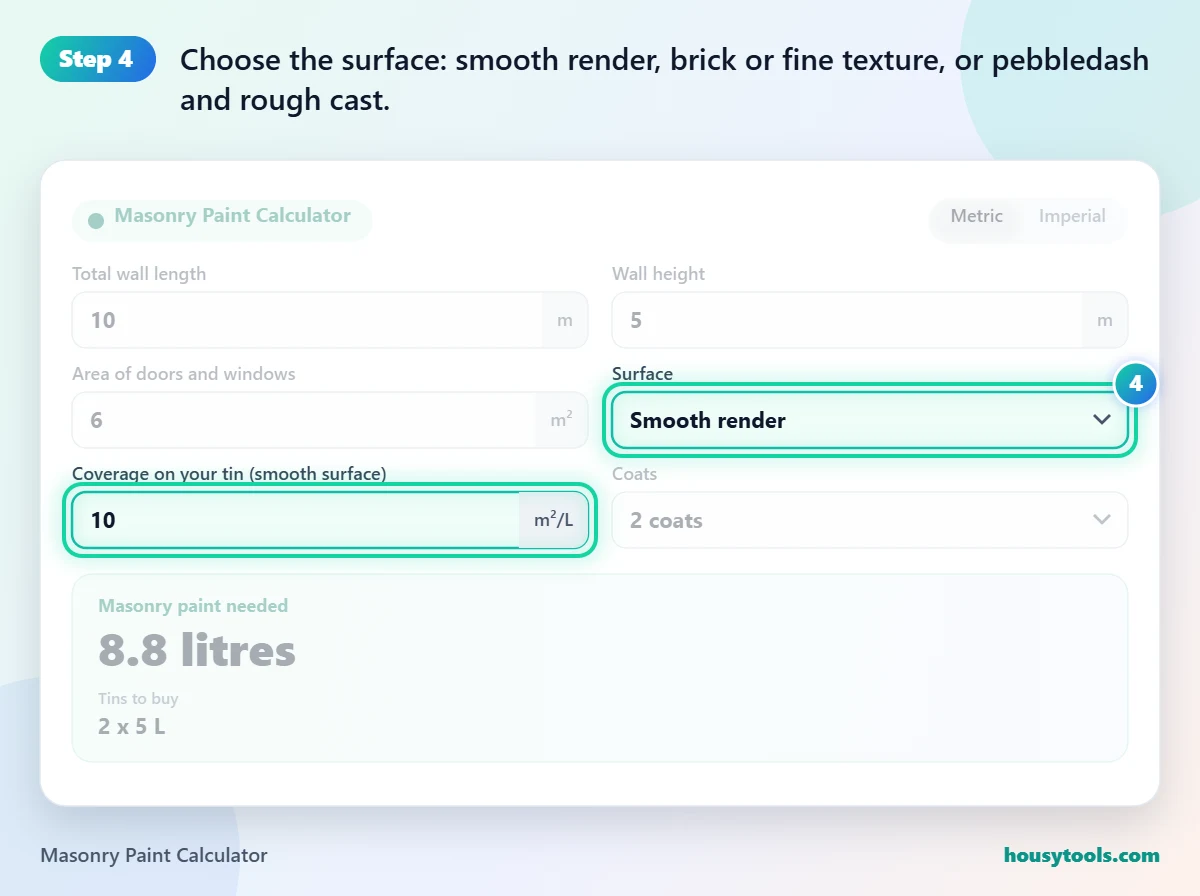
- Choose the surface: smooth render, brick or fine texture, or pebbledash and rough cast.
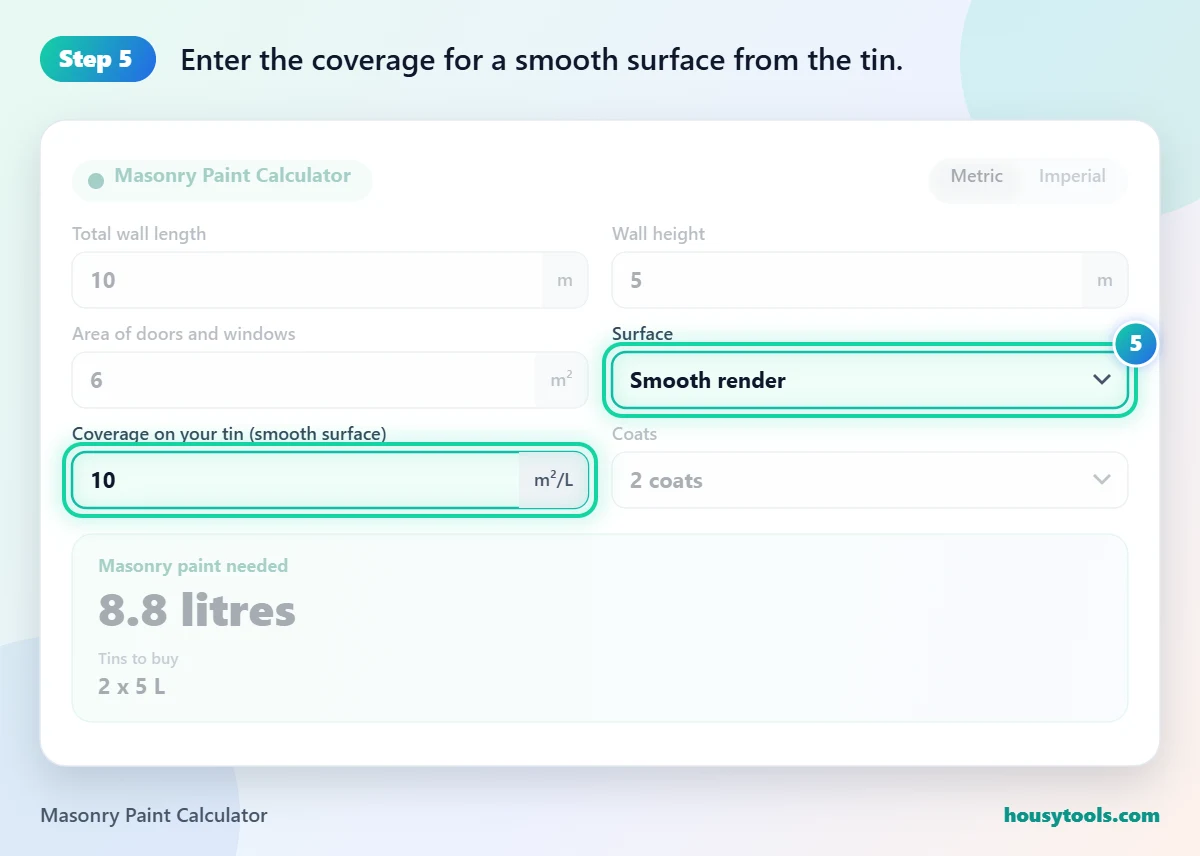
- Enter the coverage for a smooth surface from the tin. The calculator applies the surface factor for you.
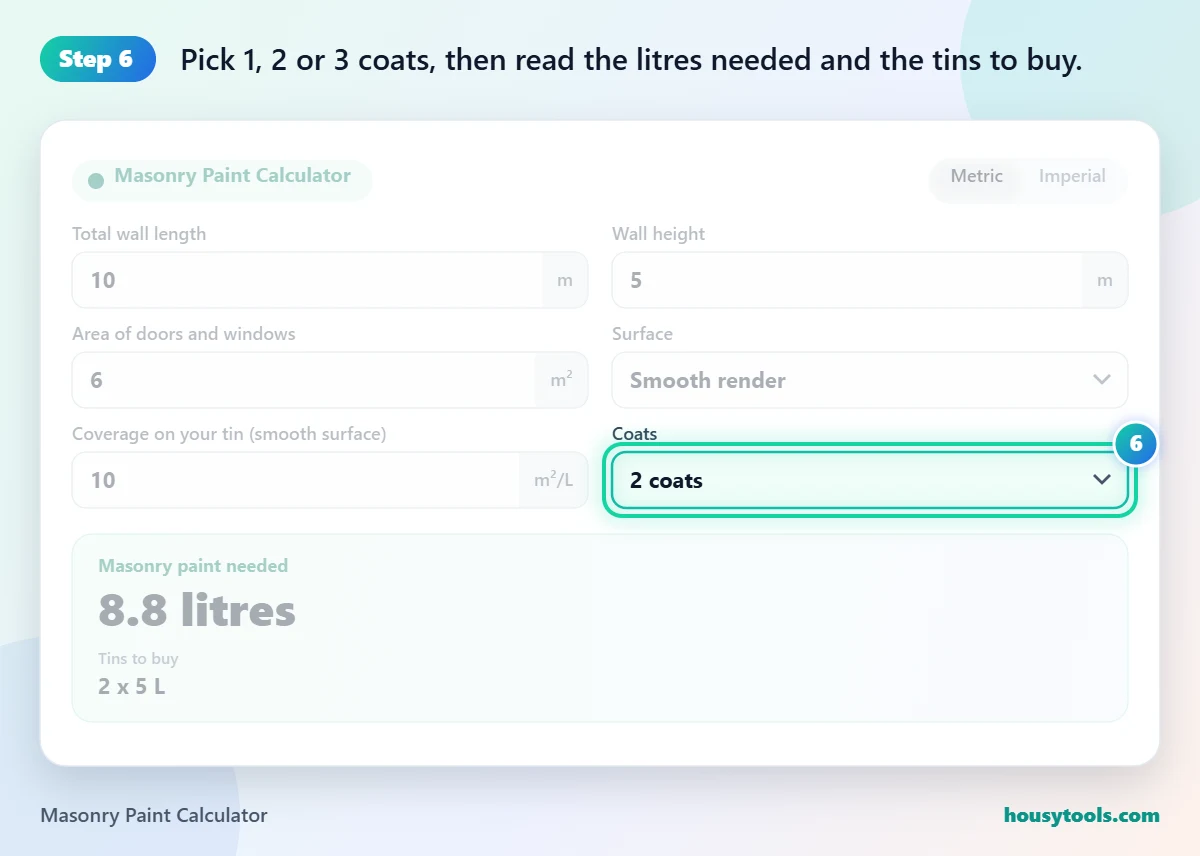
- Pick 1, 2 or 3 coats, then read the litres needed and the tins to buy.
How Much Masonry Paint Do I Need for a House?
A typical UK semi with about 80 m² of wall to paint needs roughly 16 litres of masonry paint for two coats on smooth render, but around 32 litres if the walls are pebbledash.
Wall area is the biggest driver. A two storey house is usually 5 m or more to the eaves, so even a short front elevation adds up quickly. Gable ends need extra care before you use the masonry paint calculator: measure the rectangle up to the eaves, then add the triangle above it, which is its width times its height to the apex, divided by two.
Surface texture is the second driver. Rough surfaces have far more real area than their flat measurement suggests, and the paint has to be worked into every gap. The masonry paint calculator handles this with the surface setting, so you can measure the wall as if it were flat.
How Much Does Pebbledash Increase the Paint Needed?
Pebbledash typically needs at least half as much paint again as smooth render, and our calculator allows twice as much to be safe.
Crown’s trade advice on working out exterior paint amounts suggests increasing quantities by a half to two thirds for pebbledash and rough cast. Manufacturer data shows a similar gap between finishes: Dulux Trade lists up to 14 m² per litre for Weathershield Maximum Exposure Smooth, against up to 8 m² per litre for its textured masonry paint.
The rough setting halves the smooth coverage, which allows for very open dash and spare paint for a third coat on weathered patches. If your tin already gives a separate figure for pebbledash, choose Smooth and enter that figure directly, so the factor is not applied twice.
Masonry Paint Coverage by Surface Type
The table shows the factor the masonry paint calculator applies to a tin rated at 10 m² per litre, and the paint each surface needs for Emma’s 79.4 m² over two coats.
| Surface | Surface factor | Coverage used | Paint for 79.4 m², 2 coats | Tins to buy |
|---|---|---|---|---|
| Smooth render | 1 | 10 m² per litre | 15.9 litres | 3 x 5 L + 1 x 1 L |
| Brick or fine texture | 0.75 | 7.5 m² per litre | 21.2 litres | 4 x 5 L + 1 x 2.5 L |
| Pebbledash or rough cast | 0.5 | 5 m² per litre | 31.8 litres | 6 x 5 L + 1 x 2.5 L |
Worked Example: Emma’s Pebbledash Semi
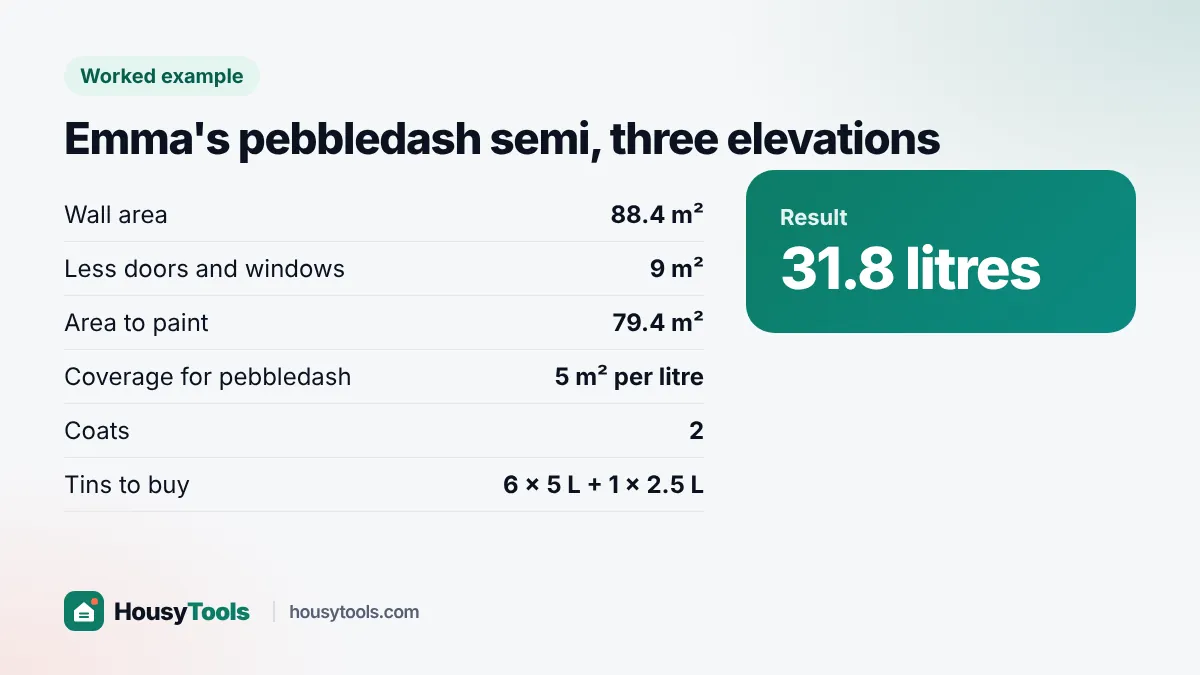
Emma owns a 1950s semi detached house in Glasgow with grey pebbledash on three sides. The front, side and rear walls measure 17 m in total and 5.2 m to the eaves. Her doors and windows add up to 9 m². The smooth masonry paint she likes says 10 m² per litre, and she plans two coats.
- Area: 17 m x 5.2 m = 88.4 m², less 9 m² of openings = 79.4 m²
- Coverage: 10 x 0.5 (pebbledash factor) = 5 m² per litre
- Paint: 79.4 x 2 / 5 = 31.76 litres, shown as 31.8 litres
- Tins: 6 x 5 L + 1 x 2.5 L
If her walls were smooth render, the masonry paint calculator would give 15.9 litres instead. Masonry paint is also widely sold in 10 litre tubs, so Emma checks whether three 10 L tubs plus a 2.5 L tin is cheaper. She can compare both options in the paint cost calculator.
When Is the Best Time to Paint Exterior Walls?
Paint masonry in a dry spell when the air and wall are above the minimum on the tin, which is 7 °C for Dulux Weathershield Maximum Exposure Smooth, and when no rain is forecast before it dries.
In the UK and Ireland, late spring to early autumn gives the most reliable window, but cold walls, morning dew and low winter sun can all slow drying. Avoid painting in direct strong sun as well, which can dry the paint too fast and leave lap marks.
- Clean off algae and loose dash first, and fill cracks with an exterior filler.
- Use a long pile roller or masonry brush for pebbledash, and expect slower progress than on smooth render.
- For upper walls, a scaffold tower or professional scaffold is safer than leaning on a ladder for long periods. The HSE advises using ladders only for short, low risk tasks.
- Old exterior woodwork and some older wall paints may contain lead. Wet sand and never burn off old paint.
- Painting your house does not normally need planning permission, but the Planning Portal explains that listed buildings need consent for significant works, so check with your council first.
Common Mistakes With Masonry Paint Quantities
- Measuring pebbledash as smooth. This is the single biggest cause of running out halfway up a wall, so always set the surface in the masonry paint calculator.
- Forgetting gable triangles, chimney breasts and the reveals around windows, which can add several square metres on an older house.
- Subtracting the whole window frame when the reveals still need painting. Subtract only the glass and frame face.
- Assuming every masonry paint covers the same. Textured masonry paints cover much less than smooth ones, so enter the figure from your own tin in the masonry paint calculator.
- Splitting a colour across batches bought weeks apart. Buy the full quantity the masonry paint calculator suggests in one order.
For interior rooms, use the paint calculator instead, as it works from room length, width and height. Garden fences are rough sawn timber rather than masonry, so the fence paint calculator uses panel sizes and wood coverage figures.
Masonry Paint Calculator FAQs
How far does 10 litres of masonry paint go?
On smooth render at 10 m² per litre, 10 litres covers about 100 m² in one coat or 50 m² in two. On pebbledash the same tub may cover only around 25 m² in two coats. Check your tin’s figure.
How many coats of masonry paint do I need?
Two coats is the usual recommendation for new or bare masonry and for a colour change, and it is the default in the masonry paint calculator. Manufacturers note that one coat may do on previously painted walls in good condition when the colour is similar.
How do I measure a house for masonry paint?
Measure the length of each wall and the height to the eaves, multiply, and add the walls together. Add gable triangles separately, then subtract doors and windows. The masonry paint calculator takes the total length and an average height.
Is smooth or textured masonry paint better for pebbledash?
Either can be used. Textured paint can hide fine cracks, while smooth paint is easier to work into the stones. What matters most for quantity is the surface, so select pebbledash in the calculator either way.
Can I use the masonry paint calculator for garden walls?
Yes. Enter the wall length and height, set openings to 0, and double the length if you are painting both faces. Add the top of the wall as extra length if it is wide.
Why does the calculator suggest so much paint for pebbledash?
Pebbledash has far more real surface than its flat measurement, and paint fills the gaps between stones. The calculator halves the tin’s smooth coverage to stay on the safe side. Leftover sealed tins are useful for future touch ups.
Checked October 2026. Sources: Dulux Trade product data, Crown Paints Professional, Planning Portal, Health and Safety Executive (HSE).