
Show the formula and working
This gravel calculator works out how much gravel, shingle or decorative stone you need for a drive, path, border, round bed or patio, in cubic metres, tonnes and bags. It is built for UK and European gardens measured in metres and millimetres, with a feet and inches switch that also shows cubic feet and cubic yards, and it lets you change the density and bag size to match what your supplier sells.
Quick answer: Multiply length x width x depth in metres to get cubic metres, add about 5% for settling, then multiply by about 1.8 to get tonnes. A 5 m by 3 m area 50 mm deep needs 0.79 m³, about 1.42 tonnes. The gravel calculator also shows how many bags to order.
What Is a Gravel Calculator?
A gravel calculator is a tool that turns the size and depth of an area into the volume and weight of gravel needed to cover it. For a rectangle, area = length x width; for a circle, area = 3.1416 x radius x radius. Volume = area x depth, with the depth converted from millimetres to metres, plus an allowance for settling. Weight = volume x density, and bags = weight divided by the bag weight, rounded up.
The Wikipedia article on gravel notes that a cubic metre typically weighs about 1,800 kg, with bulk density ranging from about 1,460 to 1,920 kg/m³. The calculator uses 1,800 kg/m³ by default, and you can change it if your supplier quotes another figure.
How Do You Use the Gravel Calculator?
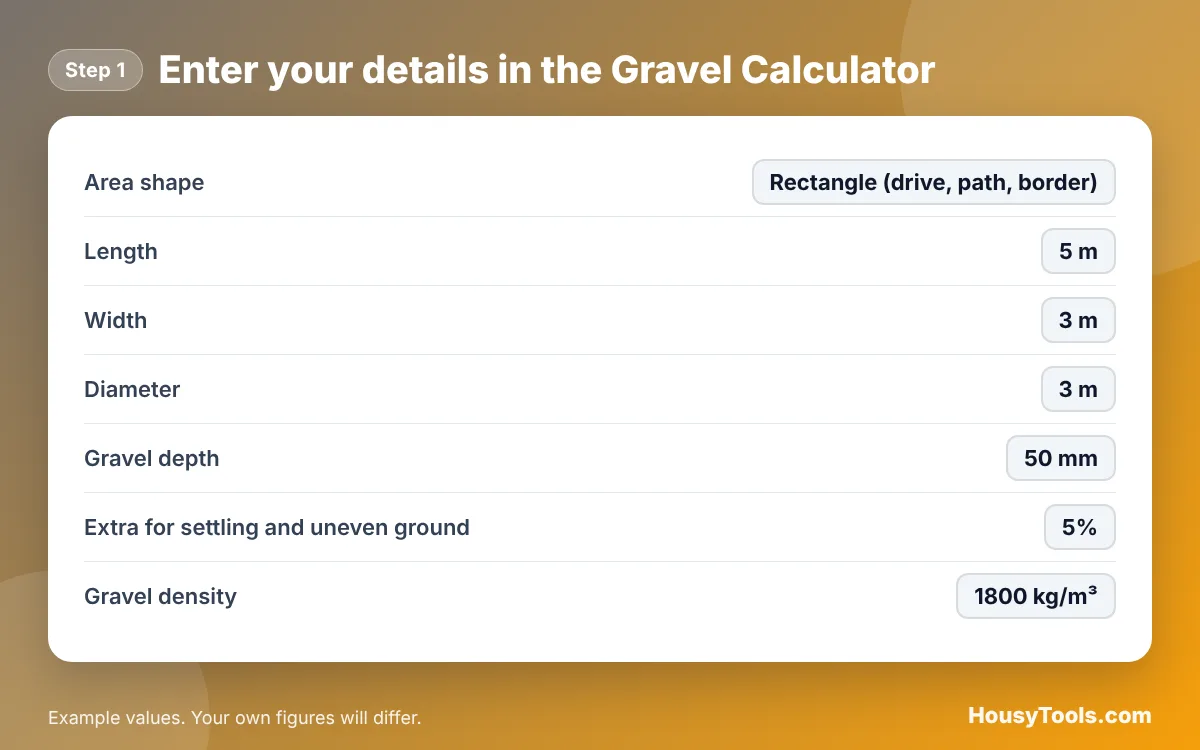
- Choose the Area shape: a rectangle such as a drive, path or border, or a circle such as a round bed.
- For a rectangle, enter the Length and Width. For a circle, enter the Diameter.
- Enter the Gravel depth in millimetres.
- Set the Extra for settling and uneven ground.
- Check the Gravel density and enter the Bag weight (from supplier).
- Read the tonnes, cubic metres and bags, then open “Show the formula and working” to see each step.

How Much Does a Cubic Metre of Gravel Weigh?
A cubic metre of gravel typically weighs about 1,800 kg, or 1.8 tonnes, though loose gravel can range from about 1.46 to 1.92 tonnes depending on the stone, its size and how wet it is. So to turn cubic metres into tonnes, multiply by about 1.8. To turn tonnes into cubic metres, divide by 1.8, so 1 tonne is about 0.56 m³.
How Much Area Does a Tonne of Gravel Cover?
At 1,800 kg/m³, one tonne of gravel covers about 11.1 m² at 50 mm deep, or about 22.2 m² at 25 mm deep. The coverage halves each time the depth doubles. Divide 1,000 by the density and then by the depth in metres to get square metres per tonne, which the calculator shows as coverage at this depth.
| Depth | Volume per 10 m² | Tonnes per 10 m² at 1,800 kg/m³ | Coverage per tonne |
|---|---|---|---|
| 25 mm | 0.25 m³ | 0.45 t | 22.2 m² |
| 40 mm | 0.40 m³ | 0.72 t | 13.9 m² |
| 50 mm | 0.50 m³ | 0.90 t | 11.1 m² |
| 75 mm | 0.75 m³ | 1.35 t | 7.4 m² |
| 100 mm | 1.00 m³ | 1.80 t | 5.6 m² |
The table shows amounts before any extra for settling. Add 5% to 10% if the ground is soft or uneven.
How Many Bags of Gravel Do I Need?
Divide the total weight by the weight of one bag and round up. For 1.42 tonnes and bulk bags of 850 kg, that is 1,418 / 850 = 1.67, so 2 bulk bags. Bag sizes vary widely between suppliers, from small bags you can lift to bulk bags delivered by lorry crane, so the 850 kg default is only an example. Enter the weight your supplier states.
Do You Need Planning Permission for a Gravel Driveway?
In England, surfacing more than 5 m² of a front garden is permitted development only if the surface is permeable or drains to a permeable area on the property. Loose gravel lets water soak through, which is why it is a common choice. The government’s guidance on permeable surfacing of front gardens explains the options. Rules elsewhere differ, and a new dropped kerb needs separate permission from the council.
If you plan to lay a concrete edge or a shed base next to the gravel, our home calculators cover the other materials. For timber edging or a fence around the area, the fence paint calculator works out the paint.
Worked Example: A Gravel Border
Example: a border 5 m long and 3 m wide is covered with gravel 50 mm deep. Add 5% for settling and uneven ground and use the typical density of 1,800 kg/m³, with a supplier that sells 850 kg bulk bags.
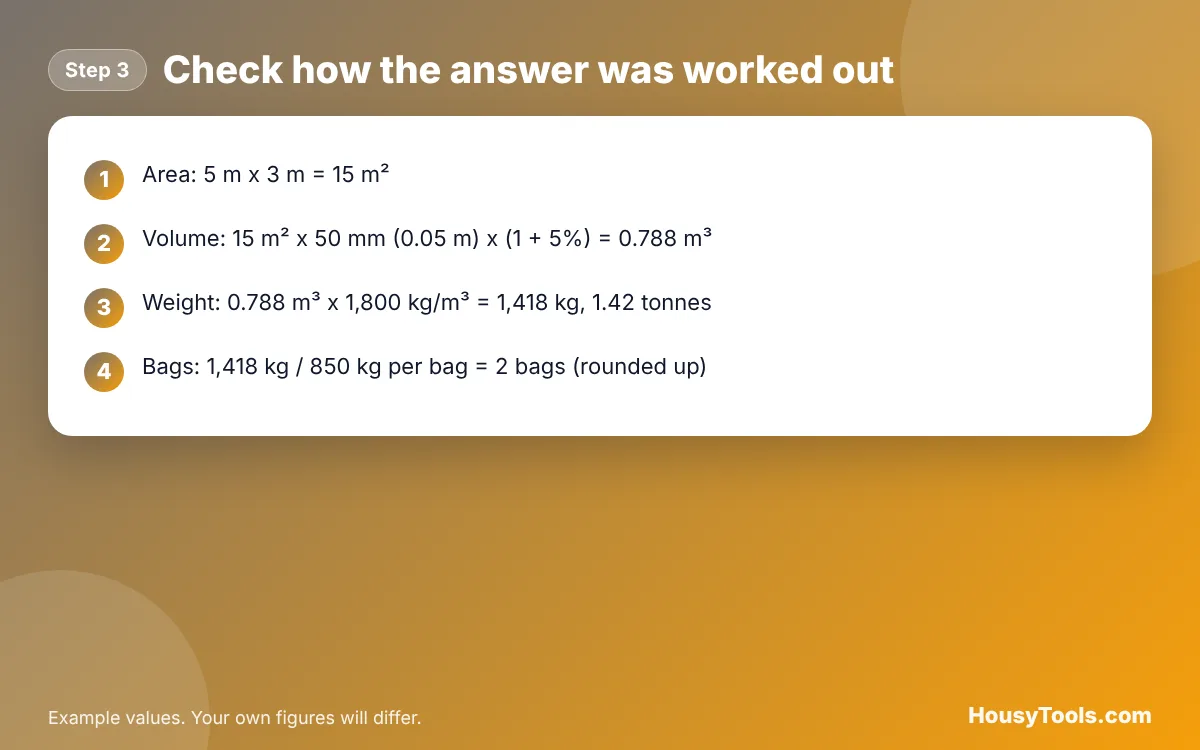
- Area: 5 m x 3 m = 15 m².
- Volume: 15 m² x 0.05 m x 1.05 = 0.788 m³.
- Weight: 0.788 m³ x 1,800 kg/m³ = 1,418 kg, about 1.42 tonnes.
- Bags: 1,418 kg / 850 kg = 1.67, so 2 bulk bags.
Two bulk bags leave about 280 kg spare, which is useful for topping up the border after it settles.
Gravel Calculator FAQs
How do I calculate how much gravel I need?
Multiply length x width x depth, all in metres, to get cubic metres. Add about 5% for settling, then multiply by the density, about 1.8 tonnes per cubic metre, to get tonnes. A 10 m² area 50 mm deep needs about 0.9 tonnes.
How many tonnes of gravel are in a cubic metre?
A cubic metre of gravel typically weighs about 1.8 tonnes, with a range of about 1.46 to 1.92 tonnes depending on the stone and moisture. Use your supplier’s figure if they give one, and enter it as the gravel density.
How many square metres does a tonne of gravel cover?
At 1,800 kg/m³, a tonne covers about 11.1 m² at 50 mm deep and about 22.2 m² at 25 mm deep. Divide 1,000 by the density and by the depth in metres to get the coverage for any depth.
How do I work out gravel for a round bed?
Choose the circle shape and enter the diameter. The calculator works out the area as 3.1416 x radius squared. A round bed 3 m across has an area of 7.07 m², so at 50 mm deep with 5% extra it needs 0.37 m³, about 0.67 tonnes.
How do I convert cubic metres of gravel to cubic yards?
Multiply cubic metres by 1.308 to get cubic yards, because one yard is exactly 0.9144 m. So 0.79 m³ is about 1.03 cubic yards. Switch the calculator to feet and inches to see cubic feet and cubic yards automatically.
Should I put a membrane under gravel?
Many gardeners lay a permeable weed membrane under decorative gravel to slow weeds and stop stones sinking into soil. It does not change the amount of gravel needed, but it helps the depth you lay stay even for longer.
Checked October 2026. Sources: Wikipedia: Gravel (density about 1,800 kg/m³, range 1,460 to 1,920 kg/m³), GOV.UK: Permeable surfacing of front gardens guidance, Wikipedia: Cubic yard.