
These flooring calculators work out how many tiles, packs, rolls, bags and boards you need for a floor or wall, for homeowners, renters and DIY fitters in the UK, Ireland and the rest of Europe. All 8 tools are free, add wastage for the way you lay the floor, round up to the packs you can actually buy, and show every step of the sum.
Quick answer: flooring calculators multiply length by width, add a wastage allowance for the layout and divide by the coverage of one tile, pack or roll, rounding up. A 4.5 m by 3.6 m living room needs 17.82 m² of laminate with 10% wastage, which is 9 packs of 2.22 m².
All 8 Flooring Calculators
The tools are grouped by the job. Most floors need more than one: a tiled floor needs tiles, adhesive and grout, and a laminate floor usually needs new skirting. Our flooring calculators share the same area inputs, so a room you measure once works across the whole set.
Tiles and tiling materials
- Tile Calculator: tiles and boxes for floors and walls, with the grout joint added to each tile and wastage set by the layout.
- Grout Calculator: kilograms and bags of grout from tile size, joint width, joint depth and grout density.
- Tile Adhesive Calculator: bags of adhesive by area and notched trowel size, with an option to add 30% for back-buttering.
Floor coverings
- Laminate Flooring Calculator: packs of laminate, rolls of underlay and an optional cost for any room.
- Vinyl Flooring Calculator: the length of sheet vinyl to buy from 2, 3 or 4 m wide rolls, with a trim allowance.
- Carpet Calculator: carpet, underlay and gripper rod for a room from 4 m or 5 m rolls.
Preparation and finishing
- Self Levelling Compound Calculator: bags of floor levelling compound by area and average depth.
- Skirting Board Calculator: metres and lengths of skirting for a room, less door openings, plus an allowance for mitres.
Most Popular Flooring Calculators
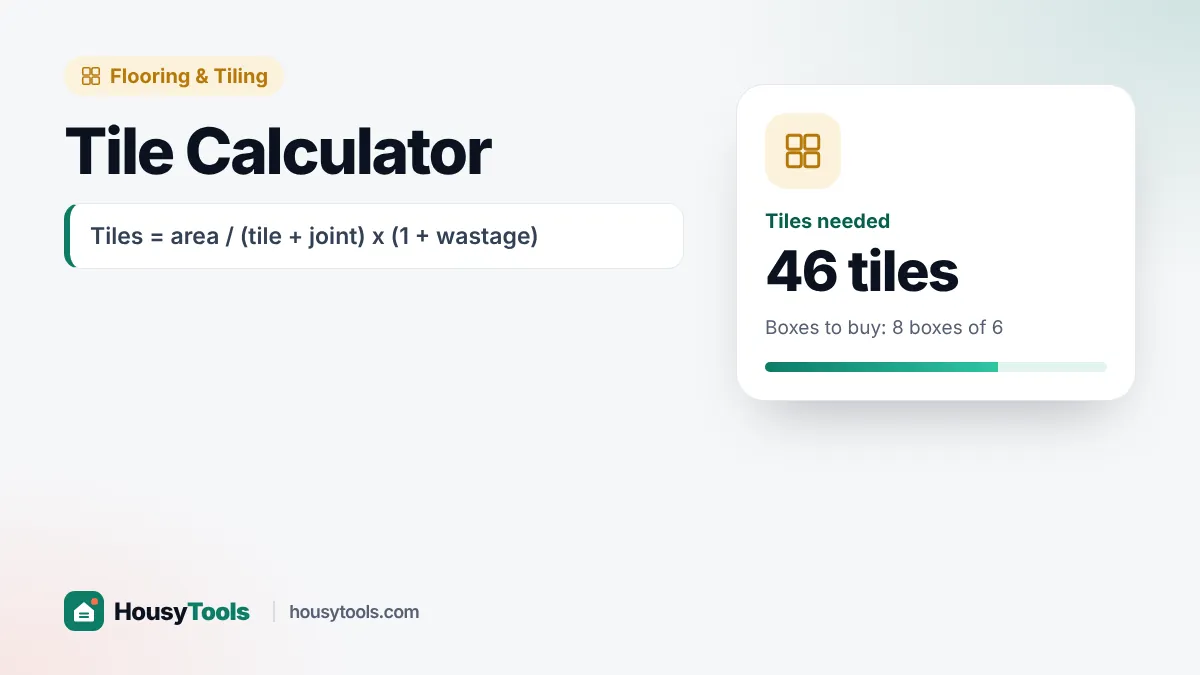
The tile calculator is the most used of our flooring calculators. It adds the grout joint to the tile size before dividing, which matters with small tiles and wide joints, and it rounds up to whole boxes. A 2.4 m by 1.8 m bathroom floor in 600 by 300 mm tiles, laid in brick bond, needs 27 tiles, or 5 boxes of 6.
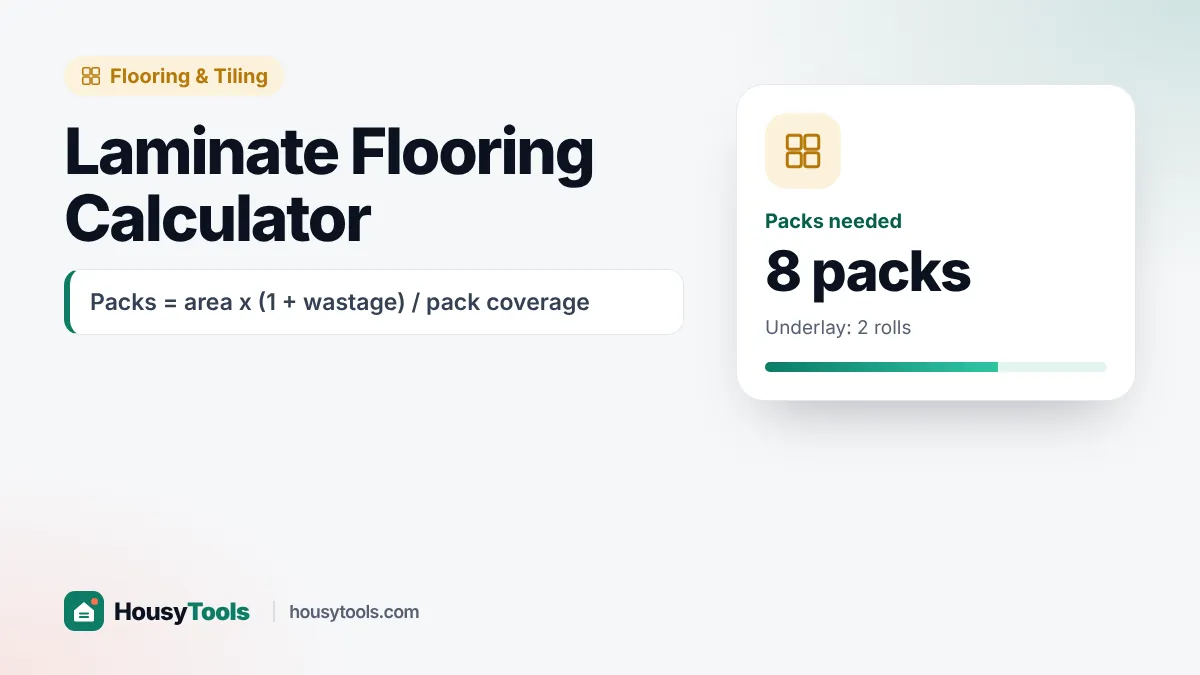
Second among our flooring calculators is the laminate flooring calculator. It turns room size and pack coverage into whole packs and underlay rolls, so you do not run one pack short on the last row.
Of the flooring calculators, the carpet calculator is the one to use before visiting a carpet shop. Carpet is cut from a roll, so the piece you pay for is the roll width times a length, not the room area. A 4.2 m by 3.6 m bedroom needs a 4 m by 4.3 m piece, which is 17.2 m².
Which Flooring Calculator Do I Need?
Match the tool to the material you are buying: tiles, grout and adhesive for a tiled floor or wall, laminate, vinyl or carpet for a floor covering, and the levelling and skirting tools for the jobs before and after. Most projects use two or three of these flooring calculators together.
- Tiling a bathroom floor: tile calculator, then tile adhesive calculator and grout calculator for the same area. Check the base with the self levelling compound calculator if it is uneven.
- Tiling a kitchen splashback or shower wall: tile calculator with the untiled area box, then grout and adhesive.
- Laying laminate in a lounge: laminate flooring calculator for packs and underlay, then the skirting board calculator if the old skirting comes off.
- New kitchen floor in sheet vinyl: vinyl flooring calculator to choose the roll width and avoid a seam.
- Carpeting a bedroom or stairs landing: carpet calculator with the roll widths your shop sells.
How Do You Plan a Flooring Job?
Plan a floor in five steps: measure, check the base, count the main material, add the materials that go under and around it, then buy everything in one order from the same batch. The flooring calculators below follow that order.
- Measure wall to wall at the widest points, in metres to two decimal places, and split L shaped rooms into rectangles.
- Check the floor is flat, dry and sound. Use the self levelling compound calculator for any dips before you lay tiles or vinyl.
- Run the main tool with your real tile, pack or roll size from the label, not the example defaults in the flooring calculators.
- Add the supporting materials: grout and adhesive for tiles, underlay for laminate and carpet, and skirting where needed.
- Buy all the tiles or packs at once and check the batch numbers, then keep a few spares for future repairs.
How Much Extra Flooring Should You Buy for Wastage?
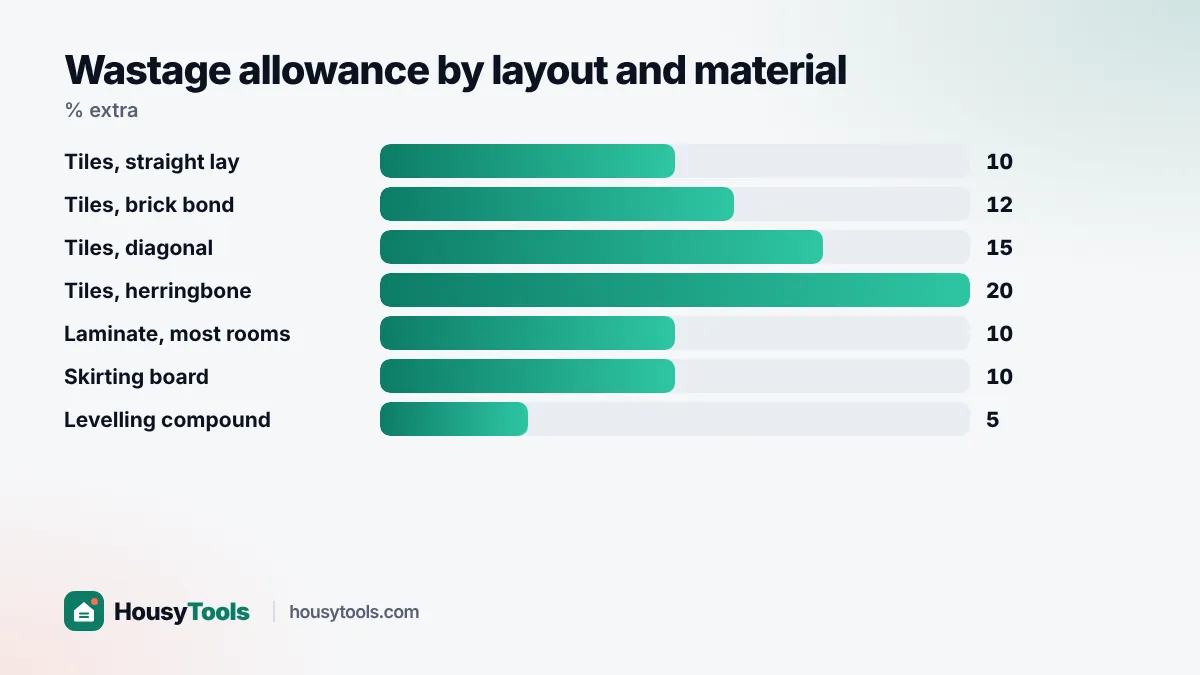
Allow about 10% extra for most floors, rising to 15% for diagonal tiling and 20% for herringbone. These are the allowances built into our flooring calculators, in line with common UK retailer guidance.
| Material or layout | Wastage added | Tool |
|---|---|---|
| Tiles, straight lay | 10% | Tile Calculator |
| Tiles, brick bond | 12% | Tile Calculator |
| Tiles, diagonal | 15% | Tile Calculator |
| Tiles, herringbone | 20% | Tile Calculator |
| Laminate, simple room / most rooms / many corners | 5% / 10% / 15% | Laminate Flooring Calculator |
| Skirting board, mitres and offcuts | 10% | Skirting Board Calculator |
| Grout | 10% | Grout Calculator |
| Tile adhesive | 5% | Tile Adhesive Calculator |
| Self levelling compound | 5% | Self Levelling Compound Calculator |
Patterns waste more because more pieces are cut and the offcuts are often the wrong shape to reuse. Rounding up to whole boxes or packs adds a little on top, so compare the amount needed with the amount bought in the flooring calculators before you add more.
How Much Grout and Tile Adhesive Do You Need per m²?
Most tiled floors need about 4 kg of adhesive per m² with a 10 mm notched trowel and roughly 0.1 to 0.7 kg of grout per m², depending on tile size and joint width.
Adhesive depends on the trowel notch: about 1.5 kg per m² for a 3 mm notch on mosaics, 2.5 kg for a 6 mm notch on small wall tiles, 4 kg for 10 mm on floors and 5 kg for 12 mm on large format tiles. Back-buttering adds about 30%.
Grout depends on how much joint there is. Large 600 by 600 mm tiles with 3 mm joints use about 0.16 kg per m², while 300 by 300 mm tiles use about 0.32 kg. The grout itself is explained in the Wikipedia article on grout. Both tools in our flooring calculators let you enter the figure from your own bag.
Should You Choose a 4 m or 5 m Carpet or Vinyl Roll?
Choose the narrowest roll that still covers one side of the room plus trim in a single piece, because that avoids a seam and gives the least waste.
For carpet, a 4 m roll suits rooms with one side under about 3.9 m, and a 5 m roll suits rooms where both sides are between about 3.9 m and 4.9 m. Sheet vinyl comes in 2, 3 and 4 m widths, so a 3.4 m by 2.7 m kitchen needs 3.5 m of a 3 m roll, 10.5 m² with no seam. The carpet and vinyl flooring calculators compare widths for you.
What Should You Check Before Lifting or Cutting an Old Floor?
Check for asbestos in old floor tiles and adhesives, and control the dust when cutting new tiles, before any of the numbers from the flooring calculators matter.
The HSE notes that asbestos was added to PVC and thermoplastic floor tiles and to some adhesives. In a building from before 2000, do not sand, scrape or break old tiles until they have been checked.
Cutting tiles makes fine dust, and the HSE explains that tiles contain silica. Use a wet cutter or a manual scorer, work in a ventilated space and wear a suitable dust mask. Leave an expansion gap of about 8 to 10 mm around laminate, as makers such as Quick-Step specify.
All results are estimates. Read how we test the tools on the how our calculators work page, and see the disclaimer for the limits of any online estimate.
Flooring Calculators FAQs
Are these flooring calculators free to use?
Yes. All 8 flooring calculators on this page are free, need no sign up and work in metric or imperial units. Each one shows its working under the result, so you can check how the tiles, packs, rolls or bags were counted before you order.
How many tiles do I need per square metre?
Divide 1 m² by the area of one tile including its joint. A 600 by 300 mm tile with a 3 mm joint covers 0.1827 m², so you need 5.47 tiles per m² before wastage, and 2.75 per m² for 600 by 600 mm tiles.
How much extra laminate should I buy?
Buy about 10% more than the room area for most rooms, 5% for a plain rectangle and 15% for rooms with many corners or a diagonal lay. The laminate flooring calculator adds your choice and rounds up to whole packs.
Do I need new underlay with a new carpet?
Yes. The Carpet Foundation recommends new underlay with every new carpet, says it can increase carpet life by 40 per cent, and warns that some warranties may not apply over old underlay. The carpet calculator includes the underlay area.
How much self levelling compound do I need?
Allow roughly 1.6 to 1.7 kg per m² for every millimetre of depth, plus about 5% for losses. A 12 m² floor at an average depth of 5 mm needs about 101 kg, which is six 20 kg bags.
How many skirting boards do I need for a room?
Work out the perimeter, subtract door openings and add about 10% for mitres. A 4 m by 3.5 m room with one 0.9 m door has a 14.1 m run, which is seven 2.4 m boards or four 4.2 m boards.
Checked October 2026. Sources: Health and Safety Executive (asbestos and silica guidance), Wikipedia (grout), Carpet Foundation, Quick-Step, results from each HousyTools tool page.