
These free electrical calculators help UK and European homeowners plan lighting, compare LED savings, choose the right plug fuse, check extension lead loads and size generators, inverters and battery backup, with the formula behind every answer.
Quick answer: Pick the calculator for your job, enter the wattage, lumens or load from the product label, and read the result with the working. These tools help you plan and buy the right product; any new wiring, consumer unit or fixed circuit work must be done by a qualified electrician.
How Many Watts Can a UK Plug Socket Take?
A standard UK 13 A socket supplies up to about 3,000 watts at 230 volts, and the plug fuse protects the appliance flex, not the wall socket. The plug and extension lead calculators follow the BS 1363 and BS 1362 ratings and warn you before a total goes over 13 A.
How Many Lumens Do You Need for a Room?
Lumens measure light output, so compare bulbs by lumens rather than watts: a modern LED bulb gives the light of an old 60 W bulb at about 806 lumens while using under 10 watts. The lighting calculators let you set the light level you want for each room.
When Do You Need an Electrician?
In England and Wales, new circuits, consumer unit changes and work in bathrooms are usually notifiable under Approved Document P. A generator connected to a home must use a proper changeover switch fitted by an electrician, never a plug-to-plug lead. Electrical Safety First has more safety guidance.
To turn watts into running costs, use the electricity cost calculator or convert units with the watts to amps converter.
Tips for Accurate Results With Our Electrical Calculators
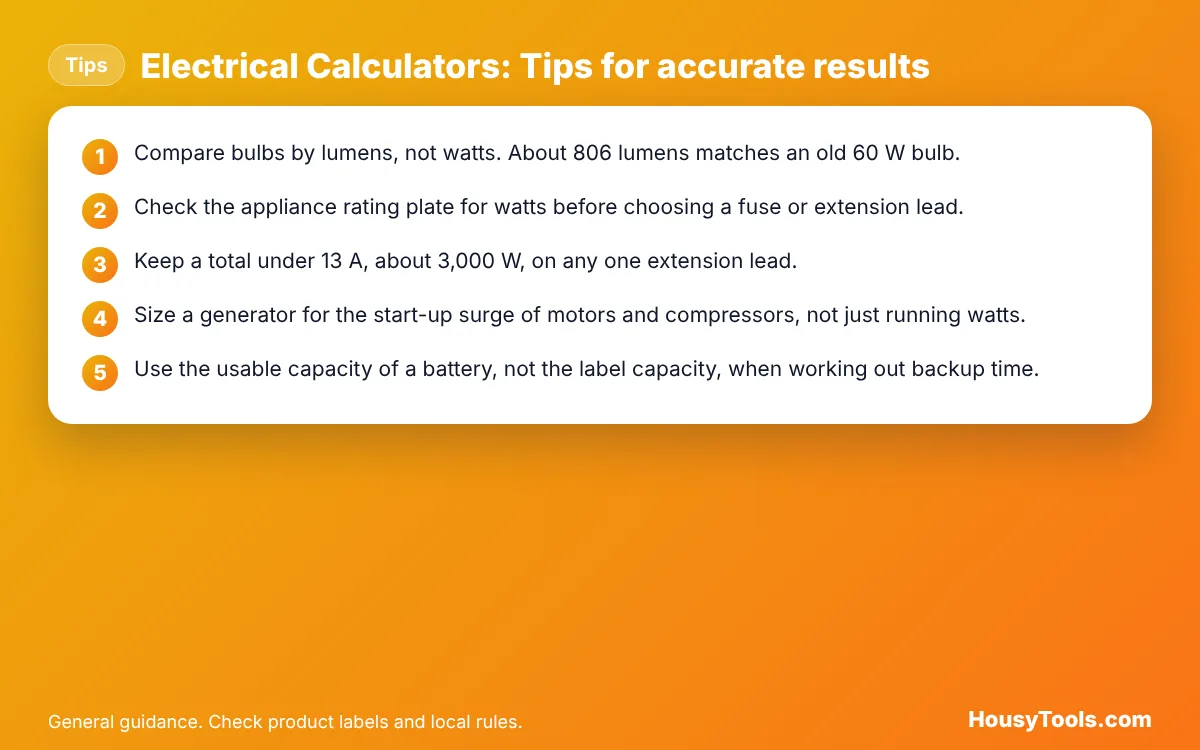
- Compare bulbs by lumens, not watts. About 806 lumens matches an old 60 W bulb.
- Check the appliance rating plate for watts before choosing a fuse or extension lead.
- Keep a total under 13 A, about 3,000 W, on any one extension lead.
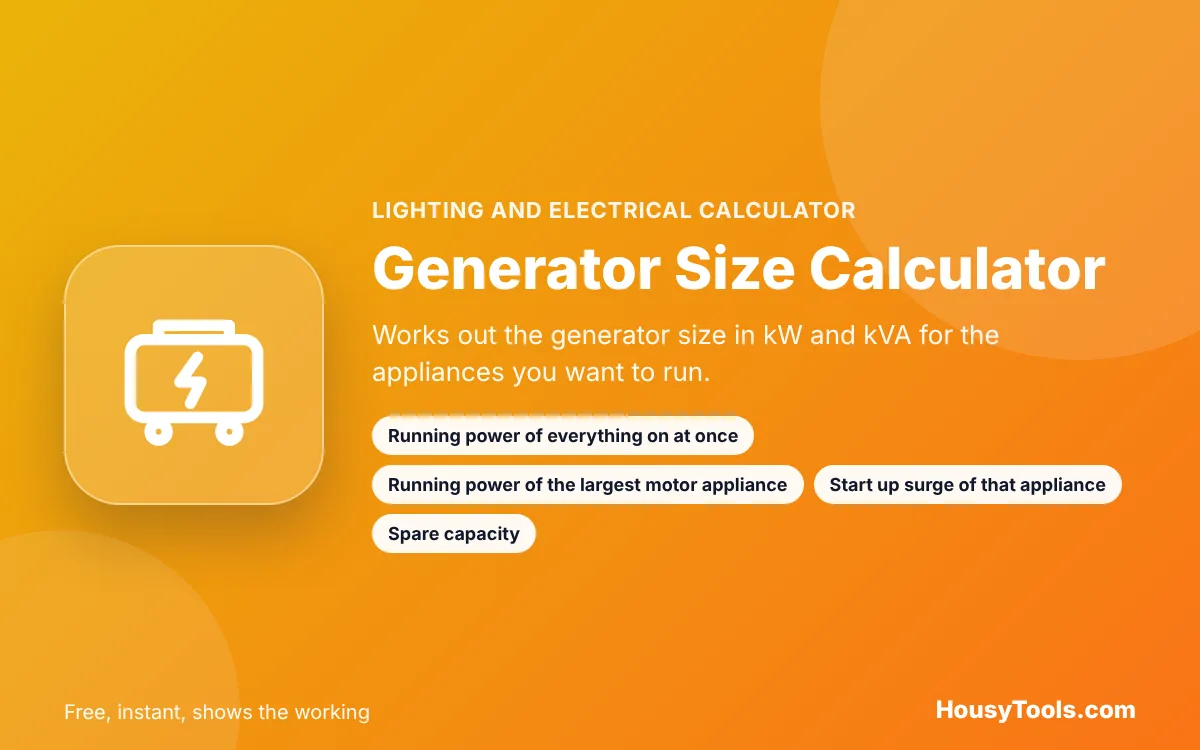
- Size a generator for the start-up surge of motors and compressors, not just running watts.
- Use the usable capacity of a battery, not the label capacity, when working out backup time.
Common Mistakes to Avoid
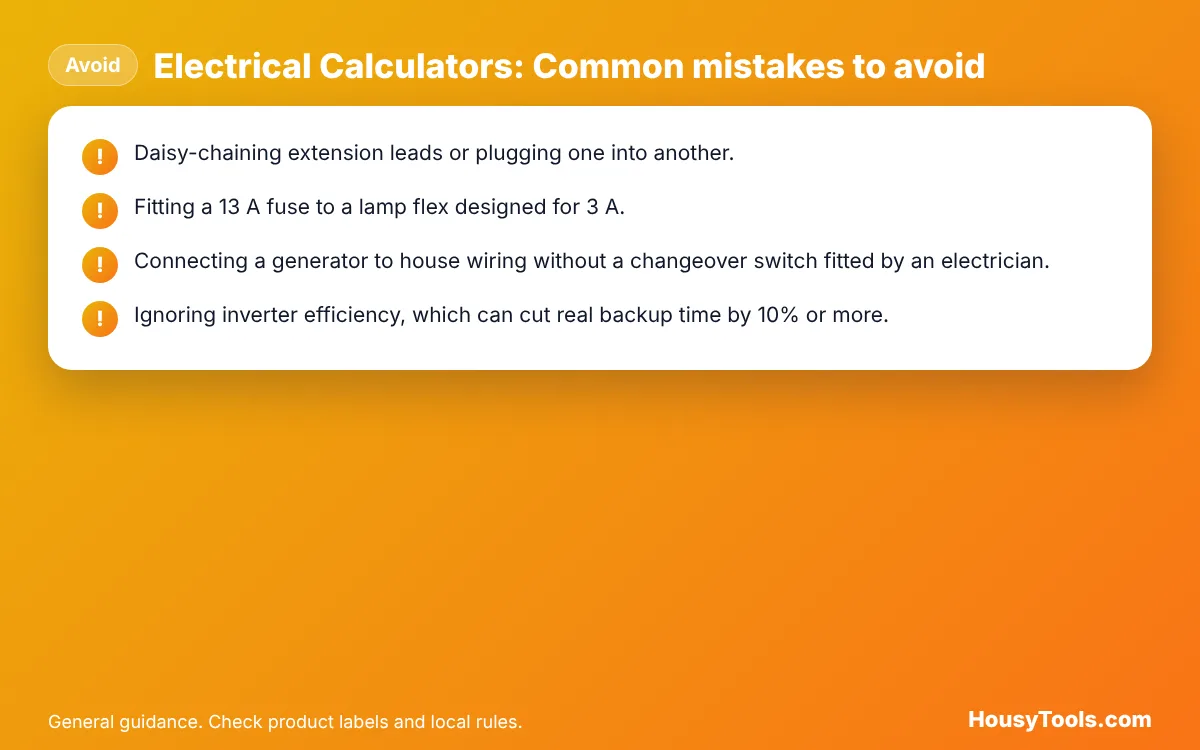
- Daisy-chaining extension leads or plugging one into another.
- Fitting a 13 A fuse to a lamp flex designed for 3 A.
- Connecting a generator to house wiring without a changeover switch fitted by an electrician.
- Ignoring inverter efficiency, which can cut real backup time by 10% or more.
See the Calculators in Action
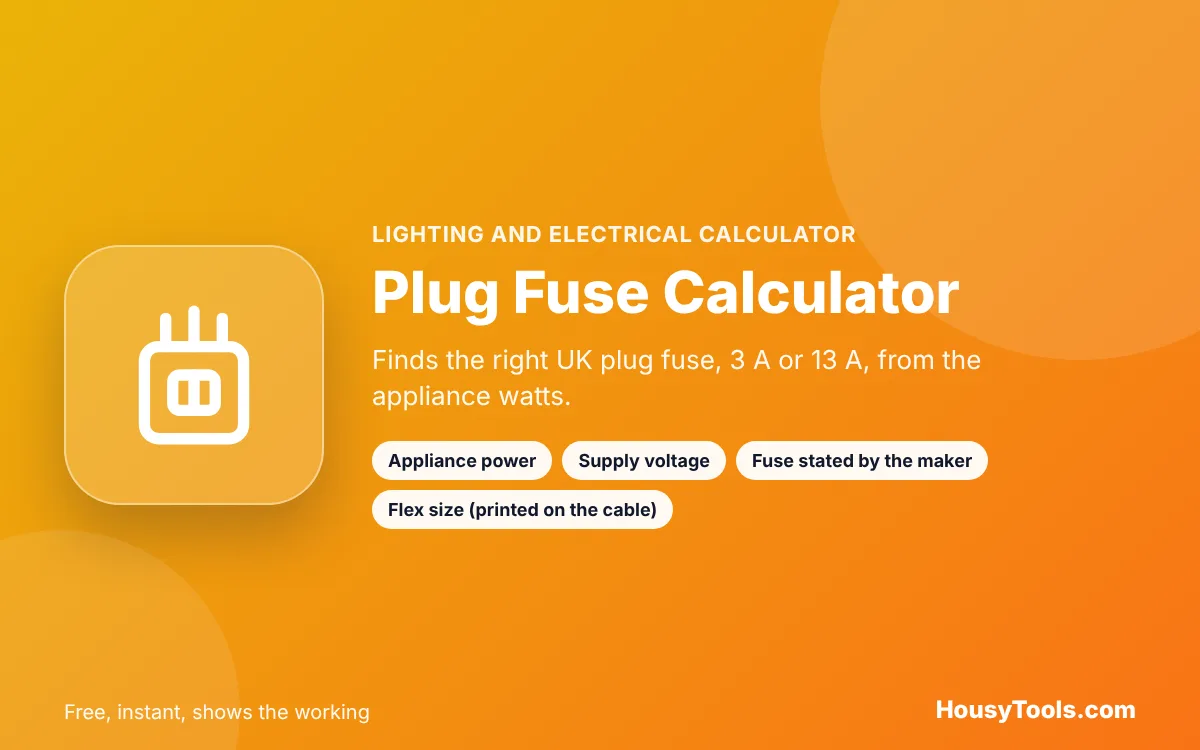
Each tool shows the formula, your result and a worked example. Here is what a few of these electrical calculators look like.

Electrical Calculator FAQs
What fuse should I use in a plug?
Use a 3 A fuse for appliances up to about 700 W, such as lamps and phone chargers, and a 13 A fuse for appliances from about 700 W up to 3,000 W, such as kettles and heaters. Always follow the appliance maker if it states a fuse.
Do LED bulbs really save money?
Yes. An LED bulb uses roughly a sixth of the electricity of an old incandescent bulb for the same light, so a light used for several hours a day usually pays back the bulb within a year at current UK electricity prices.
Can I run a heater on an extension lead?
A heater can draw close to the full 13 A an extension lead allows, so plug it straight into a wall socket where possible and never plug other high power appliances into the same lead.