
Show the formula and working
This free balcony solar power calculator estimates how much electricity a plug-in solar kit on a balcony, wall or patio will produce in a year, how much of your bill it will cut and how long it takes to pay back, for flats and houses in the UK, Ireland, Germany, the Netherlands and the rest of northern Europe. It allows for the 800 W inverter limit, upright railing mounting, east or west facing panels and shading, and works in pounds or euros.
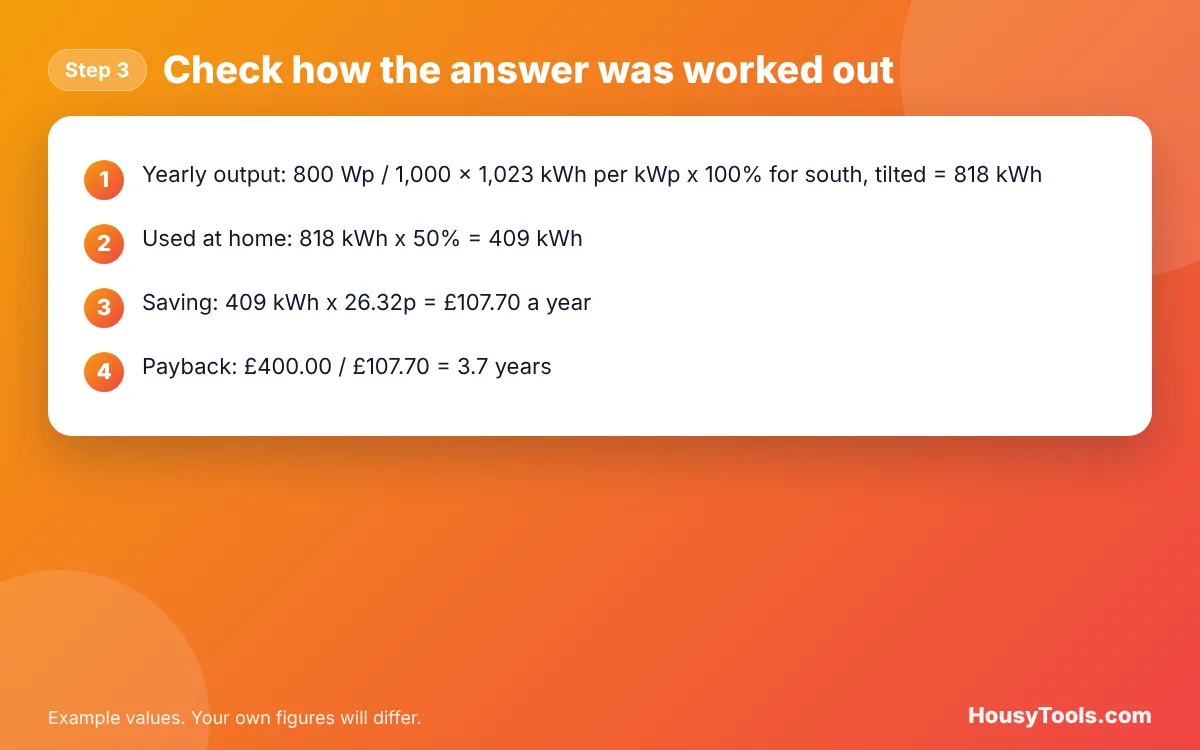
Quick answer: A balcony solar power calculator multiplies panel power by local yield and a direction factor. An 800 Wp kit tilted south in London makes about 818 kWh a year. If you use half of it at 26.32p per kWh, that saves £107.70 a year. Mounted upright on a railing, output falls to about 600 kWh.
What Is a Balcony Solar Power Calculator?
A balcony solar power calculator is a tool that estimates the yearly output and bill saving of a small plug-in solar kit, known in Germany as a Balkonkraftwerk. These kits have one to four panels and a small inverter that plugs into a normal socket, so the power feeds your home’s circuits directly.
The formula in plain words: divide the total panel power in watts peak by 1,000 to get kWp, multiply by the yearly yield per kWp for your location, then multiply by the direction factor and by what is left after shading. That gives yearly output in kWh. Multiply the output by the share you use yourself to get the kWh you no longer buy, then multiply by your unit rate for the saving. Divide the kit price by the yearly saving for the payback time.
How Do You Use the Balcony Solar Power Calculator?
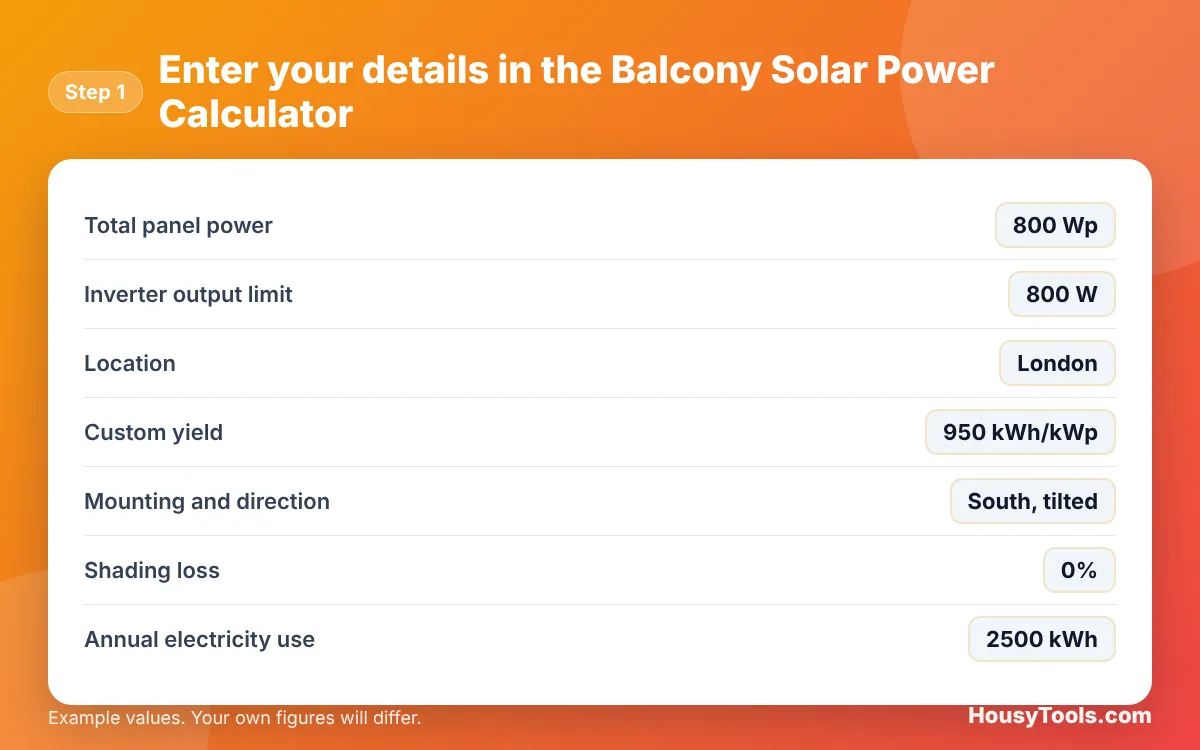
- Enter the Total panel power in Wp from the panel labels, and the Inverter output limit in W from the inverter’s data sheet.
- Choose your nearest Location, or choose “Custom yield” and enter a figure in Custom yield.
- Pick the Mounting and direction that matches your balcony, and add a Shading loss if walls, trees or the balcony above shade the panels.
- Enter your Annual electricity use and the Share of output you use yourself.
- Enter your Electricity unit rate, any Export rate your supplier pays, and the Kit price.
- Read the result and open “Show the formula and working” to see the output, the kWh used at home and the payback worked out.

How Much Electricity Does an 800 W Balcony Solar Kit Produce?
An 800 Wp balcony kit in northern Europe produces roughly 730 to 840 kWh a year when tilted towards the south, and about 530 to 620 kWh when mounted upright on a railing. The table uses yearly yields from EU PVGIS and the direction factors described below. Output in December is only around a third of June output, so most of the saving comes from April to September.
| Location | Yield per kWp (tilted south) | 800 Wp tilted south | 800 Wp upright on a railing | Saving tilted, 50% used at 26.32p |
|---|---|---|---|---|
| London | 1,023 kWh | 818 kWh | 600 kWh | £107.70 |
| Dublin | 988 kWh | 790 kWh | 579 kWh | £104.02 |
| Amsterdam | 1,027 kWh | 822 kWh | 602 kWh | £108.12 |
| Hamburg | 980 kWh | 784 kWh | 574 kWh | £103.17 |
| Copenhagen | 1,053 kWh | 842 kWh | 617 kWh | £110.86 |
| Edinburgh | 908 kWh | 726 kWh | 532 kWh | £95.59 |
Does Mounting Panels Upright on a Railing Lose Much Output?
Mounting panels upright on a south facing railing loses about a quarter of the output compared with tilting them. In a yield table from the Verbraucherzentrale Rheinland-Pfalz for a 900 Wp kit in Mainz, south at 60 degrees gives 819 kWh a year, south upright gives 600 kWh, east gives 618 kWh and west gives 610 kWh. The calculator uses those ratios: 73.3% for upright, 75.5% for east and 74.5% for west. Upright panels lose least in winter, when the sun is low, and most in summer.
Is Balcony Solar Legal in the UK and Germany?
Yes. Plug-in solar kits of up to 800 W became legal to buy and use across Great Britain on 27 August 2026, and Germany allows plug-in kits with an inverter of up to 800 W. The GOV.UK announcement says kits must be accredited devices and registered with the network operator as microgeneration, and renters may need permission from a landlord, building owner or freeholder. In Germany, a special energy plug allows up to 2,000 Wp of panels with the same 800 W inverter. An 800 W kit draws about 3.5 A at 230 V, well within a standard 13 A socket, but follow the manufacturer’s instructions and ask a qualified electrician to check older wiring before you plug in.
How Much of the Output Will I Actually Use?
Most households use about half of what a balcony kit produces, and the rest flows to the grid. The Verbraucherzentrale example assumes about 50% for a home using 2,500 kWh a year with a 900 Wp kit. You use more if someone is home in the day or you run the washing machine and dishwasher at midday. The fridge, router and other standby loads take a steady share around the clock, which the electricity cost calculator can price for each appliance.
Worked Example: A Balcony in Hamburg
Example: a rented flat in Hamburg has a south facing balcony. Two 400 Wp panels are fixed upright on the railing with an 800 W inverter, the tenant pays 30 cents per kWh, uses 2,500 kWh a year and expects to use half of the solar output. The kit cost €400 in this example.
- Yearly output: 800 / 1,000 x 980 kWh per kWp x 73.3% = 574 kWh.
- Used at home: 574 x 50% = 287 kWh, about 11% of the yearly use.
- Saving: 287 kWh x 30c = €86.15 a year.
- Payback: €400 / €86.15 = 4.6 years.
To reproduce this, switch the currency to euros, choose Hamburg, choose “South, upright on a railing or wall” and enter 30 as the unit rate. If the panels could be tilted, the output would rise to 784 kWh. For a full roof system, the solar panel calculator covers larger arrays.
Balcony Solar Power Calculator FAQs
How much can a balcony solar panel save a year?
An 800 Wp kit tilted south in London saves about £107.70 a year if you use half its output at 26.32p per kWh. Upright on a railing it saves about £78.90. The UK government puts the saving at up to £110 a year.
Can I use more than 800 W of panels?
Yes, panels can exceed the inverter rating, and German rules allow up to 2,000 Wp of panels with an 800 W inverter. On bright days output is capped at 800 W, so extra panels mainly help in the morning, evening and winter. The calculator warns when its yearly figure becomes an upper estimate.
Does a balcony solar kit work facing east or west?
Yes. Tilted panels facing east or west produce about 75% of a south facing tilted kit, based on the Verbraucherzentrale yield table. East suits households that use power in the morning and west suits evening use, which can raise the share you use yourself.
Do I get paid for power my balcony kit exports?
Usually not, so the calculator’s export rate defaults to zero. Surplus power flows to the grid without payment unless your supplier offers an export tariff that accepts plug-in kits. Check with your supplier before entering an export rate.
Will balcony solar work in winter?
It works, but output is low. In London, PVGIS data gives about 38 kWh per kWp in December against 120 kWh in June, so an 800 Wp tilted kit averages around 1 kWh a day in December and 3.2 kWh a day in June.
Do renters need permission for balcony solar?
Often yes. GOV.UK guidance says renters and flat owners may need permission from a landlord, building owner or freeholder, especially for fixings on railings or walls. Ask before you buy, and choose a kit that can be removed without damage when you move.
Checked October 2026. Sources: GOV.UK, Households can save as plug-in solar panels come to market, Verbraucherzentrale Rheinland-Pfalz, Steckersolargeräte, EU Joint Research Centre PVGIS, Ofgem, Energy price cap unit rates and standing charges.