
Show the formula and working
This compost calculator answers the question how much compost do I need for beds, borders and vegetable plots. Enter the size of a bed, the depth of compost you want to dig in or spread on top, and how many beds of that size you have, and it shows the litres, cubic metres and number of bags. It works in metres or feet for gardens in the UK, Ireland and the rest of Europe.
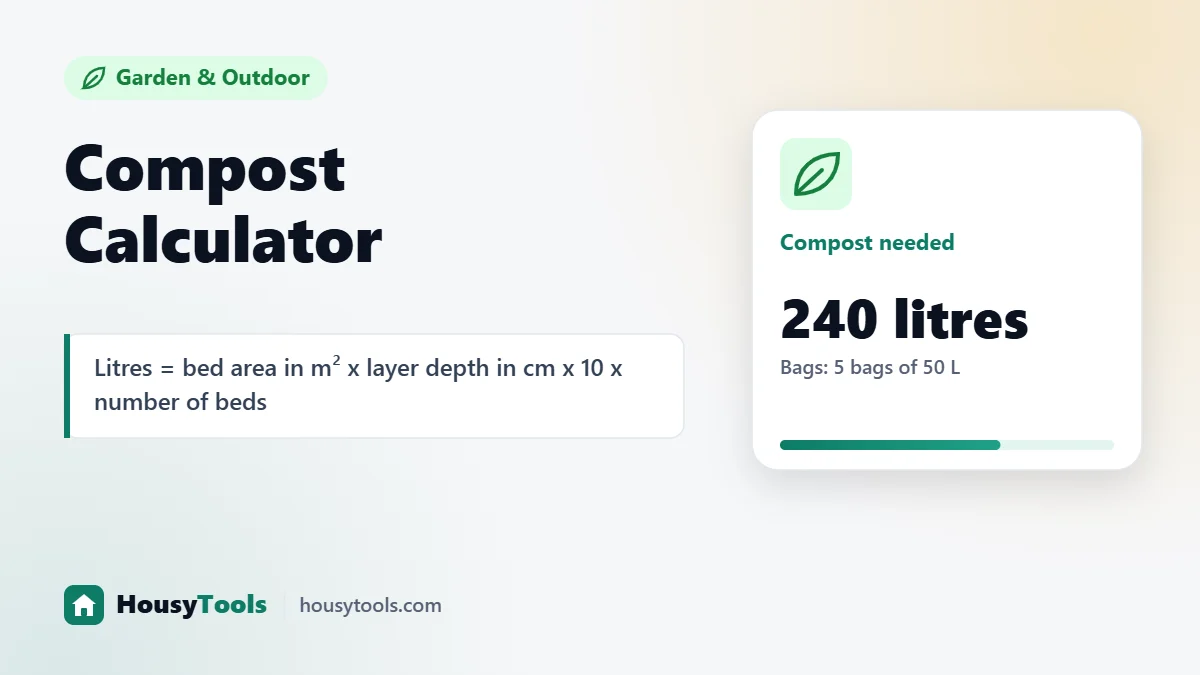
Quick answer: To work out how much compost you need, multiply the bed area in square metres by the layer depth in centimetres, then by 10 to get litres. A 4 m by 1.2 m bed is 4.8 m², so a 5 cm layer needs 240 litres, which is 5 bags of 50 litres.
What Is a Compost Calculator?
A compost calculator is a tool that converts the area of your beds and the depth of compost you plan to add into the volume to buy and the number of bags.
The formula in plain words: one square metre covered 1 cm deep holds 10 litres. So litres equal the bed area in m², times the depth in cm, times 10, times the number of beds of the same size. Divide by the bag size and round up to whole bags. Divide litres by 1,000 to get cubic metres, which is useful when you compare bagged prices with a bulk delivery.
How Do You Use the Compost Calculator?
- Measure the length and width of one bed and enter them.
- Enter the depth of compost you want to add.
- Enter how many beds of that size you have.
- Enter the bag size and price if you want the cost.
- Read the litres and bags of compost to buy.


How Much Compost Should You Add to a Bed?
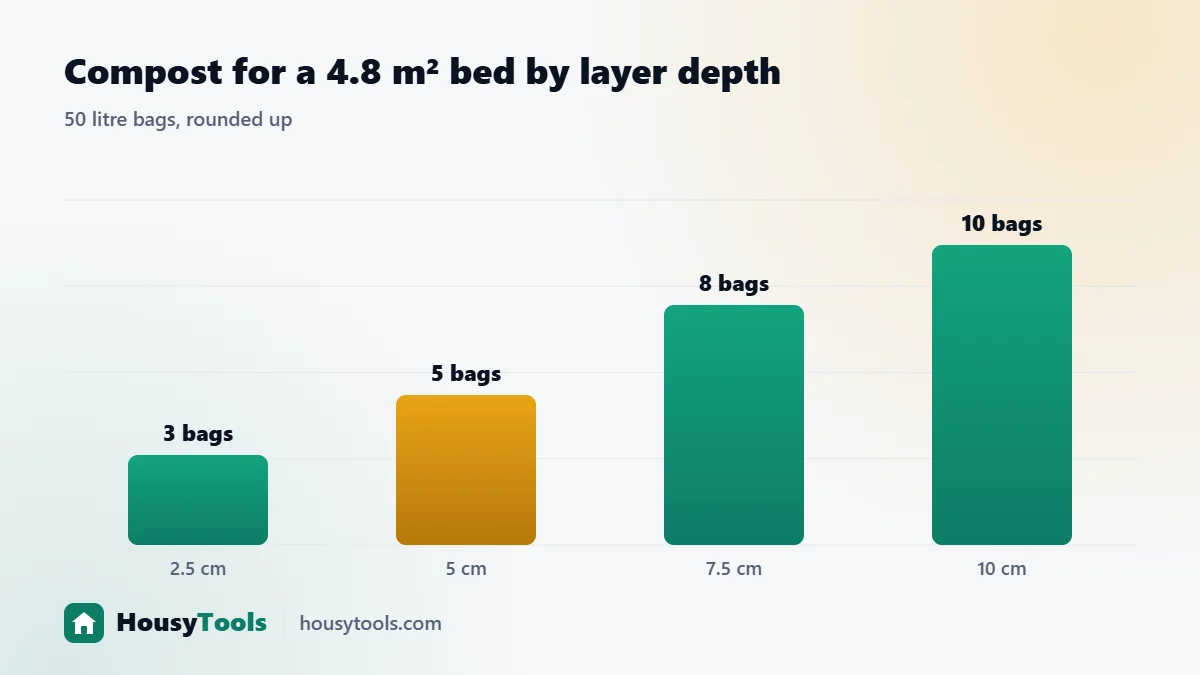
A 5 cm layer spread over the surface or forked in each year is a common way to keep beds in good heart, while new or very poor beds often get more.
| Layer depth | Litres per m² | Litres for 4.8 m² | 50 litre bags |
|---|---|---|---|
| 2.5 cm | 25 L | 120 L | 3 |
| 5 cm | 50 L | 240 L | 5 |
| 7.5 cm | 75 L | 360 L | 8 |
| 10 cm | 100 L | 480 L | 10 |
Organic matter such as compost improves the structure of both heavy clay and light sandy soils, helping clay drain and sandy soil hold water. The RHS guidance on organic matter explains how to use it and when.
Should You Dig Compost In or Leave It on Top?
Both work: spreading compost on the surface as a mulch lets worms take it down and disturbs the soil less, while digging it in mixes it through the root zone faster.
Many vegetable growers now prefer a no dig approach, adding a layer to the surface each year. If you leave it on top, the mulch calculator gives the same volume for bark or other mulches. If you are filling new raised beds rather than improving existing soil, the raised bed soil calculator splits the fill between topsoil and compost.
Bagged Compost or Home Made?
Home made compost is free and full of life, while bagged compost is consistent and convenient; many gardeners use both.
If you buy bags, check whether the product is peat free, which the RHS and many gardeners now prefer for environmental reasons. Multipurpose compost is aimed at pots and seed sowing; for improving beds, soil improvers and well rotted manure are often better value per litre. For large orders, ask suppliers for a price per cubic metre.
Worked Example: Four Vegetable Beds
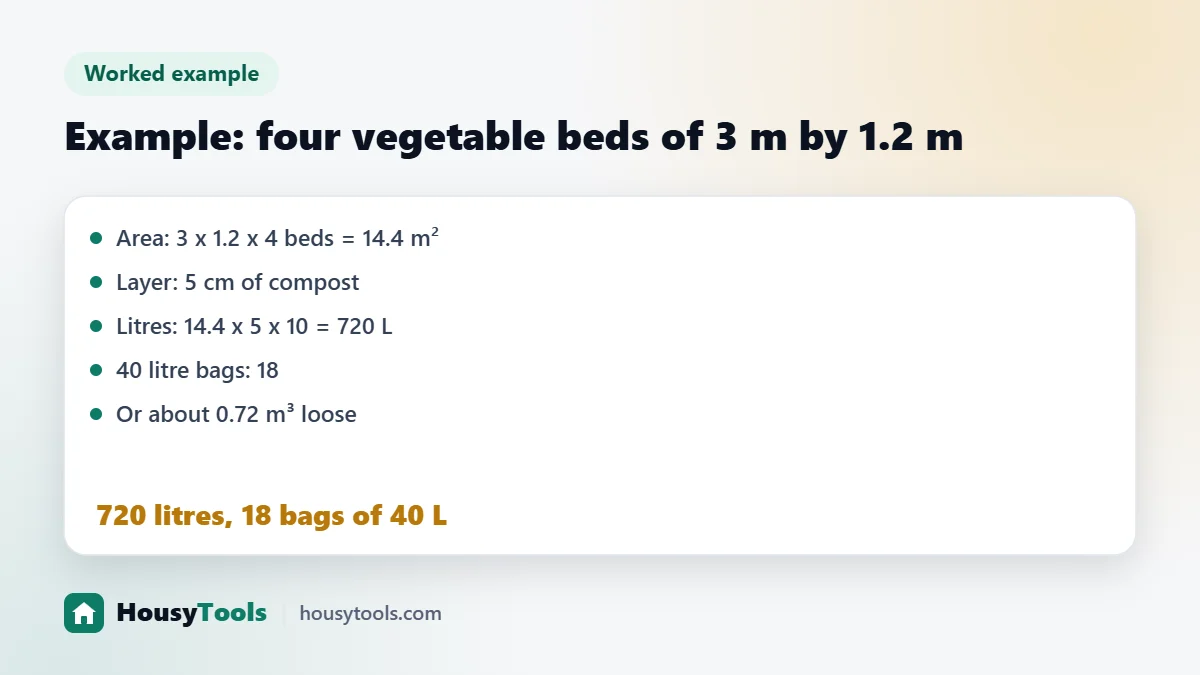
Example: an allotment holder has four beds, each 3 m by 1.2 m, and wants to add a 5 cm layer of compost before spring. The local garden centre sells 40 litre bags.
- Area: 3 x 1.2 = 3.6 m² per bed, so 14.4 m² for four beds
- Litres: 14.4 x 5 x 10 = 720 L
- Bags: 720 / 40 = 18 bags
- Volume: 0.72 m³
Eighteen bags is a lot to carry onto an allotment, so the holder compares the price of a bulk bag of soil improver, and plans to start a compost bin to cut the cost next year. A practical tip: spread compost in autumn on clay soils so winter frost and worms can work it in before sowing.
Common Compost Mistakes
The most common mistake is underestimating how much compost a bed needs, because a few bags spread thinly hardly change the soil.
- Using a depth in centimetres but measuring the bed in feet without switching units.
- Buying multipurpose compost for large beds when soil improver is cheaper.
- Digging compost into waterlogged soil, which damages structure.
- Forgetting paths and edges when measuring several beds.
Compost Calculator FAQs
How much compost do I need per square metre?
Multiply the depth in centimetres by 10. A 5 cm layer needs 50 litres per m², and a 2.5 cm layer needs 25 litres per m².
How many bags of compost do I need for a raised bed?
For filling a new raised bed, use the raised bed soil calculator. For topping up an existing bed of 2.4 m by 1.2 m by 5 cm, you need about 144 litres, or 3 bags of 50 litres.
When should I add compost to my garden?
Autumn and early spring are common times. Autumn suits heavy soils, while spring suits light soils and beds you are about to plant.
Is home made compost as good as bought compost?
Well made home compost is an excellent soil improver. It may contain some weed seeds, so many gardeners use it on beds rather than for seed sowing.
How much is a cubic metre of compost in bags?
One cubic metre is 1,000 litres, which is 20 bags of 50 litres or 25 bags of 40 litres.
Can I use too much compost?
Very heavy yearly applications can over enrich soil for some plants. A steady layer of around 5 cm a year suits most beds.
Checked October 2026. Sources: RHS guidance on organic matter and soil improvement.