
Show the formula and working
This underfloor heating mat calculator works out what size of electric underfloor heating mat to buy for a bathroom, kitchen or conservatory, with its total wattage, the current it draws at 230 V and a daily running cost. It is built for homes in the UK, Germany, the Netherlands and the Nordic countries using metric mats, with a feet and inches switch and pounds or euros. It takes off the floor under baths, units and fixtures, and picks the largest mat that fits, because heating cable must never be cut.
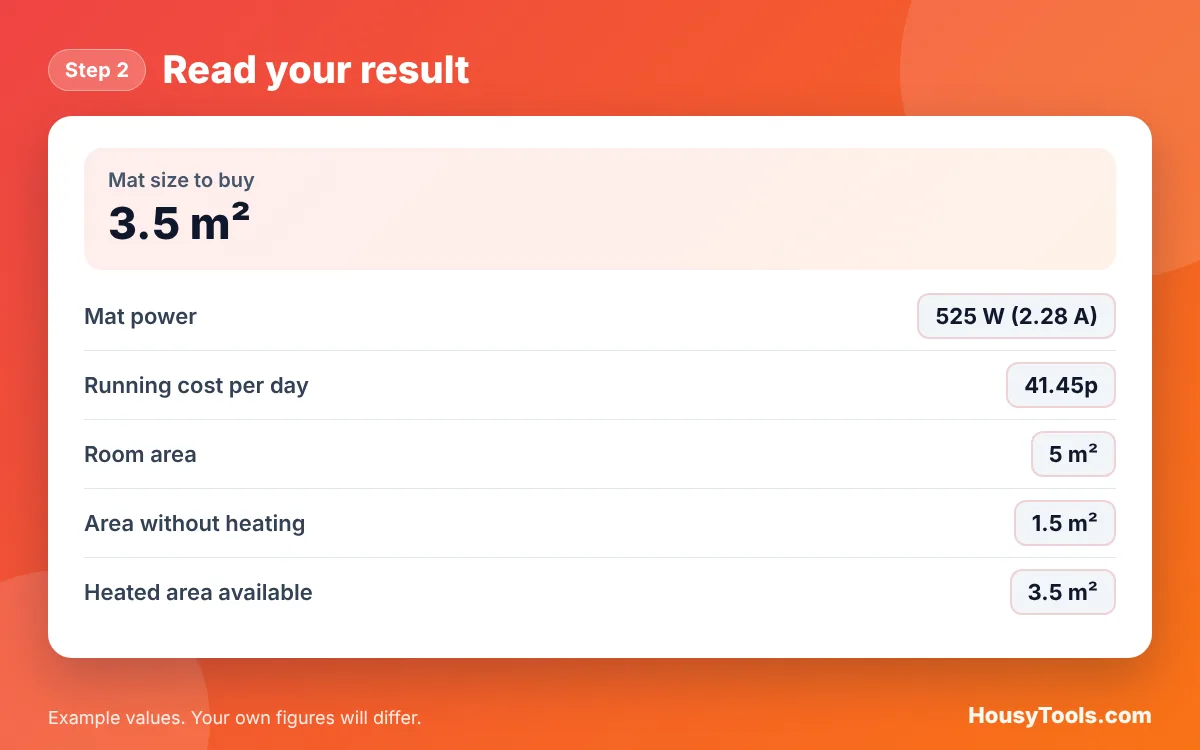
Quick answer: Take the room area, subtract the floor under the bath, units and fixtures, then choose the largest mat that fits. Multiply the mat area by its watts per m² for the power. A 2.5 m by 2 m bathroom with 1.5 m² unheated takes a 3.5 m² mat, which the underfloor heating mat calculator shows as 525 W.
What Is an Underfloor Heating Mat Calculator?
An underfloor heating mat calculator is a tool that converts a room’s free floor area into the mat size, power and current of an electric underfloor heating system. The formula in plain words: heated area = room length x width minus the areas without heating; mat size = the largest size in the maker’s range that is not bigger than the heated area; power in watts = mat area x output in W/m²; current = watts / 230 V; daily cost = watts x hours at full power / 1,000 x unit rate.
Mats are heating cable fixed to a mesh. The mesh can be cut and turned to fit the room, but the cable itself must never be cut or shortened, which is why you buy a mat a little smaller than the free floor rather than larger.
How Do You Use the Underfloor Heating Mat Calculator?
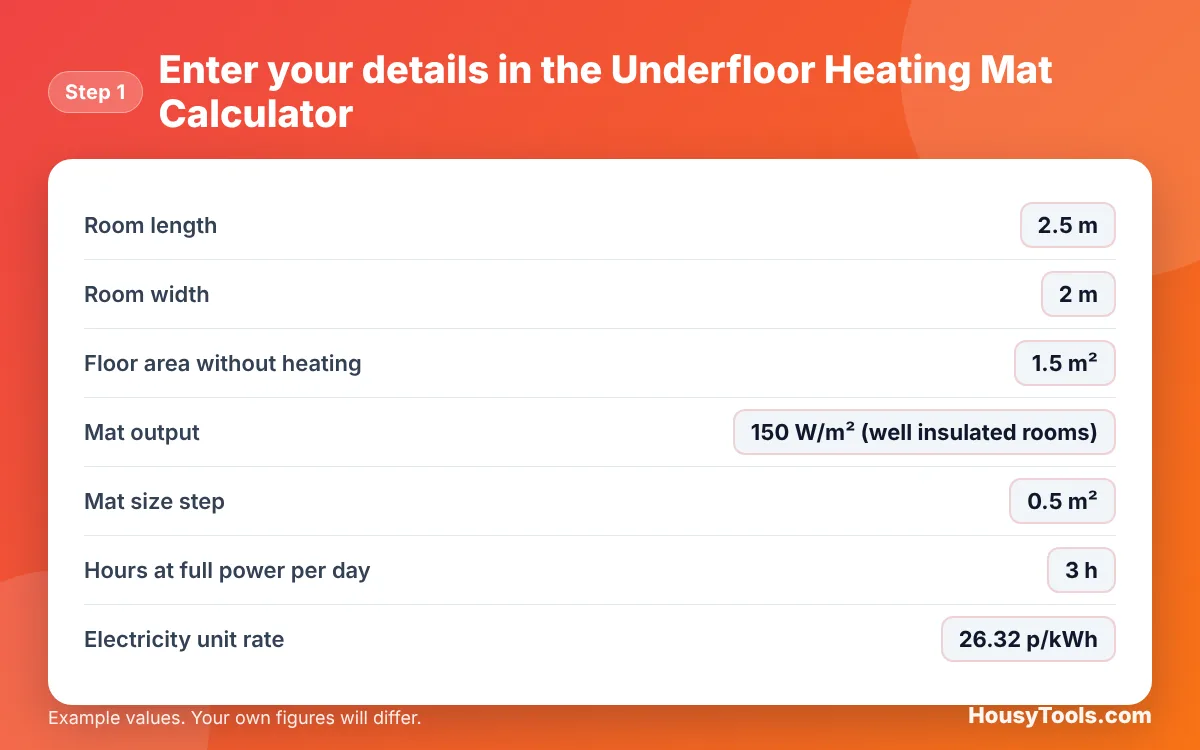
- Enter the Room length and Room width.
- Enter the Floor area without heating: under the bath, shower tray, WC, fitted units and a small border at the walls.
- Choose the Mat output for the room.
- Set the Mat size step to match the range you are buying from.
- Enter the Hours at full power per day and your Electricity unit rate.
- Read the mat size, power and running cost, then open “Show the formula and working” to see each step.
What Size Underfloor Heating Mat Do I Need?
Buy the largest mat that fits the free floor area, not the room area. Measure the room, subtract anything fixed to the floor and a small border at the walls, then choose a mat equal to or just under what is left. In a 5 m² bathroom where the bath, basin and WC cover 1.5 m², a 3.5 m² mat is the right choice.
| Mat size | Power at 150 W/m² | Current at 230 V | Power at 200 W/m² | Current at 230 V |
|---|---|---|---|---|
| 1.5 m² | 225 W | 0.98 A | 300 W | 1.30 A |
| 3 m² | 450 W | 1.96 A | 600 W | 2.61 A |
| 4.5 m² | 675 W | 2.93 A | 900 W | 3.91 A |
| 6 m² | 900 W | 3.91 A | 1,200 W | 5.22 A |
| 10 m² | 1,500 W | 6.52 A | 2,000 W | 8.70 A |
| 15 m² | 2,250 W | 9.78 A | 3,000 W | 13.04 A |
| 20 m² | 3,000 W | 13.04 A | 4,000 W | 17.39 A |
Above about 3 kW, which is 13 A at 230 V, a mat cannot run from a 13 A fused spur and needs its own circuit designed by an electrician.
Should I Choose 150 or 200 W/m²?
Choose 150 W/m² for well insulated rooms and 200 W/m² for rooms that lose heat quickly, such as conservatories. Warmup sells its StickyMat in both outputs on that basis, in 0.5 m wide mats for 230 V supplies. Higher output warms the floor faster but does not make the room hold heat better, so insulation under the mat matters as much as the mat itself. To compare whole room heating options, use the underfloor heating calculator.
Can I Install an Electric Underfloor Heating Mat Myself?
You can usually lay the mat and tile over it yourself, but the electrical connection must be made by a qualified electrician, with RCD protection. In England, adding to or altering a circuit in a room with a bath or shower is usually notifiable building work under Approved Document P, so a registered electrician should certify it. Test the mat’s resistance before, during and after laying, as the maker’s instructions describe.
How Much Does Electric Underfloor Heating Cost to Run?
A 525 W mat running at full power for 3 hours a day uses 1.58 kWh and costs about 41p a day at 26.32p per kWh. The thermostat switches the mat on and off, so the hours at full power are usually far fewer than the hours the heating is set to run. A floor sensor and a programmable thermostat keep the cost down. Tiling over the mat is covered by our tile adhesive calculator.
Worked Example: Heating Mat for a 2.5 m by 2 m Bathroom
Example: a bathroom 2.5 m long and 2 m wide has a bath, basin and WC covering 1.5 m² of floor. The mat range comes in 0.5 m² steps at 150 W/m², and the mat runs for an example 3 hours a day at full power on 26.32p per kWh. These are the calculator’s default inputs.
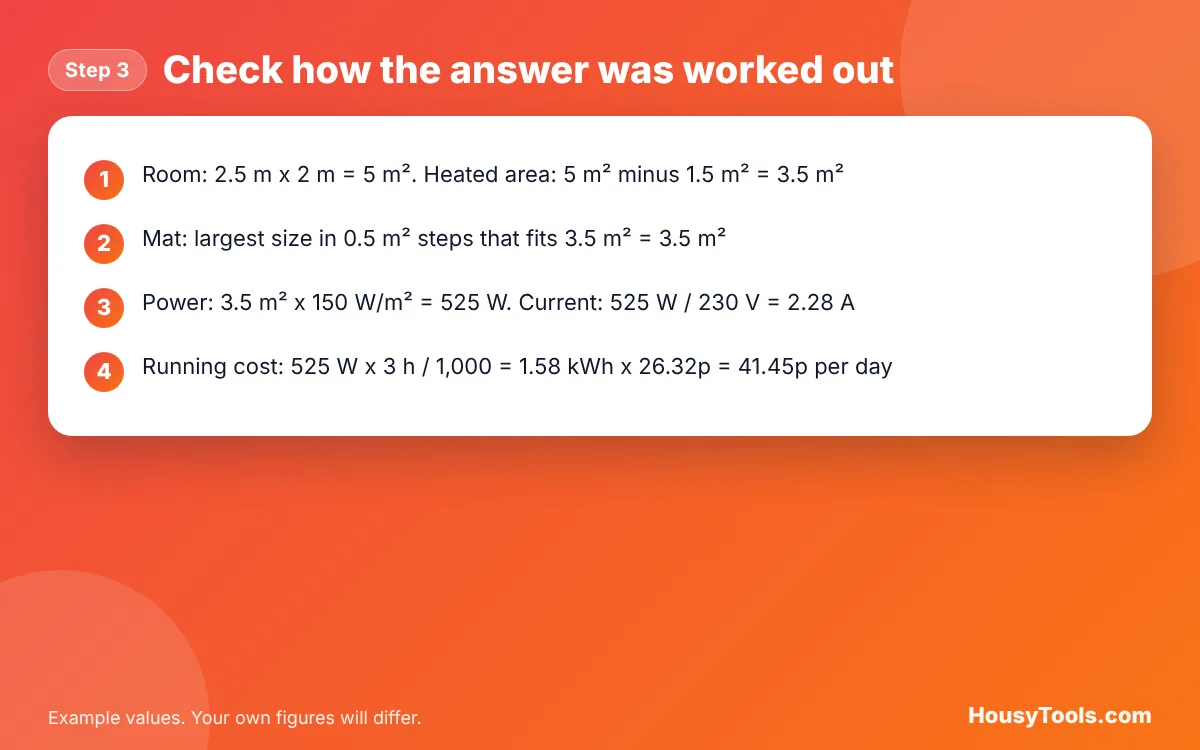
- Room: 2.5 m x 2 m = 5 m².
- Heated area: 5 m² minus 1.5 m² = 3.5 m².
- Mat: the largest 0.5 m² step that fits is 3.5 m².
- Power: 3.5 m² x 150 W/m² = 525 W. Current: 525 W / 230 V = 2.28 A.
- Running cost: 525 W x 3 h / 1,000 = 1.58 kWh x 26.32p = 41.45p a day.
At 525 W the mat is well within the 3 kW limit of a 13 A fused spur.
Underfloor Heating Mat Calculator FAQs
Can you cut an underfloor heating mat?
You can cut the mesh to turn corners and fit around obstacles, but you must never cut, shorten or overlap the heating cable. That is why you choose a mat no larger than the free floor area and lay it in the open space only.
Should underfloor heating go under the bath or units?
No. Leave out the floor under baths, shower trays, WCs, fitted units and kitchen plinths, because heat trapped there is wasted and can damage the cable or the fittings. The calculator subtracts these areas before choosing a mat.
How many amps does an underfloor heating mat draw?
Divide the watts by 230 V. A 3.5 m² mat at 150 W/m² is 525 W, which draws 2.28 A. A 20 m² mat at 150 W/m² is 3,000 W and draws just over 13 A, which is at the limit of a 13 A fused spur, so an electrician will normally give it its own circuit.
Do I need insulation under an electric heating mat?
Insulation boards under the mat stop heat going down into a concrete slab, so the floor warms faster and uses less electricity. They are especially worth fitting on ground floors. Check the mat maker’s guidance on approved boards and the build up height.
Can an underfloor heating mat go under laminate or wood?
Some mats are approved for laminate, vinyl or engineered wood, but many floor finishes have a maximum floor temperature. Check both the mat and the floor maker’s guidance, and use a floor sensor to keep the temperature within their limits.
Is underfloor heating enough to heat a bathroom?
In a well insulated bathroom a 150 W/m² mat can often be the main heat source, but small rooms with large unheated areas may also need a towel rail. Work out the room’s heat loss first to see whether the mat covers it.
Checked October 2026. Sources: Warmup: StickyMat (150 and 200 W/m², 0.5 m wide, 230 V), GOV.UK: Approved Document P, electrical safety, Ofgem: price cap 1 October to 31 December 2026 (26.32p per kWh).