
Show the formula and working
This lawn fertiliser calculator works out how much lawn feed to spread each time you feed, how much you need over a year and how many bags to buy. Enter the lawn size in metres or feet, the application rate printed on the product label and how often you plan to feed. It uses the label rate because every product is different, and spreading more than the label says can damage the lawn.
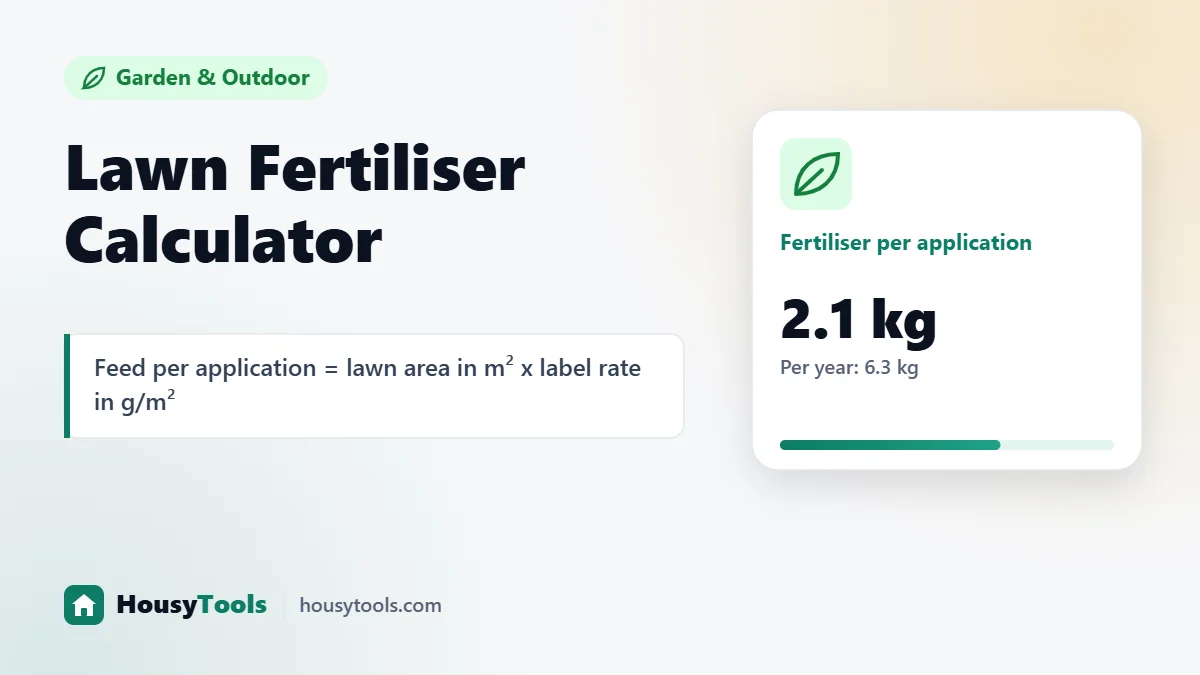
Quick answer: To work out how much lawn feed you need, multiply the lawn area in square metres by the application rate on the label in grams per square metre. A 10 m by 6 m lawn is 60 m², so at an example rate of 35 g/m² each feed needs 2.1 kg, and three feeds a year need 6.3 kg.
What Is a Lawn Fertiliser Calculator?
A lawn fertiliser calculator is a tool that multiplies a lawn’s area by a product’s application rate to give the weight of feed for each application and for a whole season.
The formula in plain words: area equals length times width. Feed per application equals area times the label rate, converted from grams to kilograms. Multiply by the number of applications in a year for the yearly total, then divide by the bag size and round up to whole bags. The calculator also shows the area one bag covers in a single feed.
How Do You Use the Lawn Fertiliser Calculator?
- Measure the length and width of the lawn and enter them.
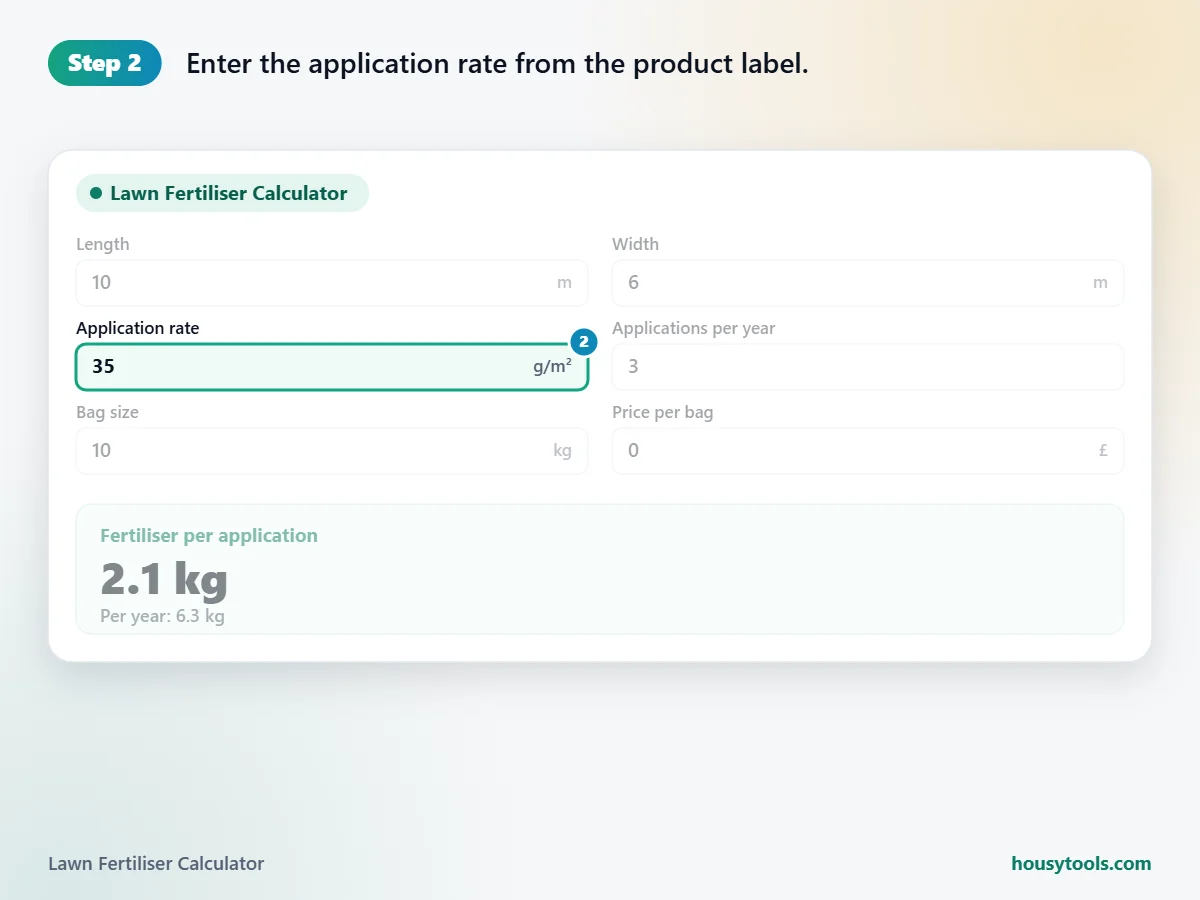
- Enter the application rate from the product label.
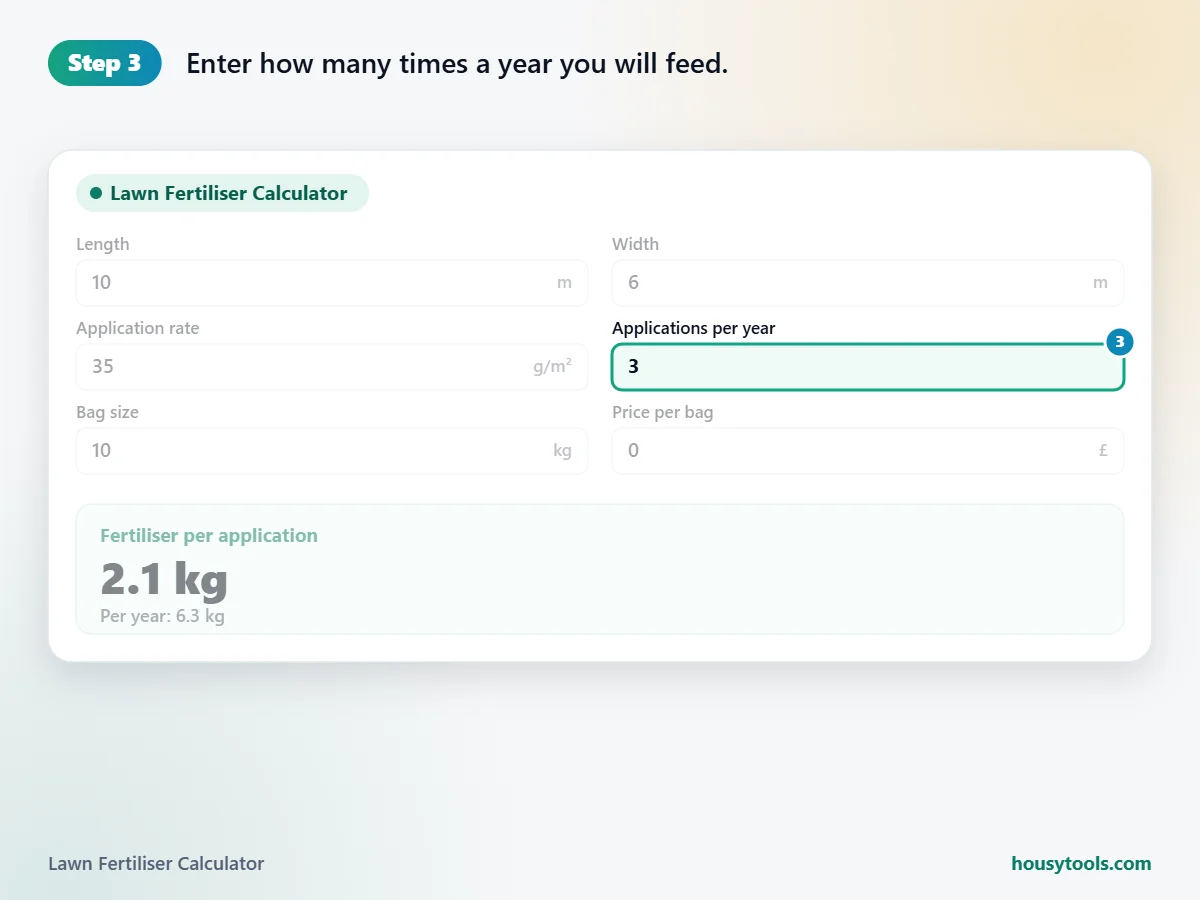
- Enter how many times a year you will feed.
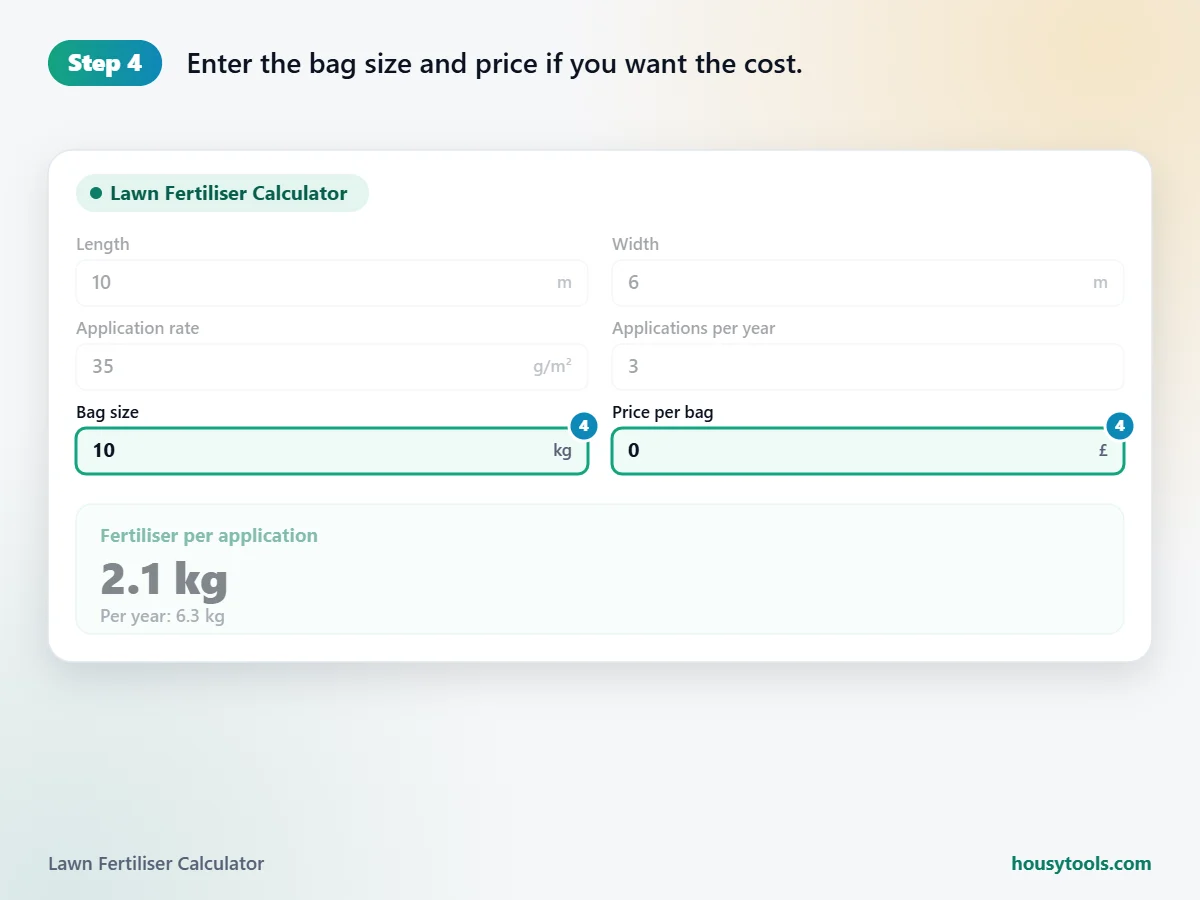
- Enter the bag size and price if you want the cost.
- Read the feed per application, per year and the bags needed.


How Much Lawn Feed Do I Need?
At an example label rate of 35 g/m², each feed needs 3.5 kg per 100 m², so three feeds a year use about 10.5 kg for a 100 m² lawn.
| Lawn area | Feed per application | Feed per year (3 feeds) | 10 kg bags per year |
|---|---|---|---|
| 25 m² | 0.88 kg | 2.63 kg | 1 |
| 50 m² | 1.75 kg | 5.25 kg | 1 |
| 100 m² | 3.5 kg | 10.5 kg | 2 |
| 200 m² | 7 kg | 21 kg | 3 |

If your product lists an area per bag instead of a rate, divide the bag weight in grams by that area to get the rate in g/m². For example, a 10 kg bag that treats 285 m² works out at about 35 g/m².
When Should You Feed a Lawn?
Most lawns are fed in spring as growth starts and again in summer, with a lower nitrogen autumn feed in some programmes, but always follow the timing on the product.
Avoid feeding during drought, when grass is not growing and fertiliser can scorch it, and avoid heavy rain forecasts, when it can wash off. The RHS lawn advice covers seasonal lawn care, and many gardeners now feed less often to support a more relaxed, wildlife friendly lawn.
How Do You Spread Lawn Feed Evenly?
A wheeled or handheld spreader set to the product’s setting gives far more even results than spreading by hand, which often leaves dark green stripes and scorched patches.
Split the feed into two halves and spread one half walking up and down and the other walking across. Water it in if the label says to, and keep children and pets off the lawn for as long as the product advises. For new lawns, wait until the grass is established; the grass seed calculator and turf calculator cover the starting stage.
Worked Example: A 15 m by 8 m Family Lawn
Example: a family has a 15 m by 8 m lawn and a feed with a label rate of 35 g/m², sold in 8 kg bags. They plan four feeds a year.
- Area: 15 x 8 = 120 m²
- Each feed: 120 x 35 = 4,200 g, or 4.2 kg
- Per year: 4.2 x 4 = 16.8 kg
- Bags: 16.8 / 8 = 2.1, so 3 bags of 8 kg

The family weighs out 4.2 kg each time rather than guessing from the bag, which keeps the lawn evenly green. A practical tip: mark the halfway point of each bag with a pen, so you can see at a glance whether you are spreading too fast.
Why You Should Never Exceed the Label Rate
More fertiliser does not mean a greener lawn: overdosing can scorch the grass, encourage soft growth that suffers in drought, and let nutrients wash into drains and streams.
Excess nitrogen and phosphorus in water can harm rivers and ponds, which is why accurate spreading matters. The Wikipedia article on fertiliser explains the main nutrients and their effects. If you spill feed on paths or patios, sweep it back onto the lawn.
Lawn Fertiliser Calculator FAQs
How much lawn feed do I need for 100 m²?
At an example rate of 35 g/m², each feed needs 3.5 kg for 100 m². Check the rate on your product, as rates vary.
How often should I feed my lawn?
Many products suggest two to four feeds a year between spring and autumn. Follow the timing on the label.
Can I put too much fertiliser on my lawn?
Yes. Overdosing can scorch the grass and wash nutrients into drains. Always spread at or below the label rate.
How do I convert area per bag into g per m²?
Divide the bag weight in grams by the area it treats. A 10 kg bag for 285 m² is 10,000 / 285, about 35 g/m².
Should I water after feeding the lawn?
Many granular feeds need watering in if it does not rain within a set time. Check the label for your product.
Is it better to feed in spring or autumn?
Spring feeds support new growth, while autumn feeds are often lower in nitrogen to strengthen roots before winter. Many lawns benefit from both.
Checked October 2026. Sources: RHS lawn advice, product label rates, Wikipedia on fertiliser.