
Show the formula and working
This cement calculator works out how many bags of cement a concrete or mortar job needs, plus the sand, gravel or ballast to go with it, for DIYers and builders in the UK, Ireland and the rest of Europe. Enter the length, width and depth of the slab, base or screed, pick the mix ratio, and it converts the wet volume into dry materials and 25 kg bags.
Quick answer: A cement calculator multiplies the wet volume by about 1.54 for concrete, or 1.3 for mortar, then takes the cement share of the mix. A 3 m by 2 m slab 100 mm thick with 5% waste in 1:2:4 concrete needs about 194 kg of cement, or 8 bags of 25 kg.
What Is a Cement Calculator?
A cement calculator is a tool that estimates the weight and number of bags of cement in a concrete or mortar mix, from the volume of the job and the mix ratio. In plain words: wet volume equals length x width x depth plus a waste allowance. Dry volume equals wet volume multiplied by a dry to wet factor, because loose sand and stones settle and the cement fills the gaps when water is added. The cement volume is the dry volume divided by the total number of parts in the mix, and the weight is that volume multiplied by the cement’s bulk density.
The factors of 1.54 for concrete and 1.3 for mortar are long standing site rules of thumb, not exact constants, so the tool lets you change them. Cement in bags is lighter than solid concrete: settled Portland cement weighs about 1,300 to 1,450 kg per m³, and the default of 1,400 kg/m³ sits in that range.
How Do You Use the Cement Calculator?
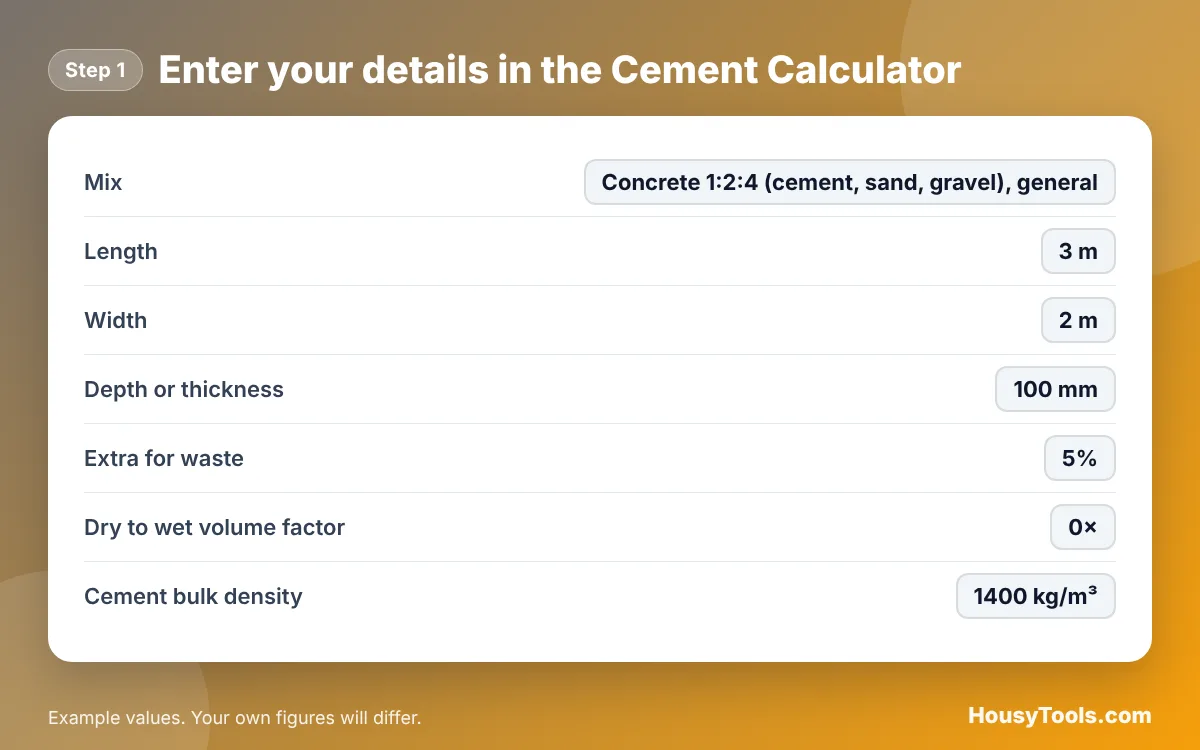
- Choose the Mix: a concrete ratio for slabs and bases, or a mortar or screed ratio.
- Enter the Length, Width and Depth or thickness. Switch to feet and inches if you prefer.
- Set the Extra for waste. 5% suits a level, well formed base; use 10% for uneven ground.
- Leave Dry to wet volume factor at 0 for the usual rule, or enter your own.
- Check the Cement bulk density, Sand and gravel bulk density and Cement bag size.
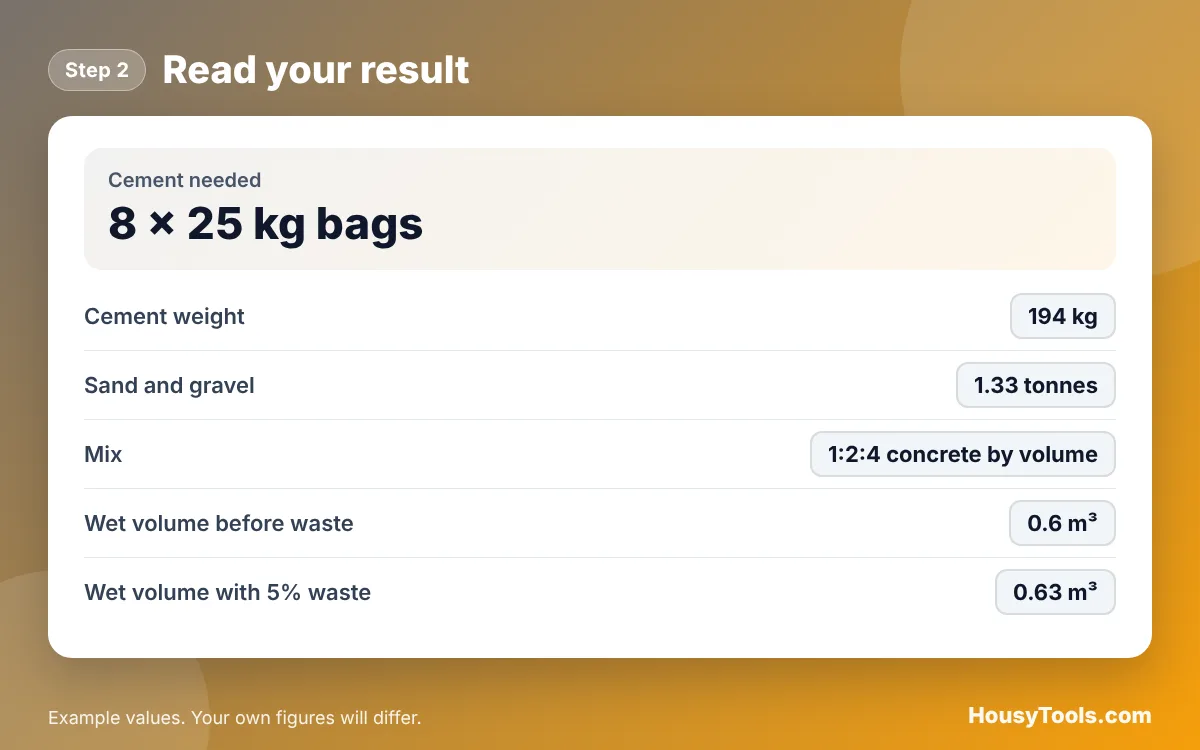
- Read the bags of cement and the tonnes of sand and gravel, then open “Show the formula and working” to see each step.

How Many Bags of Cement Are in a Cubic Metre of Concrete?
A cubic metre of 1:2:4 concrete needs about 308 kg of cement, which is roughly 12.3 bags of 25 kg. A stronger 1:1.5:3 mix needs about 392 kg, or 15.7 bags. These figures use the 1.54 dry factor and 1,400 kg/m³ cement density, so treat them as planning figures and buy a bag or two spare. For the concrete volume and weight alone, use the concrete calculator.
What Mix Ratio Should I Use?
For general DIY concrete such as paths, shed bases and post footings, 1:2:4 or 1:5 or 1:6 with all-in ballast is commonly used, while drives and structural work need a stronger, specified mix. Mortar for bricklaying is often 1:4 to 1:6 cement to building sand with plasticiser, and floor screed is often 1:3 to 1:4 with sharp sand. Building Regulations work, such as foundations, must follow the mix your designer or building control specifies. The concrete article on Wikipedia explains how cement, water and aggregate work together.
Is Cement Dangerous to Handle?
Yes, wet cement is strongly alkaline and can cause serious burns and dermatitis, so wear waterproof gloves, long sleeves, boots and eye protection. The HSE guidance on cement explains the risks. Wash wet cement off skin straight away, and do not kneel in wet concrete. Dry cement dust also irritates eyes and lungs, so open and pour bags carefully.
Cement per Cubic Metre by Mix
Cement for 1 m³ of finished concrete or mortar, using 1.54 for concrete, 1.3 for mortar and 1,400 kg/m³ cement.
| Mix | Use | Cement per m³ | 25 kg bags per m³ |
|---|---|---|---|
| 1:1.5:3 | Stronger concrete | 392 kg | 15.7 |
| 1:2:4 | General concrete | 308 kg | 12.3 |
| 1:5 ballast | General concrete | 359 kg | 14.4 |
| 1:6 ballast | Bases and footings | 308 kg | 12.3 |
| 1:3 | Strong mortar or screed | 455 kg | 18.2 |
| 1:4 | Mortar or screed | 364 kg | 14.6 |
| 1:5 | General mortar | 303 kg | 12.1 |
| 1:6 | Softer mortar | 260 kg | 10.4 |
Worked Example: A 3 m by 2 m Shed Base
Example: a shed base is 3 m by 2 m and 100 mm thick, in 1:2:4 concrete with 5% extra for waste. The wet volume is 3 x 2 x 0.1 = 0.6 m³, or 0.63 m³ with waste. The dry volume is 0.63 x 1.54 = 0.970 m³, split into 7 parts. Cement is 0.970 / 7 = 0.139 m³, which at 1,400 kg/m³ is 194 kg, so you need 8 bags of 25 kg. Sand is 2 parts, 0.277 m³ or about 0.44 tonnes, and gravel is 4 parts, 0.554 m³ or about 0.89 tonnes. These are the default inputs, so the calculator shows the same figures.
A 4 m by 3 m floor screed 40 mm thick in 1:4 needs 8 bags as well, because mortar uses more cement per m³. For brick and block walls, the mortar calculator works out the joint volume for you, and the sand calculator converts sand to bags and tonnes.
Cement Calculator FAQs
How much does a bag of cement cover?
One 25 kg bag of cement makes about 0.08 m³ of 1:2:4 concrete, enough for roughly 0.8 m² of slab at 100 mm thick. In 1:4 mortar or screed, one bag makes about 0.07 m³. Wetter or leaner mixes change this slightly.
Why multiply by 1.54 for concrete?
Dry sand and gravel contain air gaps, and cement and water fill them, so the finished concrete takes up less volume than the loose materials. About 1.54 m³ of dry materials makes 1 m³ of concrete as a common rule of thumb. Mortar uses about 1.3.
What is the difference between cement and concrete?
Cement is the grey powder that binds the mix. Concrete is cement mixed with sand, gravel and water, and mortar is cement mixed with sand and water. Cement is only a small part of concrete by volume but sets the strength.
How much water do I add to the mix?
Add water gradually until the mix is workable but not runny, because extra water weakens the concrete. Follow the guidance on the cement bag. Damp sand already contains water, so less needs adding than with dry sand.
Should I use ready mixed concrete instead?
For more than about 1 m³, ready mixed concrete delivered by truck is usually quicker and more consistent than mixing by hand. For small jobs, bagged cement with loose sand and gravel, or premixed bags, is easier to handle.
How long does a bag of cement keep?
Cement absorbs moisture from the air and becomes lumpy, so keep bags dry, off the ground and sealed, and use them before the date printed on the bag. Lumpy cement that does not break up between your fingers should not be used.
Checked October 2026. Sources: Cement (Health and Safety Executive), Concrete (Wikipedia), Breedon Portland cement data sheet (settled bulk density 1,300 to 1,450 kg/m³), Designing Buildings Wiki bulk densities.