
Show the formula and working
This ceiling paint calculator works out how many litres of ceiling paint you need for one room or a whole floor, and which tins to buy, for DIY decorators in the UK, Ireland and Europe. Enter the ceiling length and width, pick your coats, type the coverage from your tin and tick the box if the ceiling is newly plastered.
Quick answer: the ceiling paint calculator multiplies ceiling length by width, multiplies by the number of coats (plus one for a mist coat on new plaster) and divides by the coverage on your tin. A 4.2 m by 3.6 m ceiling needs about 2.5 litres for two coats at 12 m² per litre.
What Is a Ceiling Paint Calculator?
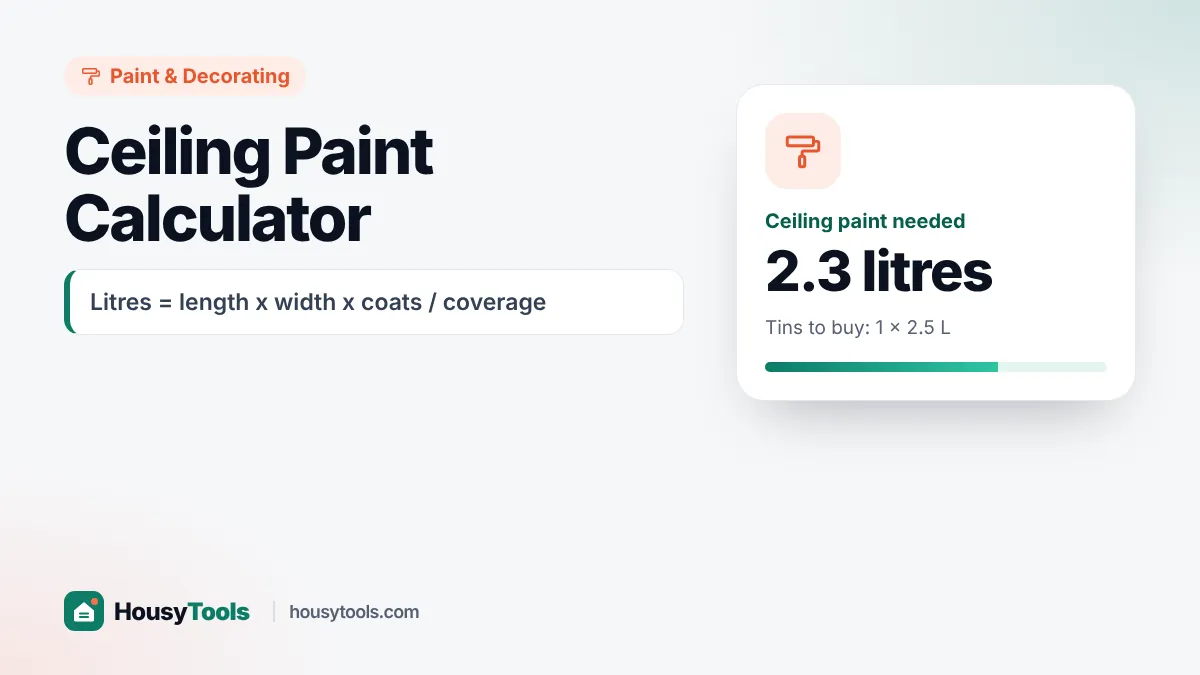
A ceiling paint calculator is a tool that turns the length and width of a ceiling into the litres of paint, and the tins, you need to cover it.
The formula has three parts. Multiply the ceiling length by its width to get the area in square metres. Multiply that area by the number of coats, adding one extra coat if new plaster needs a mist coat. Then divide by the coverage per litre printed on your tin.
Our ceiling paint calculator then chooses the mix of 5 L, 2.5 L and 1 L tins that covers the job with the least waste, and it shows the paint left over so you know how much will be spare for touch ups.
How Do You Use the Ceiling Paint Calculator?
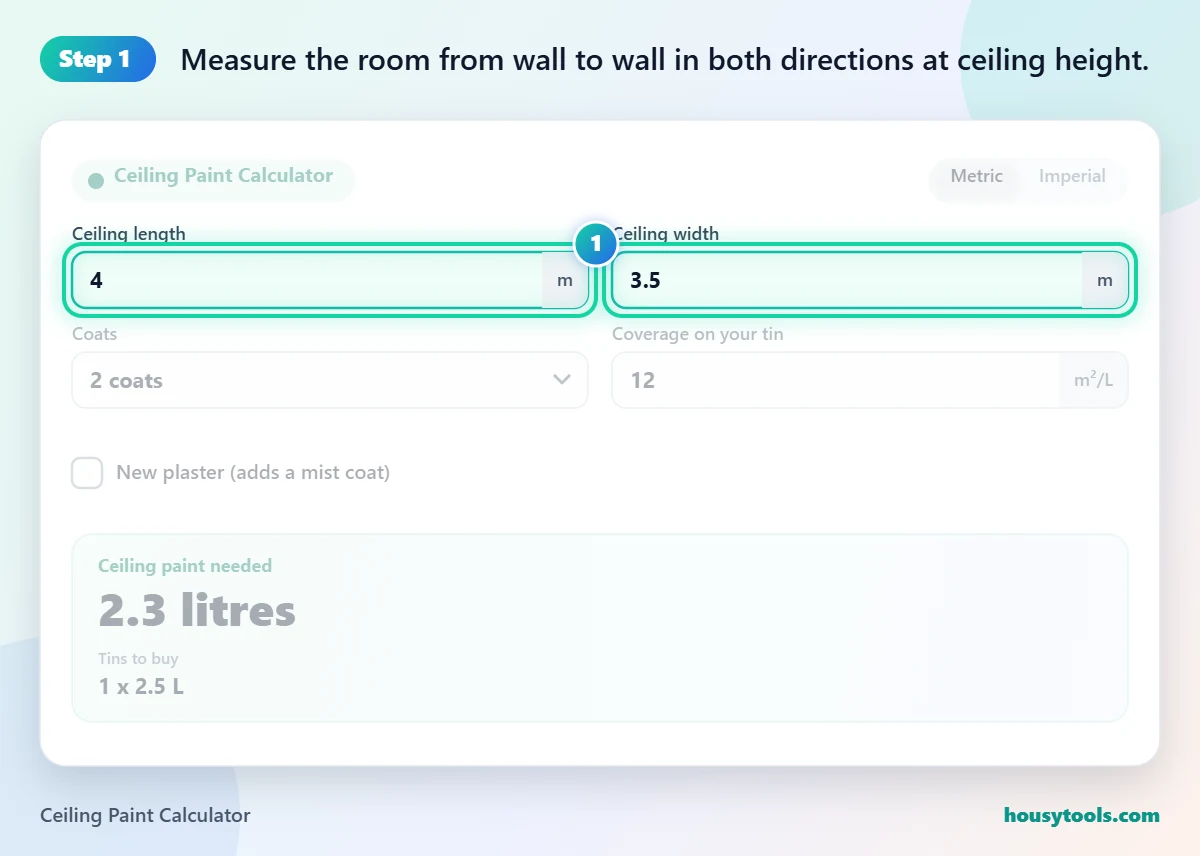
- Measure the room from wall to wall in both directions at ceiling height. Enter the length and width in metres, or switch to feet.
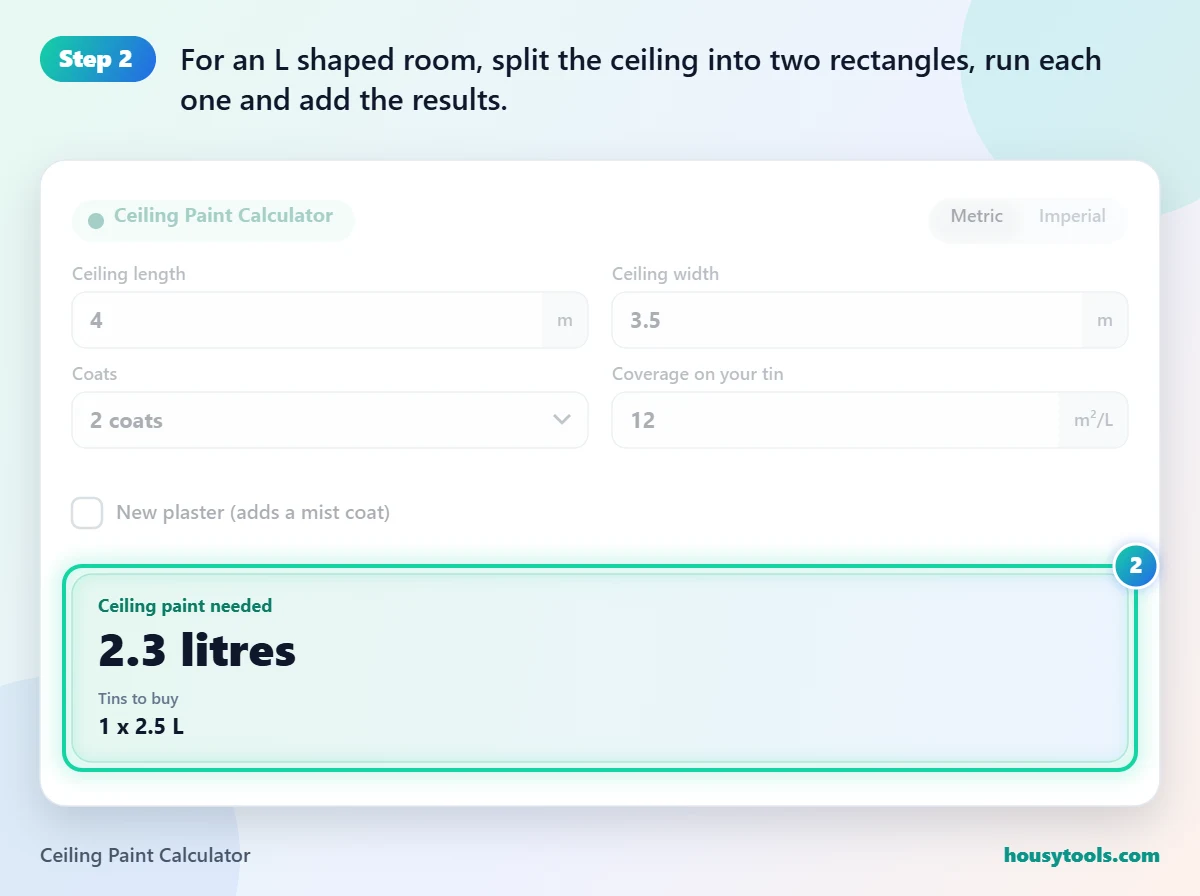
- For an L shaped room, split the ceiling into two rectangles, run each one and add the results.
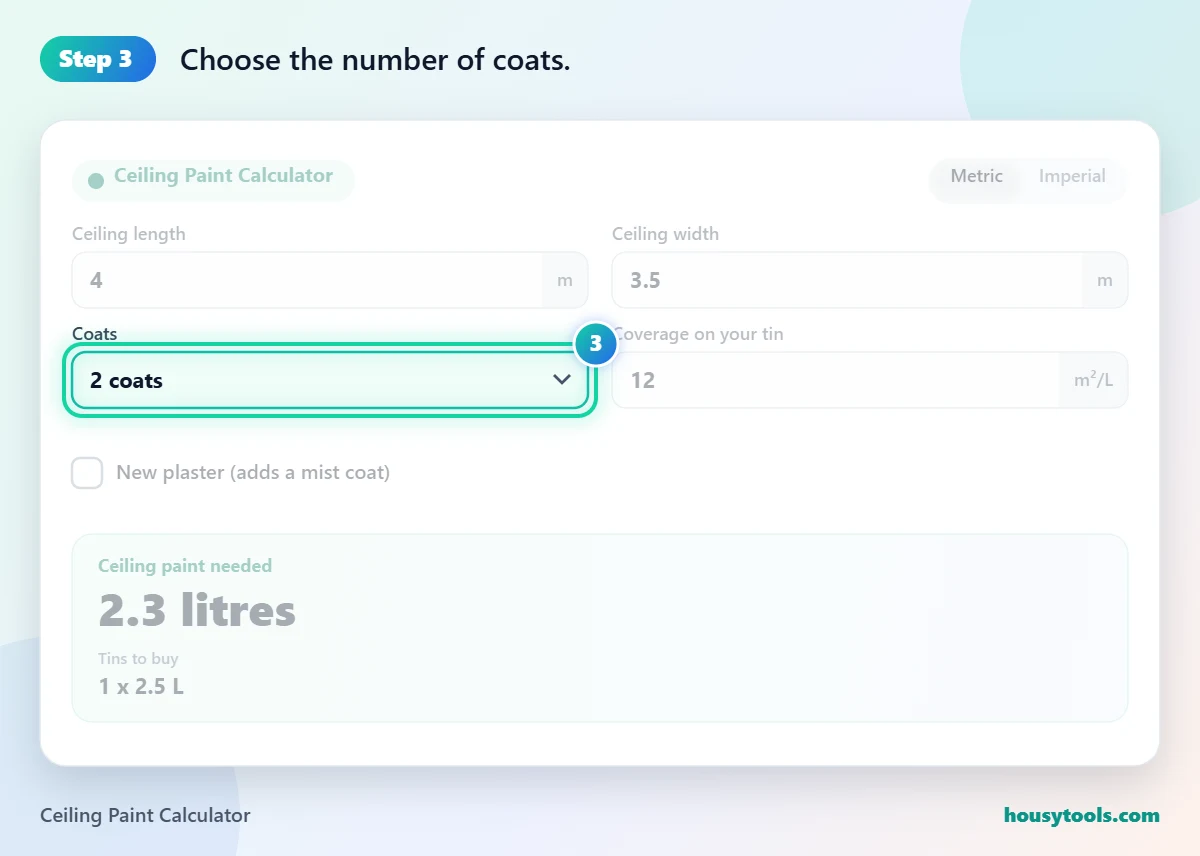
- Choose the number of coats. Two is normal for a fresh finish, one may do for a refresh in the same white.
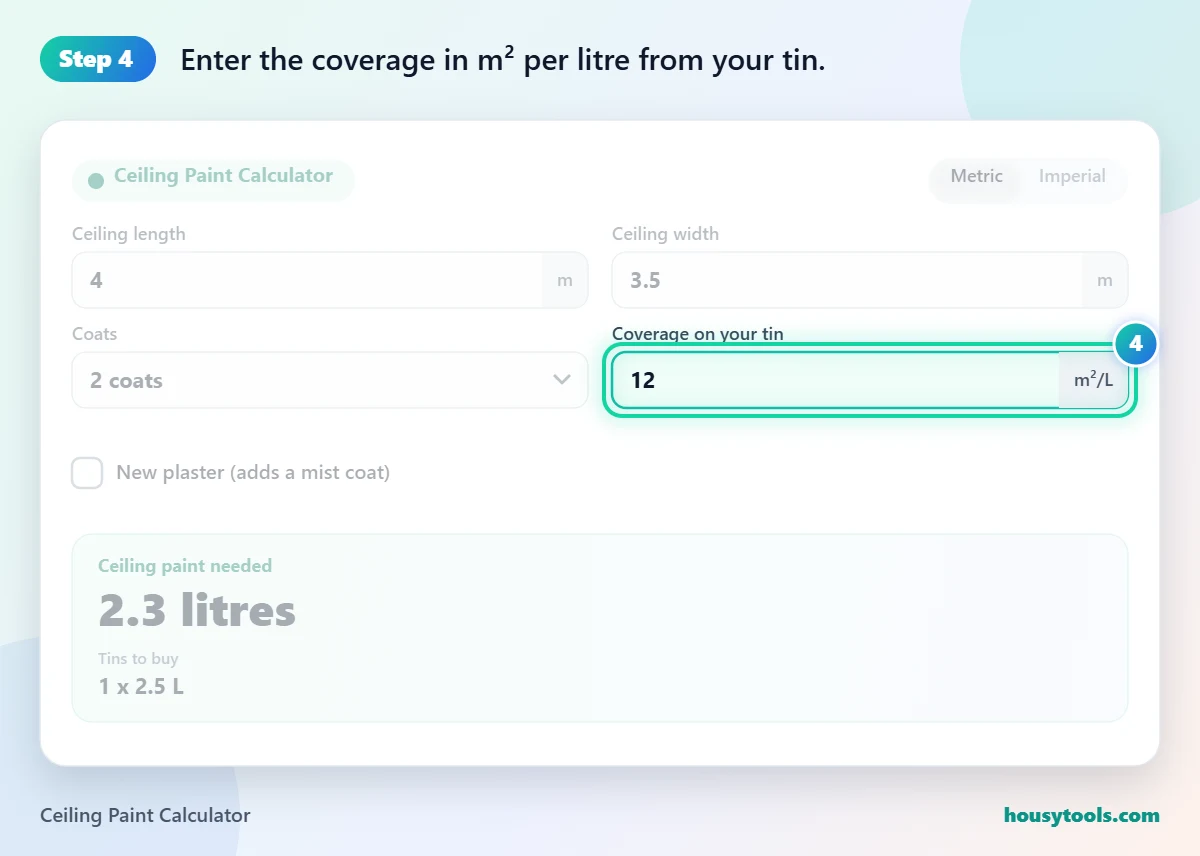
- Enter the coverage in m² per litre from your tin. The default of 12 is an example to replace.
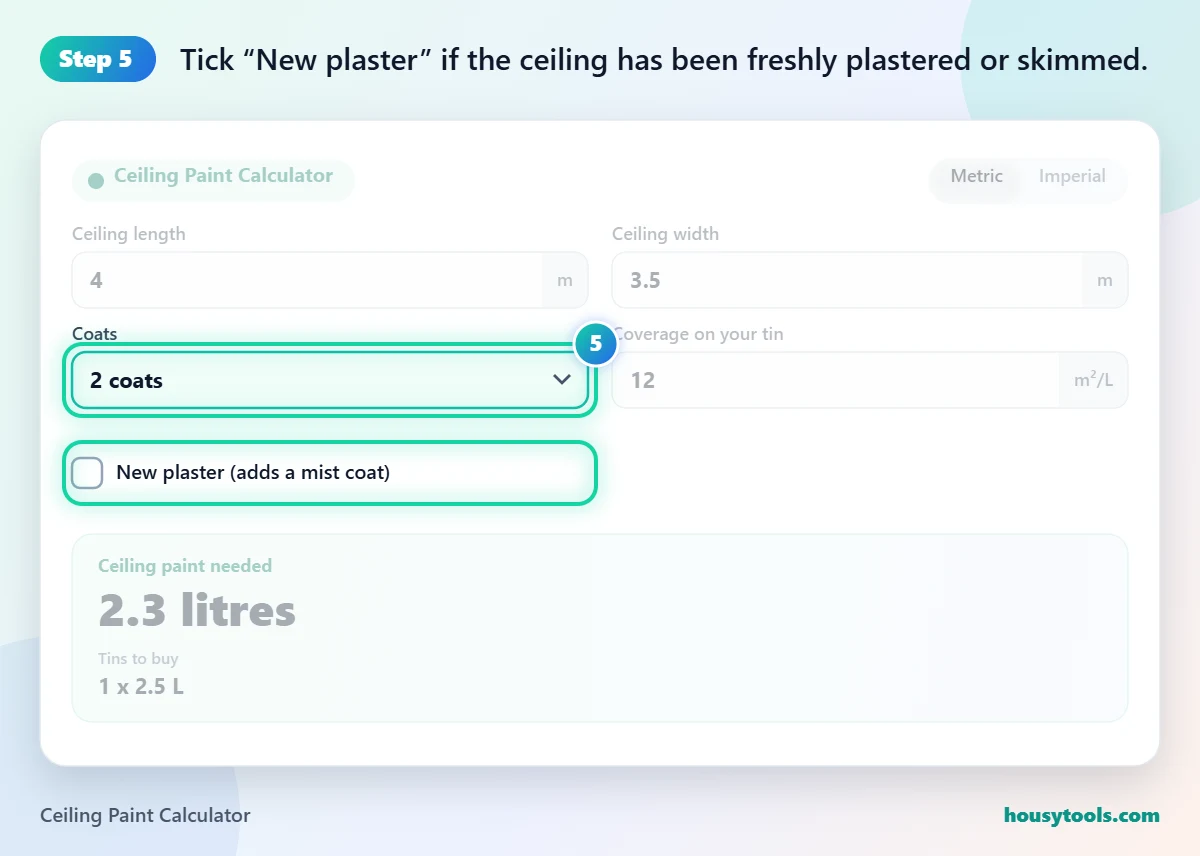
- Tick “New plaster” if the ceiling has been freshly plastered or skimmed. This adds one coat for the mist coat.
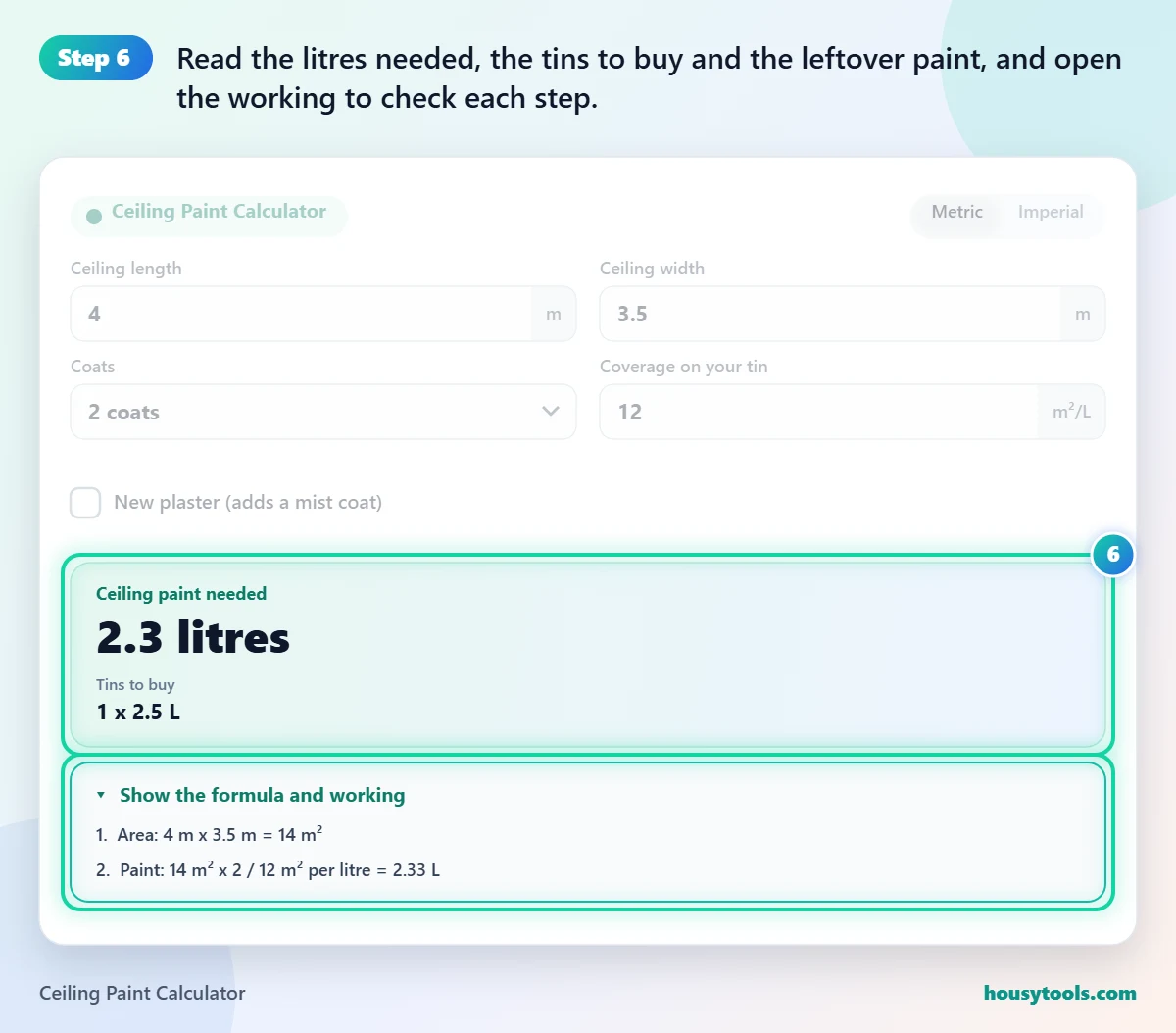
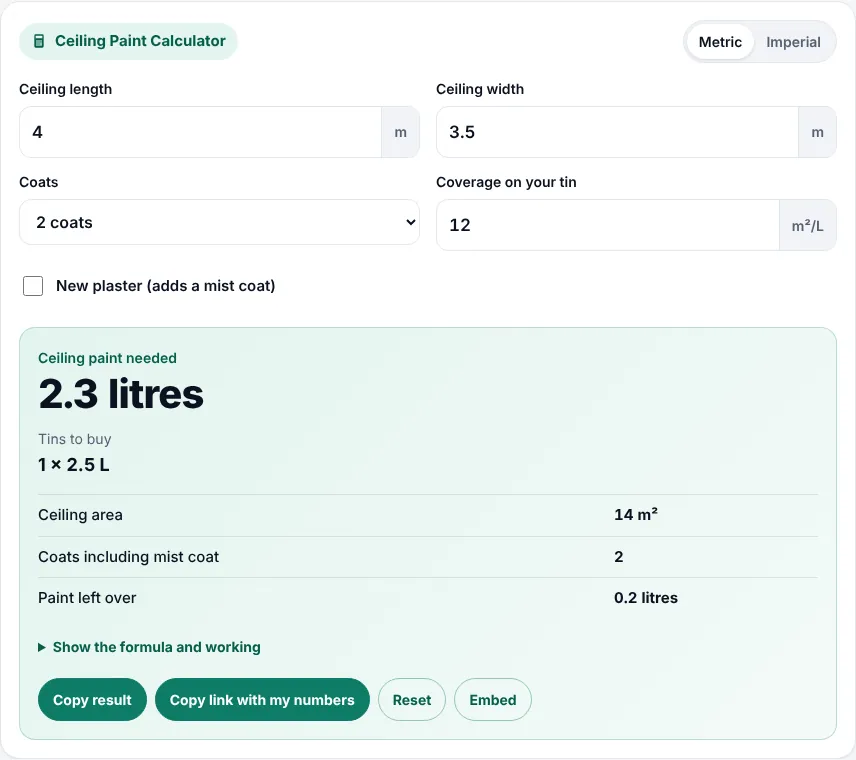
- Read the litres needed, the tins to buy and the leftover paint, and open the working to check each step.
How Much Paint Do I Need for a Ceiling?
A typical 4 m by 3.5 m UK bedroom ceiling of 14 m² needs about 2.3 litres of paint for two coats at 12 m² per litre, so one 2.5 litre tin is usually enough.
Ceiling area is the same as floor area, which makes it much smaller than the wall area of the same room. That is why ceilings often fit in a 2.5 litre tin while the walls need 5 litres or more. Bigger open plan spaces change this: a 6 m by 4.5 m kitchen diner ceiling needs 4.5 litres, so the ceiling paint calculator moves you up to a 5 litre tin.
Textured finishes such as stipple or swirl patterns hold more paint in their ridges. For those, lower the coverage input by a few square metres per litre rather than adding a whole coat.
Ceiling Paint Needed for Common Room Sizes
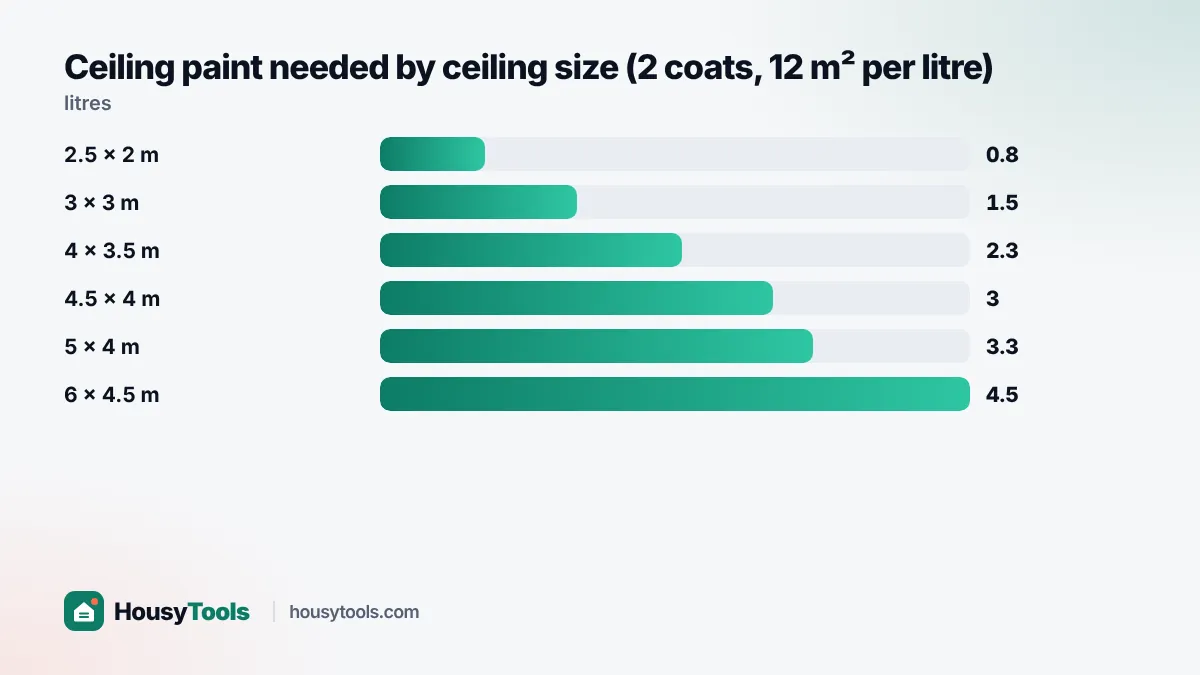
These figures were produced by the ceiling paint calculator at 12 m² per litre, with and without the extra mist coat for new plaster.
| Ceiling size | Area | 2 coats | New plaster (3 coats) |
|---|---|---|---|
| Bathroom 2.5 x 2 m | 5 m² | 0.8 L (1 x 1 L) | 1.3 L (1 x 2.5 L) |
| Small bedroom 3 x 3 m | 9 m² | 1.5 L (1 x 2.5 L) | 2.3 L (1 x 2.5 L) |
| Double bedroom 4 x 3.5 m | 14 m² | 2.3 L (1 x 2.5 L) | 3.5 L (1 x 2.5 L + 1 x 1 L) |
| Lounge 4.5 x 4 m | 18 m² | 3 L (1 x 2.5 L + 1 x 1 L) | 4.5 L (1 x 5 L) |
| Lounge 5 x 4 m | 20 m² | 3.3 L (1 x 2.5 L + 1 x 1 L) | 5 L (1 x 5 L) |
| Kitchen diner 6 x 4.5 m | 27 m² | 4.5 L (1 x 5 L) | 6.8 L (1 x 5 L + 1 x 2.5 L) |
Do You Need a Mist Coat on a New Plaster Ceiling?
Yes, a new plaster ceiling needs a thinned mist coat first, so plan for one extra coat on top of your normal two.
Fresh plaster is very absorbent, and full strength emulsion can sit on the surface and later peel. Dulux’s advice on painting new plaster says plaster can take up to four weeks to dry fully and suggests about ten parts emulsion to one part water for the mist coat.
When you tick the new plaster box, the ceiling paint calculator counts the mist coat as a full coat. Thinned paint goes slightly further, so this leaves a small safety margin rather than a shortfall.
Should You Paint the Ceiling or Walls First?
Paint the ceiling first, then the walls, because drips and roller spray fall downwards onto surfaces you have not finished yet.
Cut in around the edges with a brush, then roll the main area in strips parallel to the main window so the light does not pick out roller marks. Most ceiling whites are a flat or matt finish for the same reason. When both coats are dry, move on to the walls and work out their quantity with the paint calculator. If you want to plan the time as well, the painting time calculator adds drying waits between coats.
Worked Example: James’s New Plaster Ceiling
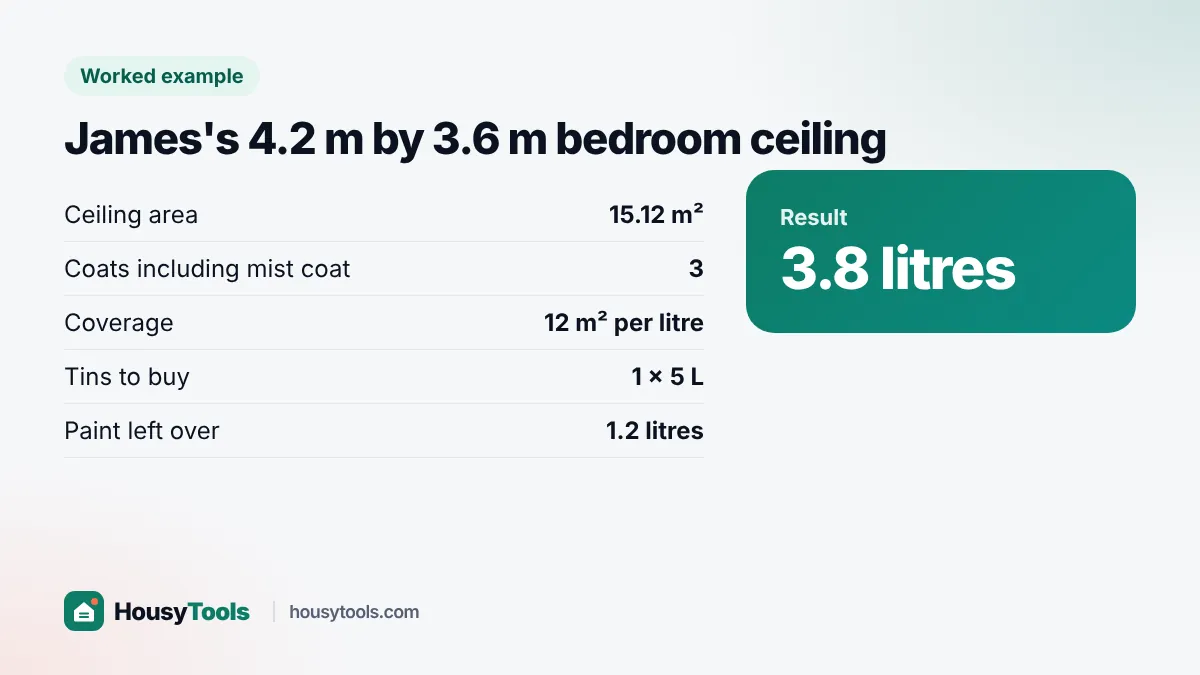
James has had the ceiling of his 4.2 m by 3.6 m back bedroom in Bristol reskimmed after removing an old Artex finish. He waited for the plaster to dry, then entered the room into the ceiling paint calculator with two coats, 12 m² per litre from his tin of white matt, and the new plaster box ticked.
- Area: 4.2 m x 3.6 m = 15.12 m²
- Coats: 2 top coats + 1 mist coat = 3
- Paint: 15.12 m² x 3 / 12 m² per litre = 3.78 litres, shown as 3.8 litres
- Tins: 1 x 5 L, with 1.2 litres left over
Without the mist coat the same ceiling needs 2.5 litres, and the tool suggests 1 x 2.5 L plus 1 x 1 L. The single 5 L tin is the simpler buy for the plastered ceiling. Before the old Artex came off, James had it tested, because the HSE warns that textured coatings in homes built or refurbished before 2000 may contain asbestos and must not be sanded or scraped untested.
How Do You Paint a Ceiling Safely?
Use a roller on an extension pole from the floor wherever you can, and use a stable stepladder or low platform only for cutting in.
- Follow the HSE’s guidance on using ladders and stepladders safely: use the right type, on firm level ground, and move it rather than overreaching.
- Turn off ceiling lights at the consumer unit before painting around fittings, and never remove a fitting yourself unless you are competent to do so.
- Keep windows open for ventilation while painting and drying.
- Wear eye protection, as roller spatter on a ceiling falls towards your face.
- In homes built before the 1960s, old ceiling paint may contain lead, so wet sand and never burn it off.
Common Mistakes With Ceiling Paint Estimates
- Measuring the floor around fitted units instead of wall to wall. The ceiling paint calculator needs the full ceiling, including the area above kitchen cupboards and wardrobes if you will paint it.
- Forgetting the mist coat on new plaster or skim, which adds half as much paint again to a two coat job.
- Using the walls’ coverage figure for a textured ceiling. Lower the coverage input in the ceiling paint calculator instead.
- Buying a 5 litre tin by habit. For many bedroom ceilings the ceiling paint calculator shows that a 2.5 litre tin, or 2.5 L plus 1 L, is enough.
- Painting over water stains without a stain block first, which lets the mark bleed back through every coat.
Ceiling Paint Calculator FAQs
How much does 2.5 litres of paint cover on a ceiling?
At 12 m² per litre, 2.5 litres covers 30 m² in one coat, or 15 m² in two coats. That is enough for most UK bedroom ceilings up to about 4 m by 3.75 m. Check the coverage on your tin, as it varies by product.
Do ceilings need two coats of paint?
Two coats give the most even finish, especially when changing colour or covering stains. A ceiling in good condition that is being refreshed in the same white may only need one. New plaster needs a mist coat followed by top coats.
Can I use wall paint on a ceiling?
Usually yes, a standard matt emulsion works on ceilings. Dedicated ceiling paints are often flatter, which hides imperfections. Check the tin says it suits ceilings and enter its coverage figure in the ceiling paint calculator.
How do I calculate paint for a sloping ceiling?
Measure the slope along its surface, not the floor below it. Multiply the slope length by its width, add any flat section, and enter dimensions in the ceiling paint calculator that give the same total area.
Does the ceiling paint calculator work for a whole floor?
Yes. Run each room separately and add the litres, or add the ceiling areas together and enter dimensions that give the same total. Buying all the paint at once keeps the white consistent from room to room.
How long should I wait between ceiling coats?
Follow the recoat time on your tin. Many water based matt emulsions list 2 to 4 hours in good conditions, but cold or humid rooms take longer. Mist coats on new plaster should be fully dry before the top coat goes on.
Checked October 2026. Sources: Dr Dulux new plaster guide, Dulux product data, Health and Safety Executive (HSE) ladder, lead and asbestos guidance.