
Show the formula and working
This rice to water ratio calculator tells you how much water to add to your rice for the absorption method, in millilitres and in cups, for home cooks in the UK, Ireland and across Europe who weigh rice in grams. Pick the rice type, enter the dry weight or the number of cups, and it also estimates how many people the pan will feed.
Quick answer: For the absorption method, a common starting ratio by volume is 2 parts water to 1 part white long grain rice, 1.5 to 1 for basmati and 2.5 to 1 for brown rice. Your pack instructions come first. The rice to water ratio calculator turns that ratio into millilitres for your exact amount.

What Is a Rice to Water Ratio Calculator?
A rice to water ratio calculator works out the volume of water a given amount of dry rice needs to cook through by absorbing all of it. The ratio is measured by volume: water = volume of dry rice x ratio. If you weigh your rice, the tool first turns grams into cups using the weight of one level cup of your rice, then multiplies by the ratio and by the cup size in millilitres.
Ratios differ because grains absorb water differently. Basmati and jasmine stay separate with less water, brown rice keeps its bran layer and needs more, and, as the cooked rice entry on Wikipedia notes, newly harvested rice usually needs less water than older stock. That is why the ratio is a starting point you can change, not a fixed rule.
How Do You Use the Rice to Water Ratio Calculator?
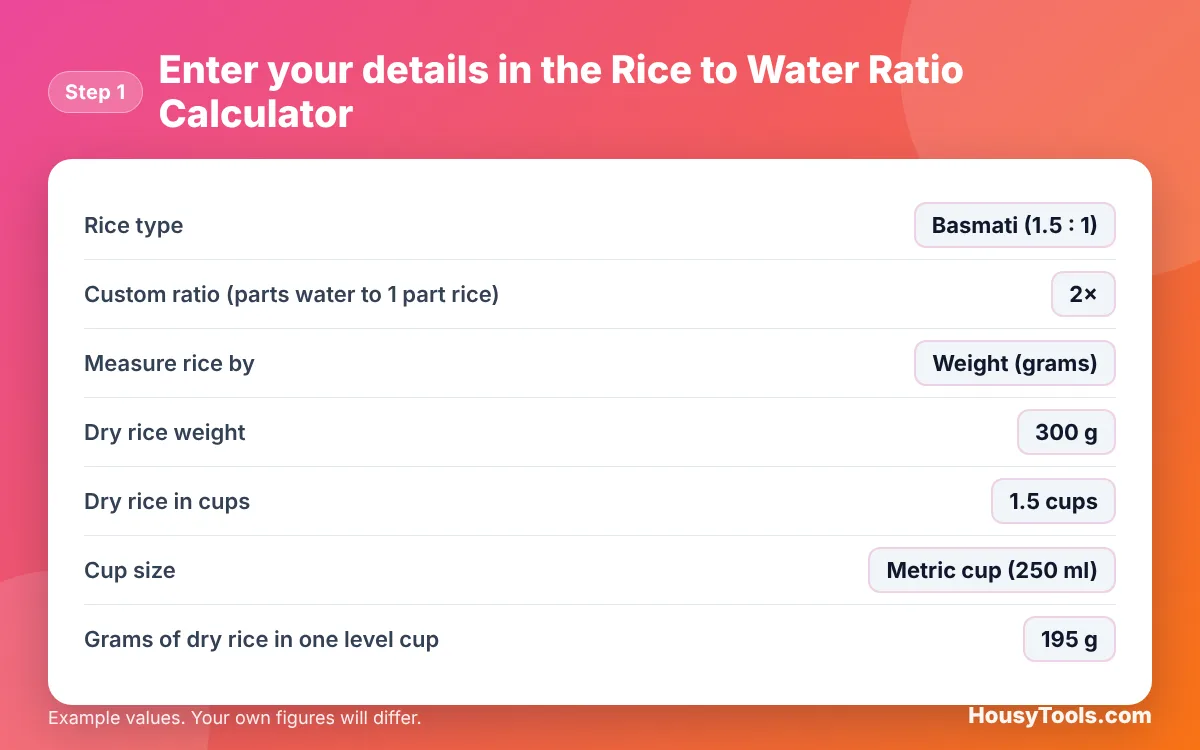
- Choose your Rice type. If your pack gives a different ratio, choose “Custom ratio” and enter it in Custom ratio (parts water to 1 part rice).
- Set Measure rice by to “Weight (grams)” or “Cups”.
- Enter Dry rice weight in grams, or Dry rice in cups if you measure by volume.
- Pick your Cup size. If you weigh your rice, check Grams of dry rice in one level cup by weighing one level cup of your own rice.
- Adjust Dry rice per person to match your usual portion.
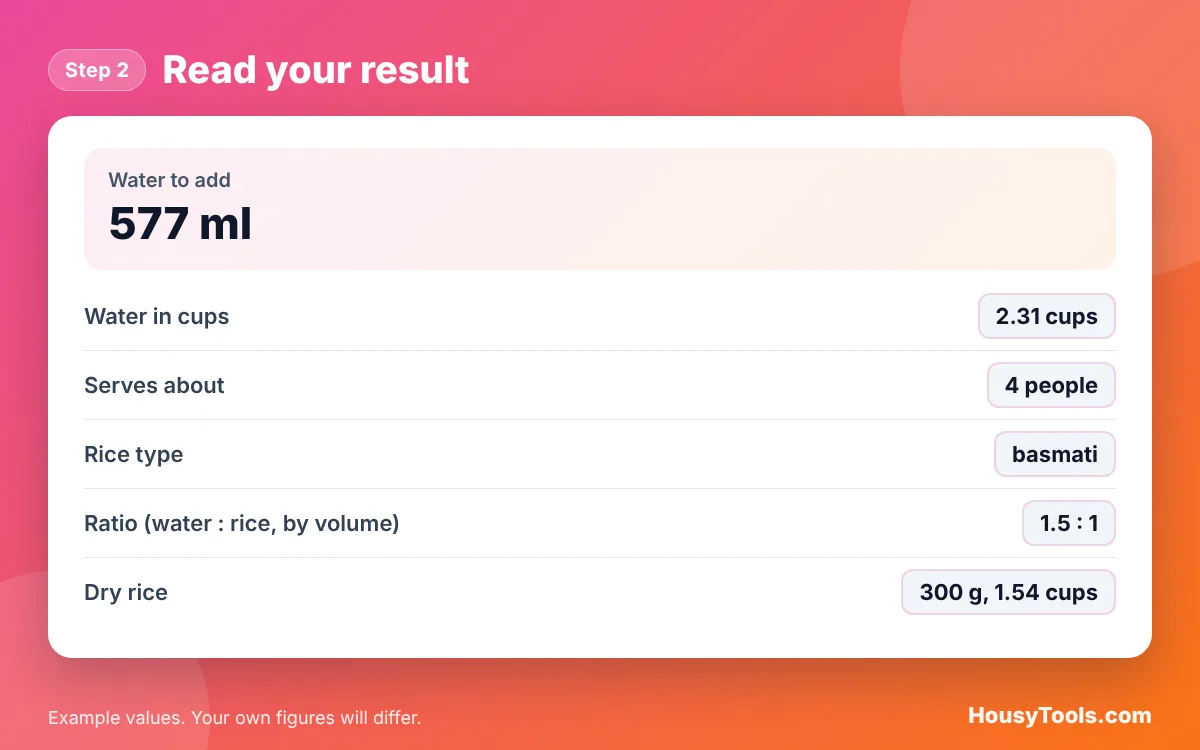
- Read the water amount and servings, then open “Show the formula and working” to see each step.
How Much Water Do You Need for 1 Cup of Rice?
One cup of white long grain rice needs about 2 cups of water, while 1 cup of basmati needs about 1.5 cups and 1 cup of brown rice about 2.5 cups. With a 250 ml metric cup, that is 500 ml, 375 ml and 625 ml of water. Use the same cup for the rice and the water and the cup size stops mattering, because the ratio is what counts.
How Much Water Do You Need for 100 g of Rice?
100 g of basmati needs roughly 190 ml of water at a 1.5 to 1 ratio, assuming one level 250 ml cup holds about 195 g of dry rice. White long grain at 2 to 1 needs about 256 ml for the same 100 g. Rice density varies with grain length, so weigh one level cup of your own rice and enter it for a closer answer.
Should You Rinse Rice Before Cooking?
Rinsing rice in cold water until it runs almost clear removes loose surface starch, which helps long grain and basmati cook into separate grains. Drain it well, as water left clinging to the grains adds a little to your ratio. Sushi and risotto rice are often left unrinsed or only lightly rinsed because their starch gives the sticky or creamy texture those dishes need.
How Long Can You Keep Cooked Rice?
Cool leftover rice quickly, ideally within one hour, keep it in the fridge for no more than one day, and reheat it only once until it is steaming hot all the way through. This is the advice in the Food Standards Agency home food fact checker. Spreading rice out in a shallow container helps it cool faster, so cooking only what you need is the simplest way to avoid waste.
If you cook rice on an electric hob every day, the electricity cost calculator shows what the hob or a rice cooker costs per session.
| Rice type | Starting ratio (water : rice, by volume) | Water for 1 metric cup (250 ml) | Water for 300 g (195 g per cup) |
|---|---|---|---|
| White long grain | 2 : 1 | 500 ml | 769 ml |
| Basmati | 1.5 : 1 | 375 ml | 577 ml |
| Jasmine | 1.25 : 1 | 313 ml | 481 ml |
| Brown long grain | 2.5 : 1 | 625 ml | 962 ml |
| Short grain or sushi | 1.2 : 1 | 300 ml | 462 ml |
These are common starting ratios for the absorption method with a tight lid. Always check the instructions on your pack, which reflect the specific rice inside it.
Worked Example: Basmati Rice for Four
Example: 300 g of basmati for a curry night for four. Leave Rice type on “Basmati (1.5 : 1)”, Measure rice by on “Weight (grams)”, enter 300 g, keep the metric 250 ml cup and the example 195 g per cup, and set 75 g per person.
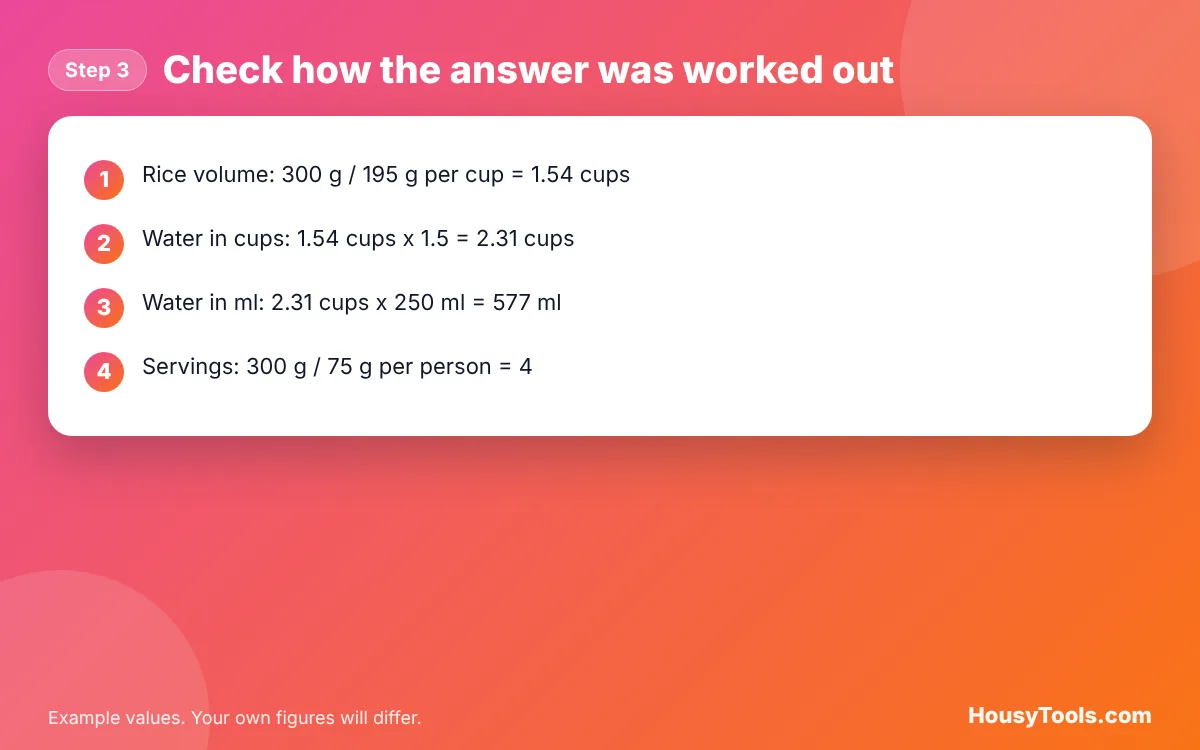
- Rice volume: 300 g / 195 g per cup = 1.54 cups
- Water in cups: 1.54 cups x 1.5 = 2.31 cups
- Water in ml: 2.31 cups x 250 ml = 577 ml
- Servings: 300 g / 75 g per person = 4
Measure 577 ml of water, bring the rice and water to the boil, cover the pan and turn the heat to low until the water is absorbed. More kitchen and household tools sit in our home calculators section.
Rice to Water Ratio Calculator FAQs
What is the ratio of water to rice?
A common starting point is 2 parts water to 1 part white long grain rice by volume. Basmati often uses about 1.5 to 1, jasmine about 1.25 to 1 and brown rice about 2.5 to 1. Follow the pack first, then adjust by a little each time until you like the texture.
Is the rice to water ratio by weight or volume?
Most pack instructions and the ratios here are by volume, such as one cup of rice to two cups of water. If you weigh your rice, the calculator converts grams to cups using the weight of one level cup, then gives the water in millilitres so you can measure it in a jug.
How much dry rice per person?
Portion sizes vary with appetite and whether rice is a side or the main part of the meal, so the calculator uses 75 g of dry rice per person as an editable example. Check the serving size on your pack, then change Dry rice per person to suit your household.
Why is my rice mushy?
Mushy rice usually has too much water, was stirred while cooking, or was not rinsed. Reduce the ratio by about 0.1 to 0.2 next time, keep the lid on, and let the rice rest off the heat for a few minutes before fluffing it with a fork.
Do I need more water for a bigger batch?
Keep the same ratio for bigger batches, but a wide pan loses less water per portion to steam, so very large amounts can need slightly less water than the full multiple. Batches above about 3 kg of dry rice cook more evenly when split between two pans.
Is it safe to reheat rice?
Yes, if you cool it within about an hour, keep it in the fridge for no more than a day, and reheat it only once until it is steaming hot throughout. This follows Food Standards Agency advice on cooked rice and reduces the risk of food poisoning.
Checked October 2026. Sources: Food Standards Agency: Home food fact checker, Wikipedia: Cooked rice.