
Show the formula and working
This solar EV charging calculator works out how many solar panels it takes to charge an electric car from your own roof and how much that saves compared with grid charging. It suits drivers in the UK, Ireland and the rest of Europe. Enter your yearly distance, the car’s efficiency, the share of charging you can do in daylight, your location and your tariffs.
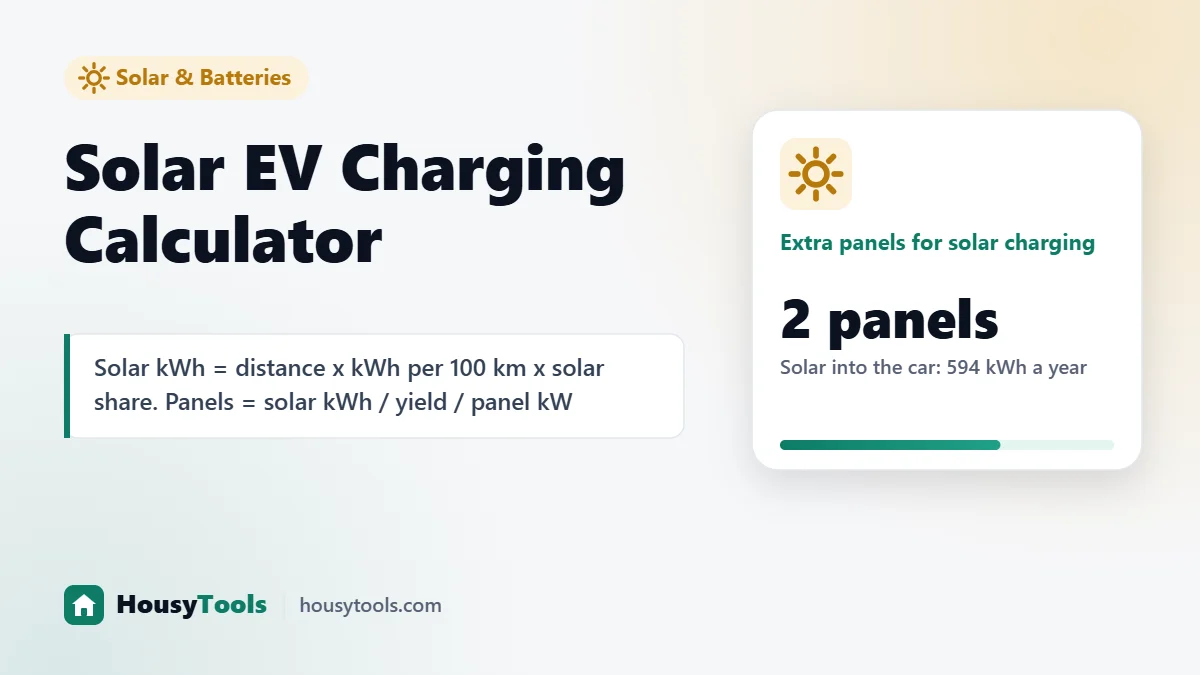
Quick answer: To find how many solar panels charge an electric car, multiply yearly distance by the car’s kWh per 100 km, take the share charged from solar, then divide by your yield per kWp and panel size. Driving 11,000 km at 18 kWh per 100 km with 30% from solar needs about 594 kWh, or two 430 Wp panels in London.
What Is a Solar EV Charging Calculator?
A solar EV charging calculator is a tool that estimates the solar energy an electric car can take from home panels, the extra panels needed to supply it and the money it saves.
The formula in plain words: the car’s yearly energy use is distance times consumption per 100 km. Multiply by the share of charging that happens while the sun is shining and the car is at home to get the solar kWh into the car. Divide by your location’s yield per kWp to get the extra array size, then by the panel rating to get the panel count. The saving is that solar kWh times your import rate, or times the gap between import and export if the solar would otherwise have been exported.
How Do You Use the Solar EV Charging Calculator?
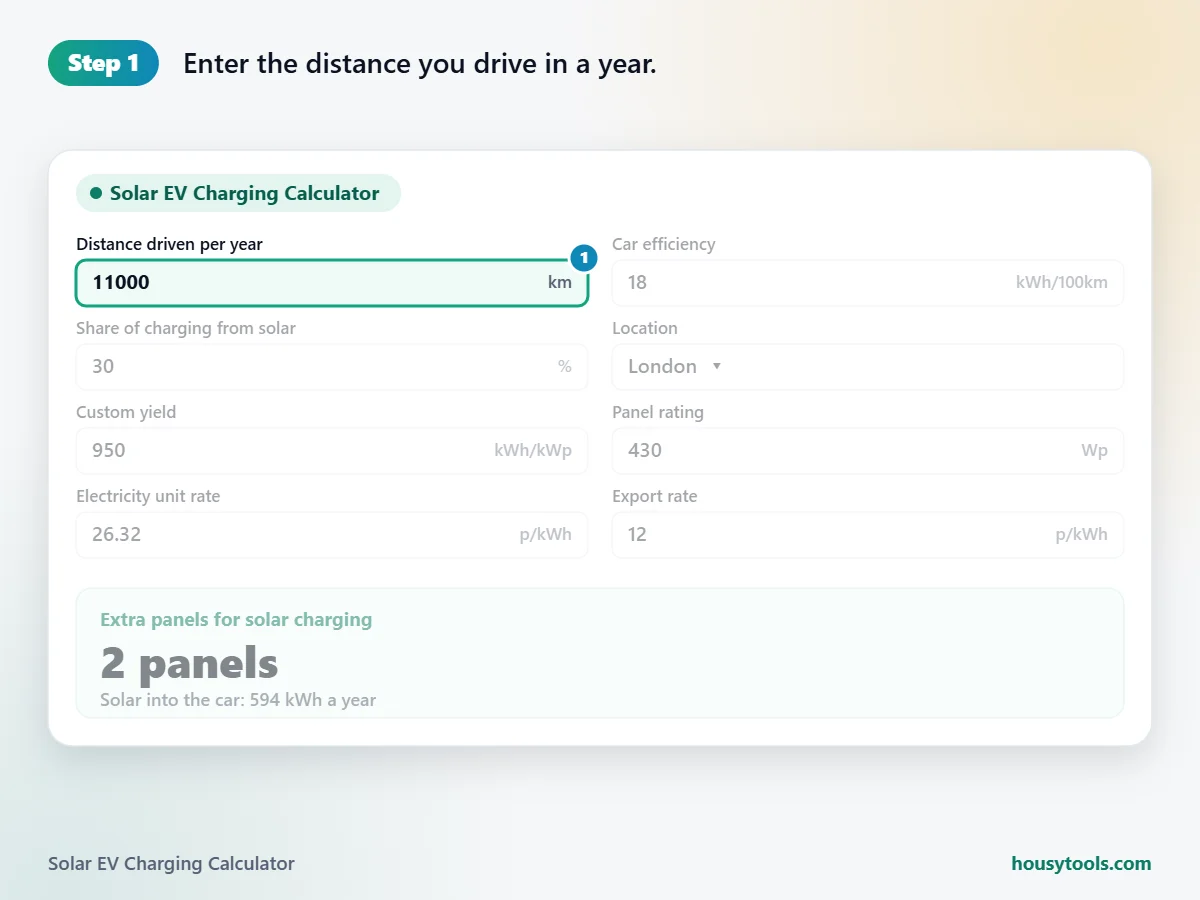
- Enter the distance you drive in a year.
- Enter your car efficiency in kWh per 100 km, or switch to imperial for miles per kWh.
- Set the share of charging that can happen while the sun shines.
- Choose your location and enter the panel rating.
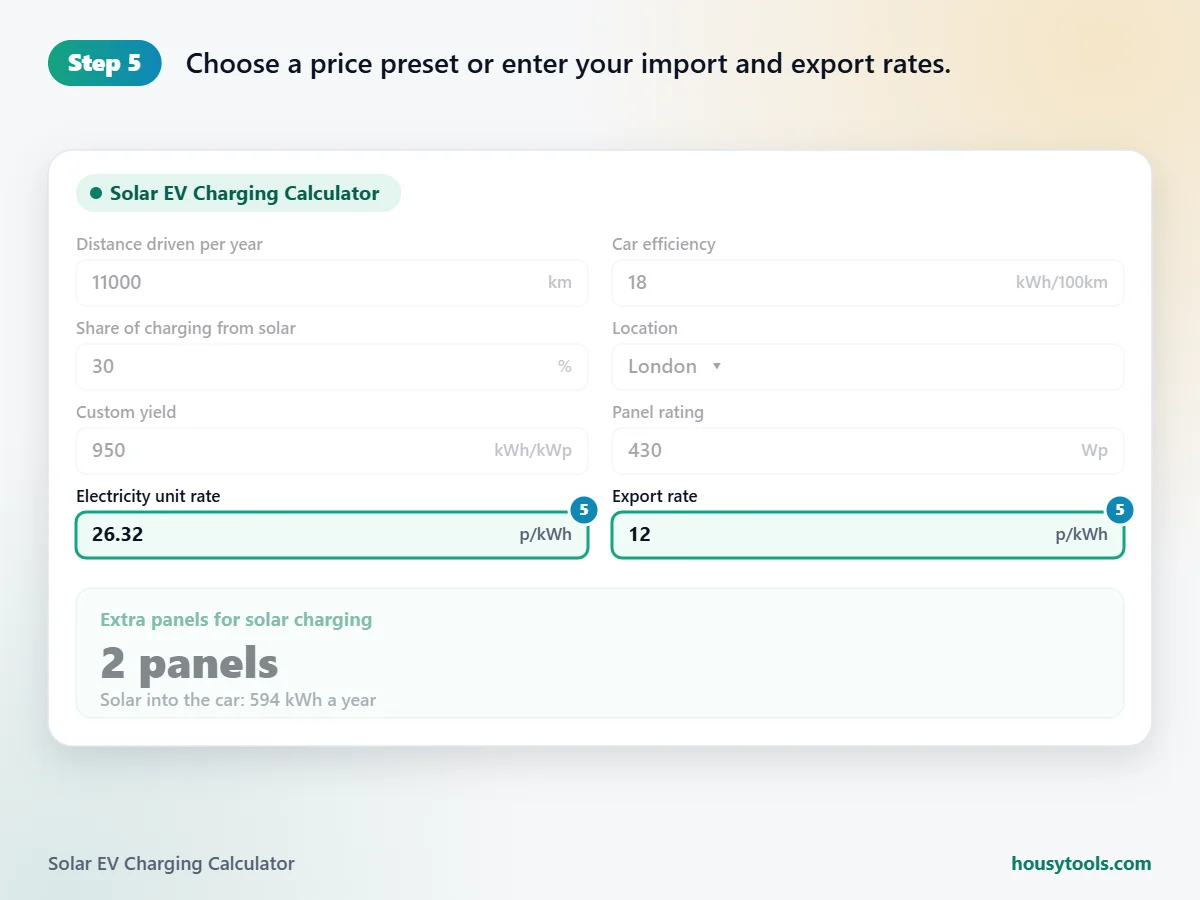
- Choose a price preset or enter your import and export rates.
- Read the extra panels, the solar kWh into the car and the yearly saving.



How Many Solar Panels Do You Need to Charge an Electric Car?
Charging an electric car fully from solar over a year would take about 1.9 kWp in London for 11,000 km, but most drivers can only charge part of the time in daylight, so two to four extra panels is a more realistic target.
| Share from solar | Solar into the car | Extra 430 Wp panels | Saving vs grid charging |
|---|---|---|---|
| 10% | 198 kWh | 1 | £52.11 |
| 20% | 396 kWh | 1 | £104.23 |
| 30% | 594 kWh | 2 | £156.34 |
| 50% | 990 kWh | 3 | £260.57 |
| 70% | 1,386 kWh | 4 | £364.80 |
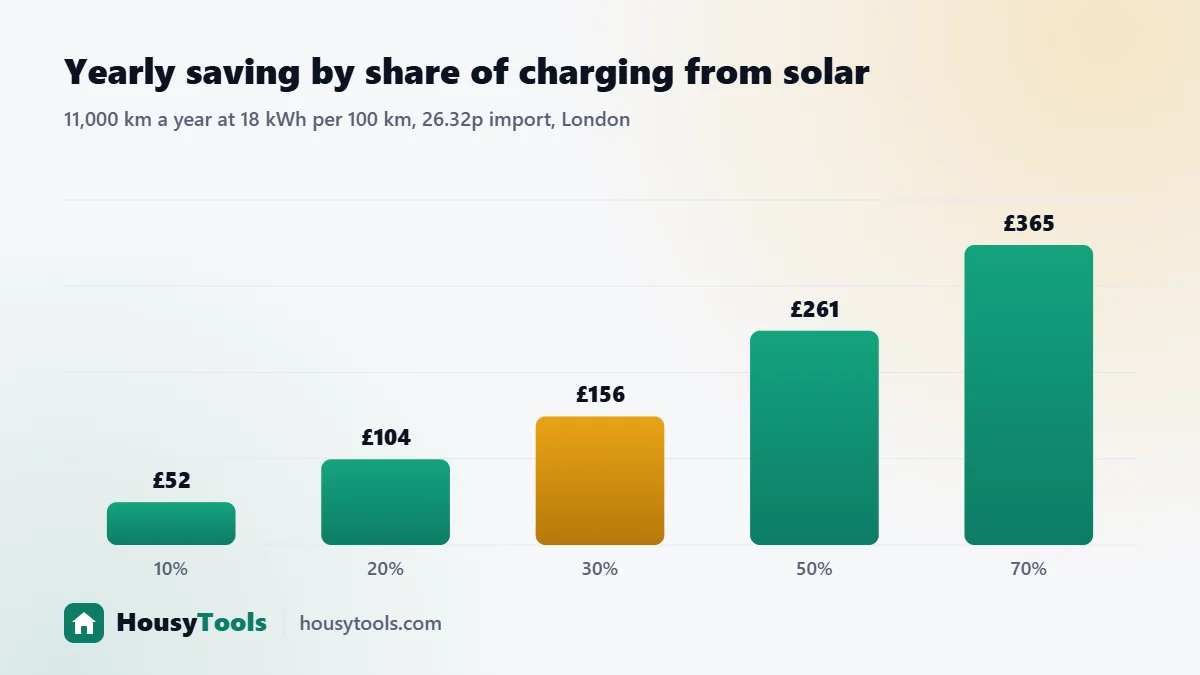
The solar share is the number that matters most. A car that is at work all day can only take solar at weekends, while a car at home during the day with a solar aware charger can take much more. The yields come from the PVGIS tool from the EU Joint Research Centre.
Is Charging an EV From Solar Worth It?
Yes, if the solar would otherwise be exported cheaply: each kWh moved into the car is worth your import rate minus your export rate, about 14.3p at 26.32p import and 12p export.
If you already charge overnight on a cheap off peak tariff, the gain from daytime solar is smaller, because you are comparing solar with that cheap rate, not the standard rate. Enter your off peak rate in the import box to see the difference. Our EV charging cost calculator shows the cost per charge on any tariff.
How Much Solar Does an EV Get in Winter?
Far less than in summer: in London a kWp of panels makes about 120 kWh in June but only 38 kWh in December, so the same panels give the car roughly a third as much in midwinter.
In the default example the car takes about 2.3 kWh a day of solar in June but only about 0.7 kWh in December. That is a few miles of range in winter, so most solar EV owners still rely on grid charging from November to February.
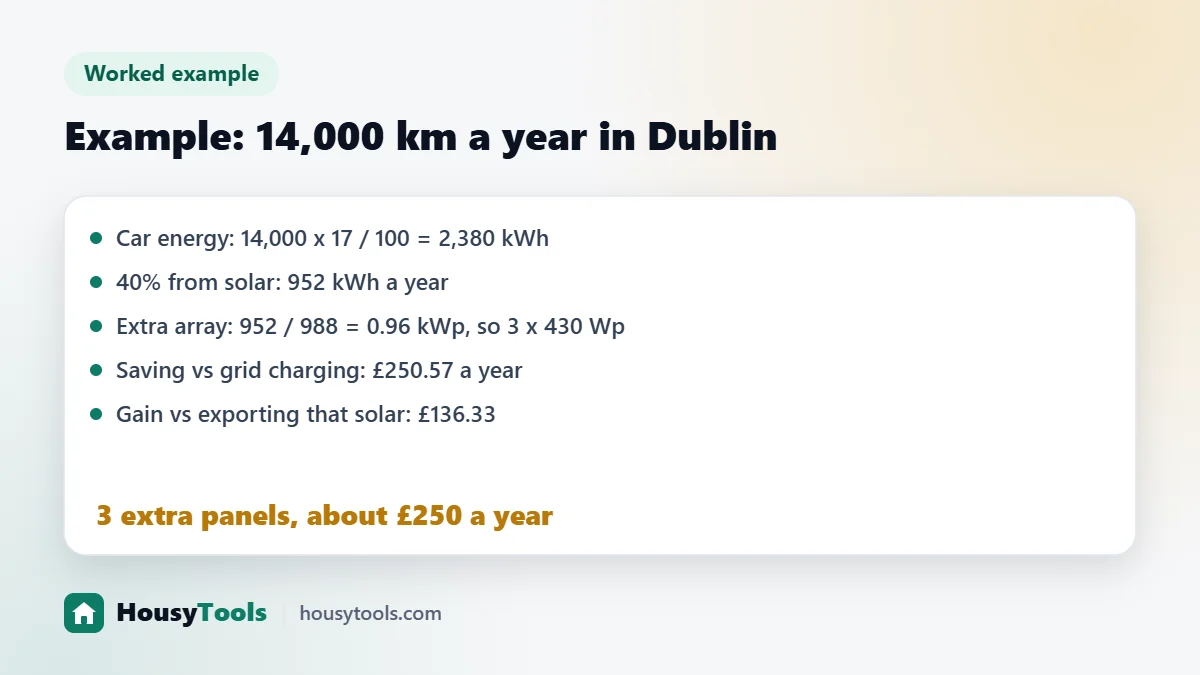
Worked Example: 14,000 km a Year in Dublin
Example: a driver in Dublin covers 14,000 km a year in a car using 17 kWh per 100 km and works from home often enough to charge 40% from solar.
- Car energy: 14,000 x 17 / 100 = 2,380 kWh a year
- From solar: 2,380 x 40% = 952 kWh
- Extra array: 952 / 988 kWh per kWp = 0.96 kWp, so three 430 Wp panels
- Saving vs grid charging: 952 x 26.32p = £250.57 a year
- Gain vs exporting that solar at 12p: £136.33 a year
The driver uses the rates in pence here; in Ireland, switch the currency to euro and enter rates in cents. To see whether the extra panels fit, use the solar roof space calculator.
How Can You Charge More of Your EV From Solar?
The most effective step is a charger that can follow solar output, so the car takes only surplus power instead of pulling from the grid on cloudy days.
- Plug in whenever the car is home in daylight, especially at weekends.
- Use a solar aware or eco mode on your charger if it has one.
- Set a lower charging current on sunny days so it matches your surplus.
- Size the array with the car in mind using the how many solar panels calculator.
Any home charger must be installed by a qualified electrician to the relevant wiring rules.
Solar EV Charging Calculator FAQs
Can solar panels fully charge an electric car?
Over a summer day, a typical 4 kWp home system can make enough to add a useful charge if the car is home. Over a whole year, few homes charge fully from solar because of winter and the times the car is away.
How many kWh does an electric car use per km?
Many cars use about 15 to 20 kWh per 100 km. 18 kWh per 100 km is about 3.5 miles per kWh. Check your car’s trip computer for your own figure.
How much does charging an EV with solar save?
Each kWh from your own solar saves your import rate, about 26.32p on the UK price cap for October to December 2026. If that solar would have been exported at 12p, the real gain is about 14.3p per kWh.
Do I need a special charger to charge from solar?
No, any charger will use solar power when panels are producing. A solar aware charger helps by matching the charging rate to your surplus, so less comes from the grid.
Is it better to charge an EV from solar or on an overnight tariff?
Solar is cheapest when it would otherwise be exported for little. If your overnight rate is lower than the value of your export, charging overnight and exporting the solar can make more sense.
How much range does solar add to an electric car?
At 18 kWh per 100 km, 594 kWh of solar adds about 3,300 km a year. In June that is about 13 km a day from the default share, and much less in December.
Checked October 2026. Sources: EU Joint Research Centre PVGIS, Ofgem energy price cap.