
Show the formula and working
This wood varnish calculator works out how many litres and tins of varnish you need for a wooden floor, doors, stairs or furniture, for homeowners and decorators in the UK and Europe working in metres. Enter the size of the wood, the coverage printed on your tin and the number of coats, and it adds an allowance for bare, thirsty timber so you can finish every coat from the same batch.
Quick answer: Multiply the wood area in m² by the number of coats, divide by the coverage on the tin and add about 10%. A 4 m by 3 m floor is 12 m², so three coats at 12 m² per litre need 3.3 litres. The wood varnish calculator rounds this up to two 2.5 litre tins.

What Is a Wood Varnish Calculator?
A wood varnish calculator is a tool that converts the area of timber you want to seal into the litres and tins of varnish needed for all coats. The formula is: litres = area in m² x coats / coverage in m² per litre x (1 + waste percentage). The area is length x width for a floor or tabletop, plus extra items such as doors or stair treads, minus anything you will leave bare.
How Do You Use the Wood Varnish Calculator?
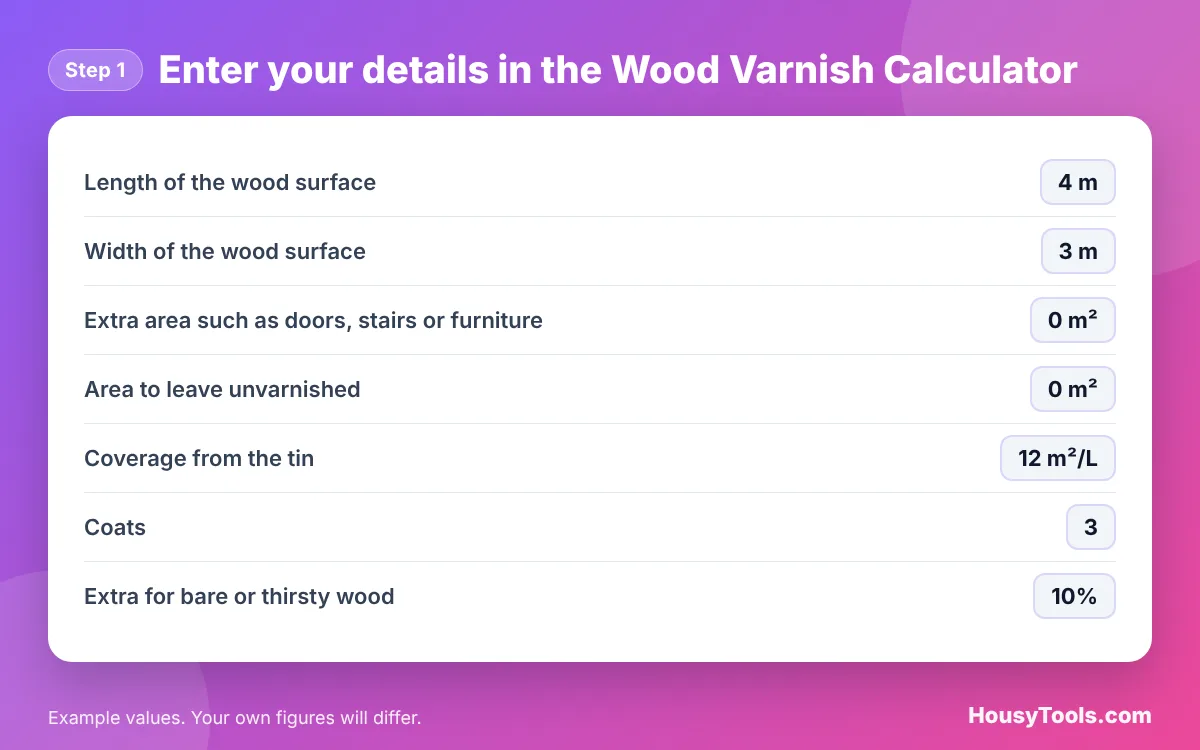
- Enter Length of the wood surface and Width of the wood surface. For a floor, use the room length and width.
- Add Extra area such as doors, stairs or furniture, counting both faces of a door, and any Area to leave unvarnished.
- Enter the Coverage from the tin in m² per litre. The 12 m² per litre default is only an example.
- Set Coats, usually 3 on bare wood, and Extra for bare or thirsty wood.
- Choose the Tin size, from 250 ml for small jobs up to 5 litres for floors.
- Read the litres and tins, then open “Show the formula and working” to see each step.


How Much Varnish Do I Need for a Floor?
A 12 m² wooden floor needs between about 1.6 and 5.3 litres of varnish for 3 coats with 10% extra, depending on whether the product covers 25 or 7.5 m² per litre. That wide range is why the coverage on your own tin matters more than any rule of thumb. The Dulux Trade Diamond Glaze floor varnish states 12 to 25 m² per litre, while the Ronseal Ultra Tough Hardglaze Varnish states up to 7.5 m² per litre.
| Varnish (manufacturer data) | Stated coverage | Coats and recoat | 12 m² floor, 3 coats, plus 10% |
|---|---|---|---|
| Ronseal Ultra Tough Hardglaze Varnish | Up to 7.5 m² per litre | 3 coats, recoat in 6 hours | 5.28 litres |
| Dulux Trade Diamond Glaze (lower figure) | 12 m² per litre | Recoat in 2 to 4 hours | 3.3 litres |
| Dulux Trade Diamond Glaze (upper figure) | 25 m² per litre | Recoat in 2 to 4 hours | 1.58 litres |
How Many Coats of Varnish Does Wood Need?
Bare wood usually needs 3 coats of varnish for lasting protection, and floors or worktops benefit most from the third coat. Ronseal specifies three coats of Ultra Tough Hardglaze, with a light sand and a wipe with a damp cloth before the final coat. Previously varnished wood in good condition may only need one or two maintenance coats after a light sand.
How Far Does a Litre of Varnish Go?
One litre of varnish covers about 7.5 to 25 m² for a single coat, depending on the product, so a 750 ml tin covers roughly 5.6 to 18.8 m² once. Soft or open grained timber, end grain and freshly sanded wood absorb more, so the first coat goes less far than later coats.
How Long Before You Can Walk on a Varnished Floor?
Light foot traffic is usually possible about 24 hours after the last coat of a water based floor varnish, and Dulux Trade gives this figure for Diamond Glaze. Wait longer before putting rugs or heavy furniture back, and check the tin, because solvent based varnishes and cold, damp rooms slow drying down.
Worked Example: An Oak Floor
Example: the oak boards in a 4 m by 3 m dining room have been sanded and need 3 coats of floor varnish. The tin states 12 m² per litre. Add 10% for the bare wood and buy 2.5 litre tins.
- Area: 4 m x 3 m = 12 m².
- Varnish: 12 m² x 3 coats / 12 m² per litre = 3 litres.
- With 10% extra: 3 x 1.10 = 3.3 litres.
- Tins: 3.3 / 2.5 = 2 tins of 2.5 litres, leaving about 1.7 litres for touch ups.
If you also varnish both faces of a standard internal door, about 3 m², add that in the extra area box and you still need two tins. For skirting you plan to paint, the skirting board calculator helps you measure lengths, and our paint and decorating calculators cover the walls.
Wood Varnish Calculator FAQs
How much varnish do I need for a door?
A standard internal door is about 1.5 m² per face, so about 3 m² for both sides. Three coats at 12 m² per litre with 10% extra need about 0.83 litres, so a 1 litre tin is enough, or a 750 ml tin with a higher coverage product.
Should I thin the first coat of varnish?
Only if the tin tells you to. Some solvent based varnishes suggest thinning the first coat on bare wood to help it soak in, while many water based floor varnishes are applied straight from the tin. Thinning changes coverage, so follow the maker’s instructions.
Do I need to sand between coats of varnish?
A light sand with fine abrasive paper removes dust nibs and raised grain and gives a smoother finish. Ronseal, for example, asks for a quick sand and a wipe with a damp cloth before the third and final coat of Ultra Tough Hardglaze.
Is varnish coverage the same on all wood?
No. Soft, open grained or freshly sanded wood absorbs more varnish than dense, previously sealed wood, so the first coat covers less. Keep the 10% allowance for bare timber, and raise it for very porous wood such as old pine boards.
How many square metres does 2.5 litres of varnish cover?
A 2.5 litre tin covers about 18.75 m² at 7.5 m² per litre, 30 m² at 12 m² per litre or 62.5 m² at 25 m² per litre, for one coat. Divide by the number of coats for the floor area it will finish.
Can I use the same varnish inside and outside?
Only if the tin says it is for exterior use. Interior varnishes are not made to cope with sunlight and rain. For outdoor decking, a decking stain or oil is usually a better choice, and the deck stain calculator works out how much you need.
Checked October 2026. Sources: Dulux Trade Diamond Glaze, Ronseal Ultra Tough Hardglaze Varnish.