
Show the formula and working
This fence paint calculator works out how much fence paint, stain or treatment you need for timber fence panels, and which tins to buy, for gardeners and homeowners in the UK, Ireland and Europe. Enter the number of panels, their width and height, whether you are painting one side or both, the coats and the coverage from your tin.
Quick answer: the fence paint calculator multiplies panels by width, height and sides, then multiplies by coats and divides by the coverage on the tin. Ten standard 1.83 m (6 ft) panels painted on one side with two coats at 5 m² per litre need 13.4 litres, about 1.34 litres per panel.
What Is a Fence Paint Calculator?
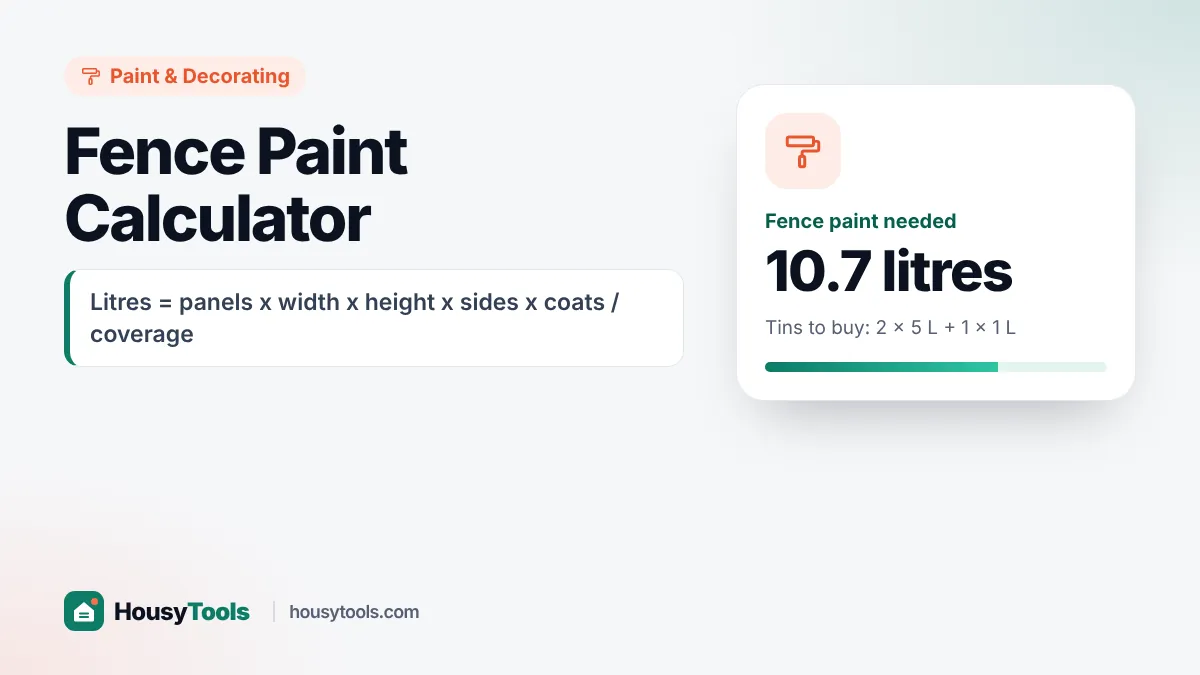
A fence paint calculator is a tool that converts the number and size of your fence panels into the litres of paint or wood treatment needed to cover them.
The formula is panels x panel width x panel height x sides painted, which gives the total area in square metres. That area is multiplied by the number of coats and divided by the coverage per litre printed on the tin. The result is the litres you need, and dividing by the number of panels gives the paint per panel.
Our fence paint calculator then suggests the mix of 5 L, 2.5 L and 1 L tins that covers the job with the least waste. Fence treatments are also sold in other sizes, such as 9 L tubs, so treat the tin mix as a guide and compare it with what your shop stocks.
How Do You Use the Fence Paint Calculator?
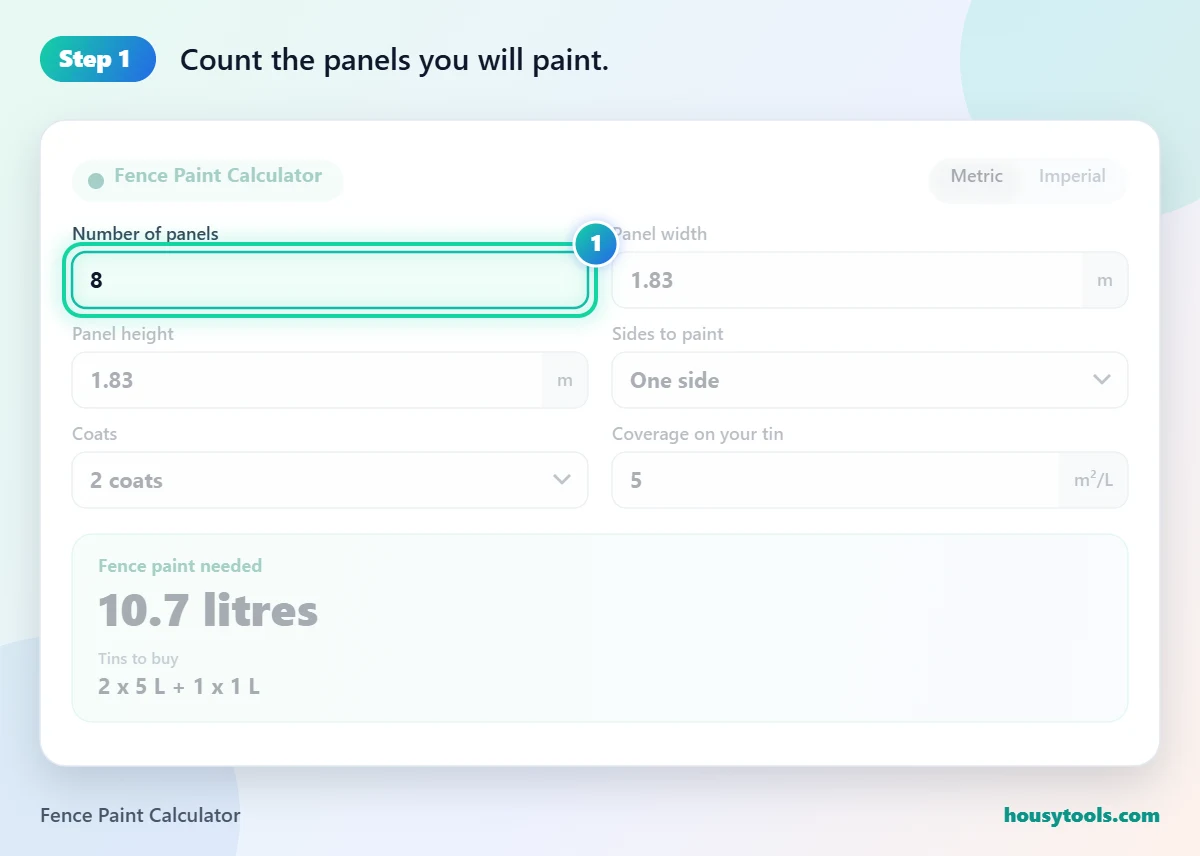
- Count the panels you will paint. Count gates as extra panels of a similar size.
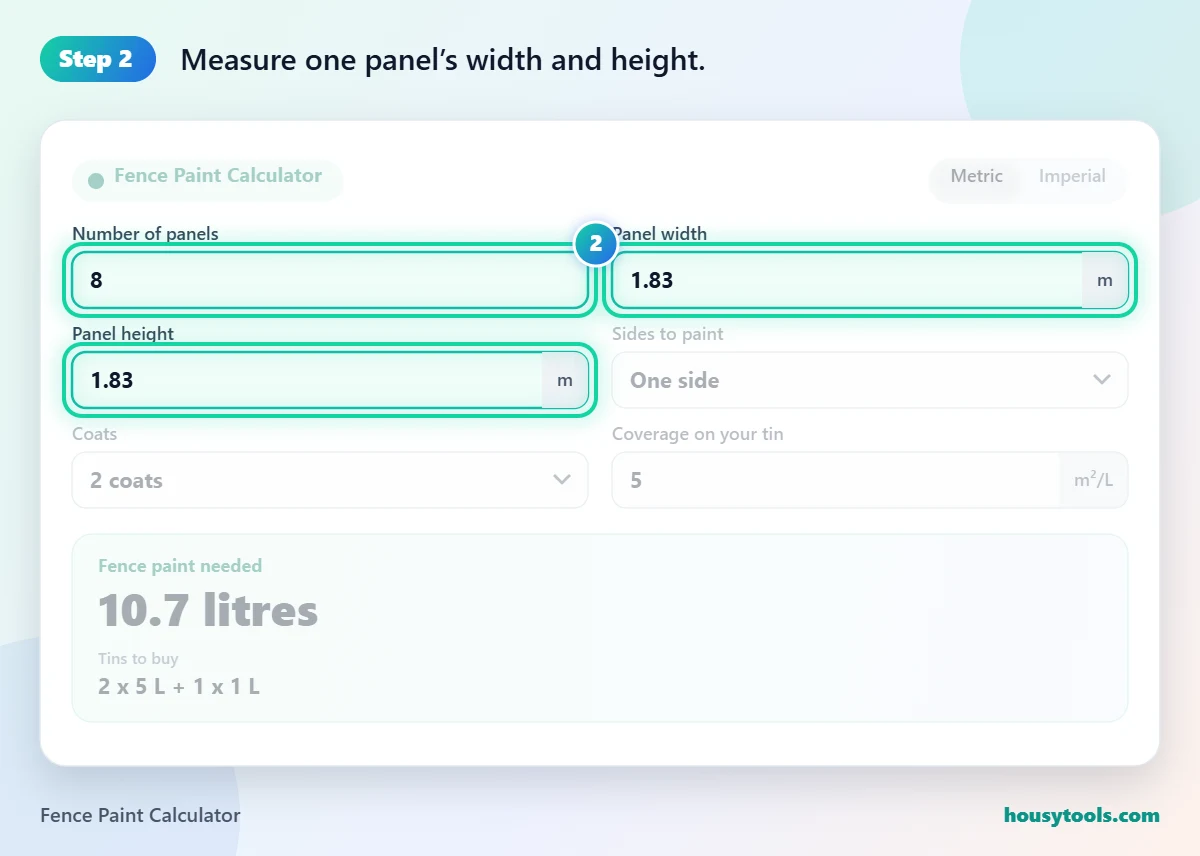
- Measure one panel’s width and height. A standard UK 6 ft panel is about 1.83 m by 1.83 m, which is the default.
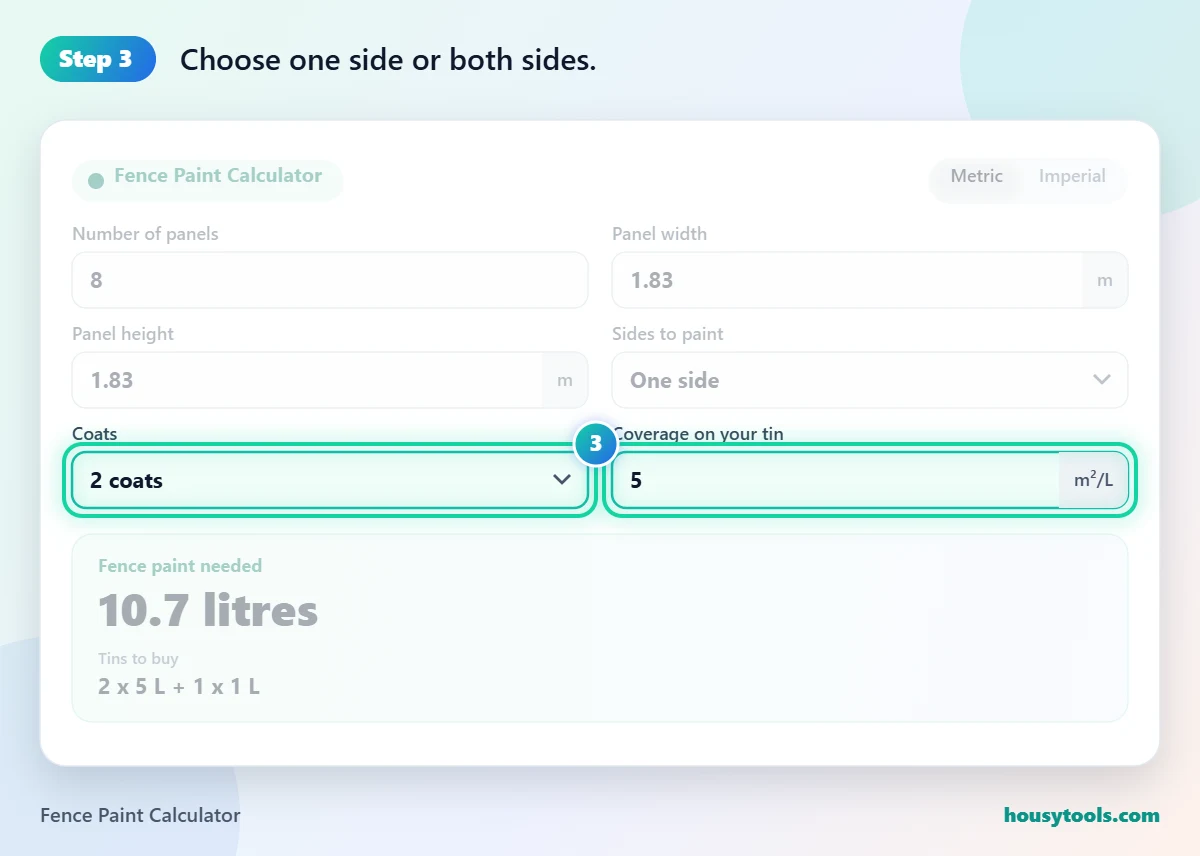
- Choose one side or both sides. Painting both sides doubles the area.
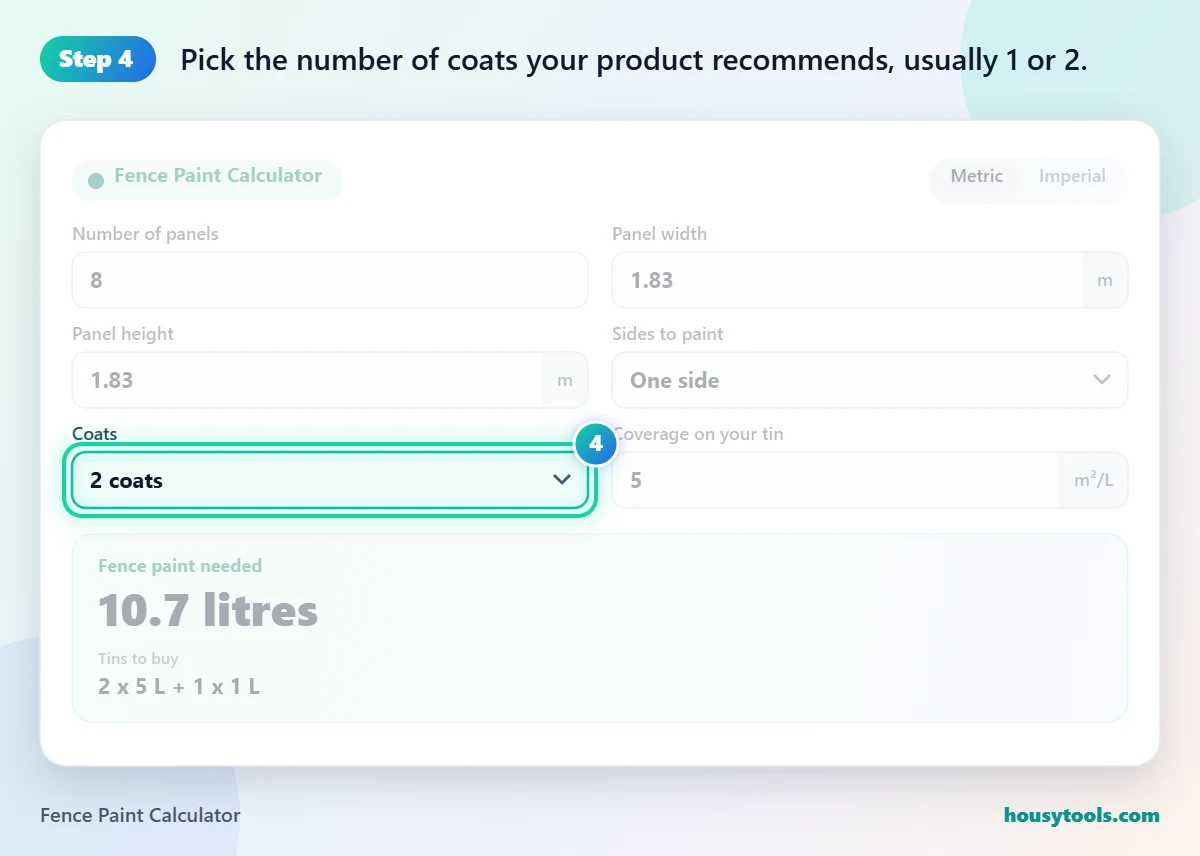
- Pick the number of coats your product recommends, usually 1 or 2.
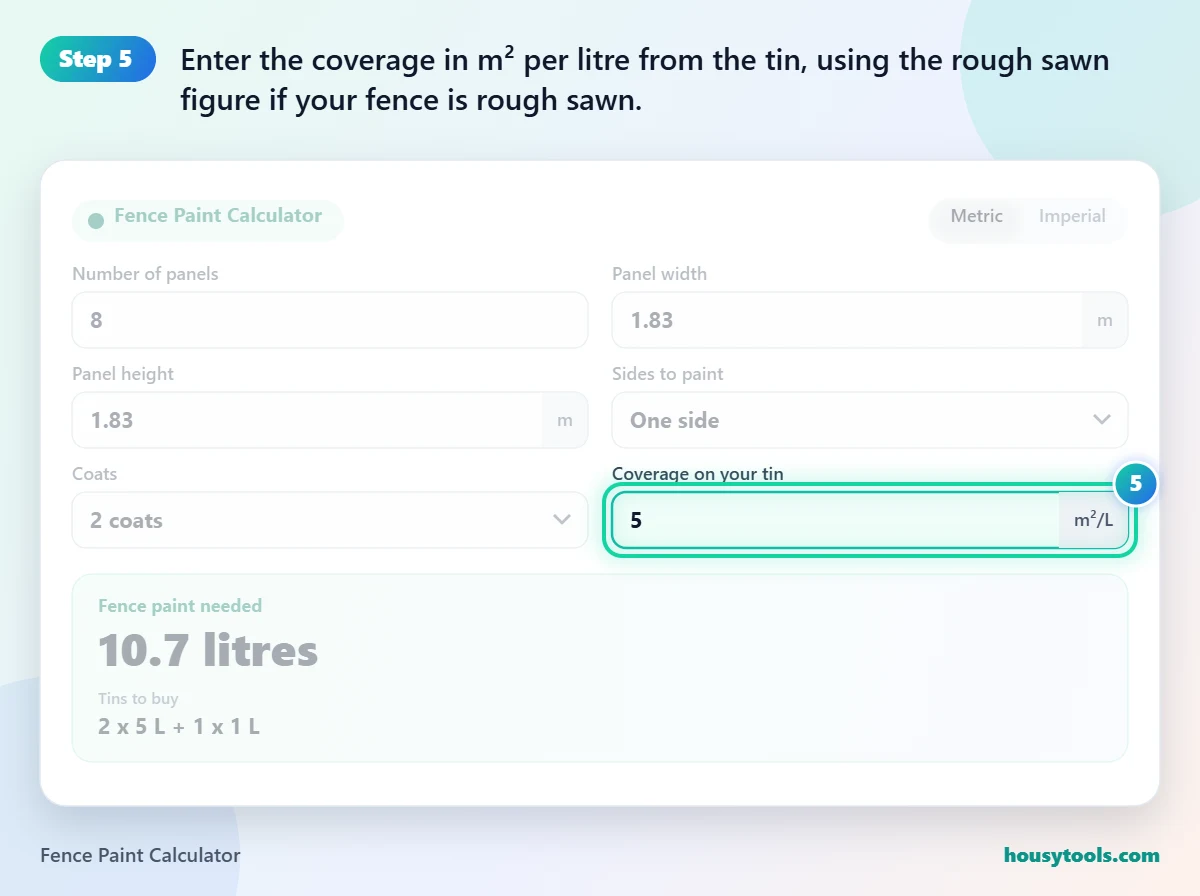
- Enter the coverage in m² per litre from the tin, using the rough sawn figure if your fence is rough sawn.
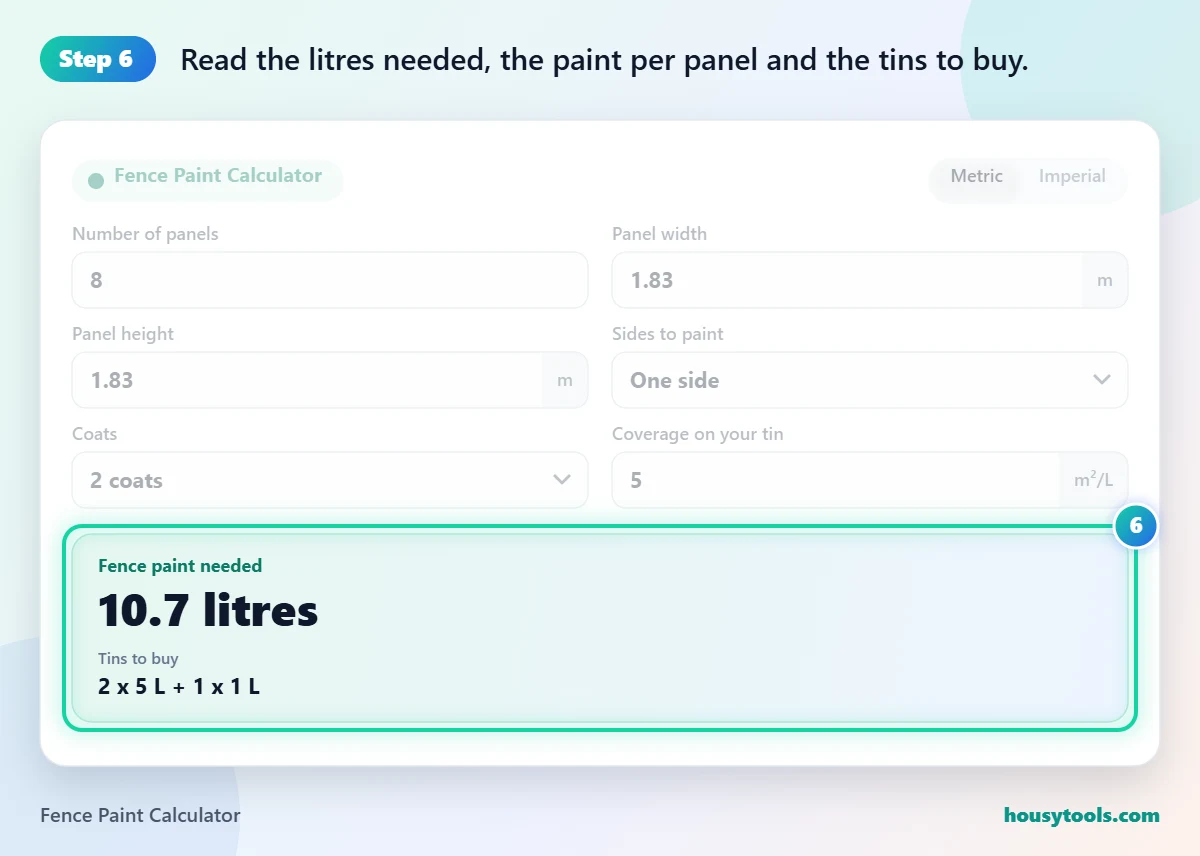
- Read the litres needed, the paint per panel and the tins to buy.
How Much Paint Do I Need for a Fence Panel?
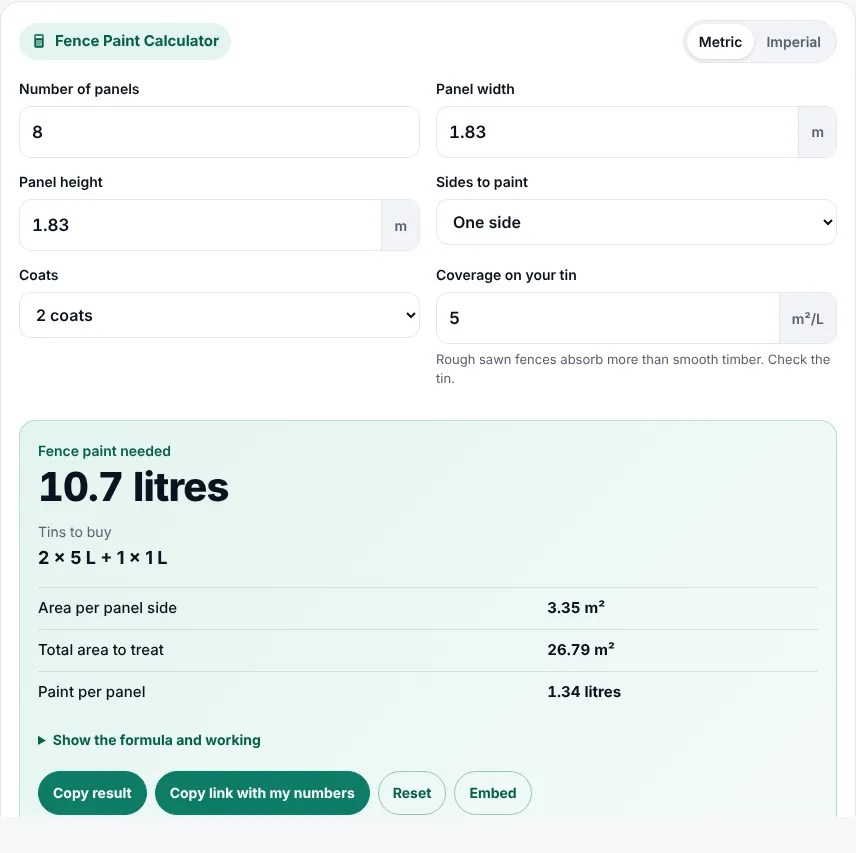
A standard 1.83 m by 1.83 m (6 ft by 6 ft) fence panel has about 3.35 m² per side, so two coats at 5 m² per litre need about 1.34 litres per panel per side.
Coverage is the number that changes everything. Most UK garden fences are made of rough sawn timber, which soaks up far more product than smooth planed wood. At 3 m² per litre the same ten panels need 22.3 litres, while at 10 m² per litre they need only 6.7 litres. That is why the fence paint calculator asks for your tin’s figure instead of assuming one.
Overlap and featheredge panels have extra edges and gaps that are not counted in a flat width times height measurement. On a very weathered fence, lower the coverage a little to allow for this.
What Coverage Do Fence Paints Give?
Most fence paints and treatments cover about 3 to 6 m² per litre per coat on rough sawn timber, and roughly twice that on smooth planed wood, but the tin is always the final word.
Manufacturer figures show the range. Cuprinol lists Garden Shades at 3 to 5 m² per litre on rough sawn wood by brush, and 10 to 12 m² per litre on smooth planed wood, with lower figures when sprayed. Ronseal states that Fence Life Plus covers up to 6 m² per litre and needs two coats on rough sawn wood and three on smooth planed wood.
One coat products exist too. Ronseal says its One Coat Shed and Fence Protector covers 6 m² per litre, with one coat on rough sawn timber in good condition. Set the fence paint calculator to 1 coat for those, and read the default of 5 m² per litre as a cautious example, not a product figure.
Fence Paint Needed by Number of Panels
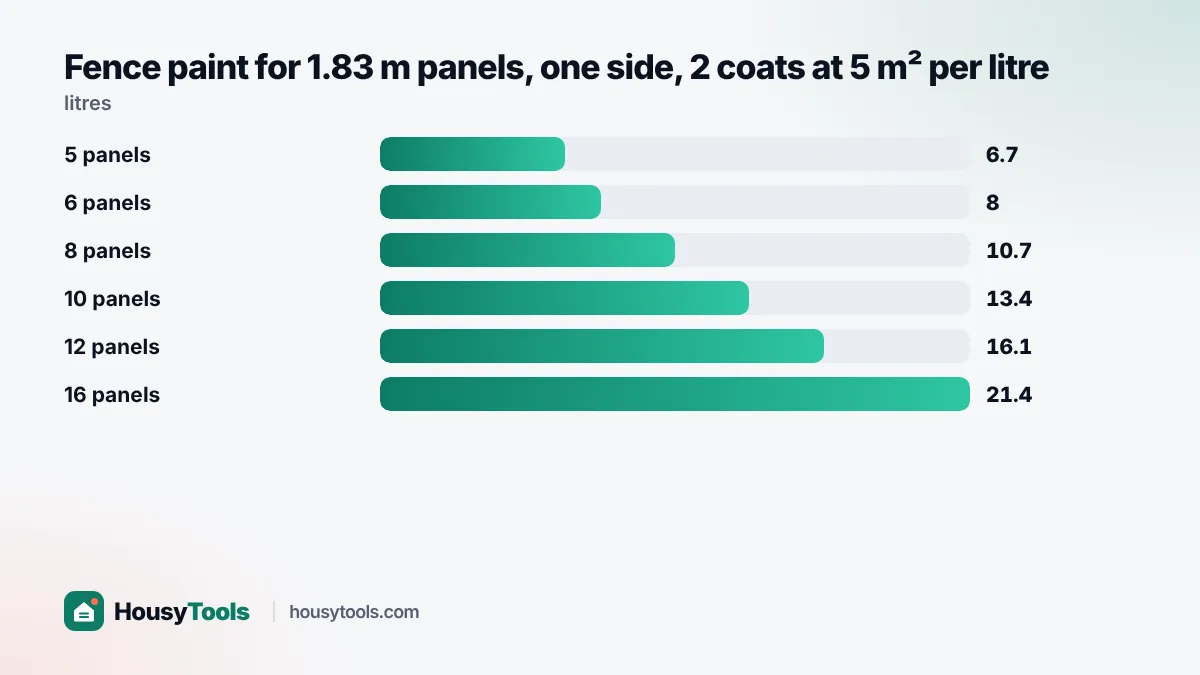
The table was produced by the fence paint calculator for standard 1.83 m panels with two coats at 5 m² per litre.
| Panels | Sides | Area to treat | Paint needed | Tins to buy |
|---|---|---|---|---|
| 5 | One | 16.74 m² | 6.7 litres | 1 x 5 L + 1 x 2.5 L |
| 6 | One | 20.09 m² | 8 litres | 1 x 5 L + 1 x 2.5 L + 1 x 1 L |
| 8 | One | 26.79 m² | 10.7 litres | 2 x 5 L + 1 x 1 L |
| 10 | One | 33.49 m² | 13.4 litres | 2 x 5 L + 1 x 2.5 L + 1 x 1 L |
| 12 | One | 40.19 m² | 16.1 litres | 3 x 5 L + 1 x 2.5 L |
| 16 | One | 53.58 m² | 21.4 litres | 4 x 5 L + 1 x 2.5 L |
| 10 | Both | 66.98 m² | 26.8 litres | 5 x 5 L + 1 x 2.5 L |
Worked Example: David’s Garden Fence
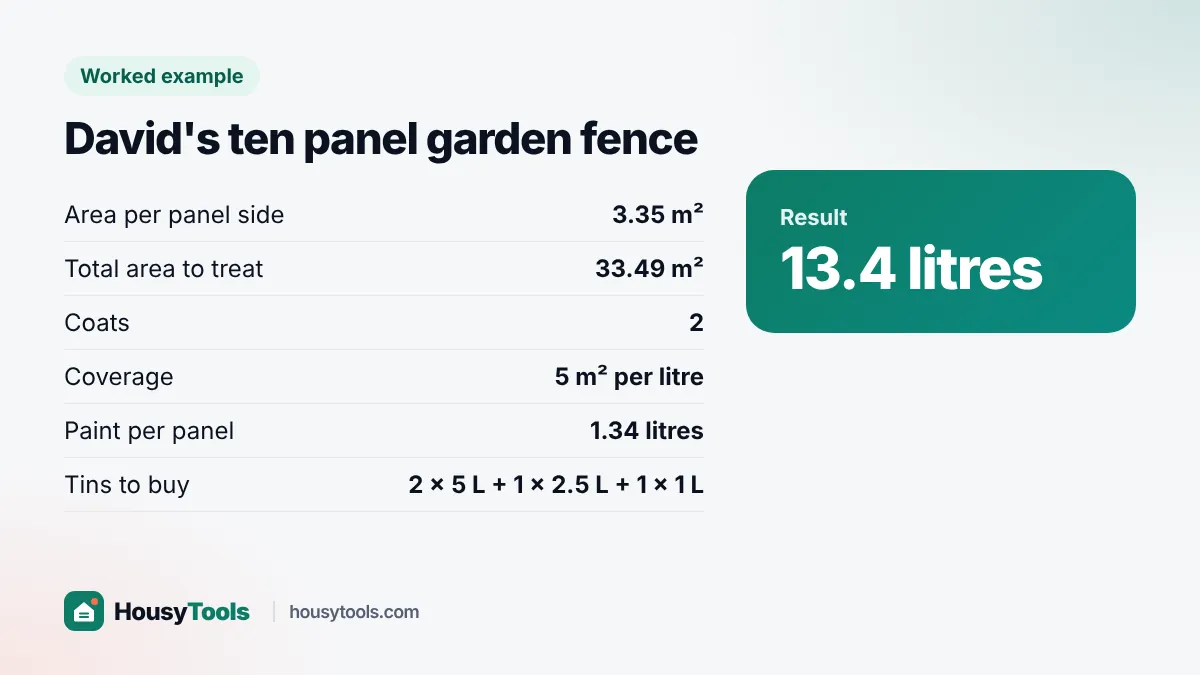
David has ten 6 ft overlap panels along the back of his garden in Norwich. He only owns the inside face, so he is painting one side. His rough sawn fence paint recommends two coats, and he enters a cautious 5 m² per litre into the fence paint calculator.
- Area per panel side: 1.83 m x 1.83 m = 3.35 m²
- Total area: 10 panels x 3.35 m² x 1 side = 33.49 m²
- Paint: 33.5 m² x 2 coats / 5 m² per litre = 13.4 litres
- Per panel: 1.34 litres
- Tins: 2 x 5 L + 1 x 2.5 L + 1 x 1 L
If David switched to a one coat product rated at 6 m² per litre, the fence paint calculator drops to 5.6 litres, suggesting 1 x 5 L and 1 x 1 L. He can weigh up the two products in the paint cost calculator using the tin prices.
When Should You Paint a Fence?
Paint a fence on a dry day when the timber is dry and the temperature is above the minimum on the tin, which is 5 °C for Cuprinol Garden Shades and 10 °C for Ronseal Fence Life Plus.
- Brush off moss, dirt and flaking old finish, and let a damp fence dry out fully first.
- Check the forecast: most treatments need a few dry hours before rain.
- Protect plants, paving and the neighbour’s side from drips and spray with dust sheets.
- Spraying is faster but uses more product, so lower the coverage figure if you spray.
- Ask your neighbour before painting their side of a shared fence or any fence they own.
- Wear gloves and eye protection, and wash brushes as the tin directs.
Painting a garden wall instead of timber? The masonry paint calculator adjusts for brick and render. For decks, the deck stain calculator works from the deck length and width.
Common Mistakes When Buying Fence Paint
- Using the smooth planed coverage on a rough sawn fence, which can leave you short by half. Enter the rough sawn figure into the fence paint calculator.
- Forgetting posts, gravel boards and gates. Add them as extra panels of a similar area.
- Buying one coat paint but planning two coats, or the reverse. Match the coats in the fence paint calculator to the tin.
- Mixing tins from different batches of a coloured treatment on one run. Stir them together in a bucket first so the shade stays even.
A short test patch on one panel is the best check of all: paint a measured area, see how much product it took, and adjust the coverage input to match your fence.
Fence Paint Calculator FAQs
How many fence panels will 5 litres cover?
At 5 m² per litre and two coats, 5 litres covers about 3.7 standard 6 ft panels on one side. Ronseal says 5 litres of its one coat shed and fence protector covers up to 6 panels. Your tin’s coverage figure decides the real number.
How much paint do I need for both sides of a fence?
Double the one side amount. Ten 6 ft panels need 13.4 litres for one side at two coats and 5 m² per litre, so both sides need 26.8 litres. Select both sides in the fence paint calculator to see the tins.
Do I need two coats of fence paint?
Many fence paints recommend two coats on rough sawn timber, and some recommend three on smooth planed wood. One coat products exist for fences in good condition. Follow the instructions on your tin and set the coats to match.
Why does rough sawn timber need more paint?
Rough sawn wood has a fibrous, open surface that absorbs more product and has more real surface area than a flat measurement shows. Cuprinol’s Garden Shades figures, for example, are less than half as high on rough sawn wood as on smooth planed wood.
How do I measure a fence that is not made of panels?
For close board or picket fencing, measure each run’s length and height and enter it as one panel with that width and height. Add posts and rails as extra panels if you will paint them.
Does the fence paint calculator work for sheds?
Yes. Treat each wall of the shed as a panel: enter its width and height, set panels to 1 and run each wall, or enter an average size and the number of walls. Add the doors and subtract nothing for small windows.
Checked October 2026. Sources: Cuprinol product data, Ronseal product data.