
Show the formula and working
This underfloor heating running cost calculator works out what electric underfloor heating costs per day, per year and per square metre. Enter the heated floor area, the output of the mat or cable in watts per square metre, how long it is switched on, the share of that time the thermostat keeps it heating and how many days a year you use it. It starts with the UK price cap unit rate, has EU presets, and you can type your own tariff.
Quick answer: Electric underfloor heating costs its power in kW times the hours it is heating times your unit rate. A 6 m² floor at 150 W/m² is 0.9 kW. On for 4 hours a day with the thermostat heating half the time, it uses 1.8 kWh a day, about 47p at 26.32p, or about £85.28 over 180 days.
How Is Underfloor Heating Running Cost Calculated?
Multiply the floor area by the heating output to get the system power, then multiply by the hours it is actually heating and by your unit rate.
The output is printed on the heating mat or cable and is given in watts per square metre, often around 100 to 200 W/m². A 6 m² floor at 150 W/m² draws 900 W, or 0.9 kW, while it is heating. The thermostat switches the system off once the floor reaches its set temperature, so it does not draw full power for every hour it is switched on. The calculator uses the heating share you enter for this. The daily kWh times your unit rate gives the daily cost, and times your days of use gives the yearly cost.
This calculator is for electric systems. Wet underfloor heating is run by a boiler or heat pump, so its cost follows your gas or heat pump running costs instead.
How Do You Use the Underfloor Heating Calculator?
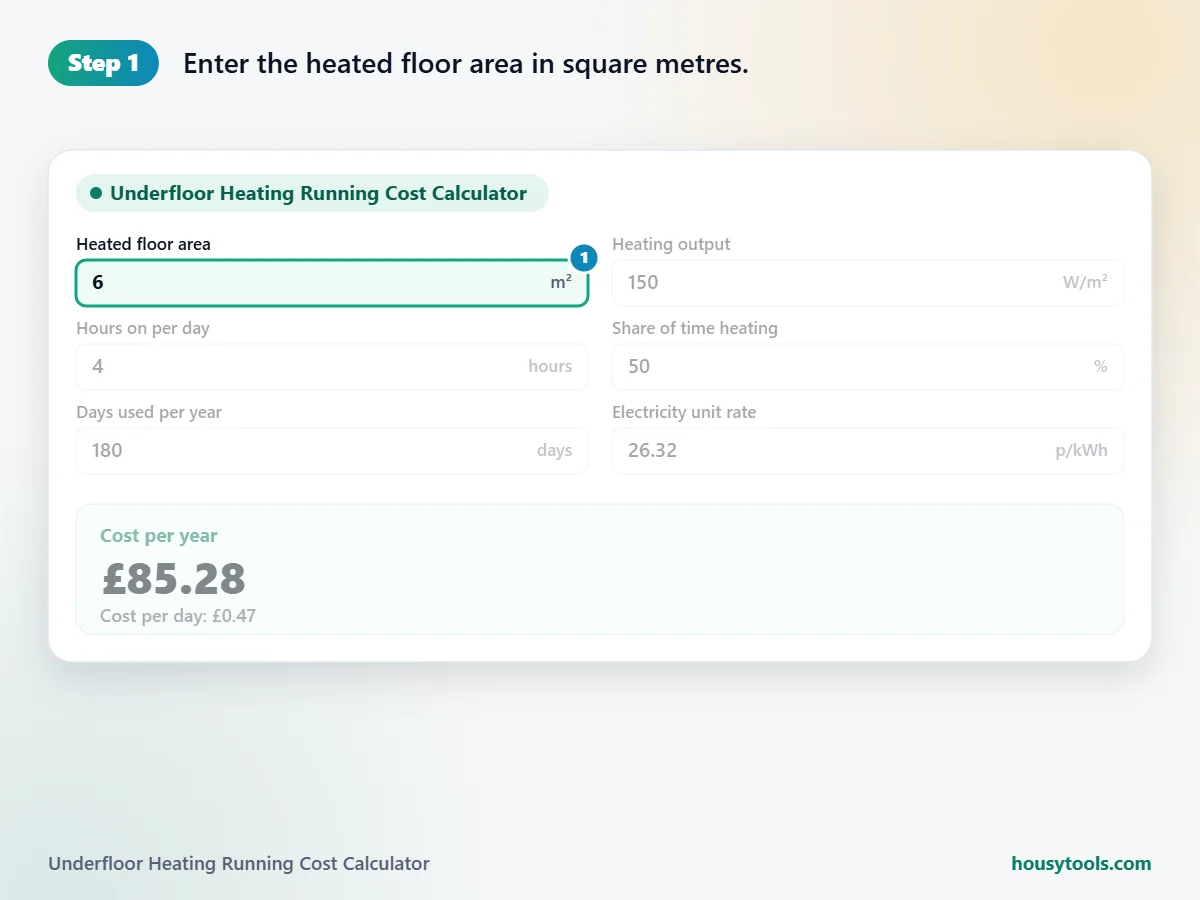
- Enter the heated floor area in square metres.
- Enter the heating output in W/m² from the mat or cable.
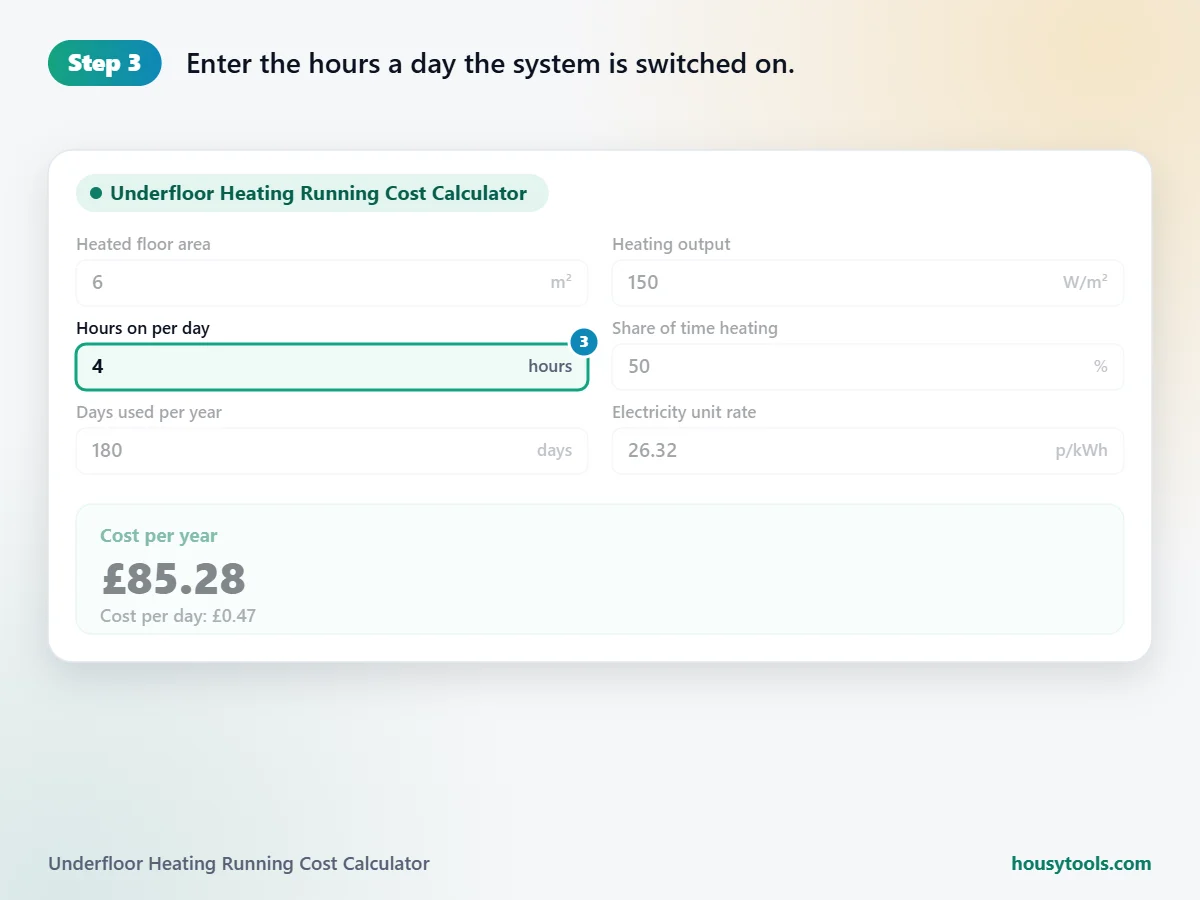
- Enter the hours a day the system is switched on.
- Set the share of time it is heating and the days used.
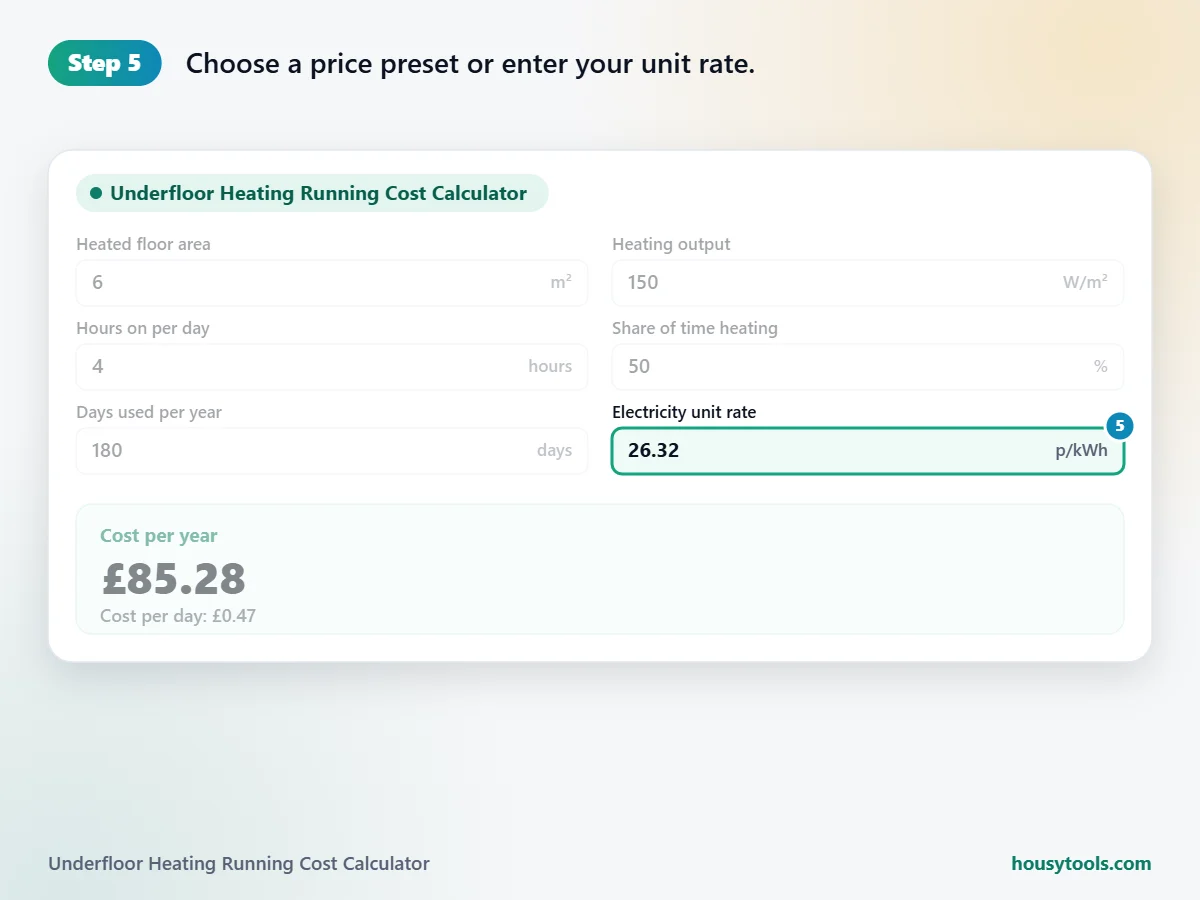
- Choose a price preset or enter your unit rate.


How Much Does Electric Underfloor Heating Cost to Run?
At 26.32p per kWh, each square metre of 150 W/m² heating costs about 3.95p for every hour it is actually heating.
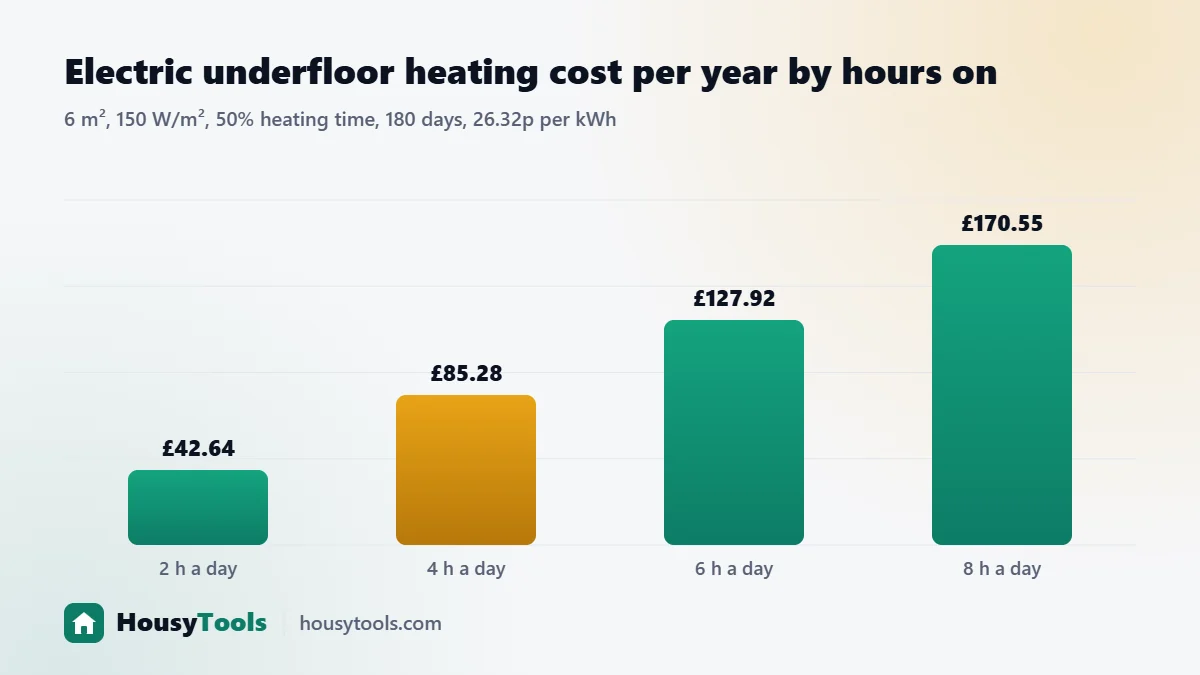
| Hours on per day | kWh per day | Cost per day | Cost per year | Cost per m² per year |
|---|---|---|---|---|
| 2 | 0.9 | £0.24 | £42.64 | £7.11 |
| 4 | 1.8 | £0.47 | £85.28 | £14.21 |
| 6 | 2.7 | £0.71 | £127.92 | £21.32 |
| 8 | 3.6 | £0.95 | £170.55 | £28.43 |
The 26.32p unit rate is the Ofgem price cap average for October to December 2026. Prices change every quarter, so you can check the latest figures on the Ofgem energy price cap page and type in your own rate.
What Affects the Heating Share?
The heating share depends mostly on how warm the room is, how well the floor is insulated underneath and how high the thermostat is set.
A floor laid over a good insulation board warms up faster and loses less heat downwards, so the thermostat can switch off sooner. A cold, uninsulated concrete slab can soak up heat for a long time before the surface feels warm. The 50% default is an example, so if your thermostat shows how long the system has been heating, use that figure. If not, try a few values to see the range of likely costs.
Is Electric Underfloor Heating Expensive to Run?
For a bathroom or small kitchen used for a few hours a day, it is usually a modest cost. It becomes expensive when it is the main heating for large rooms.
Electricity costs much more per kWh than gas, so heating a whole house with electric underfloor heating costs more than a gas boiler would for the same heat. For small rooms the comfort of a warm floor is often worth a few pounds a month. For sizing a new system, the underfloor heating mat calculator helps with mat area, and the underfloor heating calculator covers heat output.
Worked Example: A 4.5 m² Bathroom Floor
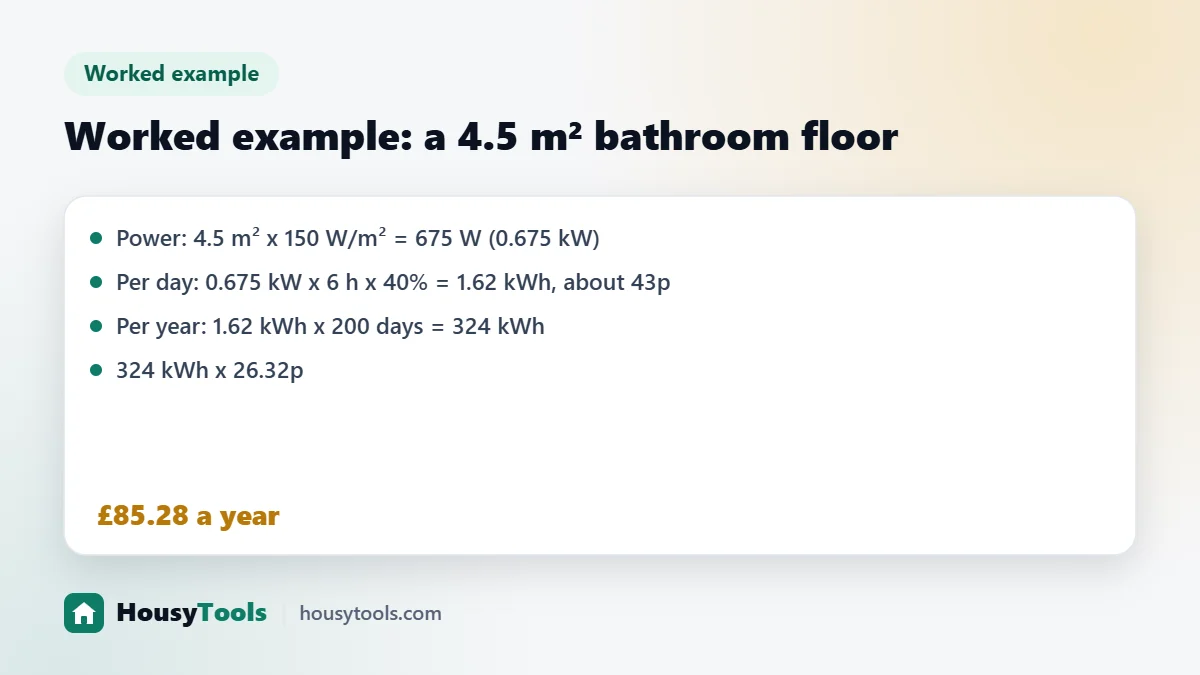
Example: a bathroom has 4.5 m² of 150 W/m² electric matting. It is on for 6 hours a day, heating 40% of that time, for 200 days a year, at the 26.32p price cap rate.
- Power: 4.5 m² x 150 W/m² = 675 W, or 0.675 kW
- Per day: 0.675 kW x 6 h x 40% = 1.62 kWh, about 43p
- Per year: 1.62 kWh x 200 days = 324 kWh
- Cost: 324 kWh x 26.32p = £85.28 a year, about £18.95 per m²
A useful habit is to set the timer so the floor is warm for the times you use the room, such as an hour before and during the morning and evening, rather than leaving it on all day. A floor sensor helps the thermostat read the real floor temperature.
How Can You Cut Underfloor Heating Costs?
Small changes to timing and temperature make the biggest difference.
- Use the timer or a smart thermostat so the floor only heats when the room is used.
- Lower the floor temperature by a degree or two and see if it still feels comfortable.
- Insulate under new systems with a suitable insulation board.
- Check the unit rate on your bill, especially if you are on a time of use tariff.
- Run the floor heating in cheap hours if your tariff has them, as a warm floor holds some heat.
Underfloor Heating Running Cost FAQs
How much does electric underfloor heating cost per hour?
A system costs its power in kW times your unit rate while heating. At 26.32p, each square metre of 150 W/m² heating costs about 3.95p per hour of heating.
How much does underfloor heating cost per m² per year?
With 150 W/m², 4 hours a day, heating half the time for 180 days at 26.32p, it is about £14.21 per m² a year. Your own hours and rate change this a lot.
Is underfloor heating cheaper than radiators?
Wet underfloor heating run by a boiler or heat pump can be efficient, because it works at lower water temperatures. Electric underfloor heating costs more per kWh than gas heating.
Does underfloor heating need to stay on all the time?
No. Electric systems warm up fairly quickly, especially over insulation board, so a timer that heats the floor before you use the room is usually cheaper.
What W/m² should I use?
Use the figure on your mat, cable or installation paperwork. Many electric systems are around 100 to 200 W/m².
Does the thermostat really reduce costs?
Yes. Once the floor reaches the set temperature the thermostat switches the power off, so the system draws power for only part of the time it is on.
Checked October 2026. Sources: Ofgem energy price cap, product output ratings from your mat or cable.