
Show the formula and working
This solar charge controller calculator works out the current rating and the PV input voltage your charge controller needs, for MPPT and PWM controllers on 12 V, 24 V and 48 V batteries. It suits vans, boats, sheds, cabins and other off grid systems. Enter your panels, how they are wired, their Voc and Isc, your battery voltage and the coldest temperature at your site.
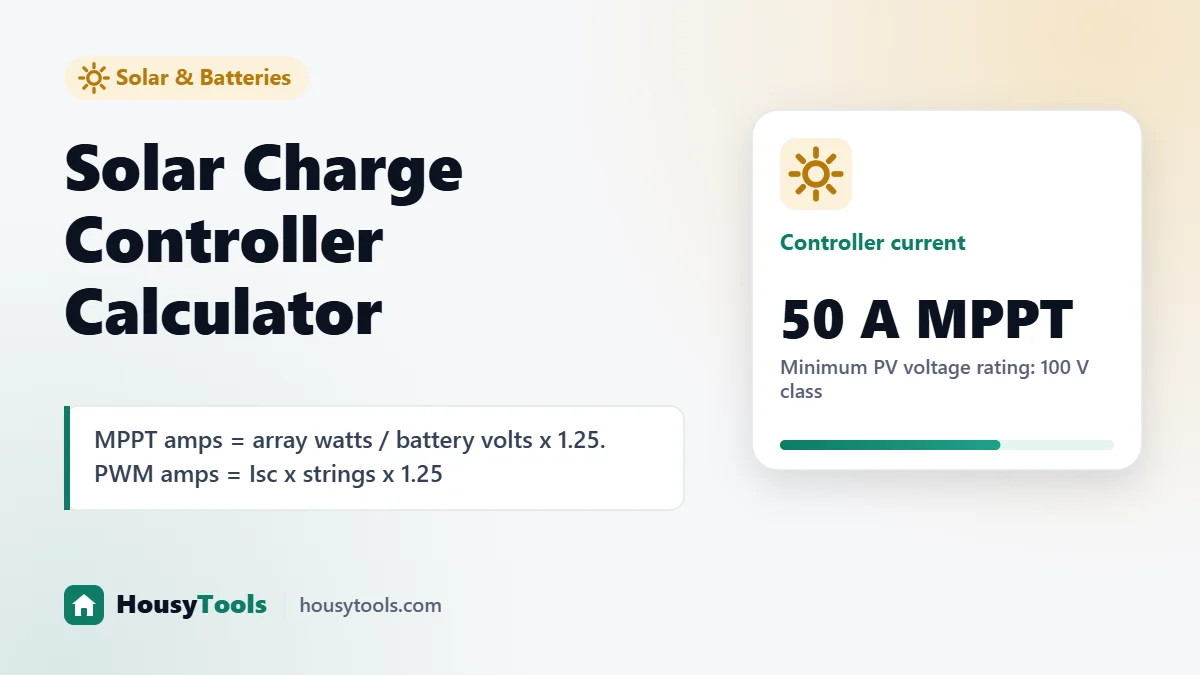
Quick answer: For an MPPT controller, divide the array’s watts by the battery voltage and add a safety margin, often 25%. For a PWM controller, multiply the panel short circuit current by the number of parallel strings and add the margin. 800 W of panels on a 24 V battery gives 41.7 A, so a 50 A MPPT controller.
What Is a Solar Charge Controller Calculator?
A solar charge controller calculator is a tool that sizes the charge controller between your solar panels and your battery, so it can handle the full charging current and the highest panel voltage safely.
The formula in plain words: an MPPT controller converts the panel voltage down to the battery voltage, so its output current is the array power divided by the battery voltage. A PWM controller connects the panels almost directly to the battery, so its current is the panels’ short circuit current times the number of parallel strings. Both get a safety margin and are rounded up to the next standard size. Panel voltage rises in the cold, so the calculator also corrects the string’s open circuit voltage for your coldest temperature and checks it against common controller voltage classes.
How Do You Use the Solar Charge Controller Calculator?
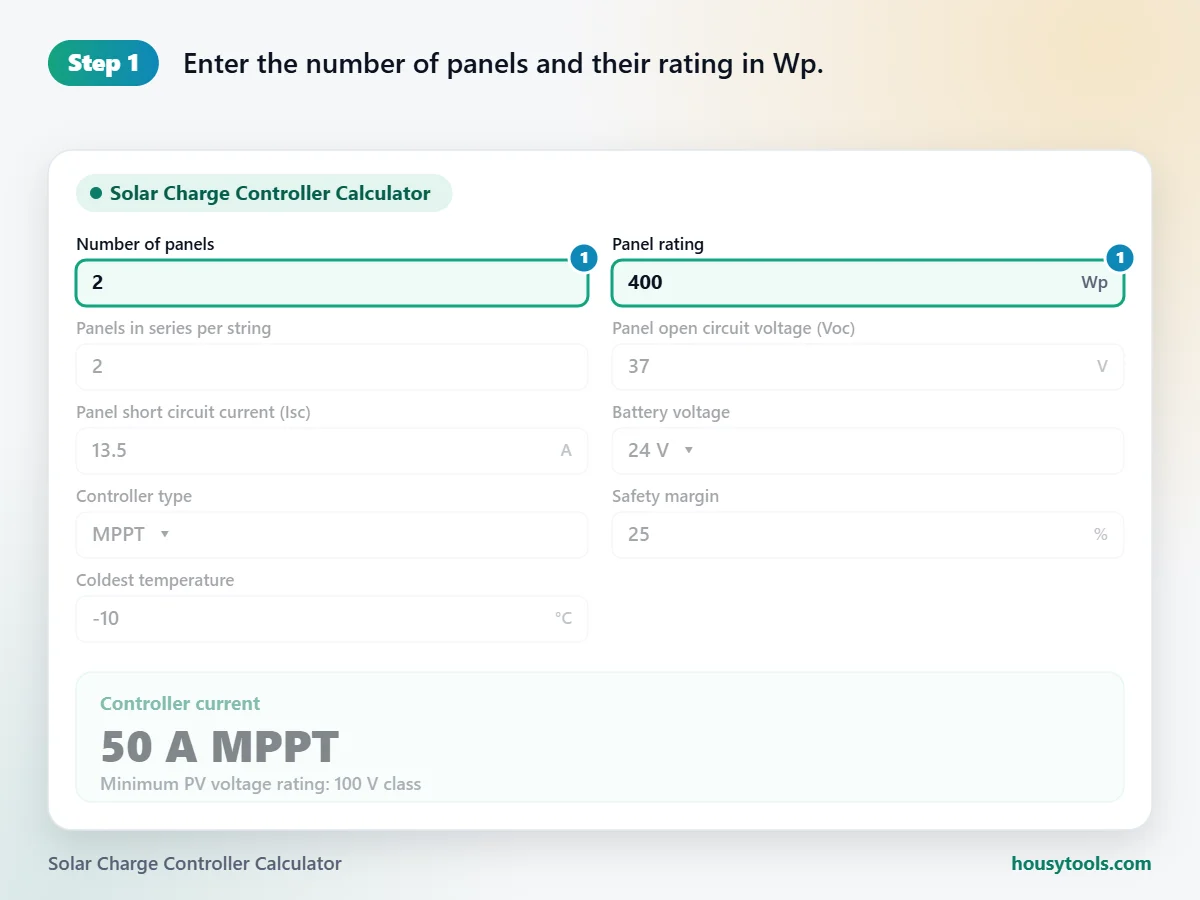
- Enter the number of panels and their rating in Wp.
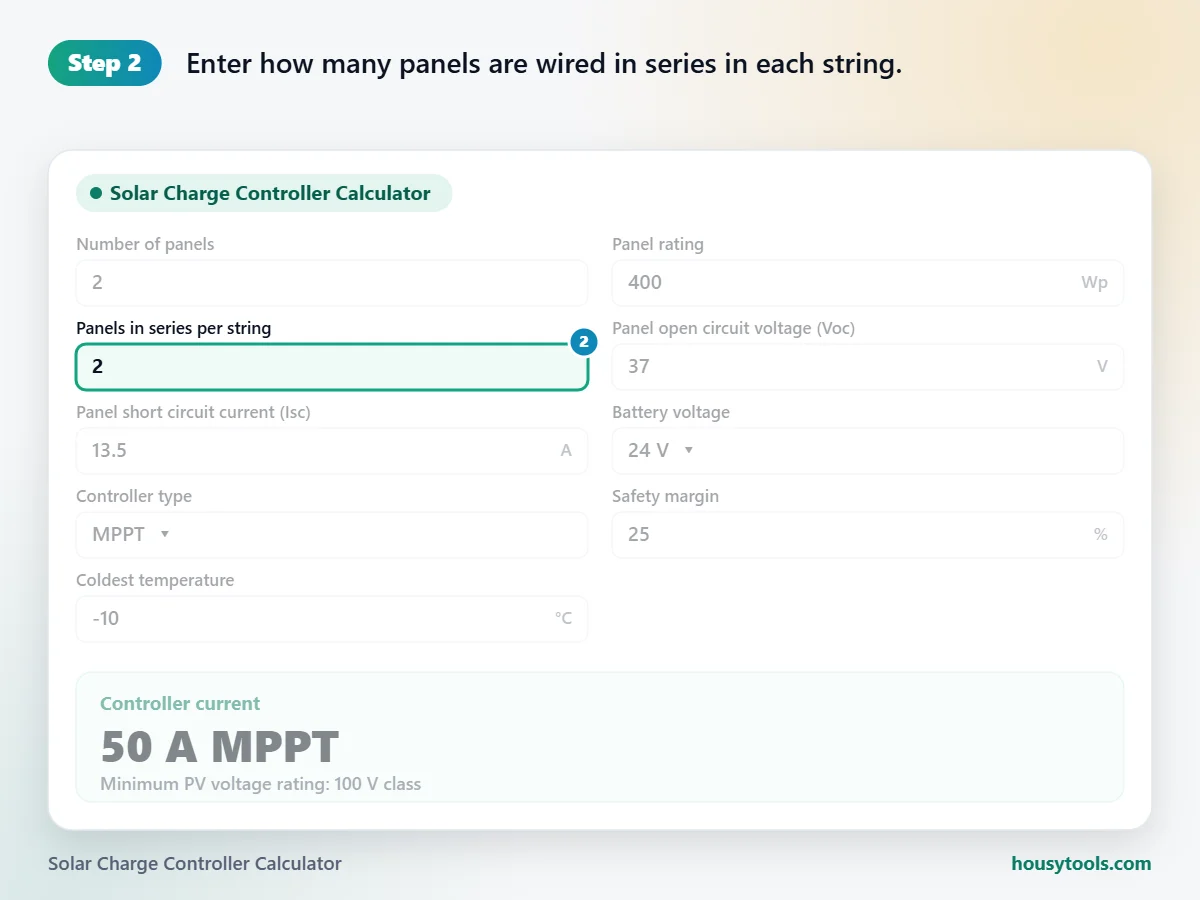
- Enter how many panels are wired in series in each string.
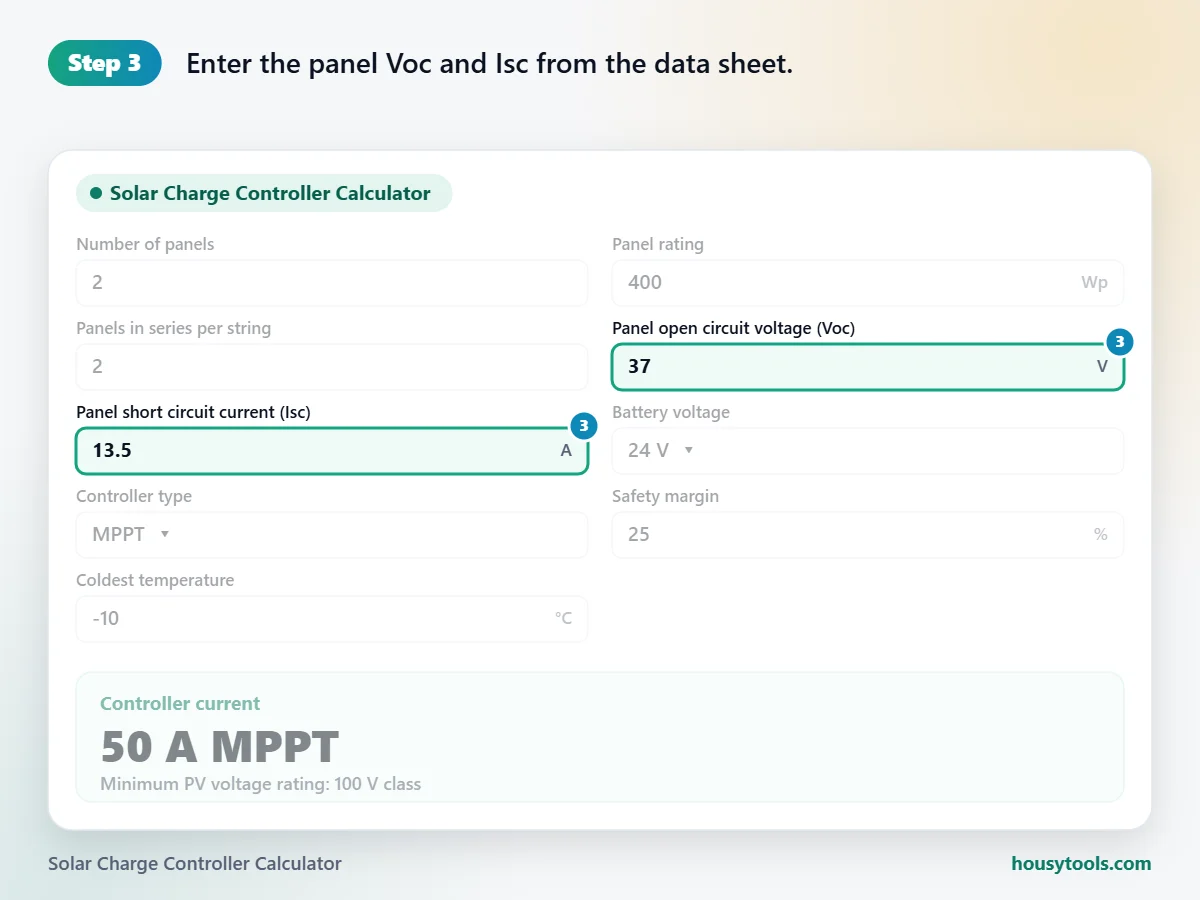
- Enter the panel Voc and Isc from the data sheet.
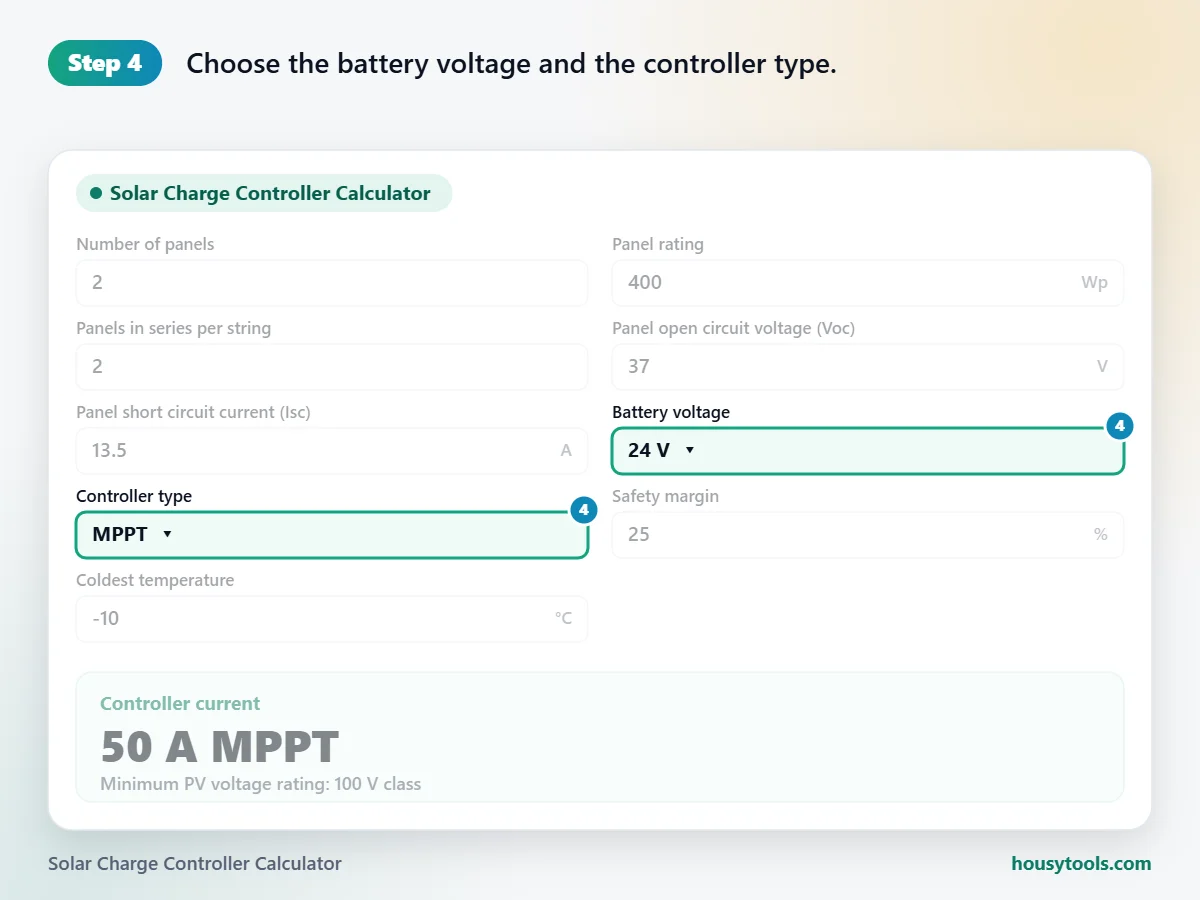
- Choose the battery voltage and the controller type.
- Set the safety margin and the coldest temperature at your site.
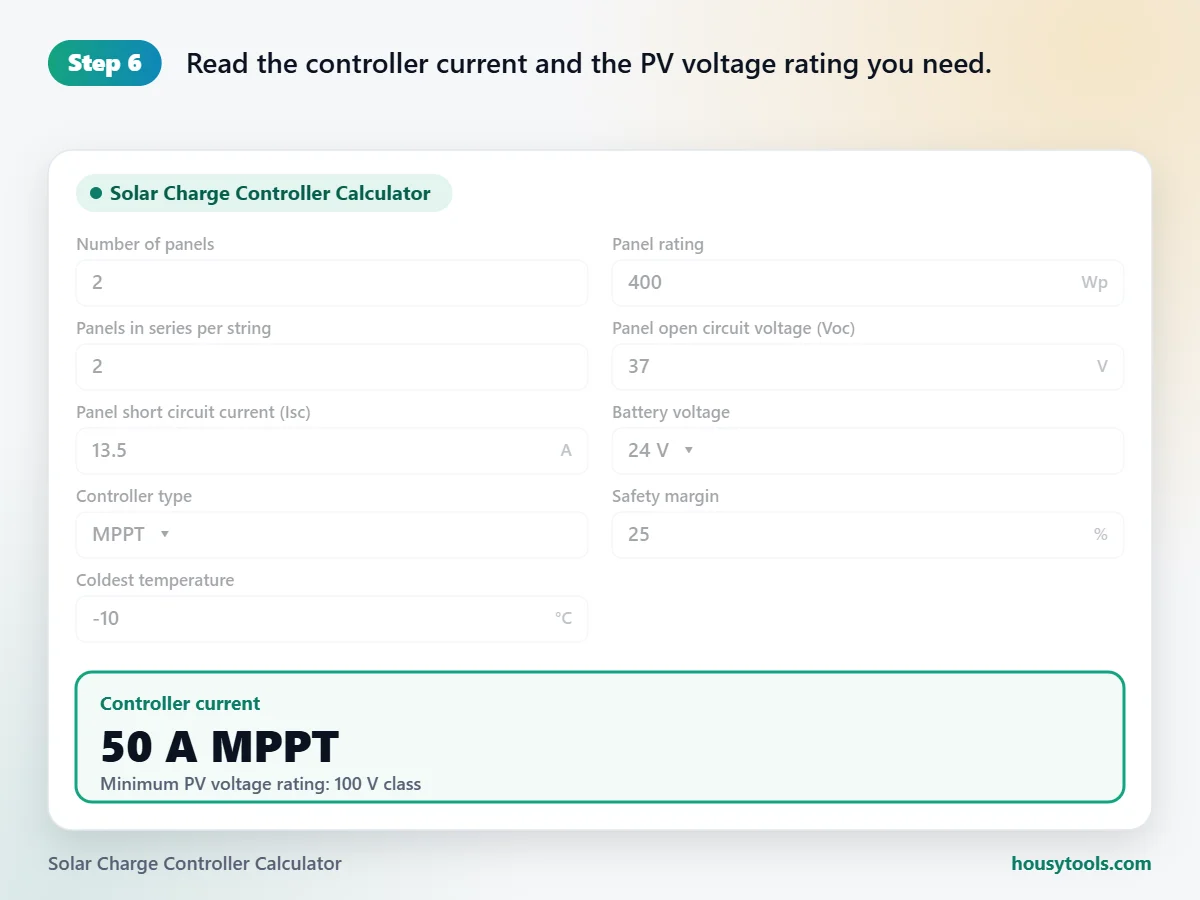
- Read the controller current and the PV voltage rating you need.

What Size Charge Controller Do I Need?
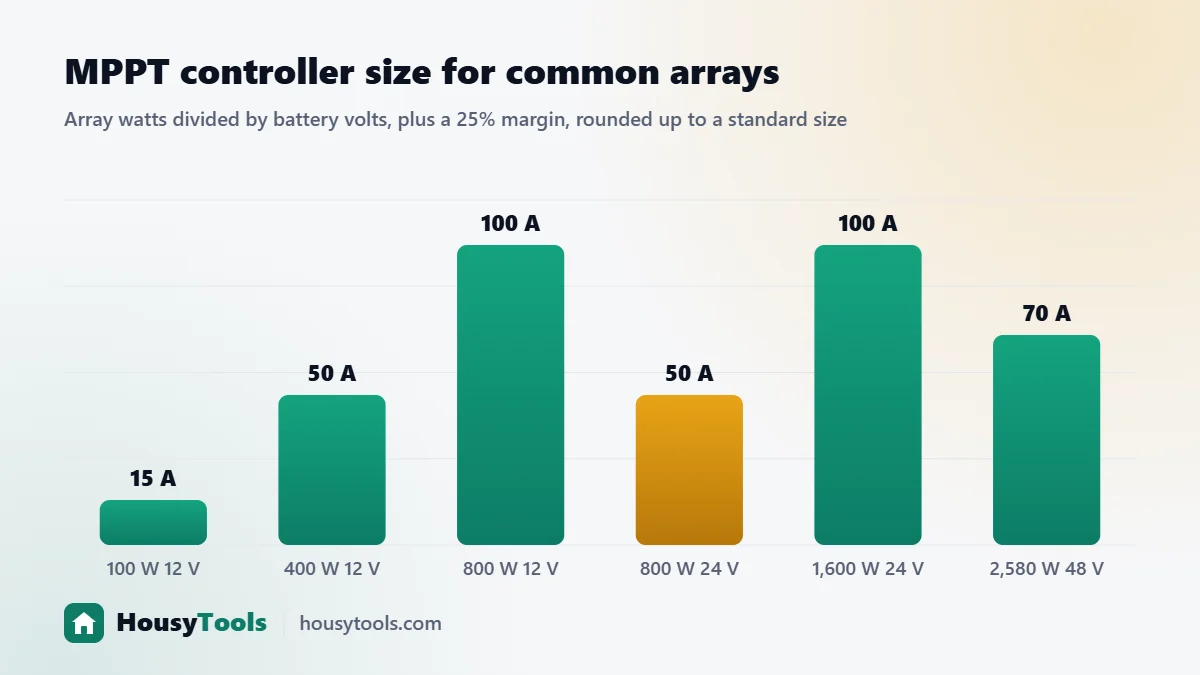
The controller size depends on the array watts and the battery voltage: 400 W on 12 V needs about 50 A, but the same 400 W on 24 V needs only about 25 A, because doubling the voltage halves the current.
| Array | Battery | Calculated current | Next standard MPPT size |
|---|---|---|---|
| 100 W | 12 V | 10.4 A | 15 A |
| 400 W | 12 V | 41.7 A | 50 A |
| 800 W | 12 V | 83.3 A | 100 A |
| 800 W | 24 V | 41.7 A | 50 A |
| 1,600 W | 24 V | 83.3 A | 100 A |
| 2,580 W | 48 V | 67.2 A | 70 A |
Some MPPT makers allow the array to be larger than the controller rating and simply limit the charging current on the brightest days. That can make sense in northern Europe, where full rated output is rare, but only within the limits on the data sheet.
MPPT or PWM: Which Charge Controller Is Better?
MPPT controllers are better for most systems because they track the panels’ maximum power point and convert extra panel voltage into extra charging current, while PWM controllers waste the voltage difference.
A PWM controller only suits small systems where the panel’s working voltage closely matches the battery, such as a single small 12 V panel. Modern home panels have working voltages well above 12 V or 24 V batteries, so with PWM much of their power is lost. You can read more about maximum power point tracking and how it raises yield.
Why Does Cold Weather Matter for Charge Controllers?
Panel open circuit voltage rises as cells get colder, so a string that is safe at 25 °C can exceed a controller’s maximum PV voltage on a frosty morning.
Crystalline silicon panels typically gain around 0.3% of Voc for every degree below 25 °C, and this calculator uses that figure. At minus 10 °C, two panels with a 37 V Voc in series reach about 81.8 V, which needs at least a 100 V class controller. For larger strings and exact coefficients, use the solar string calculator with the figures from your panel data sheet. Exceeding the controller’s maximum PV voltage can destroy it.
Worked Example: 800 W of Panels on a 24 V Van Battery
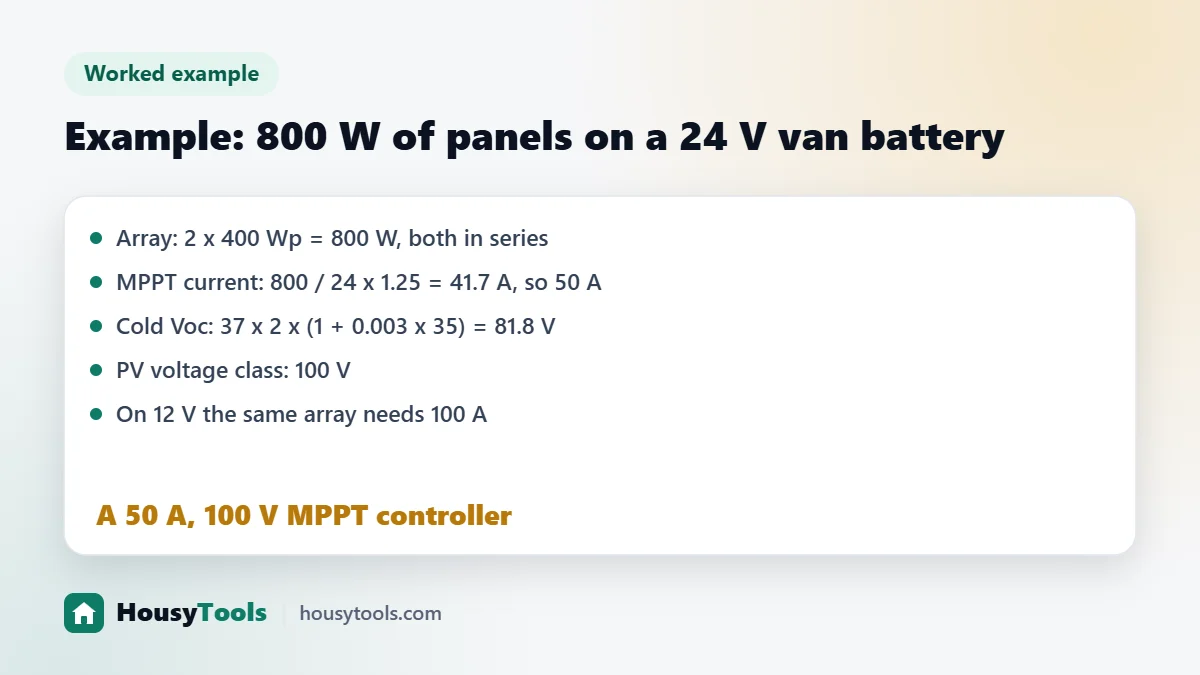
Example: a camper van has two 400 Wp panels wired in series, each with a Voc of 37 V and an Isc of 13.5 A, charging a 24 V lithium battery. The coldest night is about minus 10 °C.
- Array power: 2 x 400 Wp = 800 W
- MPPT current: 800 W / 24 V x 1.25 = 41.7 A, so a 50 A controller
- Cold Voc: 37 V x 2 x (1 + 0.003 x 35) = 81.8 V
- PV voltage class: at least 100 V
- On a 12 V battery the same panels would need a 100 A controller
Moving from 12 V to 24 V halves the controller current, which also allows thinner cables between the controller and the battery. For the energy side of the design, use the off grid solar calculator and the solar battery charge time calculator.
Charge Controller Safety Checks
Always check three numbers on the controller data sheet: the maximum PV input voltage, the maximum charging current and the maximum PV input power for your battery voltage.
- Fit a fuse or breaker between the controller and the battery, sized for the cable.
- Use cable rated for the current, with short runs to the battery.
- Set the controller’s battery profile to match your battery chemistry.
- Connect the battery before the panels, unless the maker says otherwise.
If you are not confident with DC wiring, have the system designed and installed by a qualified electrician or solar installer.
Solar Charge Controller Calculator FAQs
What size charge controller do I need for a 200 W panel?
On a 12 V battery, 200 W / 12 V x 1.25 = 20.8 A, so a 30 A MPPT controller is the next common size up. On 24 V the same panel needs about 10.4 A, so 15 A.
Can I use a bigger charge controller than I need?
Yes. A larger controller is safe and leaves room to add panels later. It only costs more. Make sure its maximum PV voltage still suits your panel string.
What happens if a charge controller is too small?
An undersized MPPT controller may limit the charging current and waste power, and exceeding its maximum PV voltage or input current can damage it. Always stay within the data sheet limits.
Do I need a charge controller for a small solar panel?
Yes, except for tiny trickle chargers designed to connect directly. A controller prevents overcharging, which can damage batteries and, with some chemistries, create a safety risk.
How do I wire panels for an MPPT controller?
Series wiring raises voltage and parallel wiring raises current. MPPT controllers usually work best with a string voltage well above the battery voltage but below the maximum PV voltage.
Is MPPT worth it over PWM?
For most arrays above about 100 W, yes. MPPT can turn the extra panel voltage into extra charging current, often giving noticeably more energy, especially in cold weather.
Checked October 2026. Sources: panel and controller data sheet conventions, Wikipedia on maximum power point tracking.