
Show the formula and working
This block paving calculator works out how many paving blocks you need for a driveway, path or patio, plus the tonnes of Type 1 sub base, laying course sand and kiln dried jointing sand. It is made for UK and European projects measured in metres and millimetres, with a feet and inches switch, and every block size, depth and density can be changed to match your products.
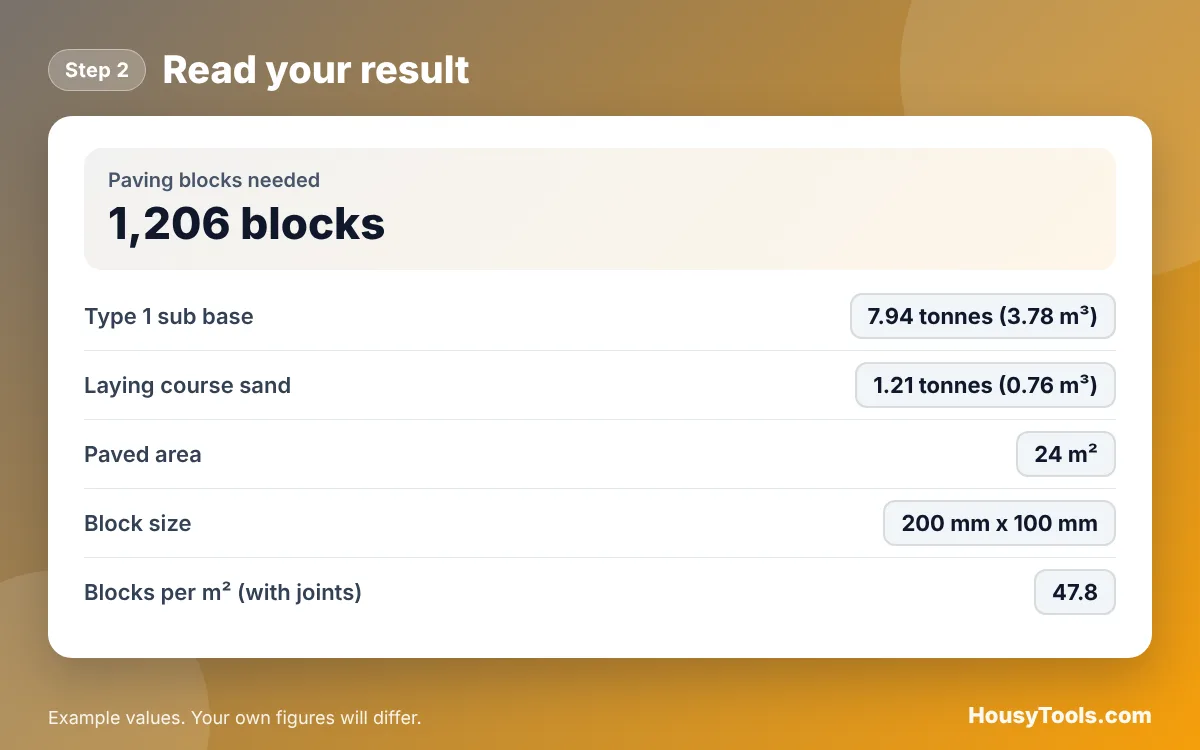
Quick answer: Multiply the area by the blocks per square metre, then add about 5% for cuts. With 200 x 100 mm blocks and 3 mm joints that is 47.8 per m², so a 6 m by 4 m driveway needs 1,206 blocks. The block paving calculator also gives 7.94 tonnes of sub base at 150 mm.
What Is a Block Paving Calculator?
A block paving calculator is a tool that converts the size of a paved area into the number of blocks and the volume and weight of the layers beneath them. Blocks per m² = 1,000,000 / ((block length + joint) x (block width + joint)) with sizes in millimetres. Blocks = area x blocks per m² x (1 + waste), rounded up. Each layer is area x depth, and tonnes are volume x density.
A block paved surface has four parts: a compacted sub base of crushed stone, a thin laying course of grit sand, the blocks themselves, and fine kiln dried sand brushed into the joints. Firm edge restraints, such as kerbs or edging blocks set in concrete, stop the blocks spreading, so the calculator also shows the perimeter.
How Do You Use the Block Paving Calculator?
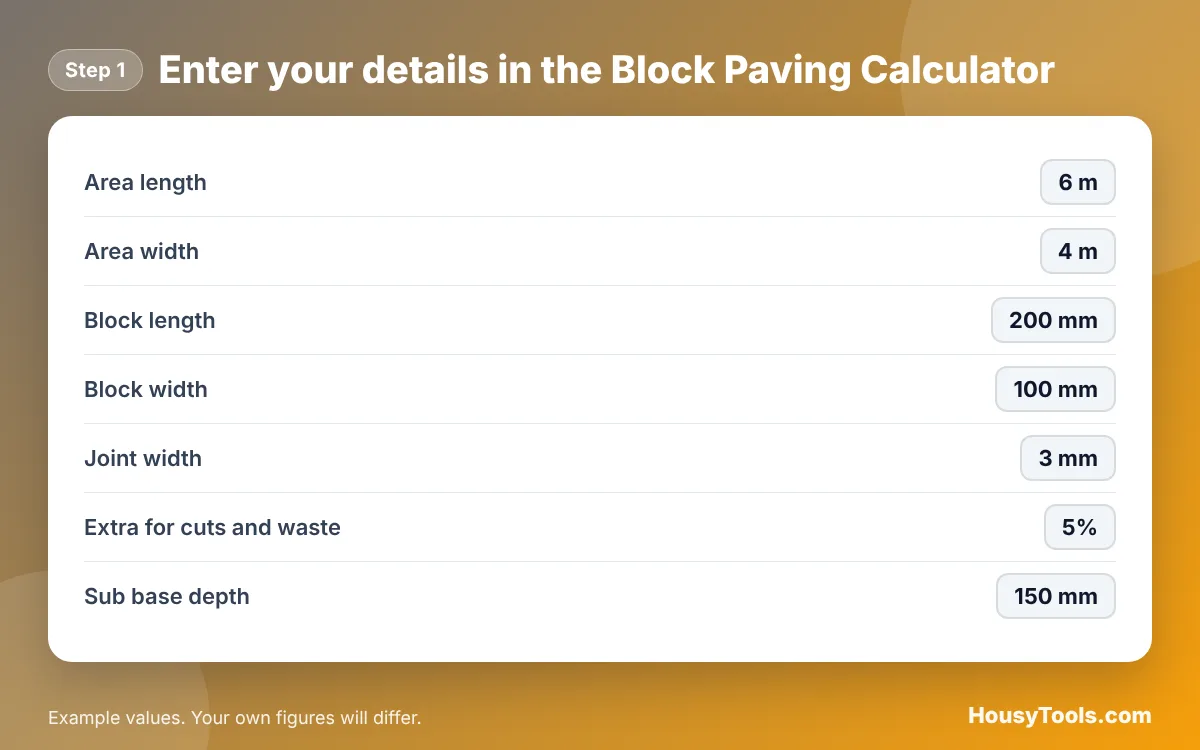
- Enter the Area length and Area width in metres. Split L shapes into rectangles and add the results.
- Enter the Block length, Block width and Joint width for your chosen blocks.
- Set Extra for cuts and waste: 5% for straight stretcher bond, more for herringbone, curves or many cuts.
- Enter the Sub base depth and Laying course depth (compacted) from the manufacturer’s guide.
- Replace the example Sub base density, Laying course sand density and Jointing sand per m² with your supplier’s figures.
- Read the blocks, tonnes of sub base and sand, then open “Show the formula and working” to check every step.

How Many Paving Blocks per Square Metre?
There are 50 blocks of 200 x 100 mm in a square metre with no joints, and about 47.8 once a 3 mm joint is allowed for. Other sizes give very different counts, so always work from the exact size on the product sheet, and add your waste allowance after working out the plain count.
| Block size | Blocks per m² (no joint) | Blocks per m² (3 mm joint) | Blocks for 20 m² with 5% waste |
|---|---|---|---|
| 200 x 100 mm | 50.0 | 47.8 | 1,005 |
| 210 x 105 mm | 45.4 | 43.5 | 913 |
| 240 x 160 mm | 26.0 | 25.3 | 531 |
| 300 x 200 mm | 16.7 | 16.3 | 342 |
How Deep Should a Sub Base Be for Block Paving?
A domestic driveway needs about 150 mm of compacted Type 1 sub base, laid in layers no thicker than 75 mm, according to the Marshalls Drivesys installation guidelines. Paths and patios with foot traffic only can often use less, while soft clay or heavy vehicles call for more, so base the depth on your ground and loads.
The same guidance sets the laying course at 30 mm of well graded grit sand after compaction, never more than 40 mm, and asks for falls of at least 1 in 80 along the drive and 1 in 40 across it. Do not use soft building sand for the laying course, and keep the finished surface at least 150 mm below the damp proof course.
How Much Sand Do You Need for Block Paving?
For a 30 mm laying course you need 0.03 m³ of grit sand per square metre, which is about 48 kg per m² at the calculator’s example density of 1,600 kg/m³. Loose sand settles when the blocks are vibrated in, so order a little more than the compacted volume and keep the waste allowance in place.
Jointing sand is a separate, fine kiln dried sand brushed into the 2 to 5 mm joints. The amount depends on joint width and block depth, so the calculator uses an editable kilograms per square metre figure that you should take from the bag. Brush it in, vibrate the paving and brush in more until the joints are full.
Do You Need Planning Permission for Block Paving a Front Garden?
In England you need planning permission to pave more than 5 m² of a front garden with a surface that sends rainwater onto the road, but not if you use permeable block paving or drain the water to a lawn or soakaway. The GOV.UK guidance on permeable surfacing of front gardens explains the options. Check local rules elsewhere in the UK and Europe.
Worked Example: A Driveway
Example: a driveway 6 m long and 4 m wide is block paved with 200 x 100 mm blocks and 3 mm joints. Add 5% for cuts, plan 150 mm of Type 1 and a 30 mm laying course, and keep the example densities and 3 kg per m² of jointing sand.
- Area: 6 m x 4 m = 24 m².
- Blocks per m²: 1,000,000 / (203 x 103) = 47.83.
- Blocks: 24 x 47.83 x 1.05 = 1,205.3, so 1,206 blocks.
- Sub base: 24 x 0.15 x 1.05 = 3.78 m³, x 2,100 kg/m³ = 7.94 tonnes.
- Laying course: 24 x 0.03 x 1.05 = 0.756 m³, x 1,600 kg/m³ = 1.21 tonnes. Jointing sand: 24 x 3 x 1.05 = 76 kg.
The perimeter is 20 m, though the side against the house may not need an edging course. For a concrete haunch behind the edging, you can use the concrete calculator, and our home calculators cover the rest of the job.
Block Paving Calculator FAQs
How many block paving bricks are in a square metre?
Standard 200 x 100 mm blocks give 50 per square metre without joints and about 48 with 3 mm joints. Larger blocks give fewer, for example about 16 of 300 x 200 mm. Divide one square metre by the block area plus its joint to check any size.
How much Type 1 do I need for a block paved driveway?
Multiply the area by 0.15 m for a 150 mm sub base. A 24 m² drive needs 3.6 m³, or 3.78 m³ with 5% extra, which is about 7.9 tonnes at an example density of 2,100 kg/m³. Confirm the density with your supplier.
What sand is used under block paving?
The laying course uses well graded grit or sharp sand, compacted to about 30 mm, never soft building sand. The joints are filled with fine kiln dried sand, which flows into narrow gaps and locks the blocks together when the surface is vibrated.
How much waste should I allow for block paving?
Allow about 5% extra for a simple stretcher bond on a rectangular area, and 10% or more for herringbone, curved edges, manholes or many cuts. Buying all blocks from one batch also keeps the colour consistent across the drive.
Can block paving be laid on concrete?
Block paving is normally laid on a flexible sand course over a Type 1 sub base, not straight onto concrete, because water trapped above a solid slab can wash out the sand. If an old slab must stay, take advice on drainage and follow the block maker’s guidance.
Does block paving need edging?
Yes, every open edge of block paving needs a firm edge restraint, such as kerbs or edging blocks bedded and haunched in concrete. Without it the blocks creep outwards under traffic and the joints open. A house wall or existing kerb can act as the restraint on that side.
Checked October 2026. Sources: Marshalls Drivesys installation guidelines (150 mm Type 1, 75 mm layers, 30 mm laying course, falls, DPC clearance), Wickes concrete block paving installation details (2 to 5 mm joints, kiln dried jointing sand), GOV.UK permeable surfacing of front gardens guidance.