To work out how to calculate appliance running costs, divide the appliance’s power in watts by 1,000, multiply by the hours it runs to get kilowatt hours (kWh), then multiply by the price you pay per kWh. That one formula works for any electrical appliance in the UK or Europe, from a broadband router to an electric shower, as long as you use realistic hours and your own unit rate.
Quick answer: Running cost = watts / 1,000 x hours used x unit rate. At the UK price cap rate of 26.32p per kWh for October to December 2026, a 2,000 W heater costs 52.64p an hour and a 3,000 W kettle costs about 4p for a 3 minute boil. Appliances with thermostats usually cost less than this.

What Is the Formula for Appliance Running Costs?
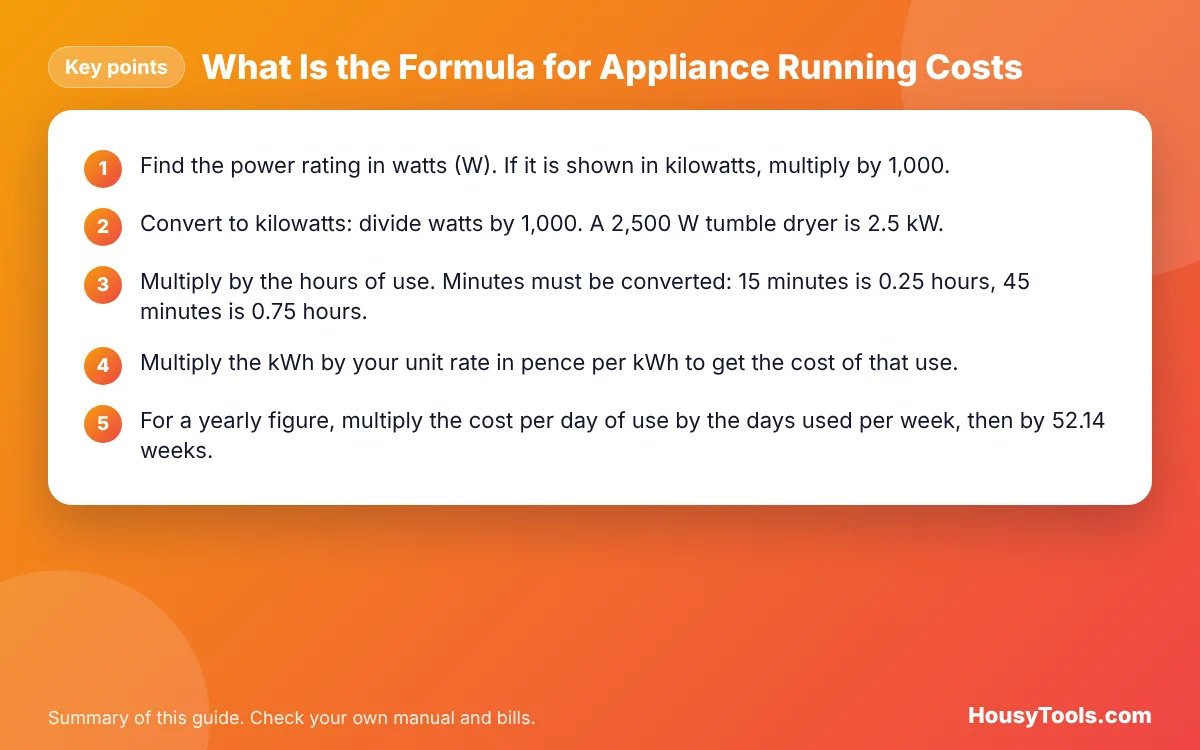
The formula is kWh = watts / 1,000 x hours, then cost = kWh x unit rate. One kWh is 1,000 watts used for one hour, as the kilowatt hour definition explains, and it is the unit your electricity meter counts and your supplier bills.
- Find the power rating in watts (W). If it is shown in kilowatts, multiply by 1,000.
- Convert to kilowatts: divide watts by 1,000. A 2,500 W tumble dryer is 2.5 kW.
- Multiply by the hours of use. Minutes must be converted: 15 minutes is 0.25 hours, 45 minutes is 0.75 hours.
- Multiply the kWh by your unit rate in pence per kWh to get the cost of that use.
- For a yearly figure, multiply the cost per day of use by the days used per week, then by 52.14 weeks.
The electricity cost calculator runs these steps for you and shows the cost per hour, day, week, month and year, with the working underneath so you can check it.
What Unit Rate Should You Use in 2026?
Use the unit rate on your latest bill; if you are on a standard variable tariff, the Ofgem price cap average from 1 October to 31 December 2026 is 26.32p per kWh for electricity paid by Direct Debit. Ofgem publishes these price cap unit rates and standing charges every quarter, and notes that the actual rate depends on your region, payment method and meter type.
Ofgem also states there is no VAT on electricity from 1 October 2026 to 31 March 2027, so the 26.32p figure already reflects that. Fixed tariffs can be higher or lower than the cap, and rates change each quarter, so a running cost worked out today is only accurate until your rate changes.
If you have a time of use tariff, such as Economy 7, use the rate for the hours the appliance actually runs. A dishwasher on a delay timer overnight uses the off peak rate, while a kettle at breakfast uses the day rate. The Economy 7 calculator shows whether a two rate tariff suits your pattern of use.
Where Do You Find an Appliance’s Wattage?
The wattage is printed on the rating plate, usually a sticker on the back, base or inside the door, and in the user manual. Look for a figure followed by W or kW. If a range is given, such as 2,520 to 3,000 W, use the higher figure for a cautious estimate.
If the plate only shows amps, multiply the amps by the voltage. The UK and Ireland use a nominal 230 V supply, so an appliance drawing 2 A uses about 460 W. This gives a maximum, not a typical figure.
Safety: Read ratings only from labels you can see without tools. Never remove covers or open hard wired appliances such as electric showers, immersion heaters or built in ovens to find a rating; check the manual instead. Any fixed wiring work must be done by a qualified, registered electrician.
How Do You Use the Energy Label Instead of Watts?
For washing machines, dishwashers, fridges and freezers, the energy label is more accurate than the wattage, because it states measured energy use rather than peak power. Since the labels were rescaled on 1 March 2021, a washing machine label shows weighted energy use in kWh per 100 cycles on the Eco 40 to 60 programme, and a fridge label shows kWh per year.
- Per 100 cycles: divide by 100 for one cycle. A label showing 50 kWh per 100 cycles means 0.5 kWh a wash, which costs 13.16p at 26.32p per kWh.
- Per year: multiply by the unit rate. A fridge freezer labelled 250 kWh a year costs about £65.80 a year at 26.32p per kWh.
These label values are examples only; use the figure on your own appliance. Label tests use set conditions, so hotter washes or a fridge in a warm kitchen will use more than the label suggests.
How Much Do Common Appliances Cost to Run per Hour?
An electric shower is usually the most expensive appliance per hour, at about £2.37 for a 9,000 W unit, while a broadband router costs about a quarter of a penny. The table uses typical wattages from the Centre for Sustainable Energy and the October to December 2026 price cap rate, at full rated power.
| Appliance | Typical power (W) | Cost per hour at full power (26.32p per kWh) |
|---|---|---|
| Electric shower | 9,000 | £2.37 |
| Immersion heater | 3,000 | 78.96p |
| Kettle | 3,000 | 78.96p |
| Tumble dryer | 2,500 | 65.80p |
| Washing machine | 2,100 | 55.27p |
| Oil filled radiator | 2,000 | 52.64p |
| Microwave | 1,000 | 26.32p |
| Dehumidifier | 500 | 13.16p |
| Fridge freezer | 300 | 7.90p |
| Desktop computer | 140 | 3.68p |
| Laptop | 50 | 1.32p |
| Broadband router | 10 | 0.26p |
Per hour figures only tell half the story. A kettle is expensive per hour but runs for minutes, while a router is cheap per hour but runs all 8,760 hours of the year. For showers, the electric shower cost calculator works per shower rather than per hour.
Why Do Fridges and Heaters Cost Less Than the Formula Says?
Appliances with a thermostat draw full power only part of the time, so multiplying their wattage by the hours they are switched on overstates the cost. The Centre for Sustainable Energy points out that fridges and freezers switch themselves off once they reach temperature. Heaters, ovens and washing machines heating water behave the same way.
For these, measure rather than estimate. A plug-in energy monitor between the socket and the appliance shows real kWh over a day or a week. A smart meter in-home display shows whole home use, so you can switch an appliance on and watch the change. Enter the measured kWh into your sum in place of watts x hours.
How Much Does Standby Cost?
Every watt left on standby all year uses 8.76 kWh, which costs about £2.31 at 26.32p per kWh. A household with several devices on standby can add up a noticeable sum: the Energy Saving Trust estimates you can save around £45 a year in Great Britain just by turning appliances off standby, in its quick tips to save energy.
Check the standby wattage in each manual, then multiply by 8.76 kWh per watt and your unit rate. Leave on anything that needs constant power to work properly, such as a fridge, freezer, boiler controls or a router you rely on.
Does the Standing Charge Count Towards an Appliance’s Running Cost?
No: the standing charge, 54.83p a day on average under the October to December 2026 electricity cap, is paid whether an appliance is on or off, so it does not belong in a per appliance sum. Include it only when estimating your whole bill, which the electricity bill calculator does from two meter readings.
Worked Example: A Tumble Dryer
Example: a 2,500 W tumble dryer runs for 1.5 hours, 3 days a week, at the price cap rate of 26.32p per kWh.
- Energy per day of use: 2,500 W / 1,000 x 1.5 h = 3.75 kWh.
- Cost per day of use: 3.75 x 26.32p = 98.7p, about 99p.
- Cost per week: 98.7p x 3 = £2.96.
- Cost per year: 98.7p x 3 x 52.14 weeks = £154.39.
- Cost per month: £154.39 / 12 = £12.87.
This assumes the dryer draws full power for the whole 1.5 hours, so the real figure is likely to be lower, especially with a sensor drying programme. Drying one of the three loads on a rack instead would save about a third, roughly £51 a year. Enter 2,500 W, 1.5 hours and 3 days into the electricity cost calculator to reproduce these figures, and see how our calculators work for the rounding we use.

What Are the Most Common Mistakes?
- Entering kilowatts as watts. 2 kW is 2,000 W; typing 2 gives a cost 1,000 times too low.
- Using minutes as hours. 20 minutes is 0.33 hours, not 0.2.
- Counting time switched on rather than time drawing power, for anything with a thermostat.
- Using an old unit rate. Price cap rates change every quarter.
- Adding the standing charge to a single appliance’s cost.
How to Calculate Appliance Running Costs FAQs
How do I convert watts to kWh?
Divide the watts by 1,000 and multiply by the hours of use. A 500 W dehumidifier running for 8 hours uses 500 / 1,000 x 8 = 4 kWh. At 26.32p per kWh, that costs £1.05.
How much does it cost to boil a kettle?
A 3,000 W kettle that takes 3 minutes to boil uses 0.15 kWh, which costs about 3.9p at the October to December 2026 price cap rate of 26.32p per kWh. Boiling only the water you need shortens the boil and cuts the cost.
Which appliances use the most electricity?
Appliances that heat water or air use the most: electric showers, immersion heaters, kettles, tumble dryers, electric heaters and ovens all draw 2,000 W or more. Over a year, how long each one runs matters as much as its wattage, so multiply power by real hours of use.
How do I work out the cost of a washing machine cycle?
Take the kWh per 100 cycles figure on the energy label, divide by 100, then multiply by your unit rate. A machine rated at 50 kWh per 100 cycles uses 0.5 kWh a wash, about 13p at 26.32p per kWh on the Eco 40 to 60 programme.
Is it cheaper to run appliances at night?
Only if you are on a time of use tariff such as Economy 7, which charges less per kWh at night. On a single rate tariff, the price per kWh is the same at any hour, so the time of day makes no difference to the running cost.
How accurate is a running cost calculation?
It is exact for appliances that draw steady power, such as a kettle or a basic heater without a thermostat. For fridges, ovens, washing machines and thermostatic heaters, it gives an upper estimate. A plug-in energy monitor or smart meter display gives the real figure.
For bills, heating, solar and EV charging tools, browse the energy bill calculators.
Checked October 2026. Sources: Ofgem: energy price cap unit rates and standing charges, Centre for Sustainable Energy: how much electricity am I using?, Centre for Sustainable Energy: energy monitors, Energy Saving Trust: quick tips to save energy, Siemens Home: the new energy label, Wikipedia: kilowatt hour, Wikipedia: mains electricity by country.