
Show the formula and working
This free door paint calculator tells homeowners, renters and decorators in the UK, Ireland and Europe how much paint and how many tins they need to paint one door or a whole house of doors. Choose a standard door size or enter your own, decide whether to include the edges, frame and architrave, and it shows the area, the litres for your number of coats and the tins to buy.
Quick answer: A door paint calculator multiplies the door height by its width, doubles it for both faces and adds the edges. A standard 1981 x 762 mm door is about 3.21 m² including edges, so two coats of a paint that covers 12 m² per litre take 0.54 litres. One 750 ml tin paints one door.

What Is a Door Paint Calculator?
A door paint calculator is a tool that converts door measurements into the litres of paint and number of tins needed for a chosen number of coats.
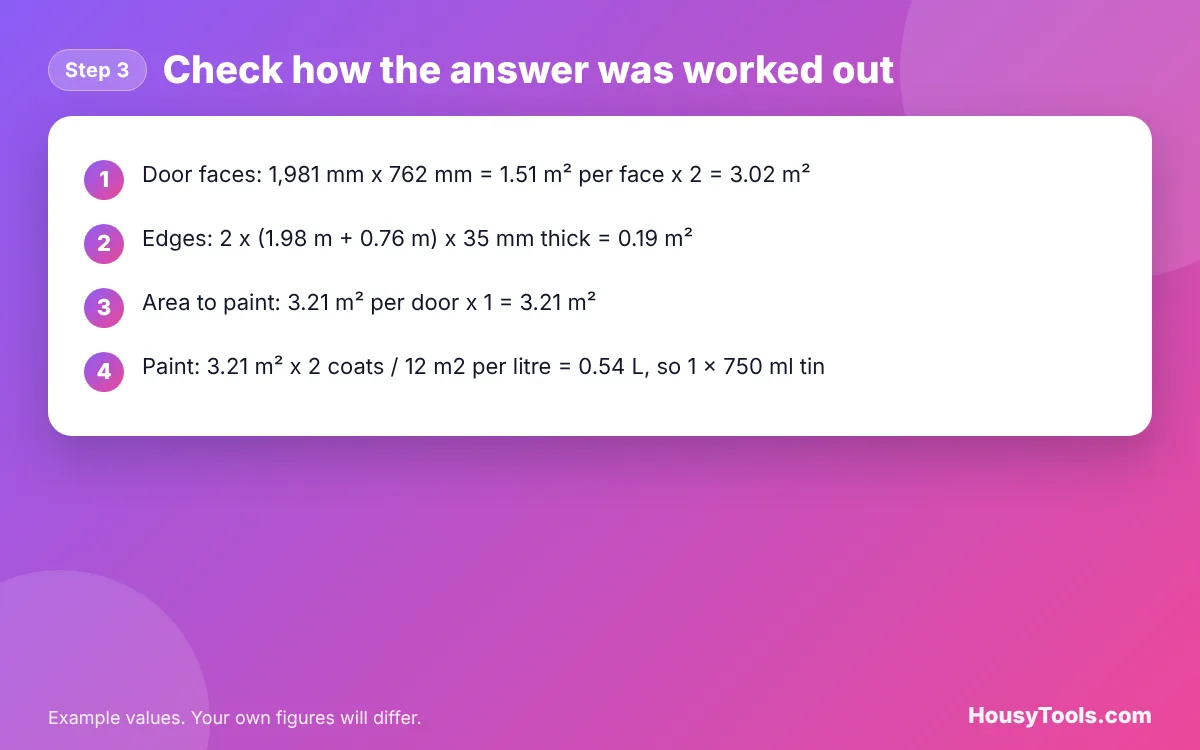
The formula in plain words: the area of one face is the height multiplied by the width. Multiply by two for both faces and add an allowance for panels if the door has mouldings. The four edges add the perimeter (twice the height plus twice the width) multiplied by the door thickness. If you include the frame, add the frame lining (two legs and a head multiplied by the lining depth) and the architrave on each side. Paint in litres equals the total area multiplied by the number of coats, divided by the coverage in square metres per litre printed on the tin. Tins equal the litres divided by the tin size, rounded up.
How Do You Use the Door Paint Calculator?
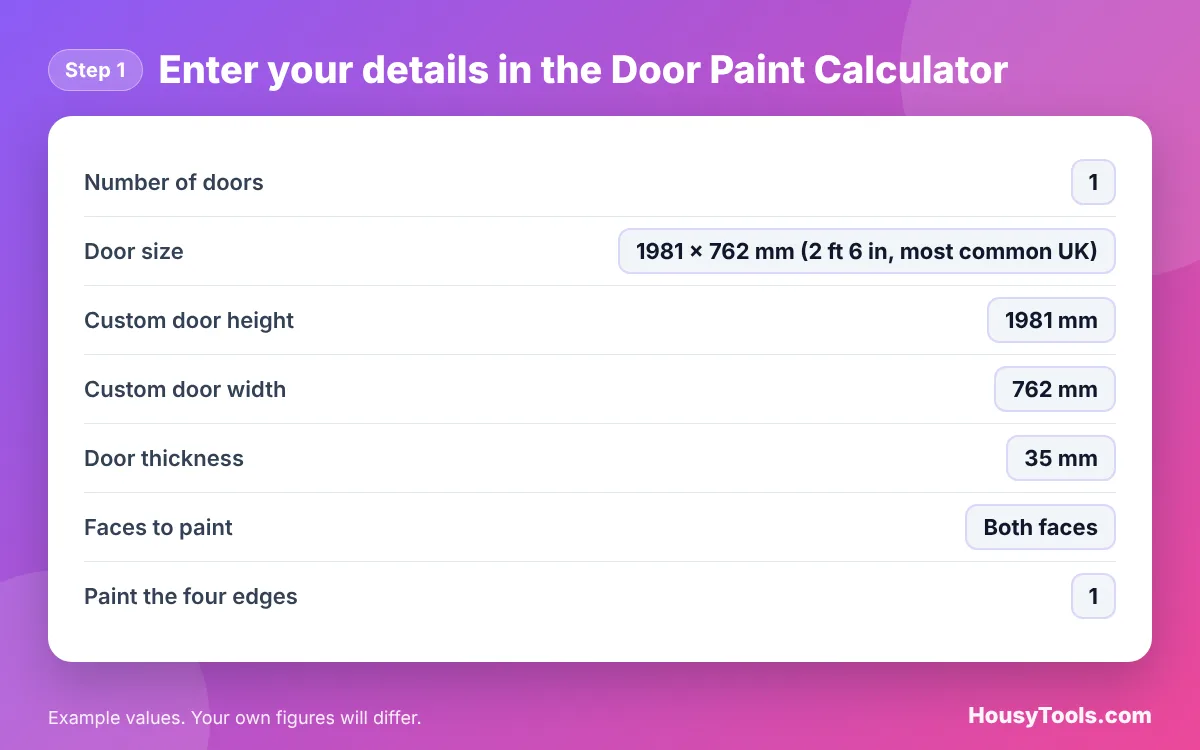
- Enter the Number of doors that are the same size, and pick the Door size. Choose Custom size to type the Custom door height and Custom door width.
- Check the Door thickness: 35 mm suits most imperial size internal doors and 40 mm suits metric doors.
- Set Faces to paint, tick Paint the four edges if you are painting them, and add a percentage in Extra area for panels and mouldings for a panelled door.
- Tick Include frame and architrave and measure the Frame lining depth and Architrave width if you are painting the woodwork round the door too.
- Enter the Coats, the Paint coverage from your tin and the Tin size you plan to buy. Tick Add one coat of undercoat and check the Undercoat coverage if your system needs one.
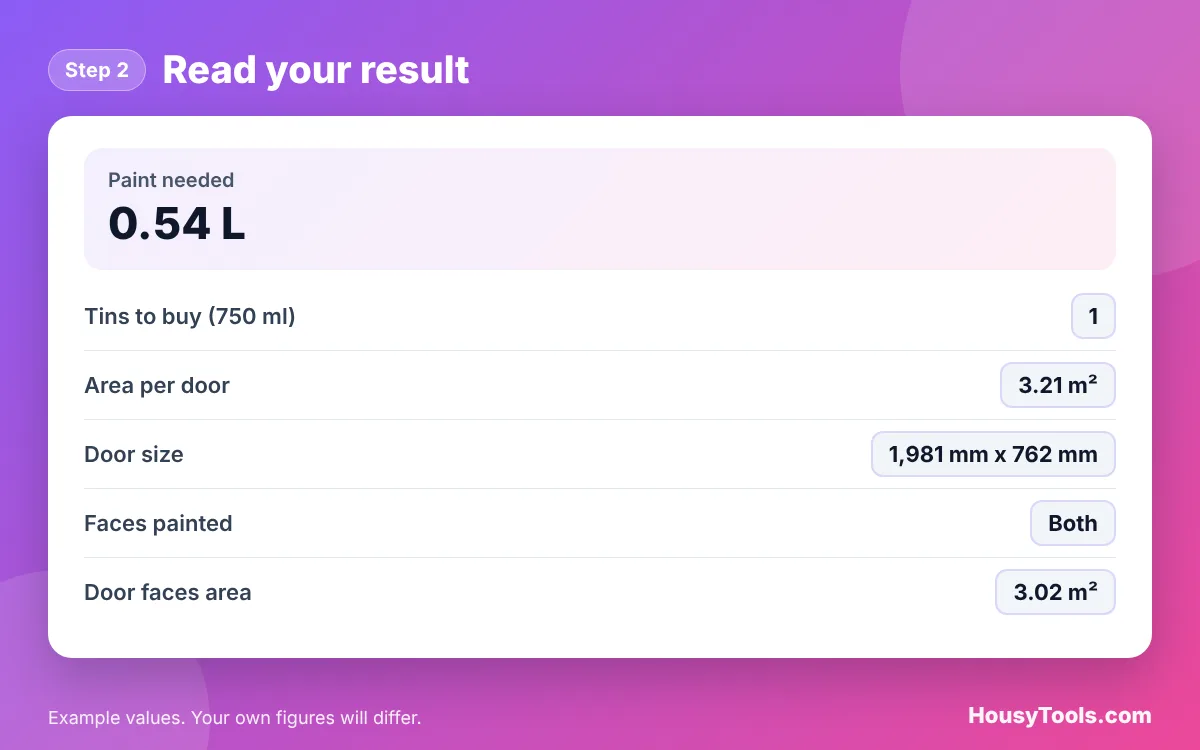
- Read the litres and tins in the result, then open “Show the formula and working” to see each area and the sum.
How Much Paint Do You Need for One Door?
One standard internal door needs about 0.5 to 0.6 litres of paint for two coats on both faces and the edges, so a single 750 ml tin is enough. A 1981 x 762 mm door has 3.02 m² of face area and 0.19 m² of edges. Two coats make 6.42 m², and at 12 m² per litre that is 0.54 litres. A solvent based satinwood or gloss that spreads further needs less, while a dark colour change or bare wood may need a third coat.
How Many Doors Does a Litre of Paint Cover?
A litre of water based satinwood that covers 12 m² per litre paints about one and a half to two standard doors with two coats on both faces. The exact figure depends on the coverage on the tin. The Dulux Trade product page for Quick Dry Satinwood gives up to 12 m² per litre and recommends two full coats on primed or previously painted surfaces, while the solvent based Dulux Trade Satinwood gives up to 17 m² per litre. Use the figure from your own tin in Paint coverage, because the result scales directly with it.
Should You Paint the Edges, Frame and Architrave Too?
Yes, painting the edges adds only about 6% to the paint for a standard door and seals the timber against moisture. The frame and architrave add more: with a 115 mm lining and 70 mm architrave on both sides, a standard door goes from 3.21 m² to about 4.45 m², which is roughly 40% more paint. If you are also painting skirting boards in the same colour, the skirting board calculator works out their length so you can buy one batch of paint.
Do You Need an Undercoat on a Door?
You need an undercoat on bare or primed wood and when you make a big colour change; a door in sound paint of a similar colour usually takes the topcoat directly. Dulux describes Dulux Trade Undercoat as covering up to 17 m² per litre, so one coat on a standard door with edges uses about 0.19 litres. Lightly sand between coats and remove dust so the topcoat stays smooth.
Door Sizes and Paint Needed
Area covers both faces and all four edges of a flush door. Paint is for two coats, without frame or architrave.
| Door size (mm) | Thickness | Area per coat | Paint at 12 m²/L | Paint at 17 m²/L |
|---|---|---|---|---|
| 1981 x 610 (2 ft) | 35 mm | 2.60 m² | 0.43 L | 0.31 L |
| 1981 x 686 (2 ft 3 in) | 35 mm | 2.90 m² | 0.48 L | 0.34 L |
| 1981 x 762 (2 ft 6 in) | 35 mm | 3.21 m² | 0.54 L | 0.38 L |
| 1981 x 838 (2 ft 9 in) | 35 mm | 3.52 m² | 0.59 L | 0.41 L |
| 2040 x 726 (metric) | 40 mm | 3.18 m² | 0.53 L | 0.37 L |
| 2040 x 826 (metric) | 40 mm | 3.60 m² | 0.60 L | 0.42 L |
Worked Example: Painting Three Doors and Their Frames
Example: three internal doors in a hallway are being repainted, each 1981 x 762 mm and 35 mm thick, with the frames and architraves. Set Number of doors to 3, leave the size and thickness, tick Include frame and architrave with a 115 mm lining and 70 mm architrave, and choose 2 coats at 12 m² per litre in 1 litre tins.
- Door faces: 1.981 m x 0.762 m = 1.51 m² per face, x 2 = 3.02 m².
- Edges: 2 x (1.981 + 0.762) m x 0.035 m = 0.19 m².
- Frame lining 0.54 m² plus architrave 0.70 m² = 1.24 m², so 4.45 m² per door and 13.36 m² for three.
- Paint: 13.36 m² x 2 coats / 12 m² per litre = 2.23 litres, so you buy 3 x 1 litre tins.
Ticking Add one coat of undercoat at 17 m² per litre adds 0.79 litres, so one 1 litre tin. If the walls are getting a fresh colour at the same time, the paint calculator handles the emulsion for the room.
Door Paint Calculator FAQs
How many coats of paint does a door need?
Most doors need two coats of topcoat. Dulux recommends two full coats of its Quick Dry Satinwood on primed or previously painted surfaces. Bare wood also needs a primer or undercoat first, and a strong colour change from dark to light may need a third coat.
Is a 750 ml tin enough for a door?
Yes, for one standard door. A 1981 x 762 mm door with edges needs about 0.54 litres for two coats at 12 m² per litre, leaving some spare for touch ups. Two doors need about 1.07 litres, so buy a 1 litre and a 750 ml tin, or a 2.5 litre tin.
What finish is best for internal doors?
Satinwood and gloss are the usual finishes for internal doors because they wipe clean and resist knocks. Satinwood gives a mid sheen that hides small marks, while gloss is harder wearing but shows every flaw. Water based versions dry faster and yellow less than solvent based ones.
How do I measure a panelled door for paint?
Measure the overall height and width as if the door were flat, then add a percentage for the panel mouldings in the calculator. The mouldings add surface that a flat measurement misses. If you are unsure, add a margin and buy the next tin size up.
How thick is a standard UK internal door?
A standard imperial size internal door in the UK is 35 mm thick, and metric doors such as 2040 x 826 mm are usually 40 mm. External doors are thicker, about 44 mm. Thickness matters only for the edges, which add about 0.19 m² to a standard door.
How long should I leave between coats on a door?
Follow the recoat time on your tin. Dulux gives 4 to 6 hours for its water based Quick Dry Satinwood and 16 to 24 hours for the solvent based Satinwood, depending on temperature and humidity. Leave the door wedged open while it dries so the edges do not stick.
Painting several rooms? The paint and decorating calculators cover walls, ceilings, wallpaper and the time each job takes.
Checked October 2026. Sources: Dulux Trade Quick Dry Satinwood (Dulux Trade), Dulux Trade Undercoat (Dulux Trade), Dulux Trade Satinwood (Dulux Trade), UK door sizes (Howarth Timber).