
Show the formula and working
This free expansion vessel size calculator works out the minimum size of expansion vessel a sealed central heating system needs, for homeowners, students and installers in the UK, Ireland and Europe checking a boiler or heat pump system. It uses the system’s water volume, the fill and maximum flow temperatures and the cold and maximum pressures, then picks the next standard vessel size.
Quick answer: An expansion vessel size calculator divides the water’s expansion by the acceptance factor. 100 litres heated from 10 to 80 C grows by 2.87 litres. With a 1 bar cold fill and 2.5 bar maximum, the acceptance factor is 0.427, so the vessel must hold at least 6.7 litres: choose 8 litres.

What Is an Expansion Vessel Size Calculator?
An expansion vessel size calculator is a tool that finds how large a sealed system’s expansion vessel must be to absorb the extra volume of water as it heats up, without the pressure reaching the safety valve.
The formula in plain words, following the method in BS 7074-1: find how much water expands between the fill temperature and the maximum flow temperature, from the ratio of water densities at the two temperatures. Multiply by the system volume to get the expanded water in litres. Convert both pressures to absolute by adding 1.013 bar, then work out the acceptance factor as 1 minus the cold absolute pressure divided by the maximum absolute pressure. The vessel volume is the expanded water divided by the acceptance factor.
How Do You Use the Expansion Vessel Size Calculator?
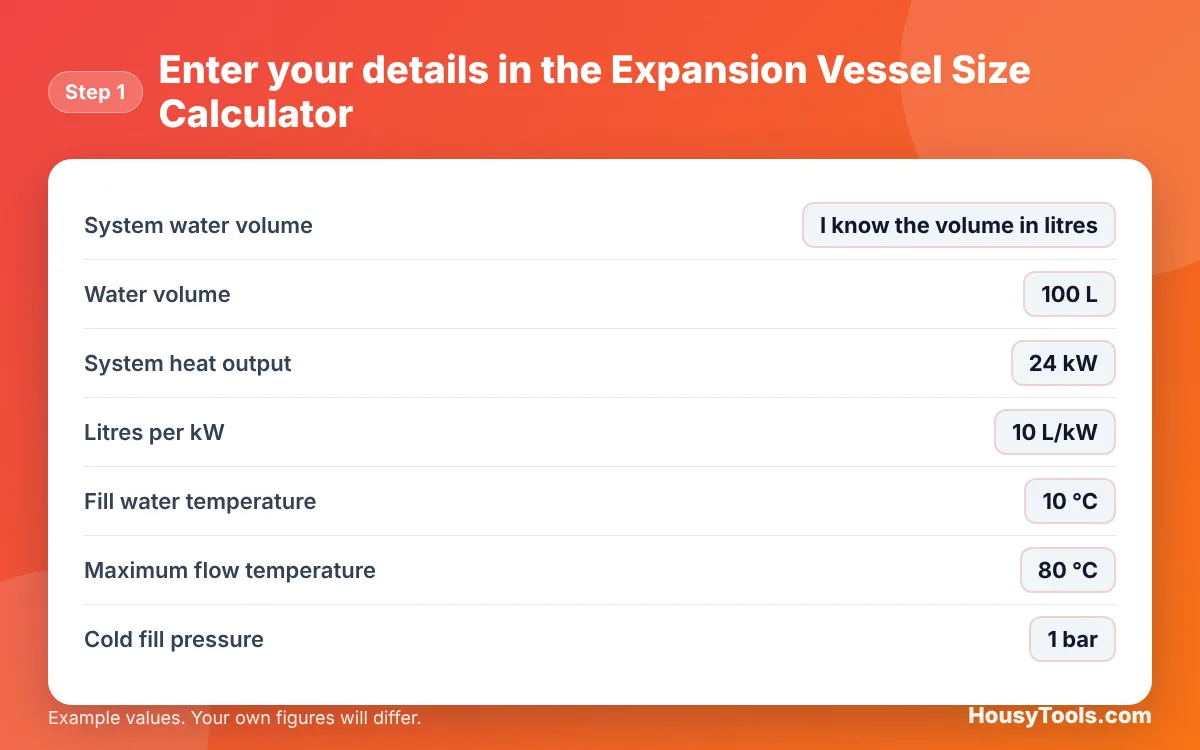
- Under System water volume, choose “I know the volume in litres” or “Estimate it from heat output”.
- Enter the Water volume, or the System heat output and Litres per kW for a rough estimate.
- Enter the Fill water temperature and the Maximum flow temperature the boiler or heat pump can reach.
- Enter the Cold fill pressure from the gauge when the system is cold.
- Enter the Maximum working pressure, set safely below the safety valve.
- Read the result and open “Show the formula and working” to see the expansion factor, acceptance factor and vessel size.


How Much Does Water Expand When Heated?
Water heated from 10 C to 80 C expands by about 2.87%, and to 90 C by about 3.56%, because its density drops from 999.70 to 971.79 and 965.31 kg per m³. A heat pump system that never goes above 50 C expands only about 1.18%, which is why low temperature systems can use smaller vessels for the same water volume.
What Size Expansion Vessel Do I Need per 100 Litres?
For 100 litres of system water at a typical 1 bar cold fill and 2.5 bar maximum, you need about 6.7 litres of vessel for an 80 C system and 8.3 litres for 90 C. Scale the figures in the table in proportion to your own water volume.
| Maximum flow temperature | Expansion from 10 C | Vessel per 100 L, 0.5 bar fill | Vessel per 100 L, 1.0 bar fill | Vessel per 100 L, 1.5 bar fill |
|---|---|---|---|---|
| 50 C | 1.18% | 2.07 L | 2.76 L | 4.15 L |
| 60 C | 1.68% | 2.95 L | 3.93 L | 5.90 L |
| 70 C | 2.24% | 3.94 L | 5.26 L | 7.88 L |
| 80 C | 2.87% | 5.04 L | 6.73 L | 10.09 L |
| 90 C | 3.56% | 6.26 L | 8.34 L | 12.52 L |
All rows use a 2.5 bar maximum working pressure. A higher cold fill pressure leaves less room in the vessel, so the vessel must be larger.
How Do You Find the Water Volume of a Heating System?
Add up the water content of every radiator from the maker’s data sheets, plus the pipework, the boiler or heat pump and any buffer tank. Radiator data sheets usually give litres per panel, and pipe content is easy to work out from the bore and length. The “Estimate it from heat output” option is only a rough starting point, so replace it with a real figure when you can. Sizing the boiler itself is covered by the boiler size calculator.
What Should the Expansion Vessel Pre Charge Be?
The vessel’s air side is usually charged to match the cold fill pressure, which itself must be at least the static head: about 0.1 bar for each metre of system height above the vessel. The charge is checked with the water side at 0 bar, using a tyre gauge on the valve. A vessel that has lost its charge is a common cause of pressure rising to 3 bar and the safety valve dripping.
Worked Example: Sizing a Vessel for a Combi Boiler System
Example: a sealed radiator system holds 100 litres, is filled with 10 C water, runs at up to 80 C, is filled to 1 bar cold and should not exceed 2.5 bar. These are the tool’s default inputs.
- Expansion factor: 999.70 / 971.79 minus 1 = 0.0287.
- Expanded water: 100 L x 0.0287 = 2.87 L.
- Acceptance factor: 1 minus 2.013 / 3.513 = 0.427.
- Vessel: 2.87 / 0.427 = 6.73 L, so an 8 litre vessel, pre charged to 1 bar.
Many combi boilers already contain an internal vessel of around this size, so check the boiler manual before adding one. Work on a sealed system, including recharging or replacing a vessel, should be done by a qualified heating engineer, and any work on a gas boiler needs a Gas Safe registered engineer. More tools are in our heating calculators.
Expansion Vessel Size Calculator FAQs
How do I calculate expansion vessel size?
Multiply the system water volume by the expansion factor, then divide by the acceptance factor, 1 minus the cold absolute pressure over the maximum absolute pressure. For 100 litres at 10 to 80 C, 1 bar cold and 2.5 bar maximum, that is 2.87 / 0.427 = 6.7 litres.
What happens if the expansion vessel is too small?
The pressure climbs too high as the water heats, and the pressure relief valve opens and dumps water. The system then loses pressure when it cools, and the boiler may lock out on low pressure. A vessel that has lost its air charge behaves the same way.
Can an expansion vessel be too big?
A larger vessel than needed is not harmful and gives more margin, but it costs more and takes more space. The usual approach is to choose the next standard size above the calculated minimum, such as 8, 12, 18 or 24 litres.
Why are absolute pressures used?
The air in the vessel compresses according to absolute pressure, which is gauge pressure plus atmospheric pressure of about 1.013 bar. Using gauge pressures directly would give a vessel that is too small.
What pressure should a sealed heating system be?
Many home systems are filled to about 1 to 1.5 bar cold and rise when hot, staying well below the 3 bar safety valve. Follow the figure in your boiler or heat pump manual, as it depends on the height of the system.
Does an unvented hot water cylinder use the same calculation?
The principle is the same, but unvented cylinders use the maker’s supplied vessel and settings, and installation must be done by a qualified unvented installer. Use the manufacturer’s instructions rather than this heating calculator for a cylinder.
Checked October 2026. Sources: Wikipedia, Expansion tank, Wikipedia, Water (data page) for density, Gas Safe Register, BS 7074-1 sizing method.