
Show the formula and working
This storage heater running cost calculator shows what your storage heaters cost to charge overnight on an Economy 7 or similar off peak tariff, plus the cost of any daytime boost. Enter the input power from the rating plate, the number of heaters, your charging hours and your night and day unit rates. You get the cost per day, per heater and per year, and how much the cheap night rate saves compared with charging at the day rate.
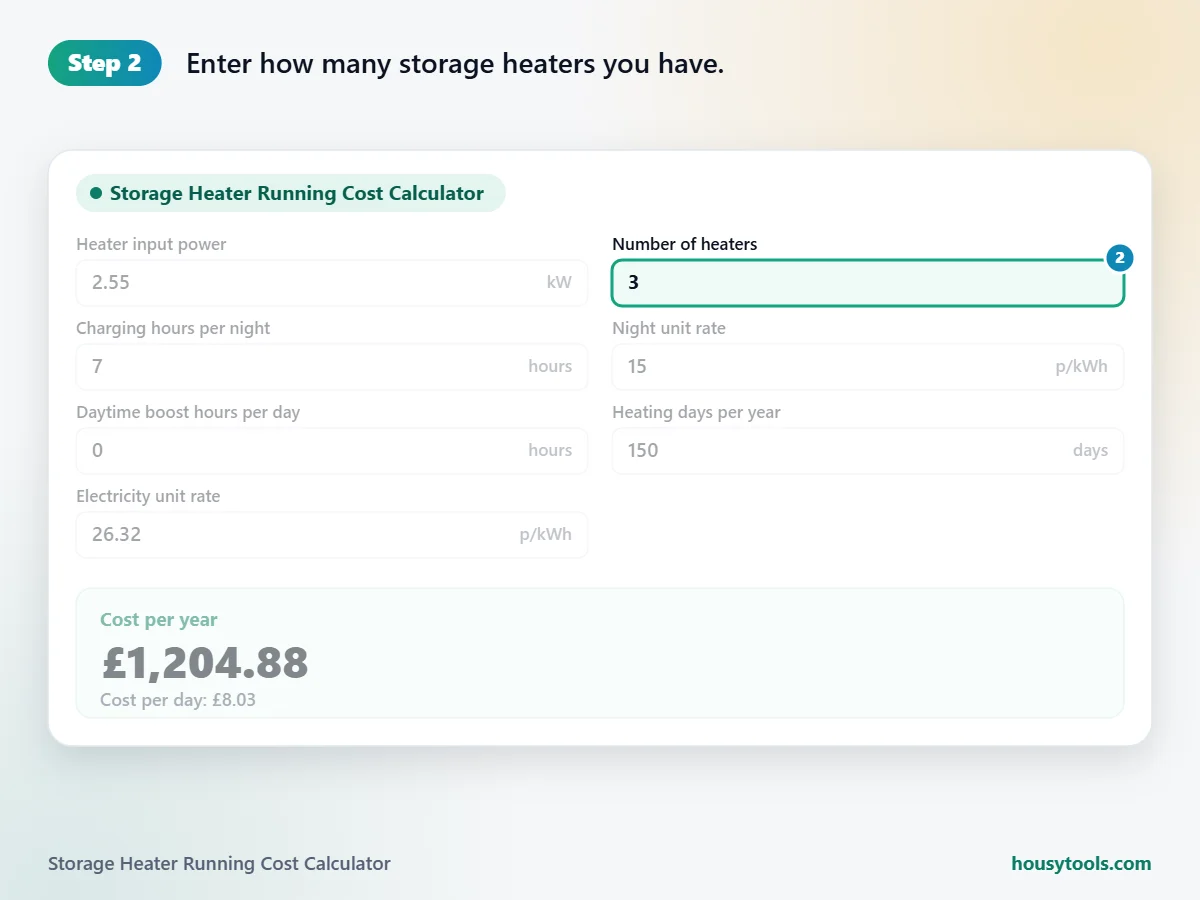
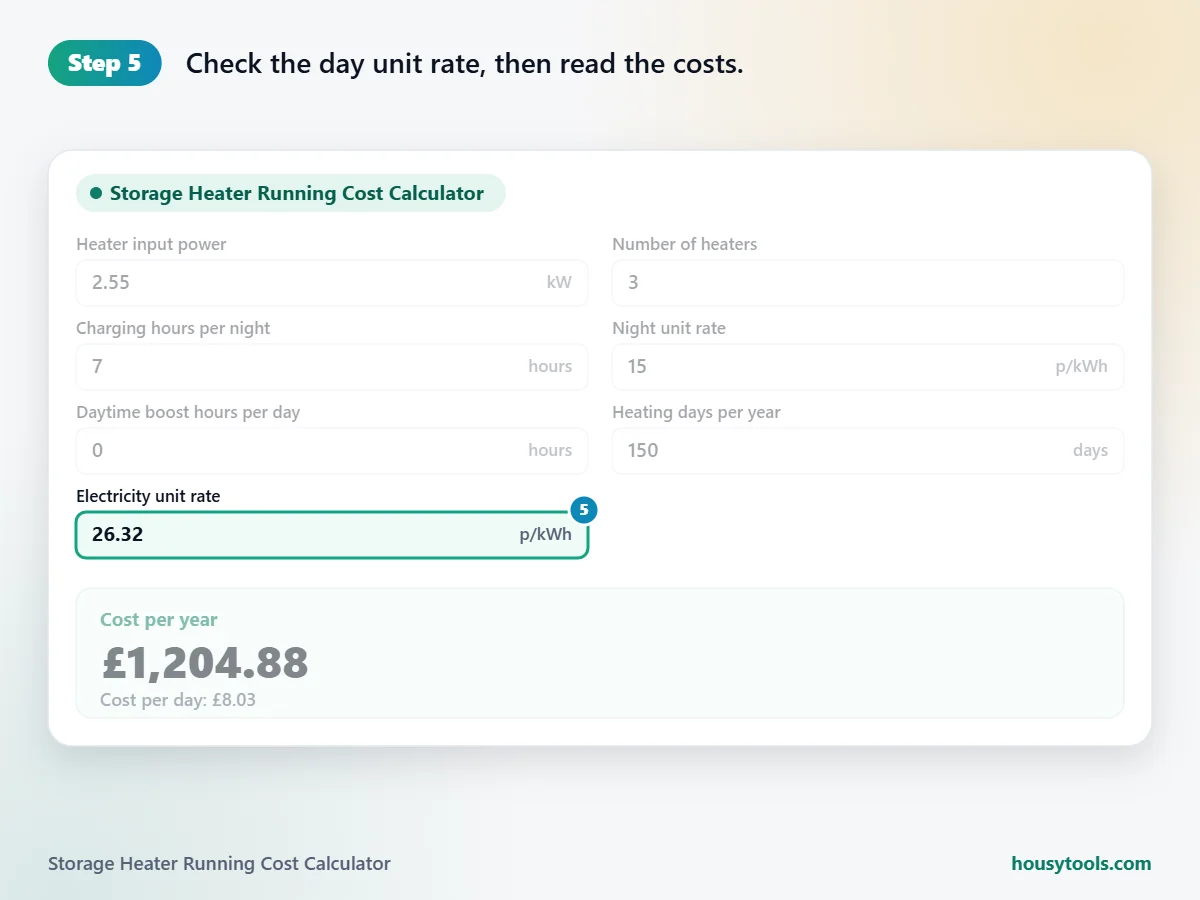
Quick answer: A storage heater costs its input power in kW times the charging hours times your night unit rate. A 2.55 kW heater charging for 7 hours uses 17.85 kWh, which costs about £2.68 a night at an example 15p night rate. Three heaters over 150 heating days cost about £1,204.88 a year. Daytime boost is charged at the higher day rate.

How Is Storage Heater Running Cost Calculated?
The cost is the energy the heaters take in overnight, at your night rate, plus any energy used for boost during the day, at your day rate.
A storage heater stores heat in clay or ceramic bricks while electricity is cheap, then releases it through the day. The calculator multiplies the input power in kW by the charging hours and the number of heaters to get the kWh used each night. That is multiplied by your night unit rate. If you use the boost or convector heater during the day, those kWh are multiplied by your day unit rate. The daily cost times your heating days gives the yearly cost.
This assumes each heater takes a full charge every night. Many modern heaters have an input control or an automatic charge controller that takes less charge on mild nights, so real bills are often lower than the full charge figure.
How Do You Use the Storage Heater Calculator?
- Enter the input power from the heater rating plate.
- Enter how many storage heaters you have.
- Set the charging hours and your night unit rate.
- Add any daytime boost hours and the heating days per year.
- Check the day unit rate, then read the costs.



How Much Does a Storage Heater Cost to Run?
At an example 15p night rate and a full 7 hour charge, each 2.55 kW heater costs about £2.68 a night, or about £401.62 over 150 heating days.

| Heaters | Night kWh per day | Cost per day | Cost per year |
|---|---|---|---|
| 1 | 17.85 | £2.68 | £401.62 |
| 2 | 35.7 | £5.35 | £803.25 |
| 3 | 53.55 | £8.03 | £1,204.88 |
| 4 | 71.4 | £10.71 | £1,606.50 |
Night rates vary a lot between suppliers and tariffs, so the 15p figure is only an example. Look for the off peak or night rate on your bill and type it in. The 26.32p day rate is the Ofgem price cap average for October to December 2026. You can check the current figures on the Ofgem energy price cap page.
Why Is the Night Rate So Important?
Storage heaters only make sense when the electricity they store is much cheaper than daytime electricity.
With the defaults, charging three heaters at the day rate instead of the night rate would cost about £909 more a year. That is why a storage heater on a standard single rate tariff is usually expensive to run. If you have storage heaters, it is worth checking you are on a tariff with a cheap overnight period, and that the heaters are wired to charge during it. The Economy 7 calculator shows whether a two rate tariff suits the rest of your household use.
Is the Boost Button Expensive?
Yes, compared with the stored heat. Boost runs a direct electric heater at the full day rate.
One hour of boost on a 3.4 kW heater uses 3.4 kWh, about 89p at 26.32p. Used every day for 150 days, that is about £134 a year for one heater. If you find you need boost most evenings, try turning the input setting up a little the night before, so more heat is stored, or turning the output setting down during the day, so heat is not released too early.
Worked Example: Two 3.4 kW Heaters With an Hour of Boost
Example: a flat has two 3.4 kW storage heaters on a full 7 hour charge at an example 15p night rate, and uses 1 hour of boost on each heater a day at the 26.32p day rate, for 150 days.
- Night charge: 2 x 3.4 kW x 7 h = 47.6 kWh, which is £7.14
- Boost: 2 x 3.4 kW x 1 h = 6.8 kWh, which is £1.79
- Per day: £8.93
- Per year: £8.93 x 150 days = £1,339.46

Without the boost, the same two heaters would cost £7.14 a day, so the boost adds about a fifth to the bill in this example. When a storage heater bill looks high, it is worth looking at boost use first, because each boost hour costs the day rate rather than the night rate.
How Can You Cut Storage Heater Costs?
Most of the saving comes from storing only the heat you need and keeping it in the room until you want it.
- Turn the input down on mild days so the heaters take less charge overnight.
- Keep the output setting low in the morning and raise it in the afternoon or evening.
- Avoid daytime boost where you can, because it uses the day rate.
- Check the heaters charge in your off peak hours, as times vary by meter and region.
- Draught proofing and insulation help stored heat last longer through the day.
- Older heaters can lose heat quickly. Modern high heat retention models hold more heat for the evening.
To compare storage heaters with portable heaters, try the electric heater running cost calculator, and to test a smart tariff with cheap hours, the time of use tariff calculator.
Storage Heater Running Cost FAQs
How much does a storage heater cost per night?
A 2.55 kW heater on a full 7 hour charge uses 17.85 kWh. At an example night rate of 15p that is about £2.68 a night. Use your own night rate for an exact figure.
Are storage heaters cheaper than electric heaters?
Usually yes, if they charge on a cheap night rate, because each kWh costs less. On a single rate tariff they can cost more, as they charge whether or not you need the heat.
Do storage heaters use electricity all day?
No. They charge during the off peak hours and release stored heat during the day. They only draw power in the daytime if you use the boost or a built in convector heater.
What does the input setting do?
The input setting controls how much heat is stored overnight. A lower setting means less charging and a lower bill, but less heat the next day.
What does the output setting do?
The output setting controls how fast the stored heat is released. Keep it low early in the day so heat is still left for the evening.
How many hours does Economy 7 give?
Economy 7 gives seven hours of cheaper electricity, usually overnight. The exact times depend on your meter and region, so check them with your supplier.
Checked October 2026. Sources: Ofgem energy price cap, Energy Saving Trust guidance on storage heaters. The night rate is an example only.