
Show the formula and working
This free skirting board paint calculator works out how much paint and how many tins you need to paint the skirting boards in a room, for homeowners, renters and decorators in the UK, Ireland and Europe. It uses the room size, door openings, board height and profile, the number of coats and the coverage on your tin, and can add a coat of undercoat.
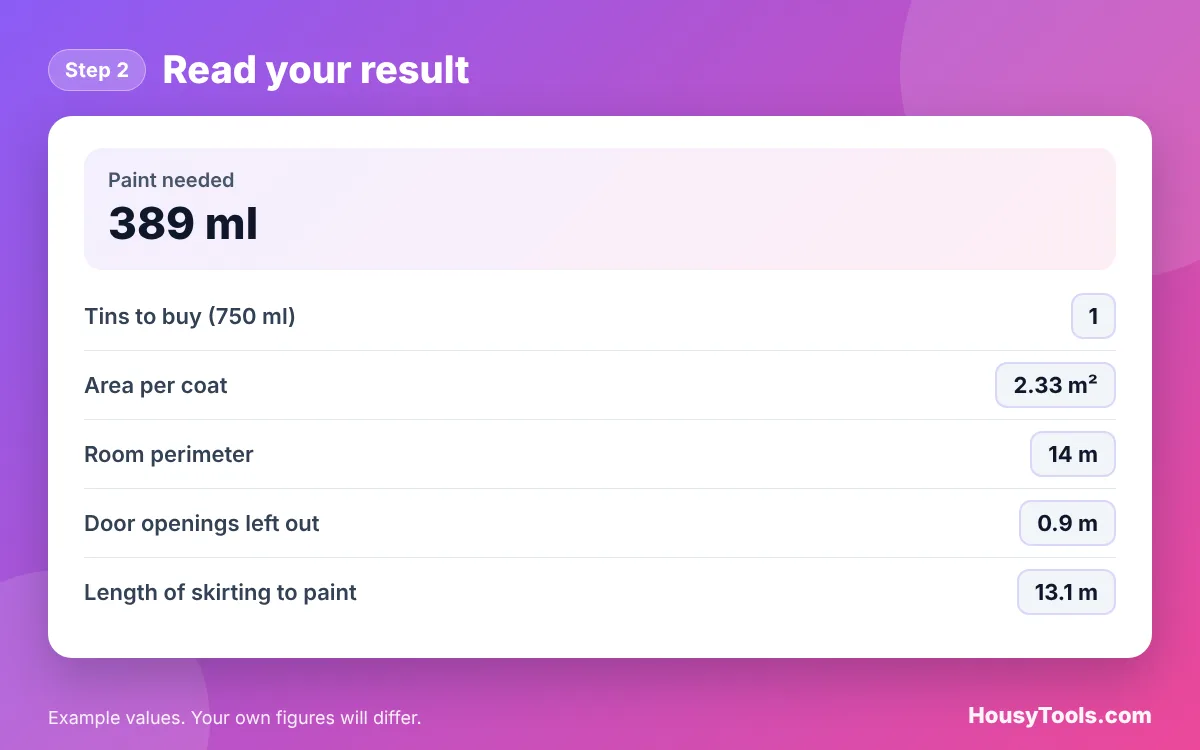
Quick answer: Multiply the length of skirting by its height plus top edge, then by the coats, and divide by the coverage per litre. A 4 m by 3 m room with one door has 13.1 m of 144 mm skirting, about 2.33 m², so a skirting board paint calculator shows 389 ml for two coats.
What Is a Skirting Board Paint Calculator?
A skirting board paint calculator is a tool that turns the length and height of your skirting into a painted area and then into litres of paint and tins to buy. In plain words: skirting length = room perimeter minus door openings. Area = skirting length x (board height + top edge thickness) x (1 + allowance for a moulded profile). Paint = area x coats / coverage per litre, rounded up to whole tins.
Skirting is usually painted in satinwood or gloss. The default coverage of 12 m² per litre comes from the Dulux Trade Quick Dry Satinwood product page, which says up to 12 m² per litre. Solvent based Dulux Trade Satinwood says up to 17. Always enter the figure on your own tin.
How Do You Use the Skirting Board Paint Calculator?
- Enter the Room length and Room width.
- Enter the number of Door openings and the Width of each door opening, measured where the skirting stops.
- Measure the Skirting height and the Skirting thickness, and set the Extra area for moulded profiles.
- Enter the Coats and the Paint coverage from your tin, then pick the Tin size.
- Tick Add one coat of undercoat for bare wood or a big colour change, and check the Undercoat coverage.
- Read the litres and tins, then open “Show the formula and working” to see each step.

How Much Paint Do I Need for Skirting Boards?
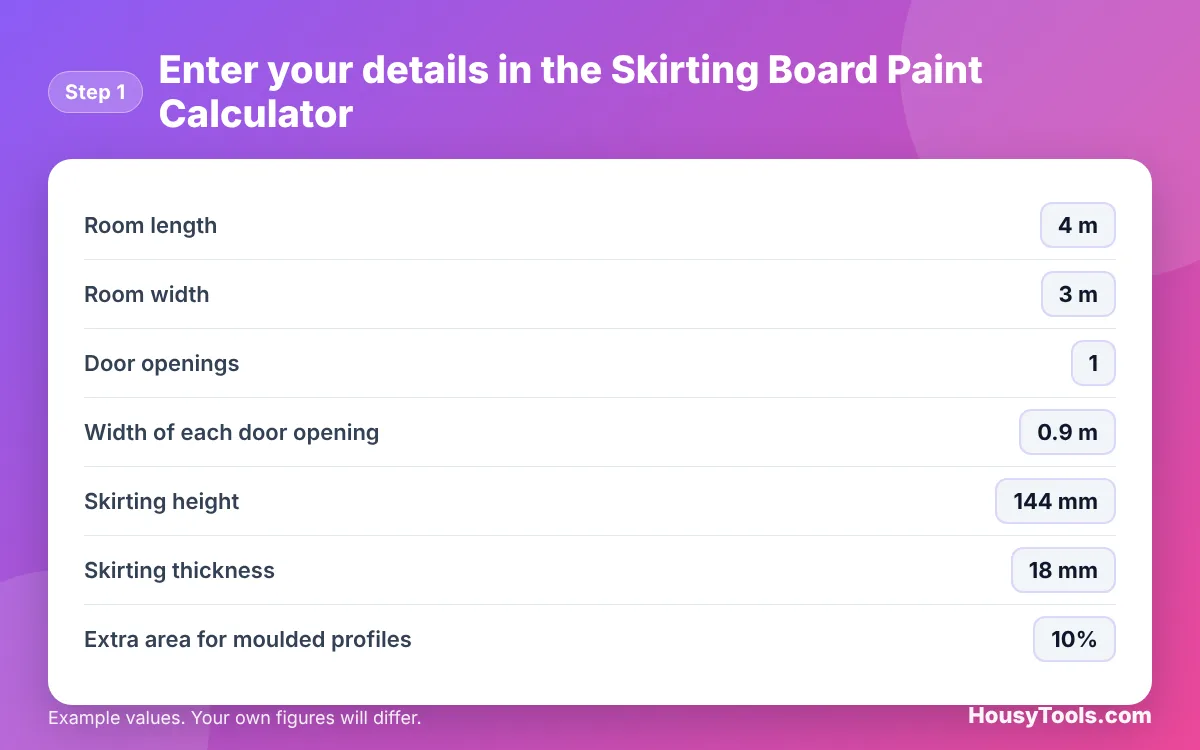
Most rooms need less than a litre: skirting in a typical 4 m by 3 m room takes about 389 ml for two coats, so one 750 ml tin is enough. Skirting is a narrow band, so even a long run adds up to only a few square metres. The table uses 144 mm boards with an 18 mm top edge, a 10% profile allowance, one 0.9 m door opening and two coats.
| Room size | Skirting to paint | Area per coat | Two coats at 12 m²/L | Two coats at 17 m²/L |
|---|---|---|---|---|
| 2.5 x 2 m | 8.1 m | 1.44 m² | 241 ml | 170 ml |
| 3 x 3 m | 11.1 m | 1.98 m² | 330 ml | 233 ml |
| 4 x 3 m | 13.1 m | 2.33 m² | 389 ml | 275 ml |
| 4 x 4 m | 15.1 m | 2.69 m² | 448 ml | 317 ml |
| 5 x 4 m | 17.1 m | 3.05 m² | 508 ml | 358 ml |
| 6 x 4 m | 19.1 m | 3.40 m² | 567 ml | 400 ml |
| 7 x 5 m | 23.1 m | 4.12 m² | 686 ml | 484 ml |
How Many Coats Do Skirting Boards Need?
Two coats of topcoat is the usual rule for skirting boards, plus one coat of undercoat or primer on bare or very dark wood. Water based satinwood is quick to recoat, while solvent based gloss needs a long wait between coats; the paint drying time calculator shows how temperature changes the wait. Lightly sand and wipe the old finish first so the new paint grips.
Should I Paint the Skirting or the Walls First?
Paint the ceiling and walls first, then the skirting, so any emulsion that runs down the wall can be covered by the skirting paint. Use masking tape along the top edge and lay a dust sheet or tape on the floor. If you are also fitting new boards, the skirting board calculator works out the lengths to buy.
Worked Example: Skirting in a 4 m by 3 m Room
Example: a 4 m by 3 m bedroom with one door opening 0.9 m wide, 144 mm skirting 18 mm thick with a simple moulding, and two coats of quick dry satinwood at 12 m² per litre. The perimeter is 2 x (4 + 3) = 14 m, so there is 14 – 0.9 = 13.1 m of skirting. The painted band is 144 + 18 = 162 mm, and with 10% for the profile the area is 13.1 x 0.162 x 1.1 = 2.33 m².
Two coats need 2.33 x 2 / 12 = 389 ml, so one 750 ml tin is plenty, and that is about 30 ml for every metre of skirting. Ticking the undercoat adds 137 ml at 17 m² per litre. For the doors in the same room, use the door paint calculator, and find more tools on the paint and decorating calculators page.
Skirting Board Paint Calculator FAQs
How far does a 750 ml tin of satinwood go on skirting?
At up to 12 m² per litre, 750 ml covers up to 9 m² for one coat, which is roughly 55 m of 144 mm skirting with its top edge. For two coats that is about 27 m, enough for most rooms.
How do I measure skirting boards for paint?
Measure the room’s perimeter, subtract door openings and any built in units with no skirting, then measure the board height and the thickness of the top edge. Multiply the length by the height plus thickness to get the area.
What paint finish is best for skirting boards?
Satinwood and gloss are the usual choices because they are hard wearing and wipe clean. Satinwood has a softer sheen and hides small marks better, while gloss is shinier and very tough. Eggshell gives a flatter, modern look.
Do I need undercoat on skirting boards?
Use undercoat or primer on bare wood, repaired areas and when changing from a dark to a light colour. If the old paint is sound and a similar colour, two topcoats are usually enough after a light sand. Follow the system on the tin.
Why add extra for moulded skirting?
Ogee, torus and other moulded profiles have curves that add surface area compared with a flat board of the same height. The calculator uses an editable 10% example allowance. Set it to 0 for flat or square edge boards.
Can I use wall paint on skirting boards?
It is not recommended. Matt emulsion is softer and marks easily where feet, vacuums and furniture knock the skirting. A trim paint such as satinwood, eggshell or gloss lasts much longer and can be wiped clean.
Checked October 2026. Sources: Dulux Trade Quick Dry Satinwood (product page), Dulux Trade Undercoat (product page).