
Show the formula and working
This render calculator works out how many bags of ready mixed render, or how much sand and cement, you need to render an outside wall. It is made for UK and European homes measured in metres and millimetres, with a feet and inches switch, and it deducts windows and doors, adds a waste allowance and lets you enter the coverage printed on your own render bags.
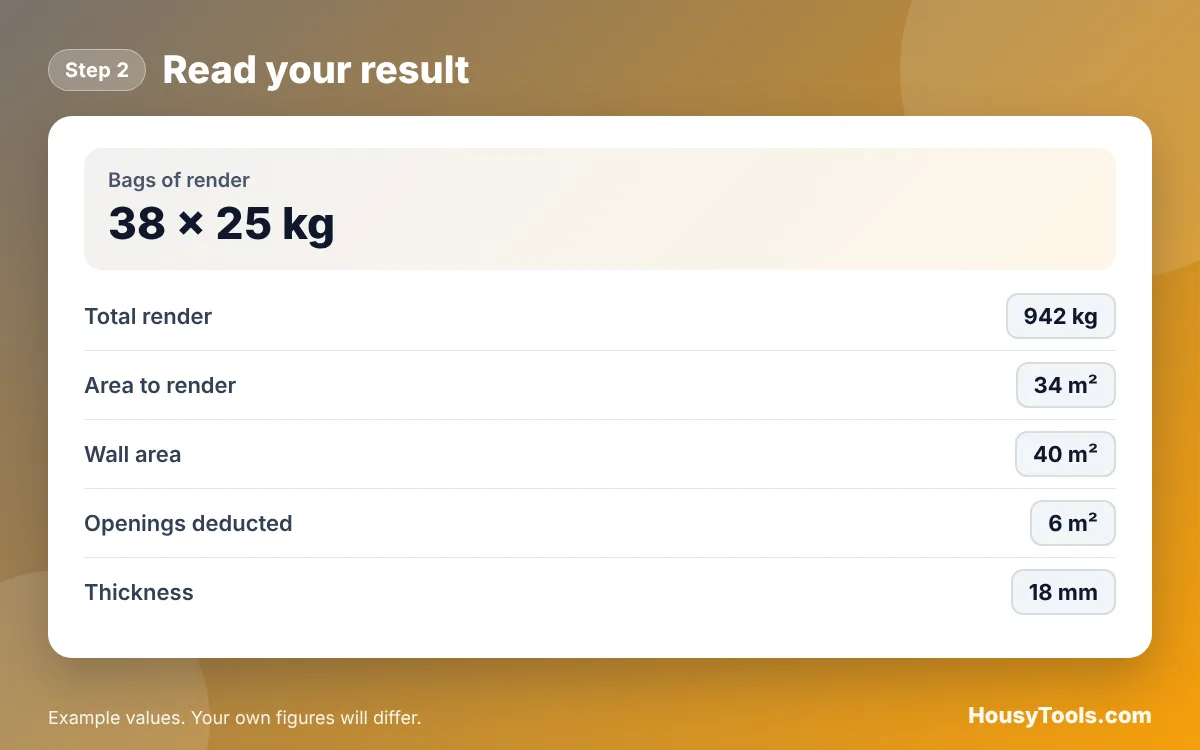
Quick answer: Multiply the wall area, minus openings, by the render thickness and the render used per m² per mm. An 8 m by 5 m wall with 6 m² of windows, rendered 18 mm thick at 1.4 kg per m² per mm plus 10% waste, needs 942 kg. The render calculator rounds that to 38 bags of 25 kg.

What Is a Render Calculator?
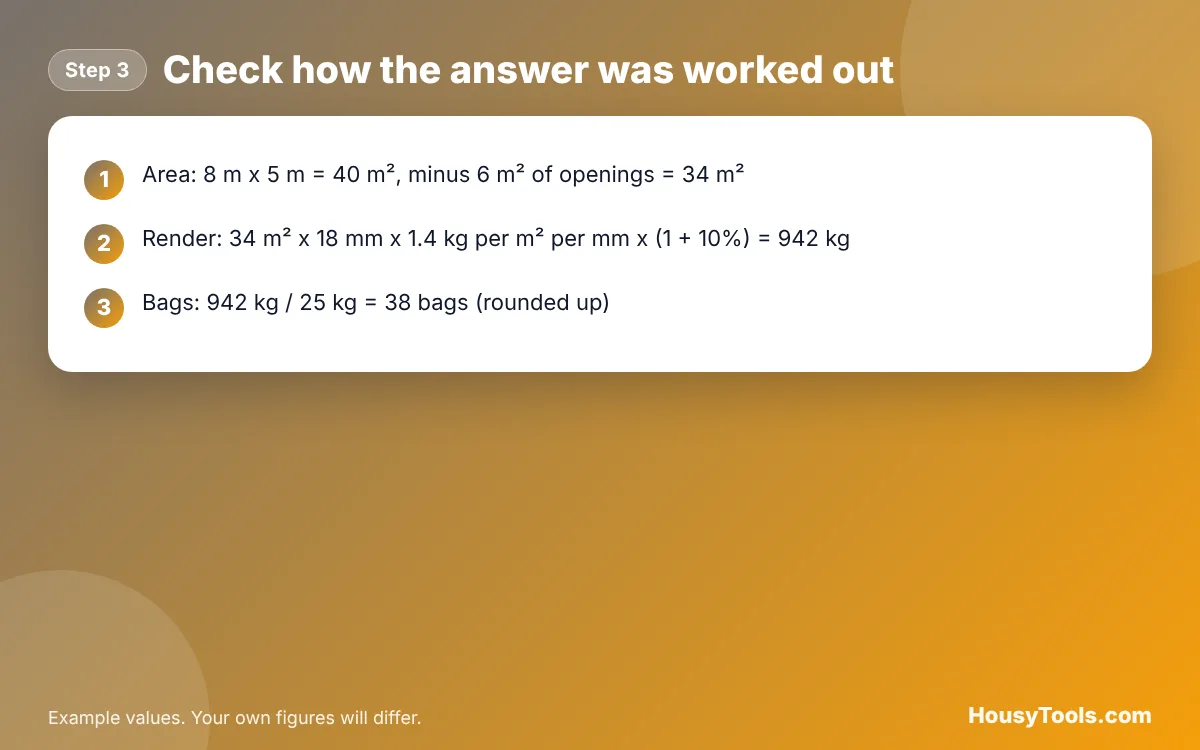
A render calculator is a tool that converts the area and thickness of a rendered wall into the weight and number of bags of render, or the sand and cement for a site mix. Area = wall length x wall height, minus windows and doors. For bagged render, kilograms = area x thickness in mm x kg per m² per mm x (1 + waste). For sand and cement, wet volume = area x thickness, which is turned into dry sand and cement by your mix ratio.
Ready mixed one coat renders, often called monocouche, come as coloured dry powder that only needs water. Traditional sand and cement render is mixed on site, usually in two or more coats, and is often painted afterwards. The calculator handles both through the Render type choice.
How Do You Use the Render Calculator?
- Choose the Render type: ready mixed bagged render (one coat) or sand and cement mixed on site.
- Enter the Wall length and Wall height, then the Windows and doors to deduct in square metres.
- Enter the total Render thickness of all coats, and set Extra for waste.
- For bagged render, enter Bagged render used per m² per mm and Render bag weight from the bag or data sheet.
- For a site mix, check Parts sand to 1 part cement, Dry materials per m³ of render, Sand density, Cement density and Cement bag weight. These are example defaults to replace with your specification and supplier figures.
- Read the bags or the sand and cement, then open “Show the formula and working” to see each step.

How Much Does a Bag of Render Cover?
A 25 kg bag of one coat render covers about 1 m² at a scraped finish, according to Weber’s guide to render coverage for its weberpral M and D renders, applied at 18 mm and scraped back to at least 15 mm. Spray roughcast finishes and walls in severe exposure use more, down to about 0.5 m² per bag.
That works out at roughly 1.4 kg of dry render per square metre for each millimetre applied, which is the calculator’s example default. Other products differ, so enter the consumption from your own data sheet. Weber also suggests allowing 10% for waste, which is the default waste figure here.
| Applied thickness | Bagged render per m² (1.4 kg per m² per mm) | 25 kg bags per 10 m² with 10% waste | Site mix sand per m² (1:4) | Site mix cement per m² (1:4) |
|---|---|---|---|---|
| 10 mm | 14.0 kg | 7 | 16.6 kg | 3.7 kg |
| 15 mm | 21.0 kg | 10 | 25.0 kg | 5.6 kg |
| 18 mm | 25.2 kg | 12 | 30.0 kg | 6.7 kg |
| 20 mm | 28.0 kg | 13 | 33.3 kg | 7.5 kg |
| 25 mm | 35.0 kg | 16 | 41.6 kg | 9.4 kg |
The site mix columns use the calculator’s example defaults (dry factor 1.3, sand 1,600 kg/m³, cement 1,440 kg/m³) with no waste, so treat them as a guide rather than a specification.
How Thick Should External Render Be?
One coat render on a house wall is typically finished at 15 to 20 mm, depending on exposure. Weber’s guidance for a scraped finish is 18 mm applied and scraped back to 15 mm on sheltered or moderate sites, and a 20 mm finished thickness built up in two passes on severely exposed walls. Traditional sand and cement systems build a similar total from a scratch coat and a finishing coat.
Enter the applied thickness, not the finished one, because render scraped off still has to be bought. Uneven brickwork, deep mortar joints and beads at corners also use extra, which is why a 10% allowance is sensible.
How Much Sand and Cement Do You Need to Render a Wall?
For 18 mm of 1:4 sand and cement render, plan on about 30 kg of sand and 7 kg of cement per square metre before waste, using the calculator’s example figures. The mix ratio changes between coats and backgrounds, and many specifications add lime or a plasticiser, so follow the render specification for your wall and adjust the parts of sand to match.
In England, cladding any part of a house with render is not permitted development in a conservation area, National Park, Area of Outstanding Natural Beauty or World Heritage Site, according to the government’s permitted development technical guidance for householders, so planning permission is needed there. Listed buildings need consent too, so check with your local planning authority first. If you plan to paint a sand and cement render, the masonry paint calculator works out the paint, and our paint and decorating calculators cover the rest of the finish.
Worked Example: A Gable Wall
Example: a wall 8 m long and 5 m high, with 6 m² of windows and a door, is being rendered. Choose a ready mixed one coat render in 25 kg bags, apply 18 mm, use 1.4 kg per m² per mm and allow 10% for waste.
- Area: 8 m x 5 m = 40 m², minus 6 m² = 34 m².
- Render: 34 m² x 18 mm x 1.4 kg x 1.10 = 942 kg.
- Bags: 942 kg / 25 kg = 37.7, so 38 bags.
Out of interest, switch to sand and cement at 1:4 with the example defaults. The calculator gives 0.673 m³ of wet render, about 1.12 tonnes of sand and 252 kg of cement, which is 11 bags of 25 kg.
Render Calculator FAQs
How many bags of render do I need per m²?
For one coat render applied about 18 mm thick, allow roughly one 25 kg bag per square metre, plus 10% waste. Spray roughcast finishes and severe exposure walls need more, up to about two bags per square metre, so check your product’s data sheet.
Should I deduct windows and doors when working out render?
Yes, deduct large windows and doors, but remember that reveals around each opening are also rendered. For deep reveals, add their area back in. Small openings such as air bricks are usually ignored because the waste allowance covers them.
What is the mix for sand and cement render?
Mixes vary with the coat and the wall, and many include lime or a plasticiser. The calculator uses 4 parts sand to 1 part cement as an example. Follow the render specification for your background, and use a weaker finishing coat than base coat where it says so.
How much waste should I allow for rendering?
Allow about 10%, as Weber suggests for its renders. Uneven walls, scraped finishes, droppings and mixing more than you can use before it stiffens all add up. Increase the allowance for walls with many corners, beads and reveals.
Is one coat render cheaper than sand and cement?
One coat render usually costs more per bag, but it is coloured through and often needs no painting, which saves labour and repainting later. Sand and cement uses cheaper materials but takes more coats and usually needs masonry paint, so compare total costs for your wall.
Can I render a wall myself?
A small garden wall is a reasonable DIY job, but rendering a house needs scaffolding, beads, the right weather and practice to get an even finish. Work at height must be done safely, so many homeowners use a professional plasterer or renderer for whole walls.
Checked October 2026. Sources: Weber UK, How much does a bag of Weber render cover? (coverage per 25 kg bag, applied thicknesses, 10% waste), GOV.UK permitted development rights for householders technical guidance (Class A, condition A.2(a)). Site mix ratio, dry volume factor and densities are editable example defaults.