
Show the formula and working
This electric towel rail running cost calculator shows what an electric or dual fuel towel rail costs to run per hour, per day and per year. Enter the rail’s power in watts, how long it is on, how much of that time it is actually heating and how many days a year you use it. It starts with the UK price cap unit rate and has EU presets, or you can type your own tariff.
Quick answer: An electric towel rail costs its power in kW times the hours it heats times your unit rate. A 300 W rail costs about 7.9p an hour at the 26.32p price cap rate, so 4 hours a day for 180 days costs about £56.85 a year. Rails with a thermostat cost less because they switch off once warm.

How Is Towel Rail Running Cost Calculated?
Running cost is energy used in kWh times your unit rate, and energy is the rail’s power in kilowatts times the hours it is actually drawing power.
The formula in plain words: divide the wattage by 1,000 to get kilowatts. Multiply by the hours the rail is switched on each day and by the share of that time it is heating. A rail with no thermostat heats all the time it is on, so the share is 100%; a thermostat or smart element switches off once the rail reaches temperature. Multiply the kWh by your unit rate for the daily cost and by the days you use it for the yearly cost.
How Do You Use the Towel Rail Calculator?
- Enter the towel rail power from its label.
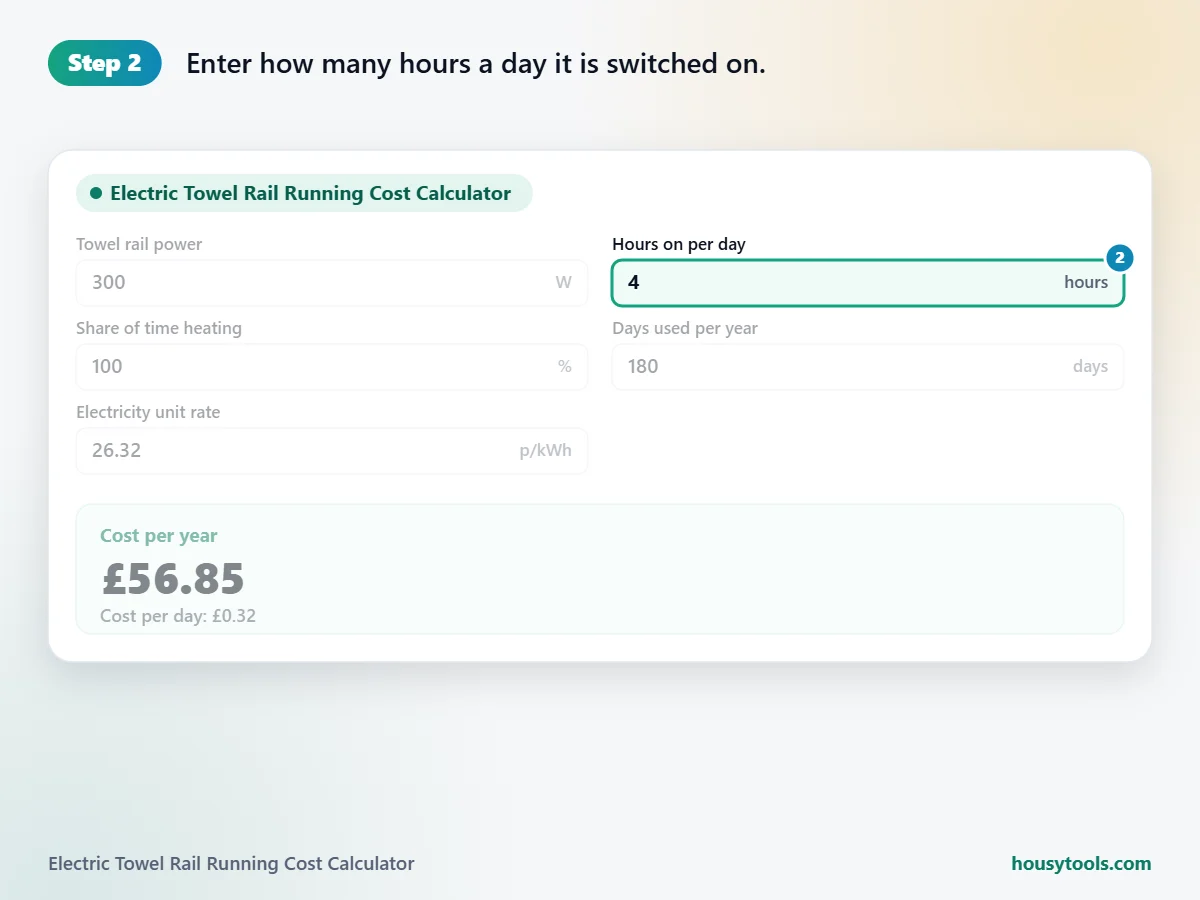
- Enter how many hours a day it is switched on.
- Set the share of time it is actually heating.
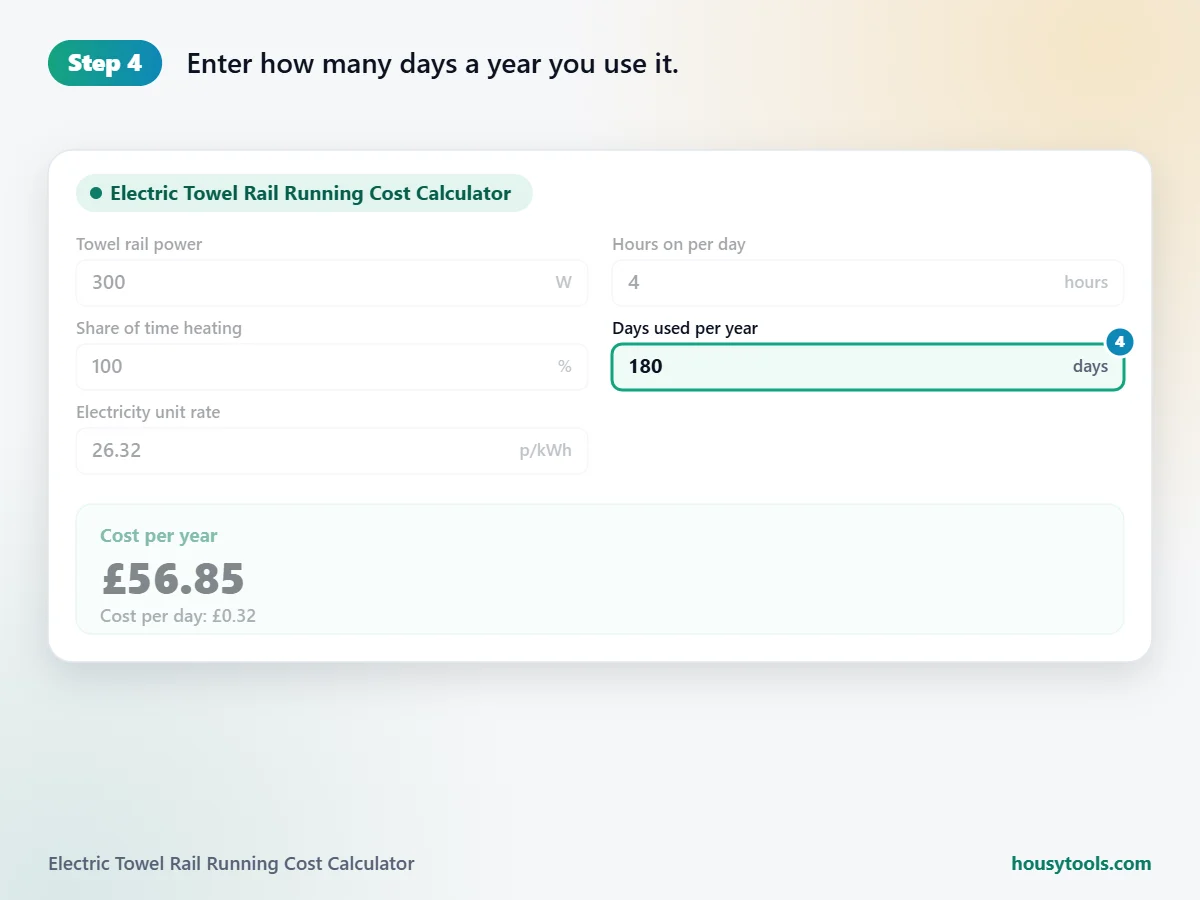
- Enter how many days a year you use it.
- Choose a price preset or enter your unit rate, then read the costs.



How Much Does an Electric Towel Rail Cost to Run?
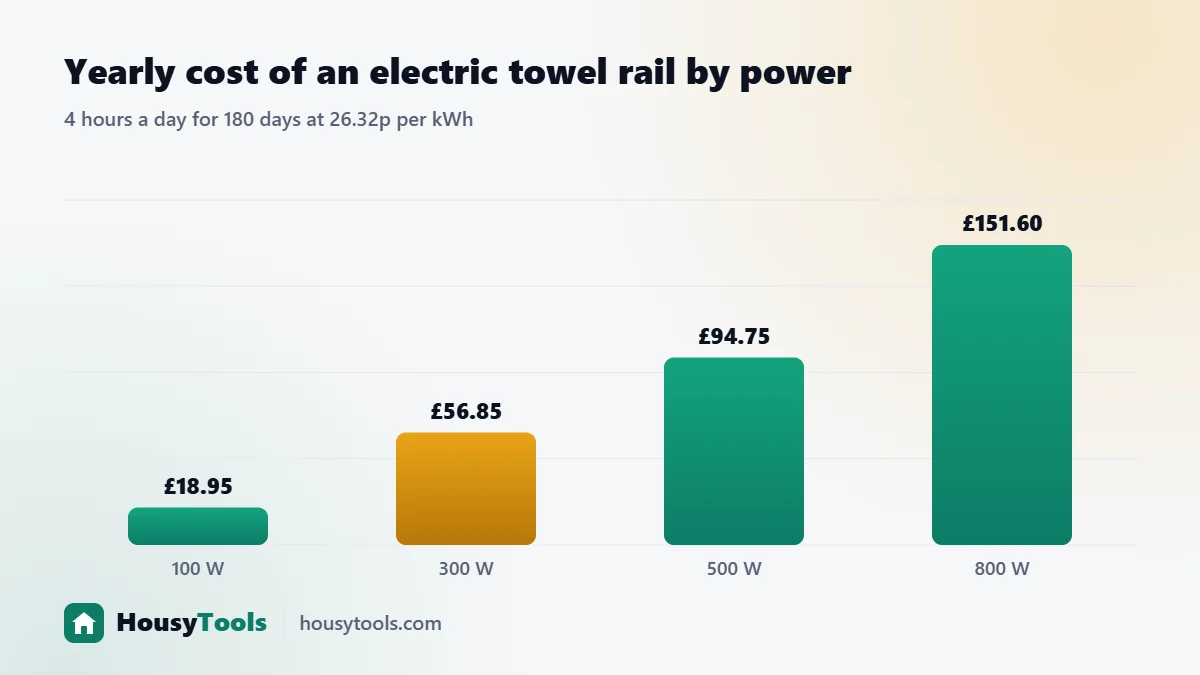
At the 26.32p price cap rate, a towel rail costs about 2.6p an hour per 100 W, so a typical 300 W rail is about 7.9p an hour and a large 800 W rail about 21p an hour.
| Rail power | Cost per hour | Cost per day (4 h) | Cost per year (180 days) |
|---|---|---|---|
| 100 W | 2.63p | £0.11 | £18.95 |
| 300 W | 7.9p | £0.32 | £56.85 |
| 500 W | 13.16p | £0.53 | £94.75 |
| 800 W | 21.06p | £0.84 | £151.60 |
The rail’s power is printed on its label or in the manual. Dual fuel rails connected to central heating only use electricity when the element is on, usually in summer when the boiler heating is off.
Is It Cheaper to Leave a Towel Rail On?
No: a rail without a thermostat uses power every hour it is on, so leaving it on all day costs far more than using a timer for the hours you need.
Rails with a thermostat cycle on and off, so leaving one on 24 hours at around 30% heating time costs about £102 a year for a 300 W rail over 180 days, almost double the 4 hour example. A plug in timer or a smart element that warms the rail before showers is usually the cheapest way to get dry, warm towels. Check today’s prices on the Ofgem energy price cap page.
Electric Towel Rail or Central Heating?
Heating towels with a central heating rail is usually cheaper per unit of heat than electricity, because gas costs far less per kWh than electricity, even after boiler losses.
But running the whole boiler in summer just for towels wastes energy, which is why dual fuel rails with a small electric element are popular. To compare an electric rail with other heaters, try the electric heater running cost calculator, and for a full picture of your bill, the electricity cost calculator.
Worked Example: A 400 W Rail Used 2 Hours a Day
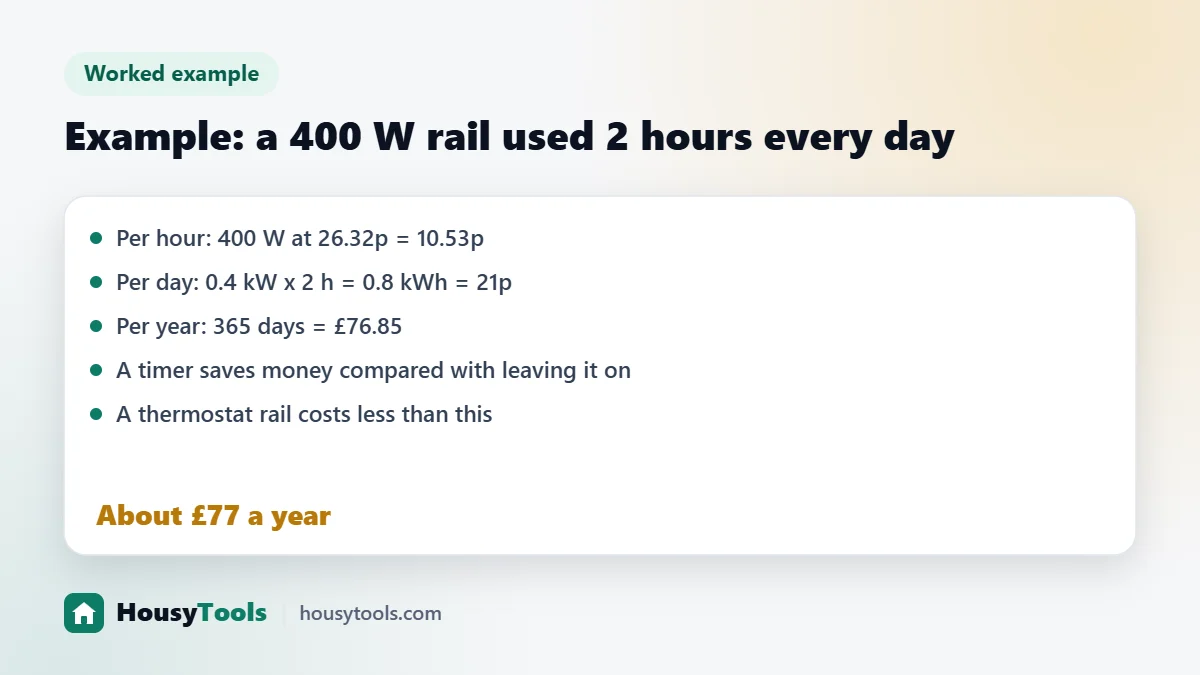
Example: a household uses a 400 W electric towel rail with no thermostat for 2 hours every morning all year, at the 26.32p price cap rate.
- Per hour: 0.4 kW x 26.32p = 10.53p
- Per day: 0.4 kW x 2 h = 0.8 kWh, which is 21p
- Per year: 21p x 365 days = £76.85
A practical tip: a towel rail is a towel warmer rather than a room heater, so in a small bathroom you may find that a short run before and after showers keeps towels dry without needing it on all day.
Common Questions About Towel Rail Costs
The biggest difference to the bill comes from hours of use and whether the rail has a thermostat, not small differences in power.
- Check the wattage label: some designer rails are much more powerful than standard ones.
- A thermostatic element or timer pays back quickly if a rail is often left on.
- Rails in bathrooms must be installed to wiring rules for wet rooms, so use a qualified electrician.
Towel Rail Running Cost FAQs
How much does a 300 W towel rail cost per hour?
At 26.32p per kWh, a 300 W towel rail costs about 7.9p per hour while heating. Use your own unit rate in the calculator for an exact figure.
Is it expensive to leave a heated towel rail on all day?
It can be. A 300 W rail without a thermostat left on 24 hours costs about £1.90 a day at 26.32p. A timer or thermostat cuts this a lot.
Do electric towel rails use a lot of electricity?
Most use 100 to 800 W, similar to a few incandescent bulbs up to a small heater. The cost depends mainly on how many hours they run.
Can a towel rail heat a bathroom?
A towel rail adds some warmth, but most are sized to warm towels rather than heat a room. A larger radiator or heater may be needed for a cold bathroom.
Are dual fuel towel rails worth it?
They let you warm towels by electricity in summer without running the boiler, and use central heating in winter. They suit bathrooms already on a heating circuit.
How can I reduce towel rail running costs?
Use a timer or smart element, lower the temperature setting, and switch the rail off when towels are dry. Each hour avoided saves the hourly cost shown.
Checked October 2026. Sources: Ofgem energy price cap, Eurostat household electricity prices.