
Show the formula and working
This hedge planting calculator works out how many hedge plants you need from the length of the hedge, the spacing between plants and whether you plant a single row or a double staggered row. It also shows plants per metre and, if you add a price, the cost of the plants. You can work in metres or feet.
Quick answer: Divide the hedge length by the spacing between plants, round down and add one for the end plant. A 10 m single row hedge at 45 cm spacing needs 23 plants, about 2.3 per metre. A double staggered row needs about twice as many.
How Is the Number of Hedge Plants Calculated?
Convert the hedge length to centimetres, divide by the spacing, round down to a whole number and add one plant to finish the row.
The extra plant is there because a row of plants has one more plant than gaps. A 1 m row at 50 cm spacing, for example, has plants at 0, 50 and 100 cm, which is three plants, not two. For a double row, the calculator multiplies the plants per row by two. In a staggered double row, the second row is set about half a spacing along, so each plant sits opposite a gap in the first row.
What Spacing Should Hedge Plants Have?
The RHS says plants in a single row are usually set 30 to 60 cm apart, depending on the final size of the plants, the size of hedge you want and how vigorous the plants are.
For a hedge thicker than about 90 cm, the RHS suggests a staggered double row, with the rows 45 cm apart and plants 90 cm apart within each row. Small, slow growing plants for a low hedge usually go closer together. Large, fast growing plants can go further apart. Always check the nursery label or supplier advice for your plant, and you can read more in the RHS guide to planting hedges.
How Do You Use the Hedge Calculator?
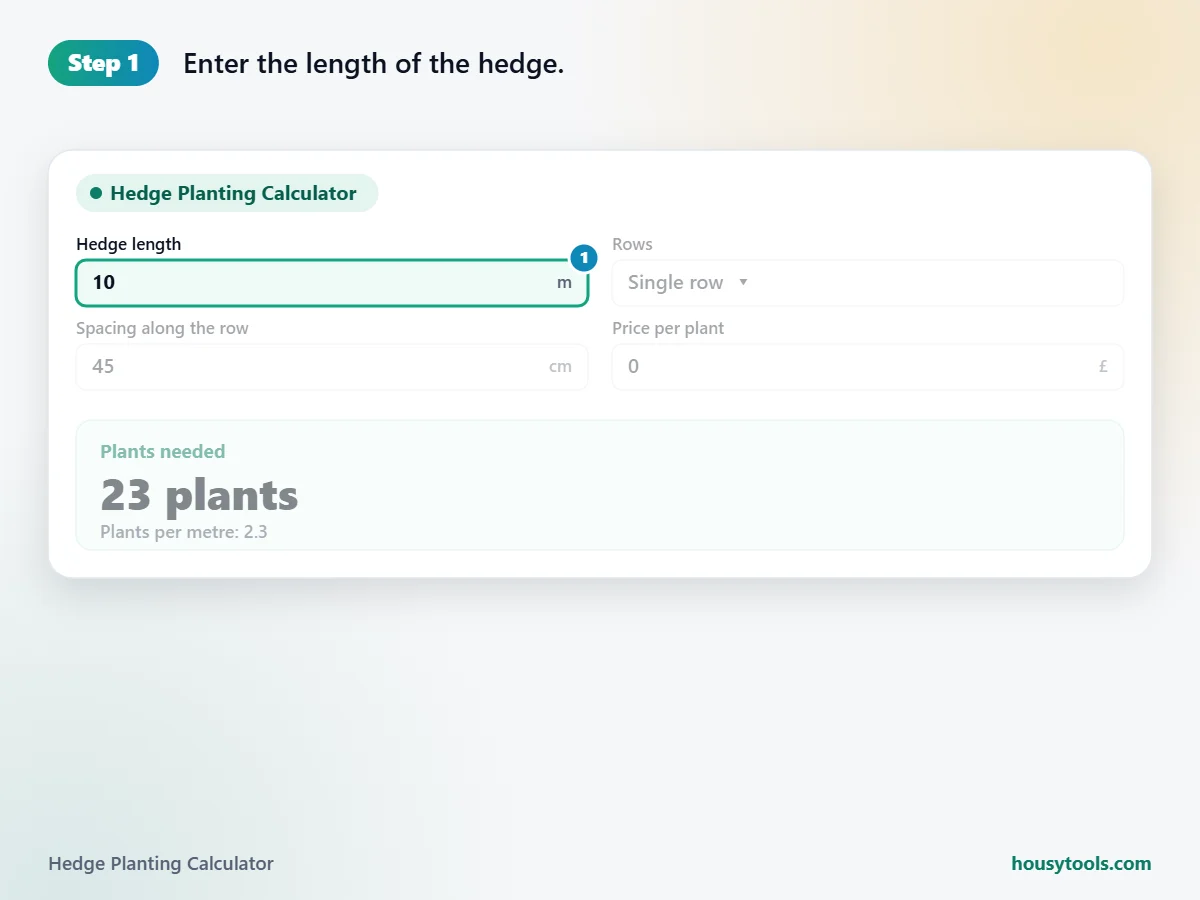
- Enter the length of the hedge.
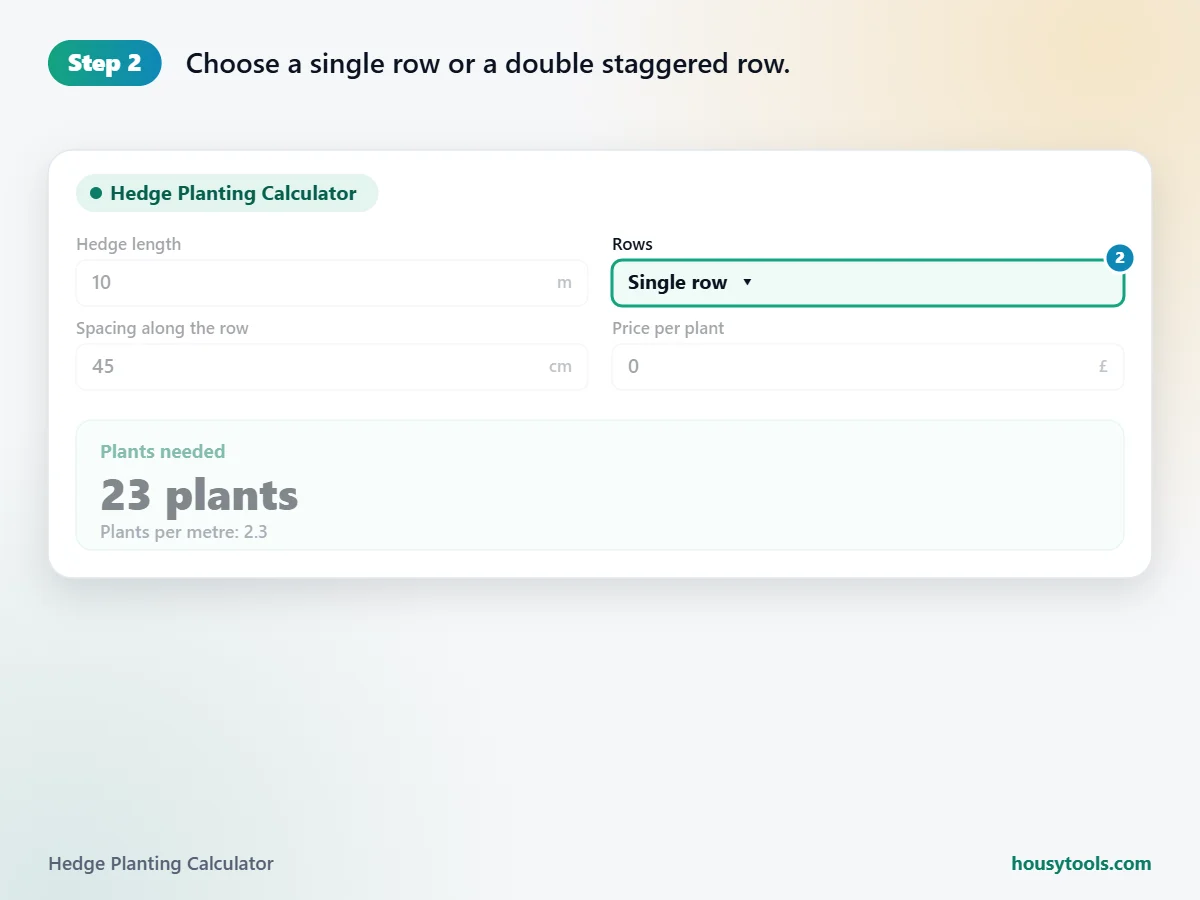
- Choose a single row or a double staggered row.
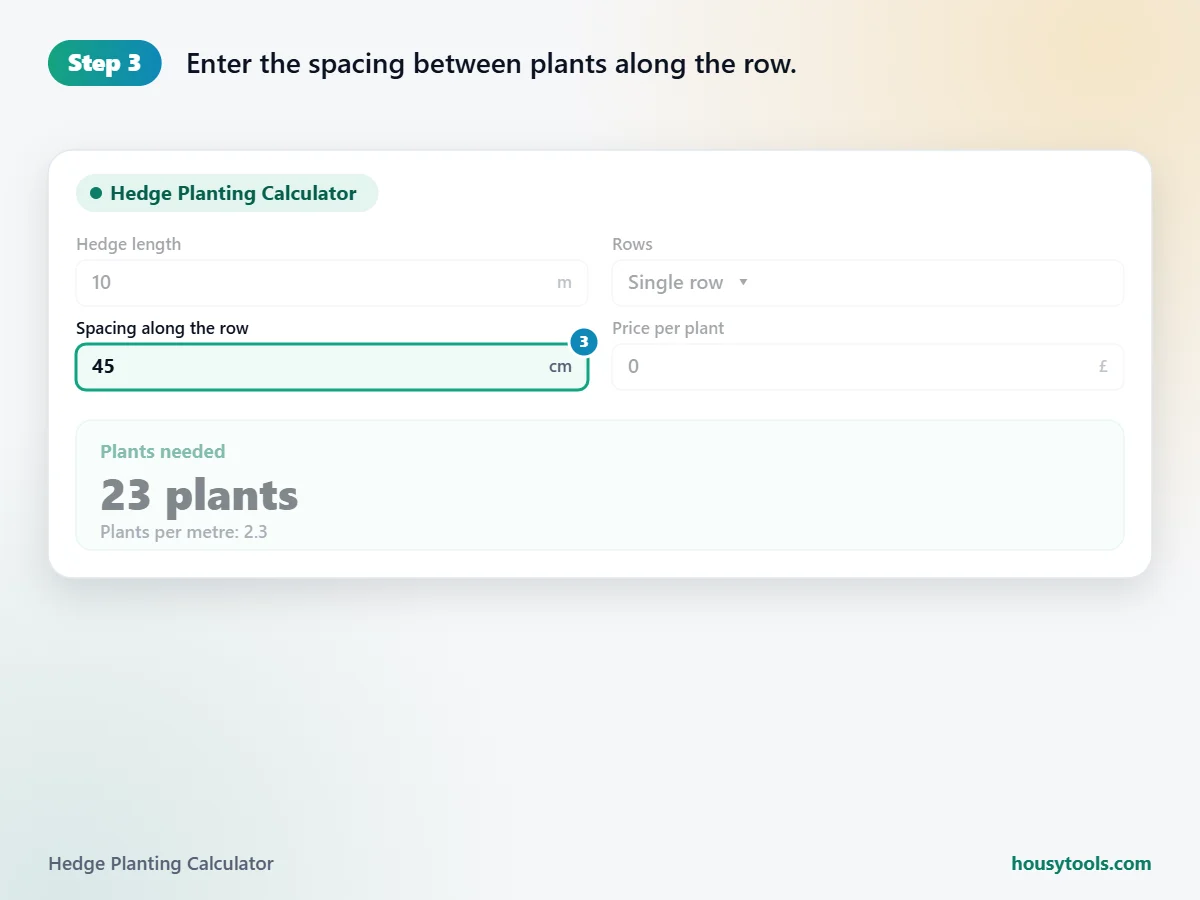
- Enter the spacing between plants along the row.
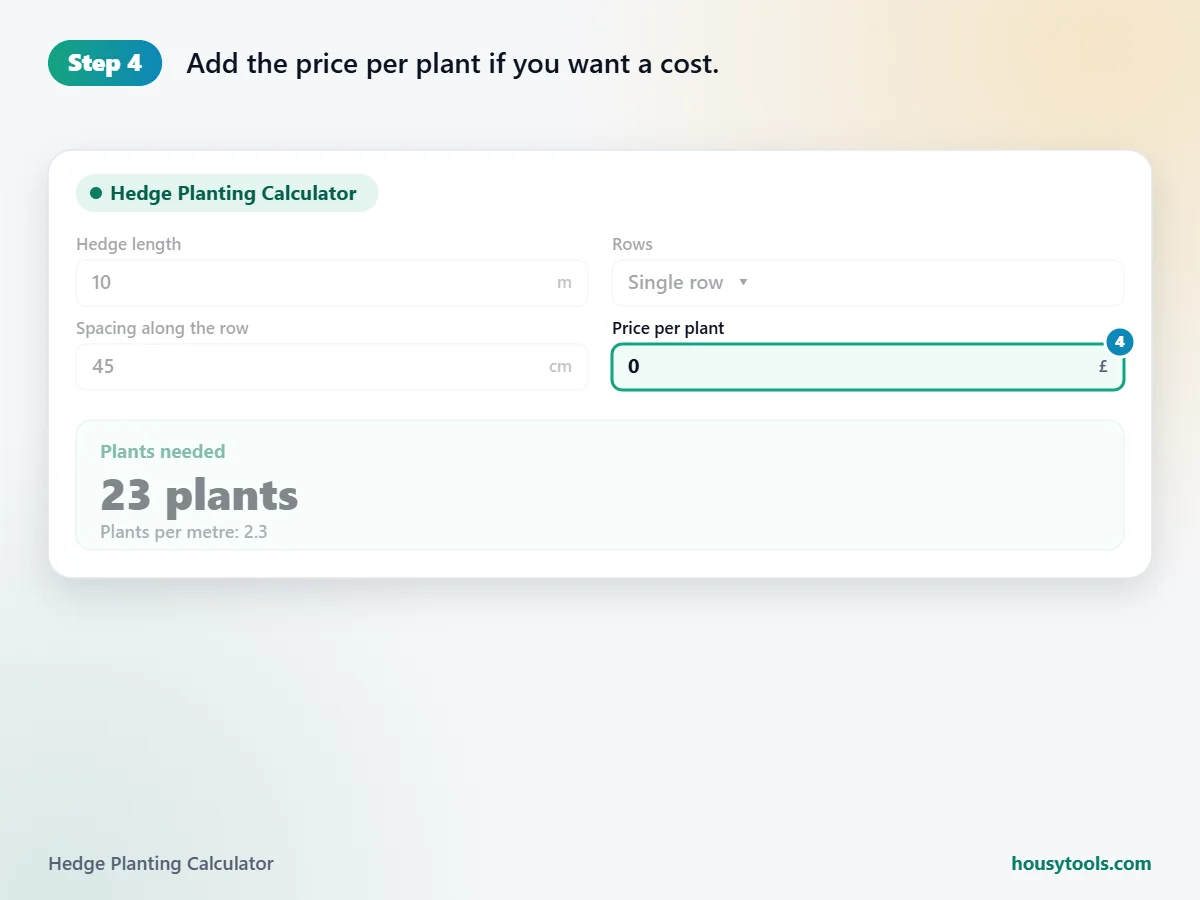
- Add the price per plant if you want a cost.
- Read the number of plants and plants per metre.

How Many Hedge Plants Per Metre?
At 30 cm spacing a single row needs about 3.4 plants per metre over 10 m, falling to about 1.2 per metre at 90 cm spacing.

| Spacing | Plants for 10 m | Plants per metre | Double row for 10 m |
|---|---|---|---|
| 30 cm | 34 | 3.4 | 68 |
| 45 cm | 23 | 2.3 | 46 |
| 60 cm | 17 | 1.7 | 34 |
| 90 cm | 12 | 1.2 | 24 |
When Should You Plant a Hedge?
According to the RHS, deciduous hedges are best planted from mid autumn to late winter, and evergreen hedges ideally in early autumn.
Bare root plants are only sold while they are dormant, in winter and early spring, and are usually the cheapest way to plant a long hedge. Avoid planting when the soil is frozen or waterlogged. Preparing the ground well helps the plants establish: the compost calculator works out how much organic matter to dig in, and the mulch calculator covers the mulch layer afterwards.
Worked Example: A 20 m Double Row
Example: a gardener plants a 20 m boundary hedge as a staggered double row, with plants 40 cm apart in each row, at an example price of £3.50 a plant.
- Plants per row: 2,000 cm / 40 cm = 50, plus 1 = 51
- Two rows: 51 x 2 = 102 plants
- Plants per metre: 102 / 20 = 5.1
- Cost: 102 x £3.50 = £357.00

Buying a few spare plants is sensible for a long hedge, because one or two may fail in the first year and gaps are easier to fill with plants of the same age.
Tips for Planting a Hedge
A little planning at the start gives a thicker hedge sooner.
- Mark the line with string and canes before you dig.
- Keep bare root plants damp and plant them as soon as you can.
- Water well after planting and through dry spells in the first year.
- Mulch along the row to hold moisture and keep weeds down.
- Leave enough room from paths and boundaries for the hedge’s final width.
Hedge Planting FAQs
How many hedge plants do I need per metre?
It depends on spacing. At 30 cm spacing you need about 3.3 plants per metre in a single row, and at 60 cm about 1.7.
How far apart should I plant hedge plants?
The RHS says 30 to 60 cm within a single row, depending on the plant and the hedge size. Check the label for your plant.
Is a double row hedge better?
A staggered double row gives a thicker hedge faster, which suits wide boundary or wildlife hedges. It needs about twice as many plants.
When is the best time to plant a hedge?
The RHS suggests mid autumn to late winter for deciduous hedges and early autumn for evergreen hedges, when the soil is not frozen or waterlogged.
Why add one plant to each row?
A row always has one more plant than gaps, so the extra plant finishes the end of the row.
Should I buy spare plants?
A few spares are useful for replacing any plants that fail, so the hedge grows evenly.
Checked October 2026. Source: RHS guidance on planting hedges. Plant prices are examples.