
Show the formula and working
This free LED savings calculator shows how much money and electricity you save each year by swapping halogen, filament or CFL bulbs for LEDs, for households in the UK, Ireland and Europe. Enter the bulbs, the hours they are on and your unit rate, and it works out the yearly saving, the payback time on the new bulbs and the saving over the LEDs’ rated life.
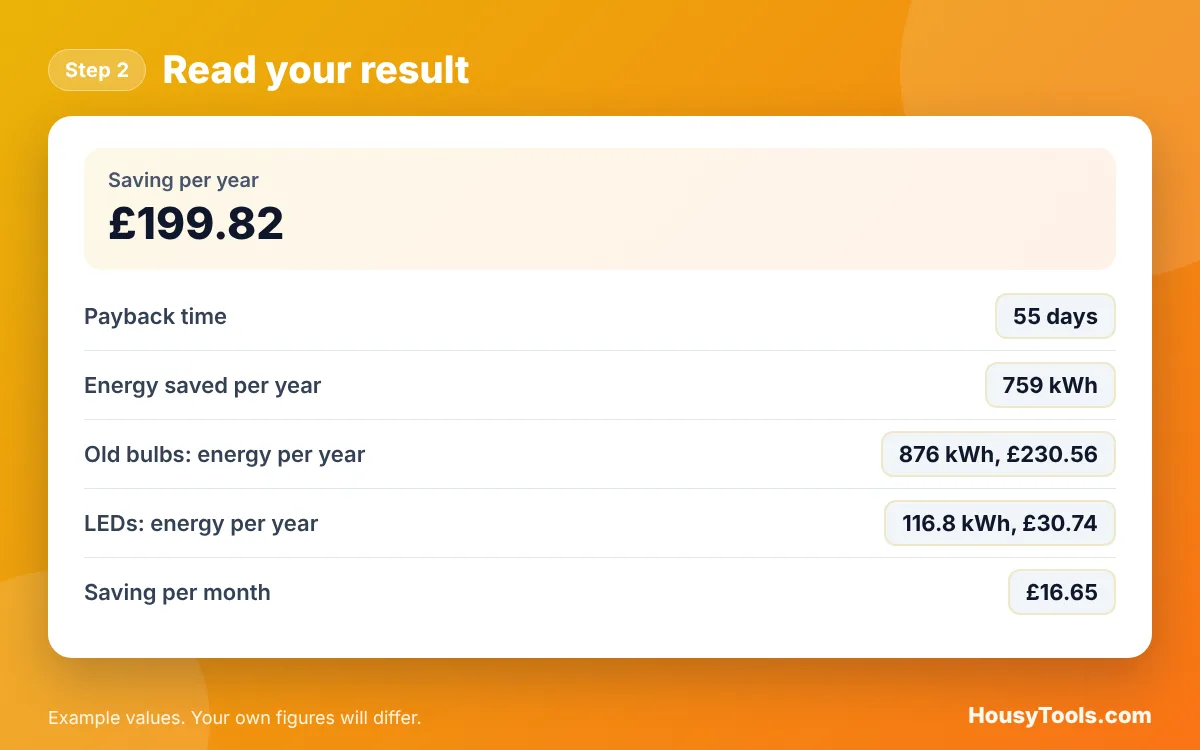
Quick answer: Multiply the watts saved by the hours used and your unit rate. Replacing ten 60 W bulbs with 8 W LEDs used 4 hours a day saves 759.2 kWh a year, which is £199.82 at 26.32p per kWh. This LED savings calculator shows £30 of LEDs pays back in about 55 days.
What Is an LED Savings Calculator?
An LED savings calculator is a tool that compares the electricity used by your old bulbs with LED replacements and turns the difference into money. In plain words: watts saved per bulb x number of bulbs x hours per day x 365 / 1,000 gives the kWh saved a year, and kWh saved x your unit rate gives the money saved. Payback time is the cost of the LEDs divided by the daily saving.
LEDs save because they need far fewer watts for the same light. For example, an 8 W LED rated at 806 lumens gives the same light as an old 60 W filament bulb. Check the lumens on the box so the new bulb is as bright as the old one, and use the light bulb base converter to match the cap, such as E27, B22 or GU10.
How Do You Use the LED Savings Calculator?
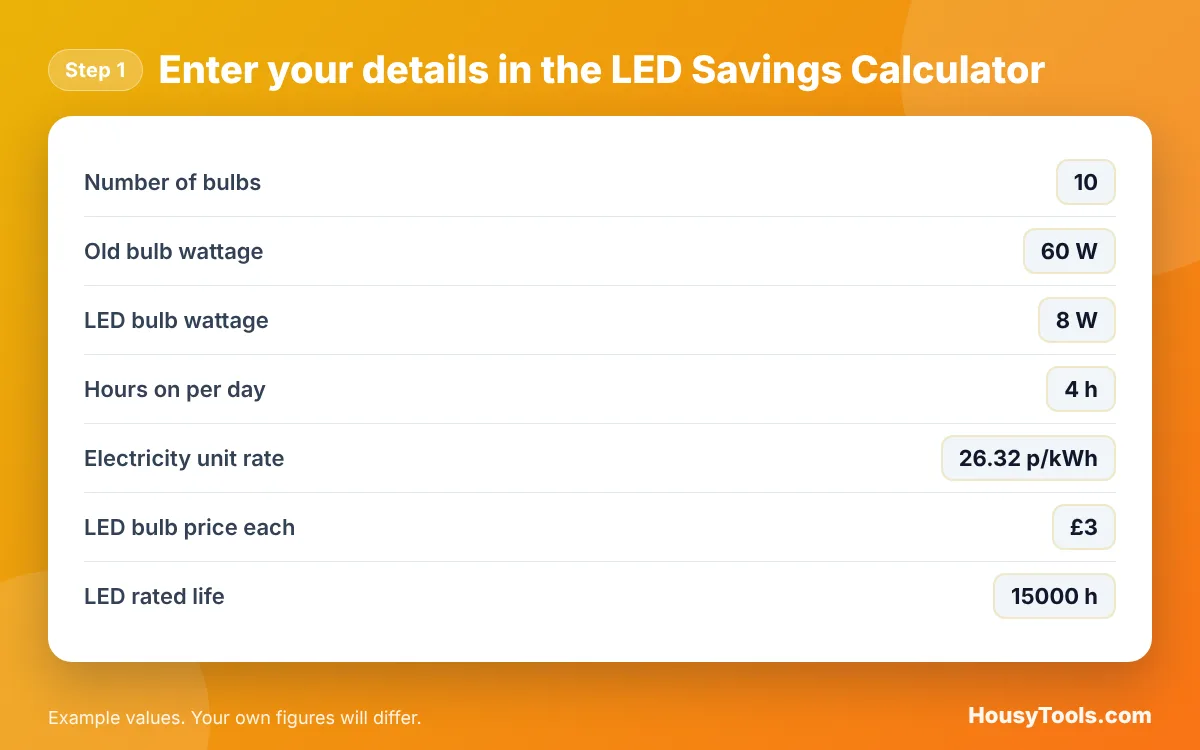
- Enter the Number of bulbs you plan to replace with the same wattage.
- Enter the Old bulb wattage and the LED bulb wattage from the bulbs or their boxes.
- Set the Hours on per day, as an average for each bulb.
- Check the Electricity unit rate. It starts at the UK price cap rate; replace it with the rate on your bill, in pence or cents.
- Enter the LED bulb price each and the LED rated life, plus the Old bulb price each and Old bulb rated life if you want the lifetime saving to include bulbs you no longer buy.
- Read the yearly saving and payback time, then open “Show the formula and working” to see every step.
How Much Does One LED Bulb Save a Year?
Swapping one 60 W bulb for an 8 W LED used 4 hours a day saves 75.92 kWh a year, which is £19.98 at 26.32p per kWh. Halogen spotlights save almost as much each: a 50 W GU10 replaced by a 5 W LED saves £17.29 a year at the same use. Kitchens with eight or ten spotlights often give the biggest saving in the home.
| Example swap | kWh saved per bulb a year (4 h a day) | Saving per bulb, 4 h a day | Saving per bulb, 8 h a day |
|---|---|---|---|
| 40 W to 5 W LED | 51.10 kWh | £13.45 | £26.90 |
| 60 W to 8 W LED | 75.92 kWh | £19.98 | £39.96 |
| 100 W to 14 W LED | 125.56 kWh | £33.05 | £66.09 |
| 35 W GU10 halogen to 4 W LED | 45.26 kWh | £11.91 | £23.82 |
| 50 W GU10 halogen to 5 W LED | 65.70 kWh | £17.29 | £34.58 |
| 11 W CFL to 8 W LED | 4.38 kWh | £1.15 | £2.31 |
The table uses 26.32p per kWh, the GB average electricity unit rate under the Ofgem energy price cap for 1 October to 31 December 2026, for Direct Debit customers. In Ireland and the rest of Europe, enter your own rate in cents.
Is It Worth Replacing CFL Bulbs With LEDs?
Replacing a working CFL saves only about £1 a year per bulb at 4 hours a day, so it is usually better to swap CFLs as they fail and replace halogen and filament bulbs first. CFLs are already fairly efficient. Shops in Great Britain stopped selling most halogen bulbs from September 2021, and most fluorescent lamps were phased out from 2023, so when an old bulb fails the replacement will usually be an LED anyway. The big wins are halogen spotlights and any old filament bulbs, where each swap saves £10 to £35 a year at typical use.
How Long Do LED Bulbs Take to Pay for Themselves?
LEDs replacing halogen or filament bulbs usually pay back within a few months: £3 LEDs replacing 60 W bulbs used 4 hours a day pay back in 55 days at 26.32p per kWh. Payback is longer for bulbs used rarely, such as a loft light, and for expensive smart or designer bulbs. The calculator shows the payback for your own prices and hours, and warns if the bulbs would not pay back within their rated life.
Worked Example: Ten 60 W Bulbs Swapped for 8 W LEDs
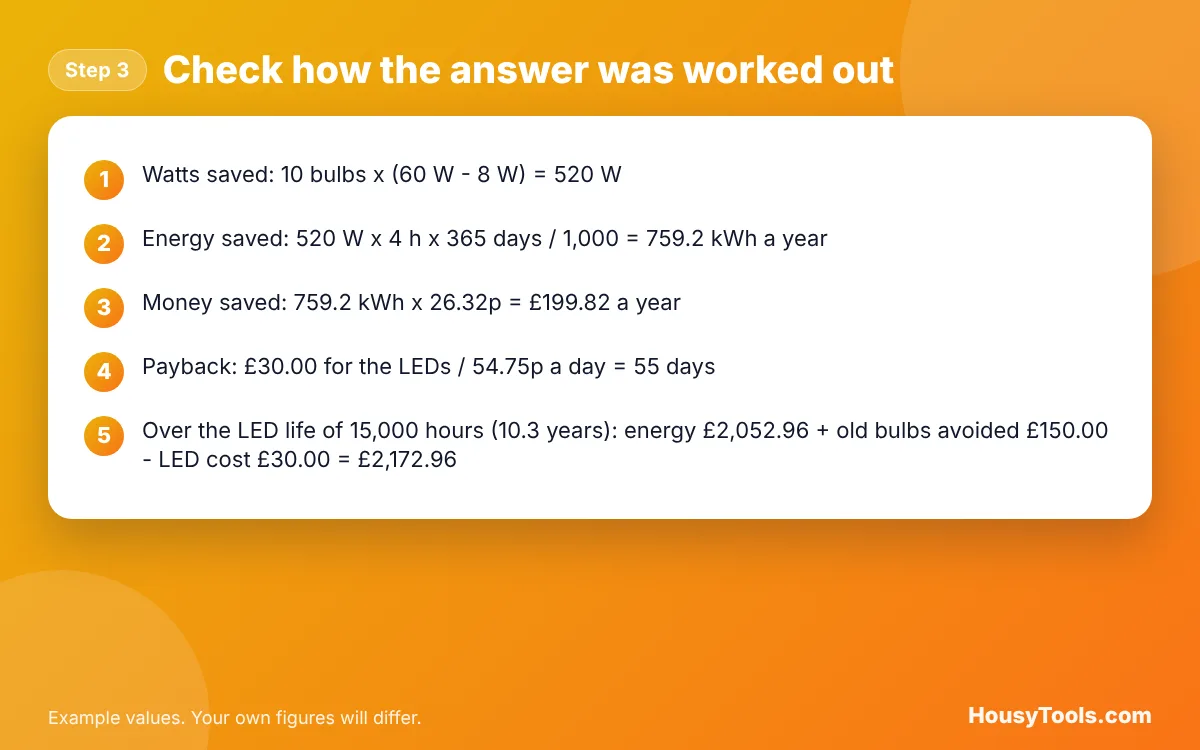
Example: a home replaces ten 60 W bulbs with ten 8 W LEDs at £3 each. The lights are on 4 hours a day and electricity costs 26.32p per kWh. The watts saved are 10 x (60 – 8) = 520 W. Over a year that is 520 x 4 x 365 / 1,000 = 759.2 kWh, and 759.2 x 26.32p = £199.82 a year, or £16.65 a month.
The LEDs cost £30, and the saving is 54.75p a day, so they pay for themselves in 55 days. With an example LED rated life of 15,000 hours, the bulbs last about 10.3 years at 4 hours a day. Over that time they save £2,052.96 of electricity, plus £150 of replacement bulbs at £2 and 2,000 hours each, so the net saving is £2,172.96. To check what any other appliance costs to run, use the electricity cost calculator, or browse the energy bill calculators.
LED Savings Calculator FAQs
How do I calculate LED savings?
Subtract the LED watts from the old bulb watts, multiply by the number of bulbs and the hours used per year, and divide by 1,000 to get kWh. Multiply the kWh by your unit rate to get the money saved.
How much does it cost to run an LED bulb?
An 8 W LED used 4 hours a day uses 11.68 kWh a year, which costs about £3.07 at 26.32p per kWh. The same light from a 60 W filament bulb would cost about £23.06 a year.
What unit rate should I use?
Use the unit rate on your latest electricity bill. The calculator starts at 26.32p per kWh, the GB average price cap rate for October to December 2026 on Direct Debit. Fixed tariffs, Northern Ireland, Ireland and the EU have different rates.
How long do LED bulbs last?
The rated life is printed on the box in hours. The calculator uses 15,000 hours as an example, which is about 10.3 years at 4 hours a day. Heat and enclosed fittings can shorten real life, so check the bulb suits the fitting.
Do LED bulbs save money if I switch them on and off often?
Yes. LEDs reach full brightness instantly and use no extra energy to start, so switching them off when you leave a room always saves electricity. Fewer hours on means a smaller yearly saving from the swap, but also a lower bill overall.
Will an LED be as bright as my old bulb?
It will if you match the lumens, not the watts. An old 60 W bulb is matched by about 806 lumens, a 40 W bulb by 470 lumens and a 100 W bulb by 1,521 lumens. These figures are printed on most LED boxes.
Checked October 2026. Sources: Ofgem, energy price cap unit rates and standing charges, LED lamp (Wikipedia).