
These paint and decorating calculators help homeowners, renters and DIY decorators in the UK, Ireland and the rest of Europe work out how much paint, wallpaper, masonry paint, fence paint and decking stain to buy, what it will cost and how long the job will take. All 8 calculators are free, work in metric or imperial, and show the full working under every result.
Quick answer: paint and decorating calculators turn room or surface measurements into litres, tins, rolls, cost and hours. Measure length, width and height, subtract doors and windows, choose coats and enter the coverage printed on your tin. A 4 m by 3.5 m bedroom with 2.4 m walls needs 5.5 litres for two coats.
All 8 Paint and Decorating Calculators
Each tool below does one job and does it carefully. Choose by the surface you are covering first, then by what you need to know: quantity, cost or time. Our paint and decorating calculators share the same inputs where they can, so a room you measure once works across several tools.
Walls and ceilings
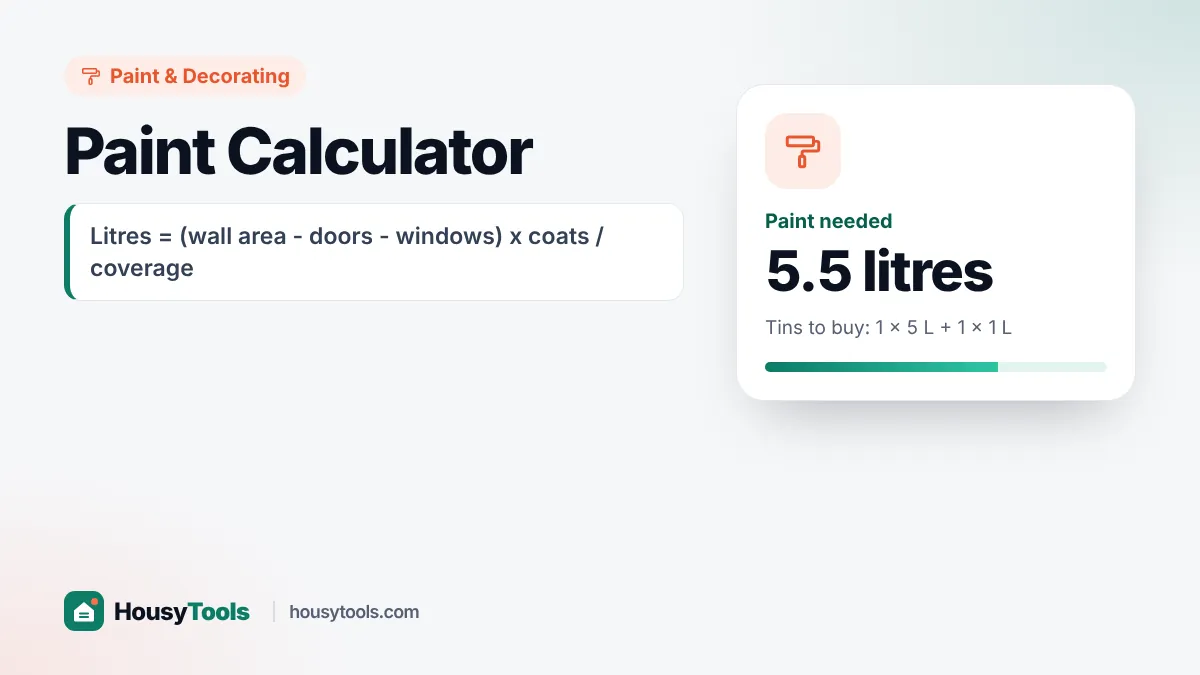
- Paint Calculator: litres of emulsion and the best mix of 5 L, 2.5 L and 1 L tins for a room, with doors, windows, coats and an optional ceiling.
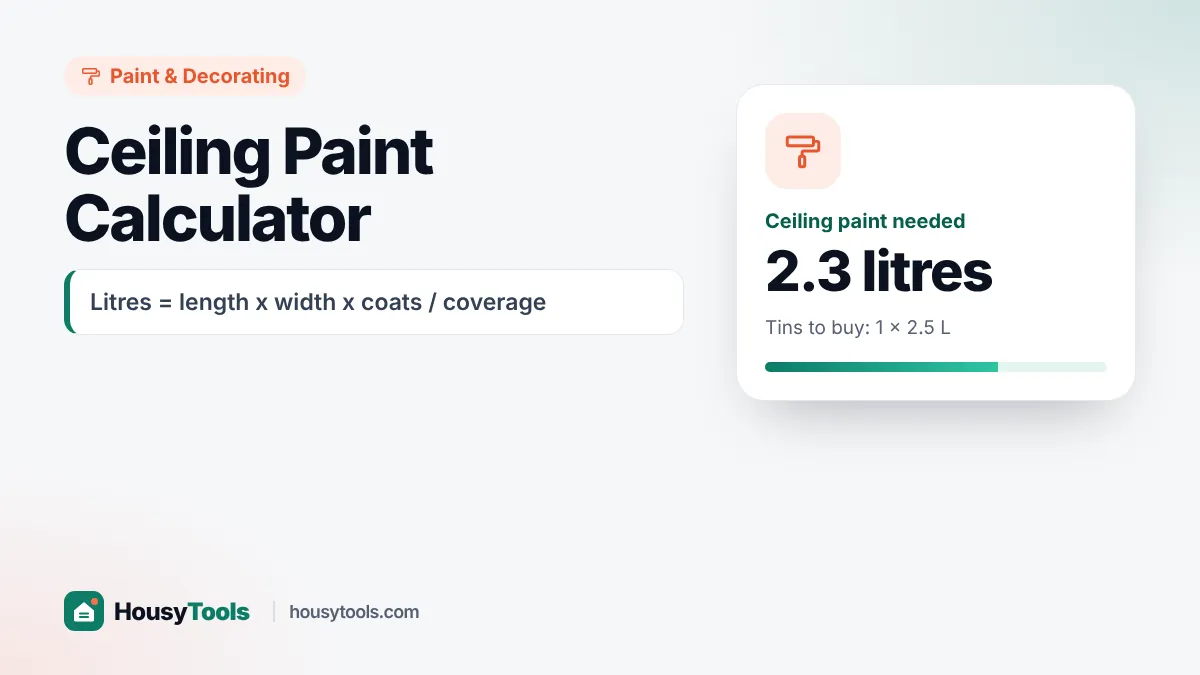
- Ceiling Paint Calculator: paint for one ceiling or a whole floor, with an extra mist coat counted for new plaster.
- Wallpaper Calculator: rolls for a room from the drops each roll gives, allowing 10 cm of trim per drop and the pattern repeat on the label.
Outside walls, fences and decks
- Masonry Paint Calculator: exterior paint for smooth render, brick or pebbledash, with the tin coverage adjusted for texture.
- Fence Paint Calculator: fence paint or treatment by number of panels, panel size, one or both sides and coats.
- Deck Stain Calculator: decking stain or oil for the deck area plus any steps and rails.
Budget and planning
- Paint Cost Calculator: the price of the whole tins you must buy, plus primer or mist coat and sundries such as rollers, tape and filler.
- Painting Time Calculator: hours and working days for a job, including prep time and the wait between coats.
Most Popular Paint and Decorating Calculators
Among our paint and decorating calculators, the paint calculator is the one most people start with, because nearly every decorating job includes walls. It works from length, width and wall height, takes off doors and windows, and rounds the result up to real tin sizes, so you see what to put in the basket rather than an abstract litre figure.
The wallpaper calculator comes next. Wallpaper is less forgiving than paint, because a roll gives a whole number of drops and a pattern repeat can cost you an extra roll or two. A 4 m by 3.5 m room with 2.4 m walls needs 8 plain rolls of 53 cm by 10.05 m paper, or 10 with a pattern repeat.
Outside, the masonry paint calculator is the most useful of our paint and decorating calculators, because exterior walls are large and texture changes the quantity so much. The same 79.4 m² of wall needs 15.9 litres on smooth render but 31.8 litres on pebbledash over two coats.
Which Paint and Decorating Calculator Do I Need?
Pick the tool that matches the surface: the paint, ceiling paint or wallpaper calculator for inside rooms, the masonry paint calculator for brick and render, and the fence paint or deck stain calculator for garden timber. Then run the cost and time tools once you know the quantity.
- Repainting a bedroom or lounge: start with the paint calculator and tick the ceiling box if you use the same paint, or use the ceiling paint calculator for a separate ceiling white.
- Freshly plastered room: use the ceiling paint calculator and paint calculator with an extra coat for the mist coat.
- Feature wall or full room in paper: use the wallpaper calculator with the roll size and repeat from the label.
- House front or garden wall: use the masonry paint calculator and choose the surface texture.
- Garden makeover: use the fence paint calculator for panels and the deck stain calculator for the deck, then add the two totals.
- Setting a budget or booking time off: finish with the paint cost calculator and the painting time calculator.
How Do You Plan a Decorating Job From Start to Finish?
Plan in five steps: measure, work out quantities, price them, estimate the time, then buy everything from the same batch in one order. Our paint and decorating calculators follow that order, so each result feeds the next tool.
- Measure every surface for the paint and decorating calculators in metres to two decimal places: room length and width at floor level, wall height from skirting to ceiling, and the size of each door and window.
- Run the quantity tools. Use the coverage printed on your own tin, because the defaults in the paint and decorating calculators are examples only.
- Price the job with the paint cost calculator, comparing tin sizes and two or three paints.
- Estimate the hours with the painting time calculator, using the recoat time from the tin.
- Buy all the paint or paper for one room at once and check that the batch numbers match, then keep a little spare for touch ups.
Work in the right order on the day: ceiling first, then walls, then woodwork, so drips only land on surfaces you have not yet finished.
How Much Paint Do You Need for Common Jobs?
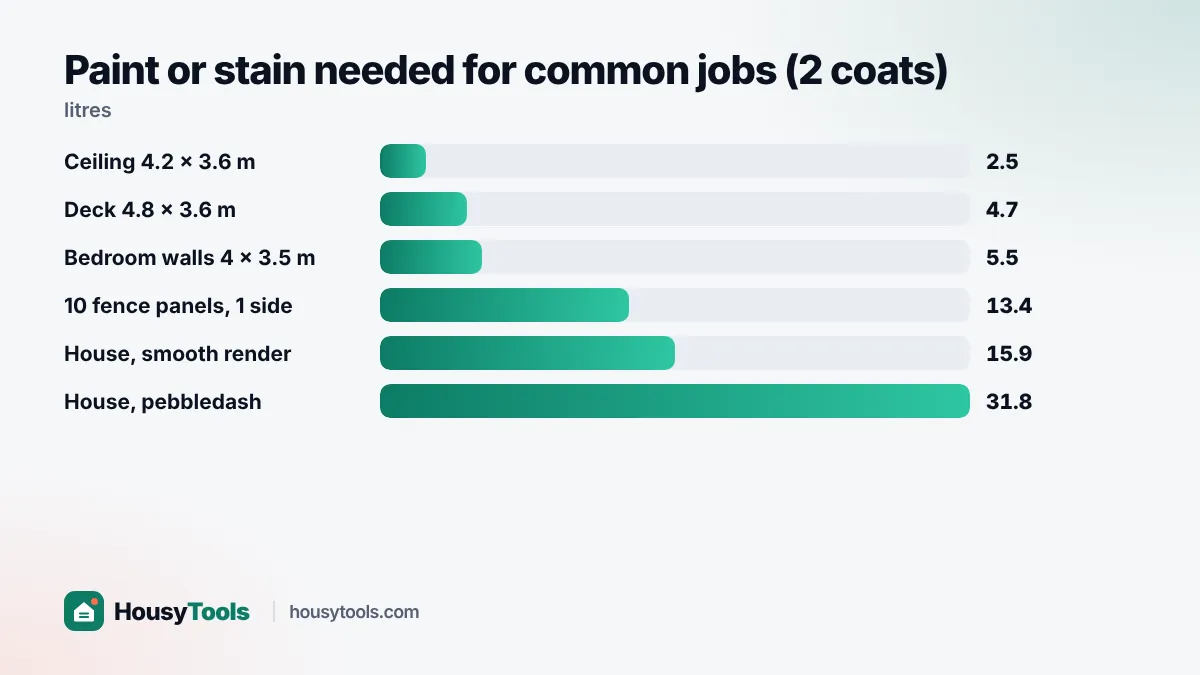
Most rooms need 2 to 8 litres of emulsion for two coats, while outside jobs need far more: 13.4 litres for ten fence panels and 15.9 to 31.8 litres for the walls of a typical semi. The figures below come straight from the worked results in our paint and decorating calculators.
| Job | Area or size | Coverage used | Litres for 2 coats | Tool |
|---|---|---|---|---|
| Bedroom ceiling | 4.2 x 3.6 m | 12 m² per litre | 2.5 | Ceiling Paint Calculator |
| Deck with steps | 4.8 x 3.6 m plus 1.5 m² | 8 m² per litre | 4.7 | Deck Stain Calculator |
| Bedroom walls | 4 x 3.5 m, 2.4 m high | 12 m² per litre | 5.5 | Paint Calculator |
| Fence, one side | 10 panels of 1.83 m | 5 m² per litre | 13.4 | Fence Paint Calculator |
| House walls, smooth render | 79.4 m² | 10 m² per litre | 15.9 | Masonry Paint Calculator |
| House walls, pebbledash | 79.4 m² | Half the tin figure | 31.8 | Masonry Paint Calculator |
Why Does the Coverage on the Tin Matter So Much?
Coverage sets how many litres you buy, so it changes the answer more than any other input: a paint that covers 14 m² per litre needs about 14% fewer litres than one that covers 12 m² per litre for the same wall.
Makers measure coverage on smooth, sealed surfaces, which is why tins say “up to”. Real walls with filler, texture or old flaking paint get less. Across all the paint and decorating calculators, garden timber is the extreme case: rough sawn fence panels often take only 3 to 6 m² per litre, and ten panels need 22.3 litres at 3 m² per litre but 6.7 litres at 10 m² per litre.
That is why all our paint and decorating calculators ask for the figure on your tin instead of assuming a brand. If you are unsure, enter a slightly lower number than the tin, or paint a measured test patch and see how far the product really goes.
How Many Coats of Paint Do You Need?
Two coats is the normal choice for walls, ceilings, fences and decks, and the default in our paint and decorating calculators, with a third coat for a strong colour change and an extra thinned mist coat on new plaster.
New plaster is very absorbent. Dulux advises that plaster can take up to four weeks to dry and suggests a mist coat of about ten parts emulsion to one part water, so the ceiling paint calculator adds one full coat when you tick the new plaster box. One coat products exist for fences, but only use one coat where the tin allows it.
Coats also drive time. Each coat adds rolling time plus the recoat wait, often 2 to 4 hours for water based emulsion, which is why the painting time calculator asks for both.
What Safety Checks Should You Make Before Decorating?
Check three things before you start: safe access at height, whether old paint might contain lead, and whether textured coatings might contain asbestos.
For ceilings and the tops of walls, use a roller on an extension pole where you can, and follow the HSE’s advice on using ladders and stepladders safely: the right ladder, firm level ground, and moving it rather than overreaching. Exterior walls above the ground floor may need a scaffold tower or a professional.
In older homes, the HSE notes that lead pigments were widely used in household paint until the 1960s, so wet sand and never burn off old layers. Textured ceiling coatings in homes built or refurbished before 2000 may contain asbestos and must be tested before anyone sands or scrapes them.
Our paint and decorating calculators give estimates only. Read how we build and test them on the how our calculators work page, and see the disclaimer for the limits of any online estimate.
Paint and Decorating Calculators FAQs
Are your paint and decorating calculators free?
Yes. All 8 paint and decorating calculators on this page are free to use, with no sign up. They work in metric or imperial units, update as you type and show every step of the sum under the result, so you can check the maths yourself.
How much paint do I need for an average room?
An average 4 m by 3.5 m UK bedroom with 2.4 m walls, one door and one window needs about 5.5 litres of emulsion for two coats at 12 m² per litre. That is one 5 litre tin plus a 1 litre tin. Larger rooms or higher ceilings need more.
How many rolls of wallpaper do I need for a room?
A 4 m by 3.5 m room with 2.4 m walls needs 8 rolls of plain 53 cm by 10.05 m wallpaper, or 10 rolls if the paper has a pattern repeat. For an exact count, enter your room and the repeat in the wallpaper tool in our paint and decorating calculators.
Should I subtract doors and windows when working out paint?
Yes, subtract the real openings. A standard UK internal door removes about 1.5 to 1.6 m² of wall and an average window 1 to 2 m². The paint and decorating calculators for rooms let you set both sizes. In a small bedroom, one door and one window save about half a litre over two coats.
How much more paint does pebbledash need?
Pebbledash needs at least half as much paint again as smooth render, and the masonry paint calculator allows twice as much to be safe. For 79.4 m² over two coats with a tin rated at 10 m² per litre, that is 31.8 litres against 15.9 litres.
How long does it take to paint a room?
An average UK room takes 1 to 2 days to paint. With default settings, the walls of a 4 m by 3.5 m bedroom take about 11.6 hours, including 3 hours of prep and a 2 hour wait between coats. Adding the ceiling takes it past two working days.
Checked October 2026. Sources: Health and Safety Executive (ladders and lead guidance), Dulux new plaster and product data, Cuprinol and Ronseal product data, results from each HousyTools tool page.