
Show the formula and working
This self levelling compound calculator works out how many kilograms and bags of floor levelling compound you need from the floor area, the average depth you will pour and the product’s consumption rate. It is set up for UK and European DIYers and fitters preparing floors for tiles, vinyl, LVT, laminate or carpet, in metric or imperial units.
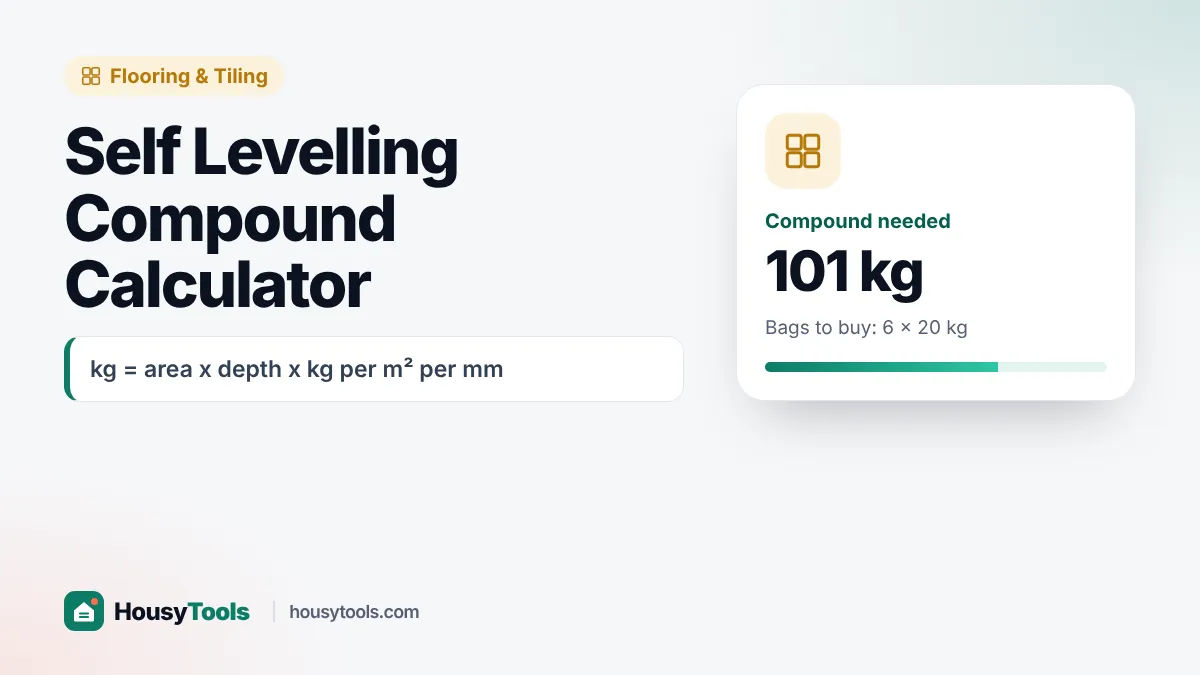
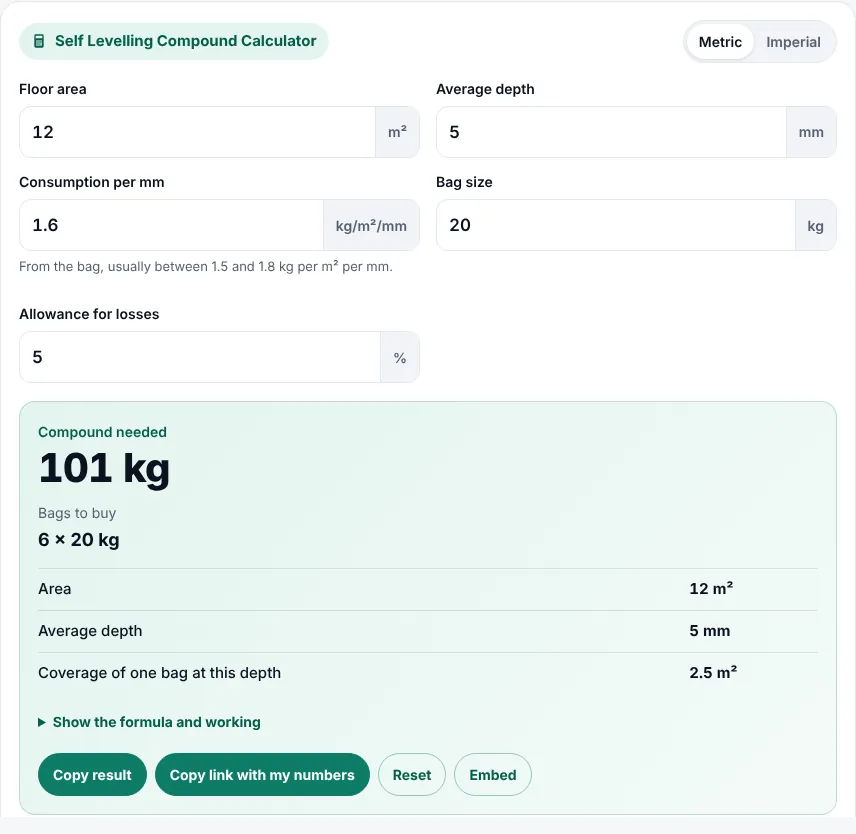
Quick answer: a self levelling compound calculator multiplies floor area by average depth in millimetres and by the product’s consumption, usually about 1.6 to 1.7 kg per m² per mm, then adds 5% for losses. A 12 m² floor at an average 5 mm depth needs about 101 kg, or six 20 kg bags.
What Is a Self Levelling Compound Calculator?
A self levelling compound calculator is a tool that estimates the weight of floor levelling compound needed to cover an area at a given average depth. Self levelling compound is a free flowing cement based screed, described on Wikipedia as a polymer modified cement with high flow, used to create a flat, smooth base for floor coverings.
The formula is: area in m² x average depth in mm x consumption in kg per m² per mm x (1 + loss allowance). The result is divided by the bag weight and rounded up. The self levelling compound calculator also shows how many square metres one bag covers at your depth, which helps when you mix and pour bag by bag.
How Do You Use the Self Levelling Compound Calculator?
- Measure the floor and enter the area in m² (or ft² in imperial mode). For an L shaped room, split it into rectangles and add them.
- Work out the average depth you need to fill, in millimetres, using the grid method explained below.
- Enter the consumption rate from the bag or data sheet. The default is 1.6 kg per m² per mm.
- Enter the bag size. Levelling compound is commonly sold in 20 kg and 25 kg bags.
- Keep the 5% allowance for losses, or raise it for rough floors that soak up more compound, then read the bags to buy.
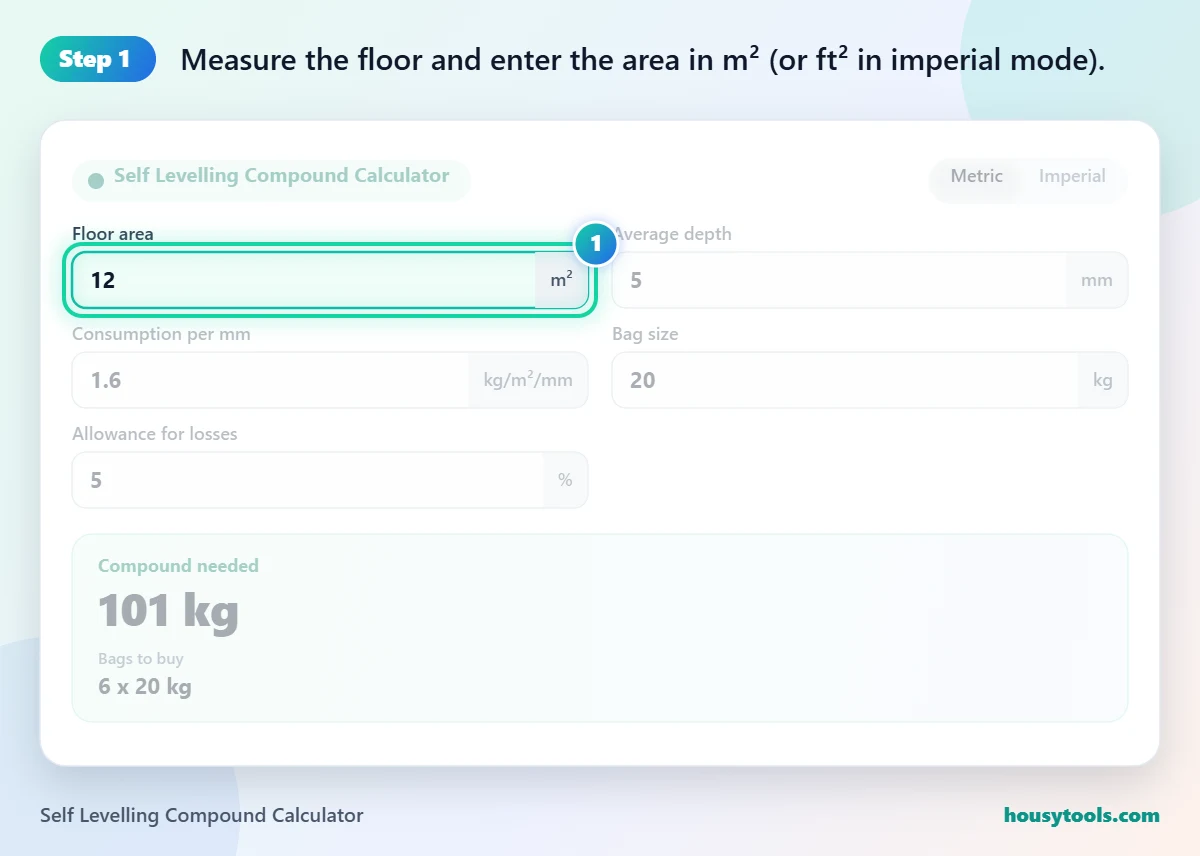
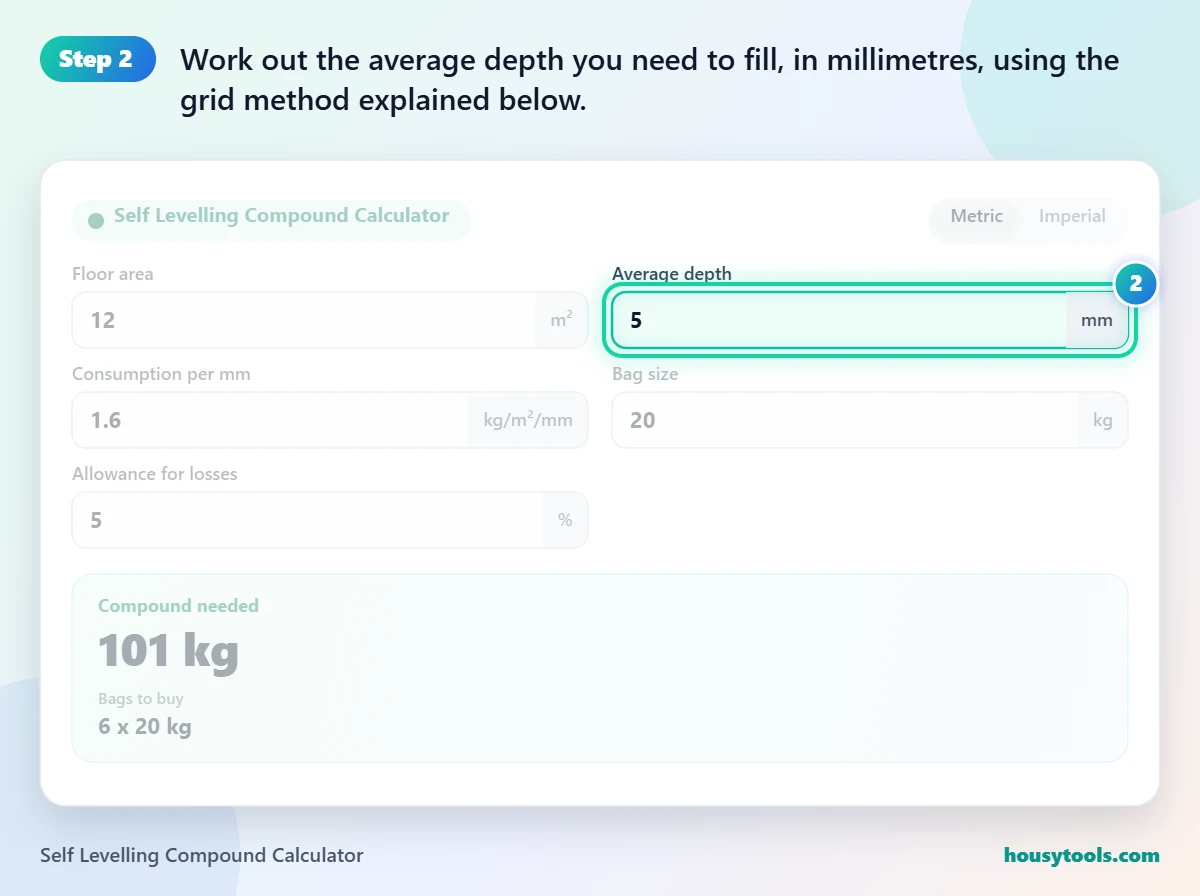
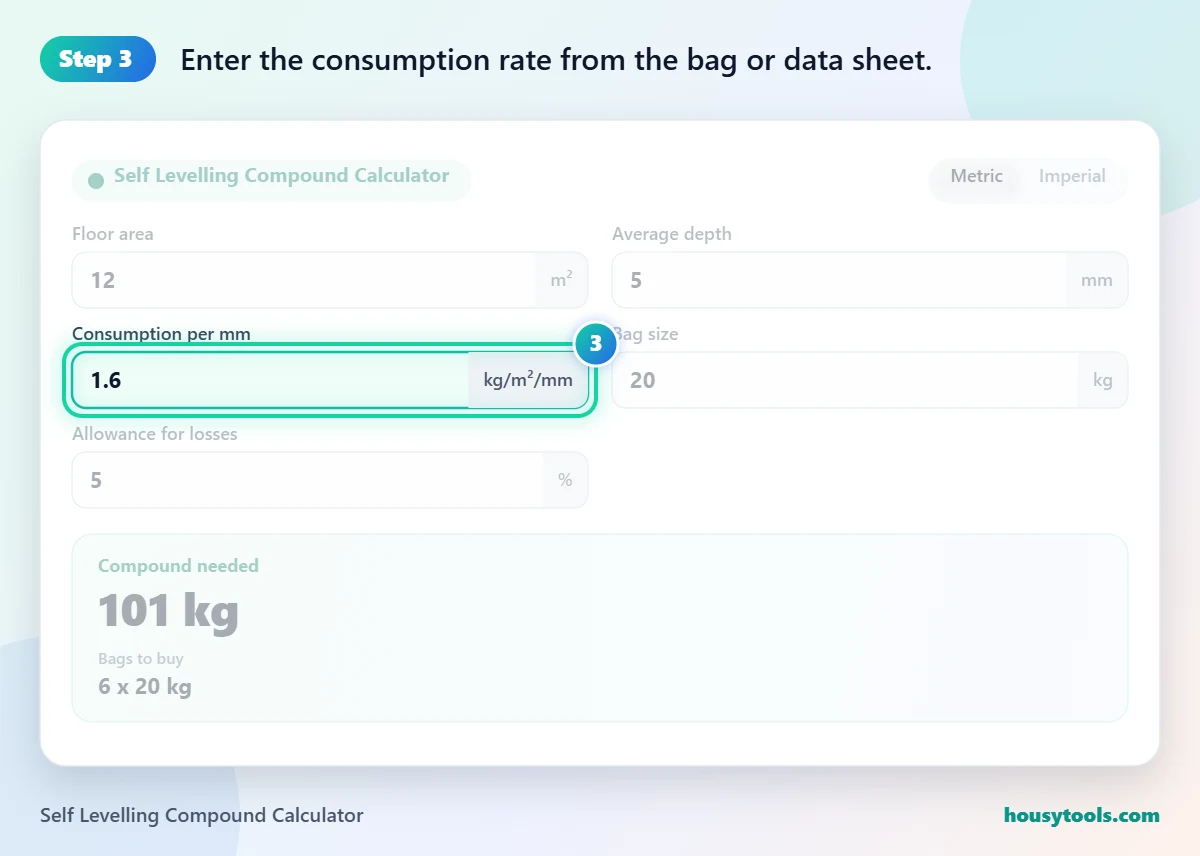
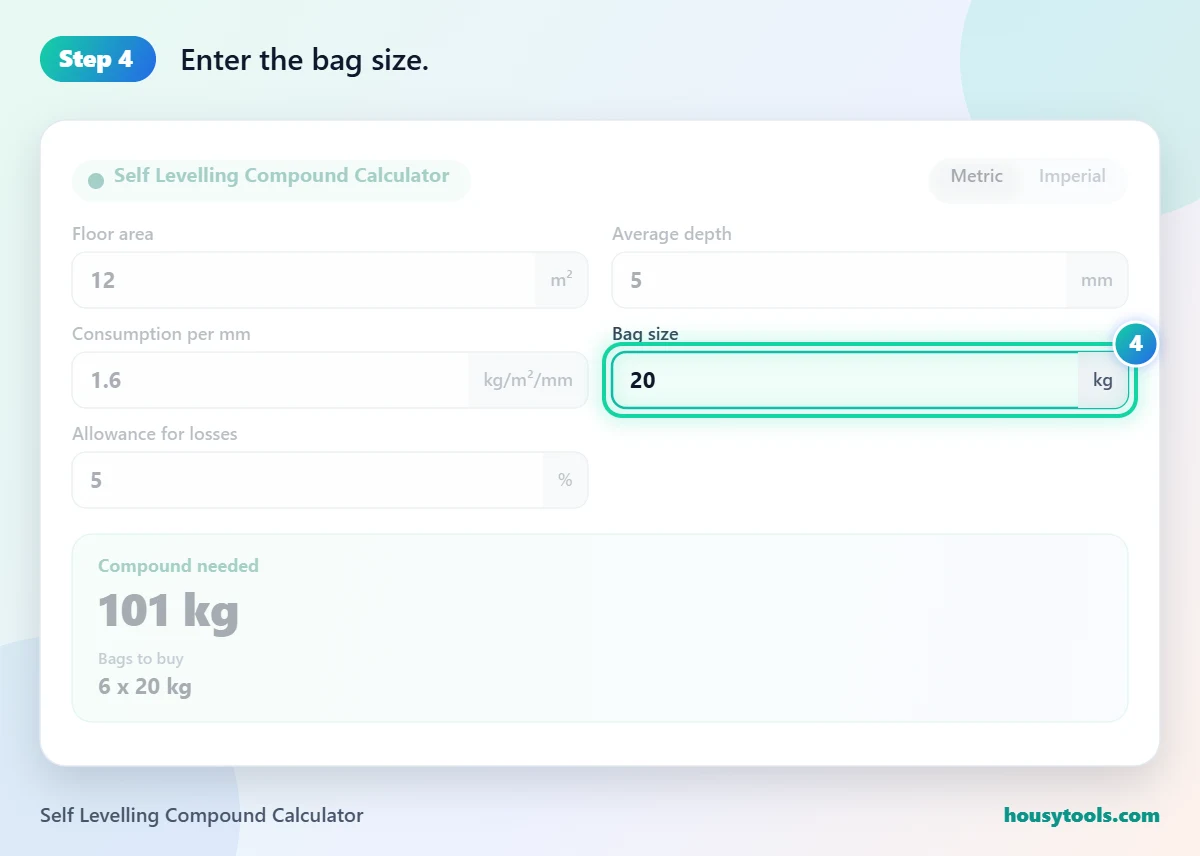
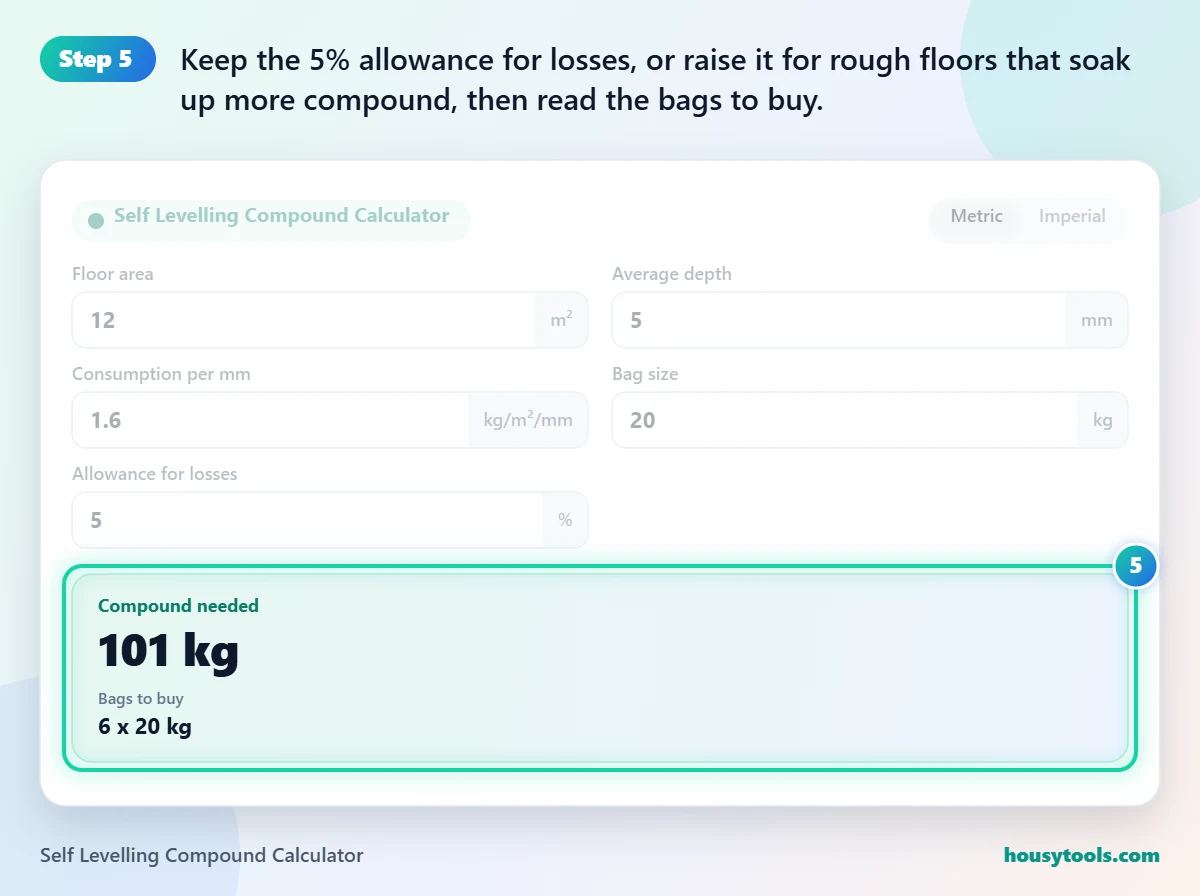
The self levelling compound calculator updates instantly. If the depth is over 10 mm, it reminds you to check the maximum layer thickness on the bag.
How Much Self Levelling Compound Do I Need per m²?
You need roughly 1.6 to 1.7 kg of compound per m² for every millimetre of depth, so a 3 mm layer uses about 5 kg per m² and a 5 mm layer about 8 kg per m².
Manufacturer data agrees closely. The weberfloor level specification on NBS Source gives 1.7 kg per m² per mm, a layer range of 2 to 30 mm and 25 kg bags. Other UK products we checked list 1.67 to 1.69 kg. Always enter your own product’s figure in the self levelling compound calculator, because fibre reinforced and rapid set compounds can differ.
Levelling Compound Needed by Depth
| Average depth | kg per m² at 1.6 | m² per 20 kg bag at 1.6 | kg per m² at 1.7 | m² per 25 kg bag at 1.7 |
|---|---|---|---|---|
| 2 mm | 3.2 | 6.25 | 3.4 | 7.35 |
| 3 mm | 4.8 | 4.17 | 5.1 | 4.90 |
| 5 mm | 8.0 | 2.50 | 8.5 | 2.94 |
| 8 mm | 12.8 | 1.56 | 13.6 | 1.84 |
| 10 mm | 16.0 | 1.25 | 17.0 | 1.47 |
| 15 mm | 24.0 | 0.83 | 25.5 | 0.98 |
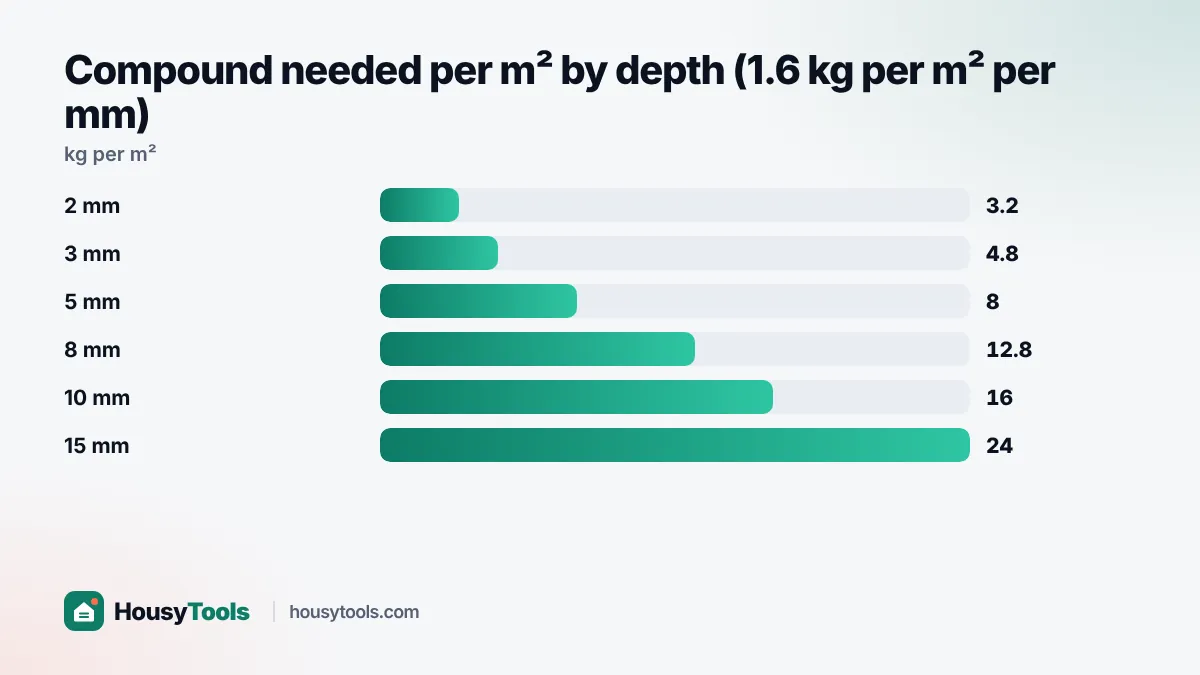
The table shows why depth matters so much: doubling the depth doubles the bags. Getting the average depth right is the single biggest factor in the result, far more than the small differences in consumption between brands that you enter in the self levelling compound calculator.
How Do You Work Out the Average Depth of a Floor?
The simplest method is a grid: take depth readings under a long straightedge or from a laser line about every 0.5 to 1 m across the floor, add them up and divide by the number of readings.
Include zero readings on high spots, because the compound still needs to cover them at the minimum thickness the bag allows. If most of the floor is flat and one corner dips by 10 mm, the average might only be 3 or 4 mm, which saves several bags compared with using the deepest reading. Enter that average, not the worst dip, in the self levelling compound calculator.
Check what goes on top too. Many tile and vinyl makers state a minimum screed or levelling thickness in their fitting guides, so use whichever is greater: that minimum or your measured average.
What Is the Maximum Depth for Self Levelling Compound?
It depends on the product: weberfloor level is rated for 2 to 30 mm, and other compounds range from about 3 mm up to 50 mm in one pour, so the bag is the only reliable guide.
That is why the self levelling compound calculator shows a reminder above 10 mm. Deeper fills may need a product designed for thick layers, added aggregate, or two layers with a primer between them, all as described on the data sheet. Over timber floors, follow the maker’s guidance on overboarding and flexible compounds.
How Do You Prepare a Floor for Self Levelling Compound?
Prepare the floor in four steps: remove old adhesive and loose material, vacuum away all dust, seal gaps and edges, then apply the primer named on the compound bag and let it dry as instructed.
Fix expansion strip or foam tape around the walls if the data sheet asks for it, and build a temporary dam at doorways so the compound stays in the room. Lift or protect any underfloor heating sensors and pipes according to their own instructions.
Plan the pour before you mix. Use the bag coverage figure from the self levelling compound calculator to mark roughly where each bag should reach, and have a helper mix the next bag while you spread the last. Work from the far side of the room towards the door so you never pour yourself into a corner. Our full set of flooring and tiling calculators covers the materials for what goes on top.
Worked Example: Ben’s Kitchen Floor
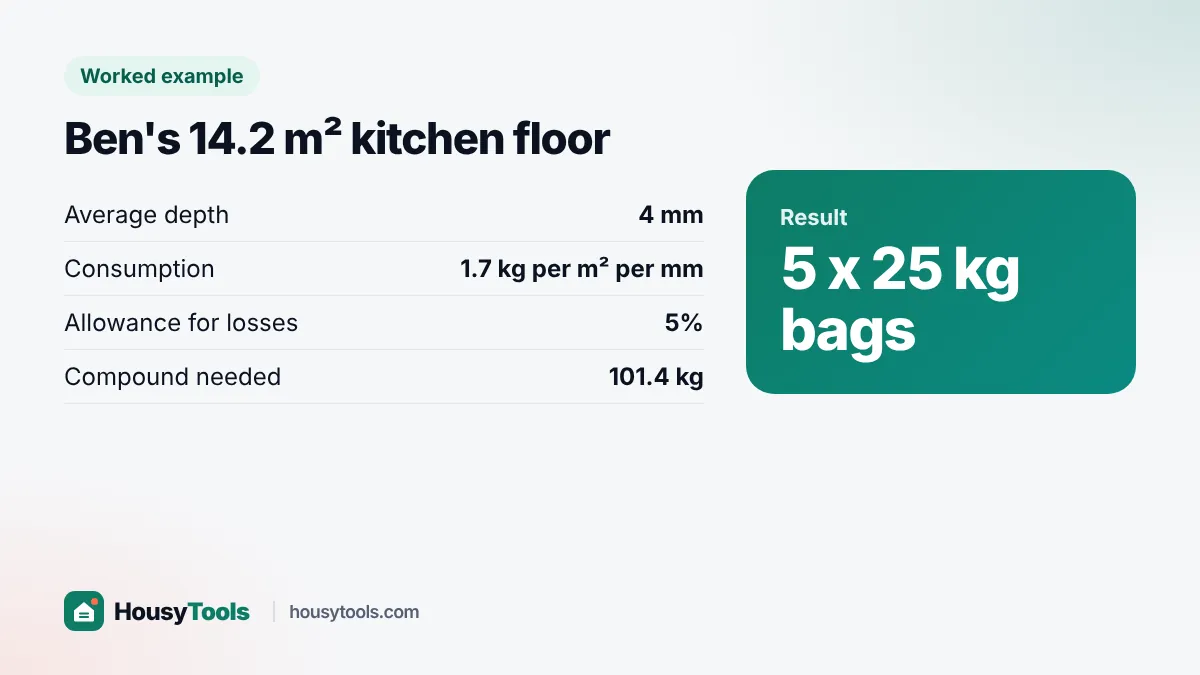
Ben in Glasgow is levelling a 14.2 m² concrete kitchen floor before laying vinyl tiles. His grid of readings averages 4 mm. He has chosen a compound with a consumption of 1.7 kg per m² per mm, sold in 25 kg bags.
- Weight: 14.2 m² x 4 mm x 1.7 kg x 1.05 = 101.4 kg
- Bags: 101.4 / 25 = 5 (rounded up)
- Coverage of one bag at 4 mm: 3.68 m²
Without the 5% allowance the floor needs 96.6 kg, which fits in four bags, so the allowance tips it to five. Ben buys five, because running short mid pour leaves a visible cold joint. The self levelling compound calculator made that trade off clear before he went to the merchant.
Common Mistakes When Levelling a Floor
- Skipping the primer. Most compounds need the base primed so it does not suck water out of the mix or form pinholes.
- Leaving gaps open. Seal gaps at door thresholds, pipes and edges so the liquid compound does not run away.
- Adding extra water. A runny mix is weaker and may crack. Use the water quantity printed on the bag.
- Mixing by hand. A paddle mixer on a drill gives a smooth, lump free mix quickly.
- Covering too soon. Wait the drying time stated for your floor covering before laying it.
Wet cement is strongly alkaline. The HSE guidance on cement warns it can cause burns and dermatitis, so wear waterproof gloves, knee protection and eye protection, and wash splashes off straight away.
Once the floor is flat, plan the next layer with our tile adhesive calculator or vinyl flooring calculator.
Self Levelling Compound Calculator FAQs
How many m² does a 20 kg bag of self levelling compound cover?
At 1.6 kg per m² per mm, a 20 kg bag covers about 6.25 m² at 2 mm, 4.17 m² at 3 mm and 2.5 m² at 5 mm. Thicker pours cover proportionally less, so enter your average depth in the self levelling compound calculator.
What is the thinnest layer of self levelling compound?
Most products have a minimum of about 2 to 3 mm; weberfloor level, for example, starts at 2 mm. Thinner layers may not flow out evenly or bond well. If the floor only needs a skim, use a smoothing compound rated for feather edges.
Do I need to prime before self levelling compound?
Usually yes. Primer controls suction on absorbent bases such as concrete and helps the compound bond to non absorbent ones such as old tile. Use the primer the compound maker specifies, at the dilution printed on the label.
Can I use self levelling compound on floorboards?
Only with a product and method approved for timber, often a flexible or fibre reinforced compound over overboarded plywood. Timber moves, so a standard rigid compound may crack. Check the data sheet before using the self levelling compound calculator for a wooden floor.
How long before I can walk on levelling compound?
Many compounds take light foot traffic within a few hours, and the weberfloor level specification states 2 to 4 hours. Drying before floor coverings takes longer and depends on depth, temperature and product, so follow the bag.
Why add 5% to the levelling compound?
Some compound is always lost in the bucket, on the mixer paddle and in low spots you did not measure. The 5% allowance covers that. Raise it in the self levelling compound calculator for very uneven or porous floors.
Checked October 2026. Sources: Weber weberfloor level specification (NBS Source), HSE, Wikipedia.