
Show the formula and working
This epoxy floor calculator works out how much epoxy floor coating you need for a garage, workshop, utility room or commercial floor, in litres, kilograms and kits, for homeowners and contractors in the UK, Ireland and Europe. It works from whichever figure your product’s data sheet gives, consumption in kg per m², coverage in m² per litre, or film thickness, and has a feet switch and a pound or euro switch.
Quick answer: Multiply the floor area by the number of coats and the consumption per coat from the data sheet, then add 10%. A 6 m by 3 m garage with two coats at 0.35 kg/m² needs 13.9 kg, or 9.2 litres at 1.51 kg/L. The epoxy floor calculator turns that into kits.
What Is an Epoxy Floor Calculator?
An epoxy floor calculator is a tool that turns a floor size and a product’s application rate into the amount of mixed epoxy and the number of kits to buy. In plain words: epoxy = floor area x coats x amount per m² per coat x (1 + wastage). Kilograms and litres are linked by the mixed density, so kg = litres x density.
When a data sheet gives a thickness instead, the rule is simple: a layer 1 mm thick over 1 m² is exactly 1 litre. For a coating with less than 100% volume solids, the wet layer must be thicker than the dry film you want, so litres per m² = dry thickness in mm / volume solids.
How Do You Use the Epoxy Floor Calculator?
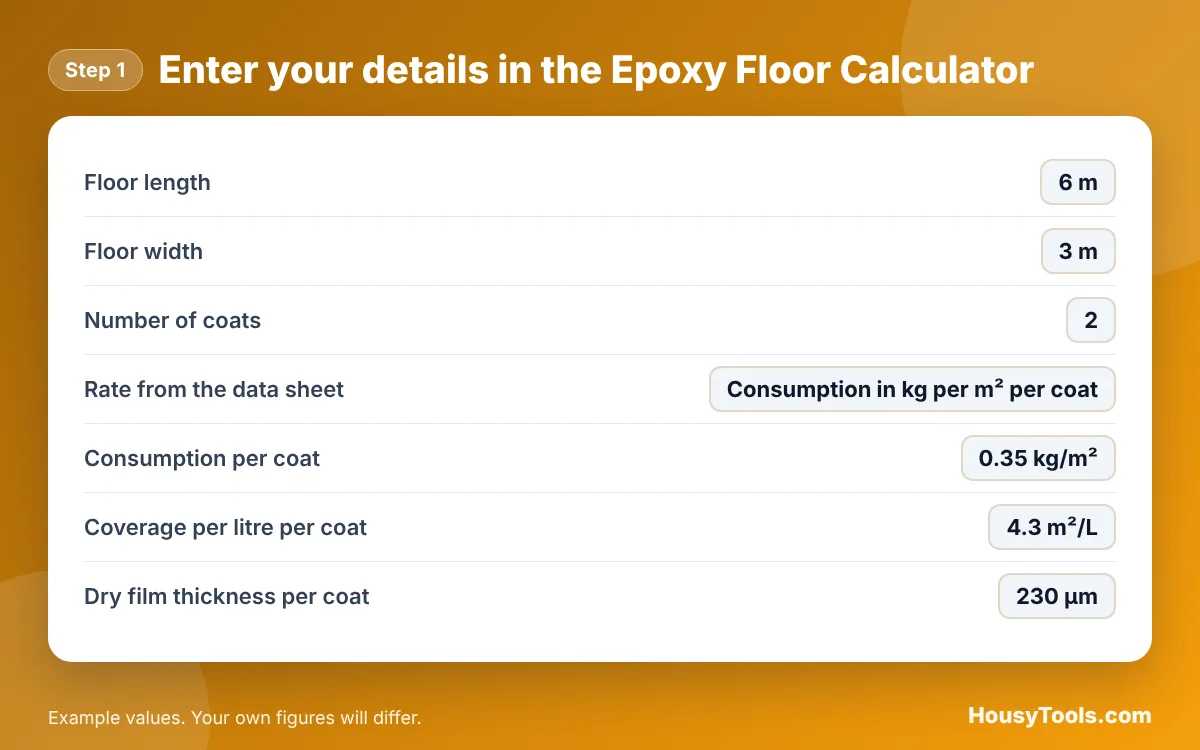
- Enter Floor length and Floor width. For an L shaped floor, split it into rectangles and add the results.
- Enter the Number of coats of this product. Work out any primer as a separate run of the calculator.
- Under Rate from the data sheet, choose the figure your product gives, then fill in Consumption per coat, Coverage per litre per coat or Dry film thickness per coat.
- Check Volume solids and Mixed density on the data sheet.
- Enter the Kit size, choose whether Kit size is in kilograms or litres, and set Wastage.
- Type your supplier’s price into Price per kit (example).
- Read the kits, litres and kilograms, then open “Show the formula and working” to see each step.

How Much Epoxy Do You Need per Square Metre?
A roller applied epoxy floor coat typically uses about 0.3 to 0.4 kg per m² per coat, so two coats take roughly 0.6 to 0.8 kg per m² before wastage. Those figures come from the Sikafloor 264 product data sheet, which also gives a mixed density of about 1.51 kg per litre, so one coat is about 0.23 litres per m².
Rates vary a lot between products. Water based garage floor paints, solvent free roller coats, and thick self levelling systems all have different figures, so always use the rate printed on your own tin or data sheet. The defaults in the calculator are only an example.
How Do You Convert Epoxy from Kilograms to Litres?
Divide the kilograms by the mixed density in kg per litre: 16 kg of epoxy at 1.51 kg/L is about 10.6 litres. Epoxy is denser than water, so a kit always holds fewer litres than kilograms. The calculator shows both, so you can compare a kit sold by weight with one sold by volume.
How Thick Should an Epoxy Floor Coating Be?
A roller coat of solvent free epoxy at 0.35 kg/m² and 1.51 kg/L is about 230 microns, or 0.23 mm, per coat, and two coats give about 0.46 mm. Self levelling and screed systems are laid much thicker, often in millimetres, and the calculator warns when a single coat goes above 3 mm.
The thickness option is useful when a specification gives a dry film thickness. Enter the microns per coat and the volume solids, and the calculator works back to litres. For lighter duty floors, a self levelling compound calculator helps you work out the base layer first if the concrete needs flattening.
Epoxy Needed for Common Floor Sizes
Figures from the calculator with two coats at 0.35 kg/m², 1.51 kg/L density, 10% wastage and 16 kg kits.
| Floor | Area | Epoxy (kg) | Epoxy (litres) | 16 kg kits |
|---|---|---|---|---|
| 2.5 x 5 m | 12.5 m² | 9.6 kg | 6.4 L | 1 |
| 3 x 6 m (single garage) | 18 m² | 13.9 kg | 9.2 L | 1 |
| 5 x 5 m | 25 m² | 19.3 kg | 12.7 L | 2 |
| 6 x 6 m (double garage) | 36 m² | 27.7 kg | 18.4 L | 2 |
| 6 x 9 m | 54 m² | 41.6 kg | 27.5 L | 3 |
Worked Example: A Garage Floor
Example: a 6 m by 3 m garage floor is being coated with two coats of a solvent free epoxy. The data sheet gives 0.35 kg/m² per coat and a mixed density of 1.51 kg/L. Keep 10% wastage, buy 16 kg kits and enter an example price of £150 per kit.
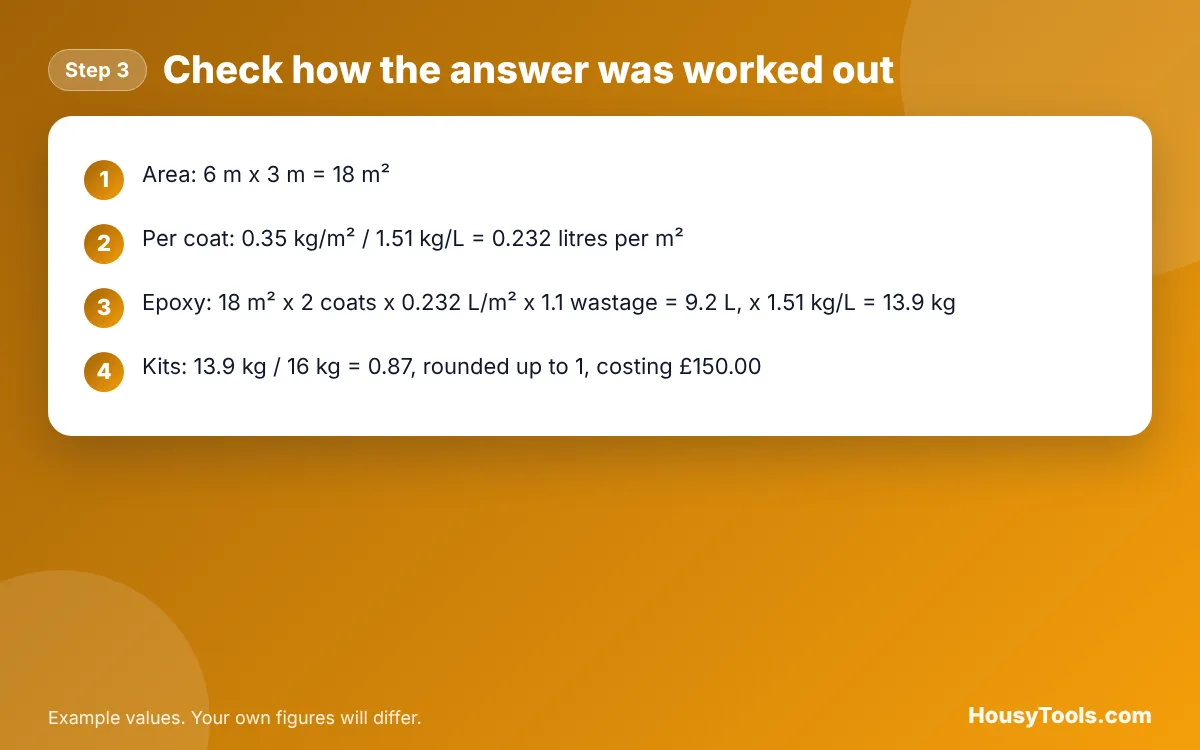
- Area: 6 m x 3 m = 18 m².
- Per coat: 0.35 kg/m² / 1.51 kg/L = 0.232 litres per m².
- Epoxy: 18 m² x 2 coats x 0.232 L/m² x 1.1 = 9.2 litres, which is 13.9 kg.
- Kits: 13.9 kg / 16 kg = 0.87, rounded up to 1 kit for £150.00.
If you use a water based floor paint instead, switch to the coverage option and enter the m² per litre from the tin, or use the flooring calculators for other finishes.
Epoxy Floor Calculator FAQs
How much epoxy do I need for a single garage?
A single garage of about 3 m by 6 m needs around 13.9 kg, or 9.2 litres, for two roller coats at 0.35 kg/m² with 10% wastage. Your product’s own rate may differ, so enter the figure from its data sheet.
How many coats of epoxy does a floor need?
Follow the system on the data sheet. Many roller applied systems use a primer and then one or two body coats. Enter the body coats in the calculator and run it again for the primer with that product’s own rate.
How much area does 1 litre of epoxy cover?
At 0.35 kg/m² and 1.51 kg/L, one litre covers about 4.3 m² per coat. A thicker coat or a rough, porous slab covers less. Divide 1 by the litres per m² shown in the result to get your own figure.
Why add wastage for epoxy?
Some epoxy stays in the tray, the roller and the mixing bucket, and rough or porous concrete soaks up more than a smooth surface. About 10% covers this on a sound floor. Mixed epoxy cannot be saved, so mix only what you can apply in the pot life.
What does volume solids mean on an epoxy data sheet?
Volume solids is the share of the wet coating that stays as dry film once the water or solvent evaporates. A solvent free epoxy is about 100%, so the dry film equals the wet film. At 50%, a coat dries to half its wet thickness.
Is epoxy safe to apply at home?
Epoxy resins and hardeners can irritate skin and cause allergies, so read the safety data sheet, wear gloves and eye protection, and ventilate the space. Keep children and pets away until the floor has cured for the time the maker states.
Checked October 2026. Sources: Sika: Sikafloor 264 product data sheet (consumption, density, solids, pack size), Wikipedia: Epoxy, Wikipedia: Litre.