
Show the formula and working
This hardcore calculator works out how much hardcore or Type 1 sub-base you need for a shed base, patio, path or driveway, in cubic metres, tonnes and bulk bags. It is built for UK and European projects measured in metres and millimetres, with a feet and inches switch that also shows cubic yards. It adds an allowance for compaction and lets you choose a material density or enter your supplier’s own figure.
Quick answer: Multiply length x width x compacted depth in metres for the volume, add about 20% for compaction, then multiply by the density, about 1.84 tonnes per m³ for Type 1. A 4 m by 3 m base 100 mm deep needs 1.44 m³ loose, about 2.65 tonnes. The hardcore calculator also counts bulk bags.

What Is a Hardcore Calculator?
A hardcore calculator is a tool that turns the size and depth of a sub-base into the volume and weight of crushed stone, crushed concrete or brick hardcore to order. The formula in plain words: area = length x width; compacted volume = area x depth in metres; loose volume to order = compacted volume x (1 + compaction allowance); weight = loose volume x density. Bags = weight divided by the bag weight, rounded up.
Hardcore is bought loose and shrinks when it is compacted with a plate compactor or roller, so you need more loose material than the finished volume. Type 1 is a crushed stone graded from larger stones down to fine dust, which compacts into a firm, stable layer.
How Do You Use the Hardcore Calculator?
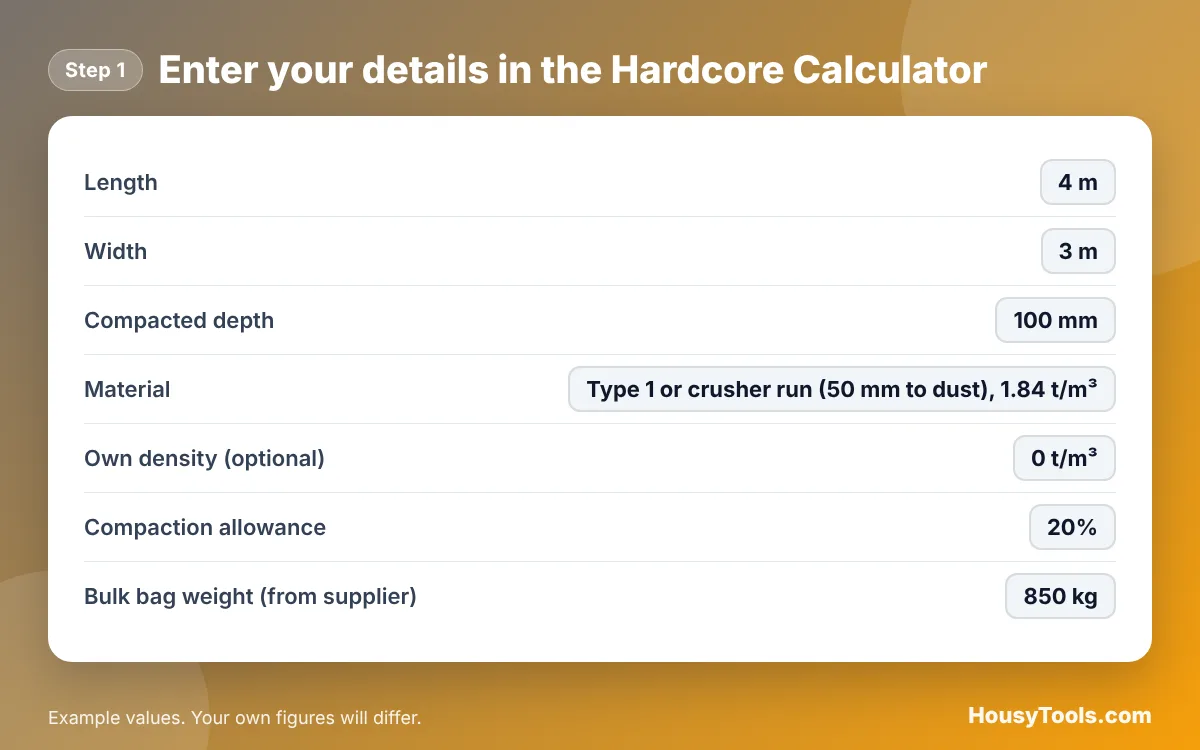
- Enter the Length and Width of the area.
- Enter the Compacted depth your base design needs.
- Choose the Material, or enter Own density (optional) from your supplier.
- Set the Compaction allowance.
- Enter the Bulk bag weight (from supplier).
- Read the tonnes, loose volume and bags, then open “Show the formula and working” to see each step.


How Much Hardcore Do I Need per Square Metre?
At 100 mm compacted depth, each square metre needs about 0.12 m³ of loose Type 1, about 0.22 tonnes, with a 20% compaction allowance. So one tonne covers about 4.5 m² at that depth. Deeper bases for driveways need proportionally more.
| Compacted depth | Compacted volume per 10 m² | Loose volume per 10 m² (+20%) | Type 1 per 10 m² at 1.84 t/m³ | Coverage per tonne |
|---|---|---|---|---|
| 50 mm | 0.50 m³ | 0.60 m³ | 1.10 t | 9.06 m² |
| 75 mm | 0.75 m³ | 0.90 m³ | 1.66 t | 6.04 m² |
| 100 mm | 1.00 m³ | 1.20 m³ | 2.21 t | 4.53 m² |
| 150 mm | 1.50 m³ | 1.80 m³ | 3.31 t | 3.02 m² |
| 200 mm | 2.00 m³ | 2.40 m³ | 4.42 t | 2.26 m² |
The 20% allowance and the depths are examples, not standards. Follow your base design or the paving maker’s laying guide for the depth.
How Much Does a Cubic Metre of Hardcore Weigh?
A cubic metre of loose Type 1 or crusher run weighs about 1.84 tonnes, while coarser crushed stone of 38 to 63 mm is lighter at about 1.48 tonnes. These are indicative loose densities, and recycled brick and concrete hardcore varies more. If your supplier quotes a figure, enter it as your own density. The tonnes to cubic metres aggregate converter converts in either direction for other materials.
What Is the Difference Between Hardcore and Type 1?
Hardcore is a general term for broken brick, concrete, stone or rubble used to build up ground, while Type 1 is a specified crushed stone sub-base with graded particle sizes that compacts consistently. For patios, paths and driveways, a graded sub-base such as Type 1 gives a firmer, more even layer than mixed rubble. Under a concrete slab, check what the slab design or building control asks for. The concrete calculator works out the slab itself.
Do I Need Planning Permission for a Hardcore Driveway?
In England, surfacing more than 5 m² of a front garden is permitted development only if the surface is permeable or drains to a permeable area on the property. A compacted hardcore sub-base under gravel or permeable paving can meet this, as the GOV.UK guidance on permeable surfacing of front gardens explains. For the top layer, the gravel calculator works out the decorative stone.
Worked Example: Hardcore for a 4 m by 3 m Shed Base
Example: a shed base 4 m long and 3 m wide needs a compacted Type 1 layer 100 mm deep. The density is the indicative 1.84 tonnes per m³, an example 20% is added for compaction, and the supplier sells 850 kg bulk bags. These are the calculator’s default inputs.
- Area: 4 m x 3 m = 12 m².
- Compacted volume: 12 m² x 0.1 m = 1.2 m³.
- Loose volume: 1.2 m³ x 1.2 = 1.44 m³.
- Weight: 1.44 m³ x 1.84 t/m³ = 2.65 tonnes.
- Bags: 2,650 kg / 850 kg = 3.1, so 4 bulk bags.
Many suppliers also sell by the loose tonne for tipper delivery, which may suit larger jobs better than bags.
Hardcore Calculator FAQs
How do I calculate how much hardcore I need?
Multiply the length, width and compacted depth in metres to get cubic metres, add a compaction allowance such as 20%, then multiply by the density in tonnes per m³. A 12 m² base 100 mm deep needs about 2.65 tonnes of Type 1.
How many tonnes of Type 1 are in a cubic metre?
Loose Type 1 or crusher run weighs about 1.84 tonnes per cubic metre. Once compacted it is denser, which is why you order more loose volume than the finished depth. Use your supplier’s figure if they give one.
How deep should hardcore be?
It depends on the use and the ground. Shed bases and paths are usually thinner than driveways, and soft or clay ground needs more. Follow the base design, the paving maker’s laying guide or building control advice rather than a single rule.
How much does hardcore compact?
Loose hardcore loses volume when compacted, and the amount depends on the material, its grading and moisture. The calculator uses an example 20% allowance. Ask your supplier for their figure, and compact in layers with a plate compactor.
How many bulk bags of hardcore do I need?
Divide the total weight by the bag weight and round up. For 2.65 tonnes and 850 kg bags, that is 4 bags. Bag weights vary between suppliers, so enter the weight your supplier states.
Can I use broken concrete as hardcore?
Clean crushed concrete and brick can be used as hardcore for some jobs, such as filling or building up ground. For paving and driveways a graded crushed stone or recycled Type 1 that meets a specification gives a more reliable base.
Checked October 2026. Sources: Designing Buildings Wiki, converting between weight and volume for bulk construction materials (indicative loose densities: road base or crusher run 1.84 t/m³, 19 to 25 mm crushed stone 1.6, 38 to 63 mm 1.48, ballast 1.54), Wikipedia: Crushed stone, GOV.UK: Permeable surfacing of front gardens guidance.