
Show the formula and working
This free firewood calculator works out how many kilograms and cubic metres of logs a wood burning stove uses in a season, and what they cost, for households in the UK, Ireland and northern Europe. It starts from the heat you want, the stove’s efficiency and the moisture in the wood, so you can see how much drier logs save.
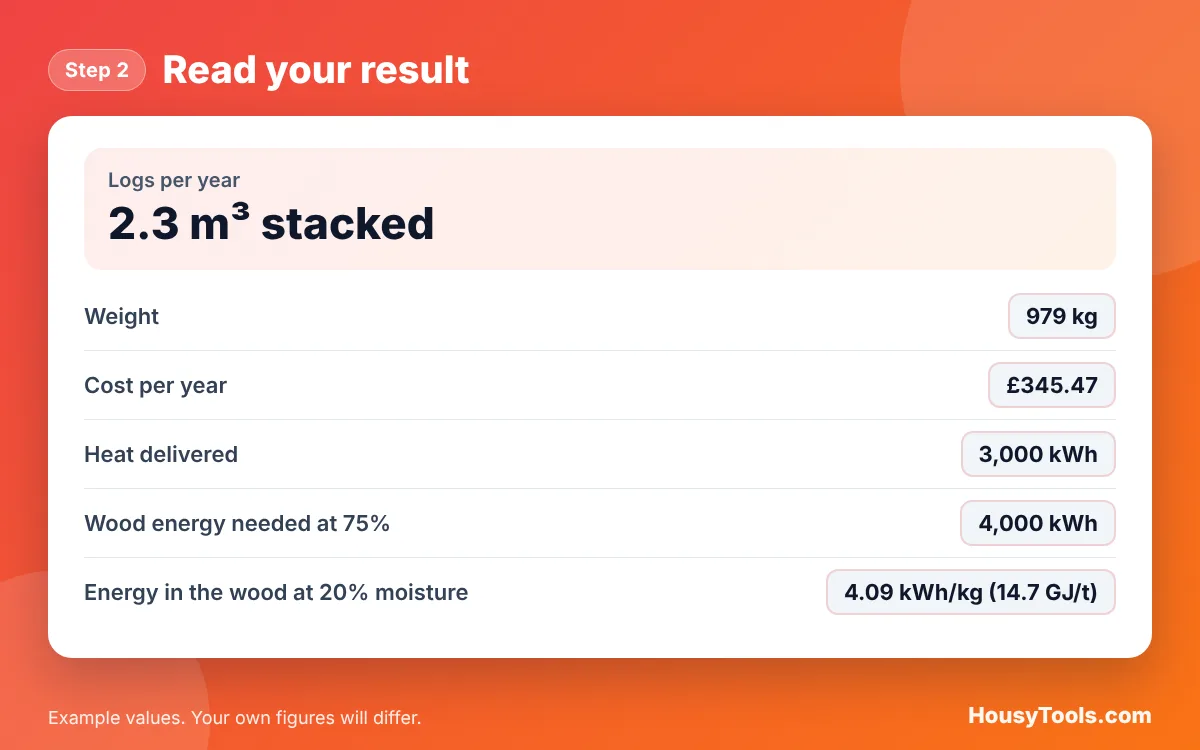
Quick answer: A firewood calculator divides the heat you need by the stove efficiency and the energy in each kilogram of wood. A 5 kW stove burning 5 hours a day for 120 days, at 75% efficiency, needs about 979 kg of logs at 20% moisture, or about 2.3 cubic metres stacked.
What Is a Firewood Calculator?
A firewood calculator is a tool that estimates how much wood a stove or fire will burn over a season, by weight and by stacked volume, from the heat it delivers.
The formula in plain words: heat delivered in kWh equals the stove’s average output in kW times the hours a day times the days. Divide by the stove’s efficiency to get the energy you must put in as wood. Divide that by the wood’s energy per kilogram, which falls as moisture rises, to get the weight, then divide by the stacked density to get cubic metres.
How Do You Use the Firewood Calculator?
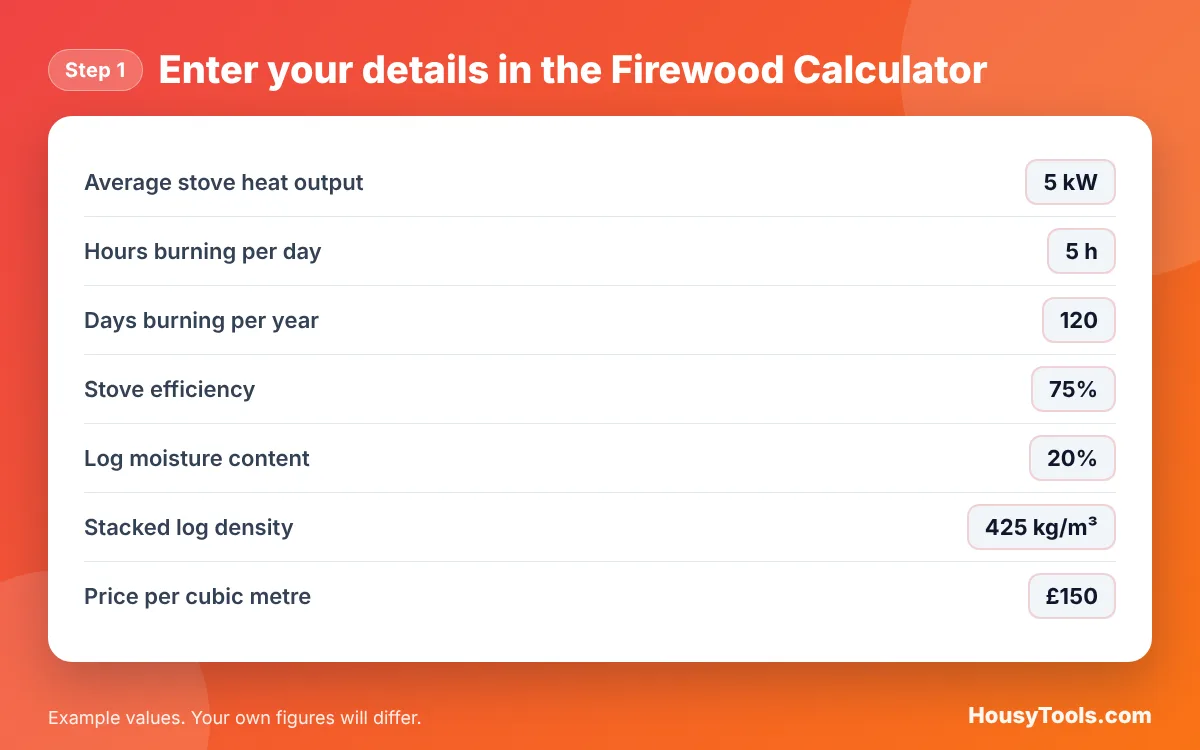
- Enter the Average stove heat output, which is often below the nominal figure on the stove.
- Enter the Hours burning per day and Days burning per year.
- Enter the Stove efficiency from your stove’s manual.
- Enter the Log moisture content, ideally measured with a moisture meter.
- Keep or change the Stacked log density and enter your supplier’s Price per cubic metre.
- Read the cubic metres, kilograms and cost in the result, then open “Show the formula and working” to see each step.

How Much Firewood Do I Need for a Winter?
A stove giving an average of 5 kW for 5 hours a day over 120 days needs about 1 tonne, or about 2.3 cubic metres, of seasoned logs. That uses the Forest Research calorific values of 4.1 kWh per kg for air dry logs at 20% moisture and 350 to 500 kg per stacked cubic metre. Burning every evening all winter, or using the stove as the main heat, can easily double it.
How Does Moisture Affect Firewood?
Wet wood gives much less heat, because part of the fire’s energy goes into boiling off the water. At 20% moisture logs give about 4.09 kWh per kg, while freshly felled wood at 50% gives about 2.30, so you burn nearly 80% more of it for the same warmth, with more smoke and tar. The calculator uses net calorific value = 19 x (1 minus moisture) minus 2.443 x moisture, in GJ per tonne, which matches the Forest Research figures at 20% and 30%.
What Is Ready to Burn Wood?
Ready to Burn wood is certified to have 20% moisture or less. In England, wood sold in volumes under 2 cubic metres must be Ready to Burn certified, while larger loads come with a notice on how to dry, store and check the wood before use. Store logs off the ground, under cover and with air moving through them, and split a log to test the moisture on the fresh face.
What Size Stove Do I Need?
Stove size depends on the room’s heat loss, not on how much wood you have. The wood burner size calculator estimates the kW for your room and the ventilation rules. Most stoves give less than their nominal output when burned gently, so enter the average output you actually get here.
Energy in Firewood by Moisture Content
Net calorific value, and the logs needed to deliver 3,000 kWh of heat at 75% efficiency (4,000 kWh of wood energy).
| Moisture content | Energy (GJ per tonne) | Energy (kWh per kg) | Logs needed |
|---|---|---|---|
| 10% | 16.9 | 4.68 | 854 kg |
| 15% | 15.8 | 4.38 | 912 kg |
| 20% (Ready to Burn limit) | 14.7 | 4.09 | 979 kg |
| 25% | 13.6 | 3.79 | 1,056 kg |
| 30% | 12.6 | 3.49 | 1,146 kg |
| 40% | 10.4 | 2.90 | 1,382 kg |
| 50% (fresh cut) | 8.3 | 2.30 | 1,739 kg |
Worked Example: Evening Burning Through the Winter
Example: a stove averaging 5 kW, lit for 5 hours a day on 120 days, 75% efficient, burning logs at 20% moisture with a stacked density of 425 kg per m³ and an example price of £150 per m³. These are the default inputs.
- Heat: 5 kW x 5 h x 120 days = 3,000 kWh.
- Wood energy: 3,000 / 0.75 = 4,000 kWh.
- Energy per kg: (19 x 0.8 – 2.443 x 0.2) / 3.6 = 4.09 kWh.
- Weight: 4,000 / 4.09 = 979 kg.
- Volume: 979 / 425 = 2.3 m³, which costs £345.47 at the example price.
At the ends of the Forest Research density range, the same wood fills 2.8 m³ at 350 kg per m³ or 2.0 m³ at 500 kg per m³. To compare with oil heating, the heating oil cost calculator shows the cost of the same heat.
Firewood Calculator FAQs
How much does a cubic metre of logs weigh?
A stacked cubic metre of air dry logs weighs about 350 to 500 kg, according to Forest Research. Hardwoods such as oak and ash sit at the heavier end and softwoods at the lighter end. Loose, thrown logs take more space than neatly stacked ones.
How long does firewood take to season?
Split logs stacked under cover with good airflow typically take one to two years to reach 20% moisture, depending on the wood and the weather. Check with a moisture meter on a freshly split face rather than going by time alone.
Is hardwood or softwood better for a stove?
Per kilogram at the same moisture, hardwood and softwood give similar heat. Hardwood is denser, so a cubic metre holds more energy and burns longer per load, while softwood lights quickly and burns faster. Dryness matters more than species.
Can I burn wood in a smoke control area?
Only in an exempt appliance, such as a Defra approved stove, and with the fuel it is approved for. Rules and penalties are set out on GOV.UK’s smoke control area pages, so check with your council before you buy a stove or fuel.
What does a net cubic metre of logs mean?
Suppliers describe volume in different ways: stacked, loose or in bulk bags. A loose load takes more space than the same wood stacked. Ask whether the price is for a stacked or loose cubic metre, and compare the moisture content too.
Is burning wood cheaper than gas?
It depends on your wood price. At the example £150 per m³, the heat costs about 11.5p per kWh. Gas at the October to December 2026 price cap average of 7.97p per kWh, burned in a 90% efficient boiler, costs about 8.9p per kWh of heat. Free or cheap wood changes the picture, so enter your own price.
For more heating tools, see the heating calculators.
Checked October 2026. Sources: Typical calorific values of fuels (Forest Research), Selling wood for domestic use in England (GOV.UK), Smoke control areas (GOV.UK).