
Show the formula and working
This solar battery savings calculator shows how much a home battery adds to the savings from solar panels you already have or plan to fit, for homes in the UK, Ireland and the rest of Europe. Enter your solar output, how much you use, the battery size and your tariffs, and it shows the extra yearly saving, the payback time and how much of your solar you end up using.
Quick answer: A solar battery saves money by storing solar power you would otherwise export and using it later instead of buying from the grid. Each stored kWh is worth your import rate minus your export rate, less round trip losses. With 26.32p import and 12p export, a 5 kWh battery adds about £127 a year in the default example.
What Is a Solar Battery Savings Calculator?
A solar battery savings calculator is a tool that estimates the extra money a home battery saves by shifting surplus solar power from the daytime to the evening.
The formula in plain words: without a battery, the share of solar you do not use is exported. A battery can store some of that export, limited by its usable capacity times the number of full cycles a year, by the surplus solar available and by how much electricity you still buy. Each kWh the battery delivers saves your import rate, but storing it means losing the export payment, and some energy is lost in charging and discharging. The yearly gain is battery output times import rate, minus the stored energy times export rate.
How Do You Use the Solar Battery Savings Calculator?
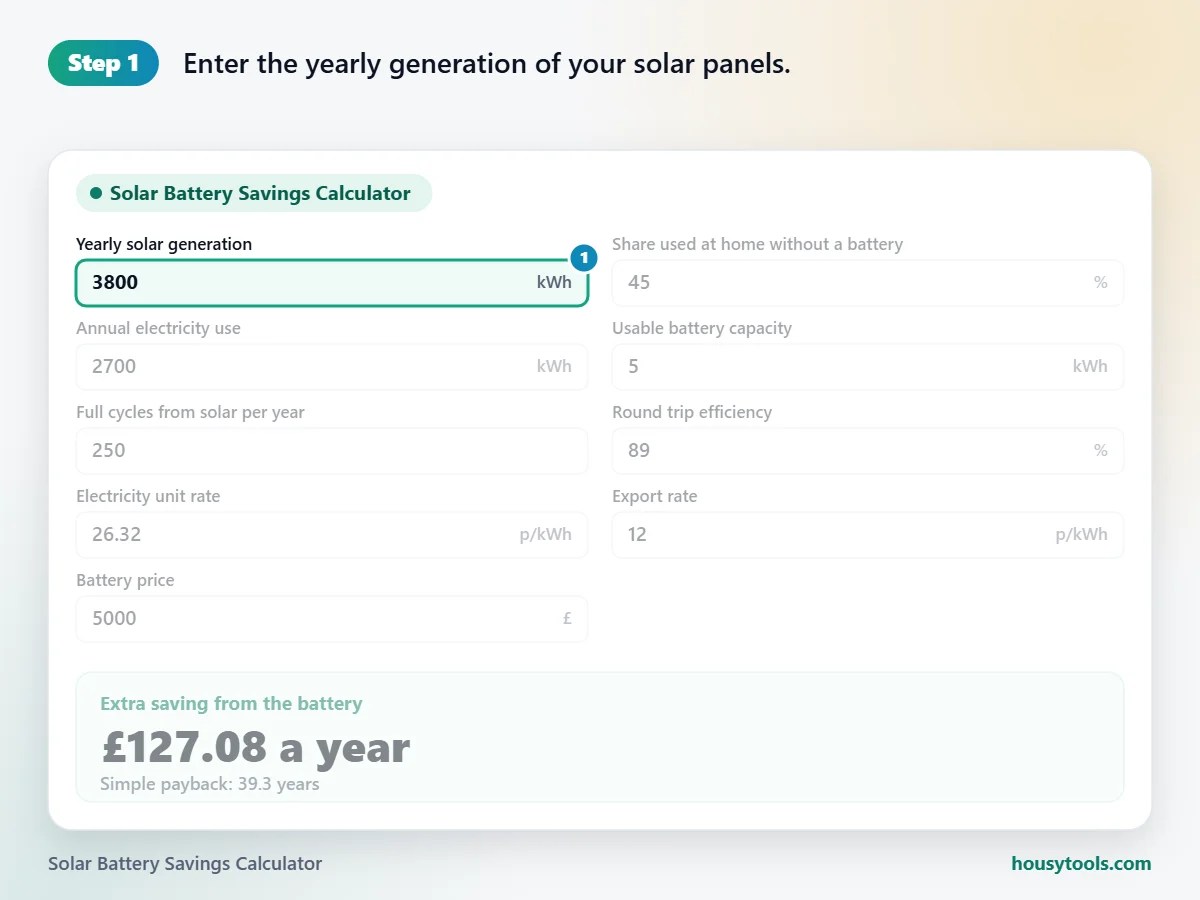
- Enter the yearly generation of your solar panels.
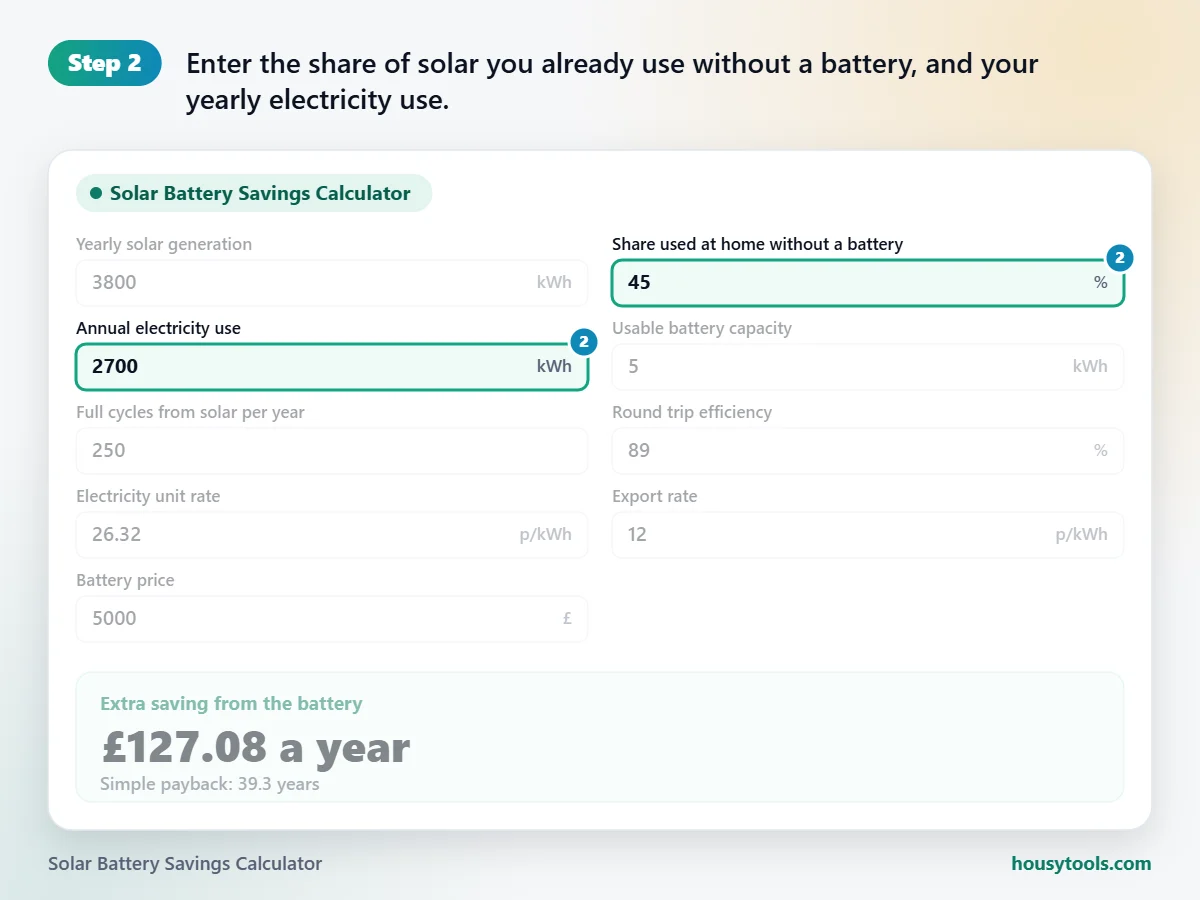
- Enter the share of solar you already use without a battery, and your yearly electricity use.
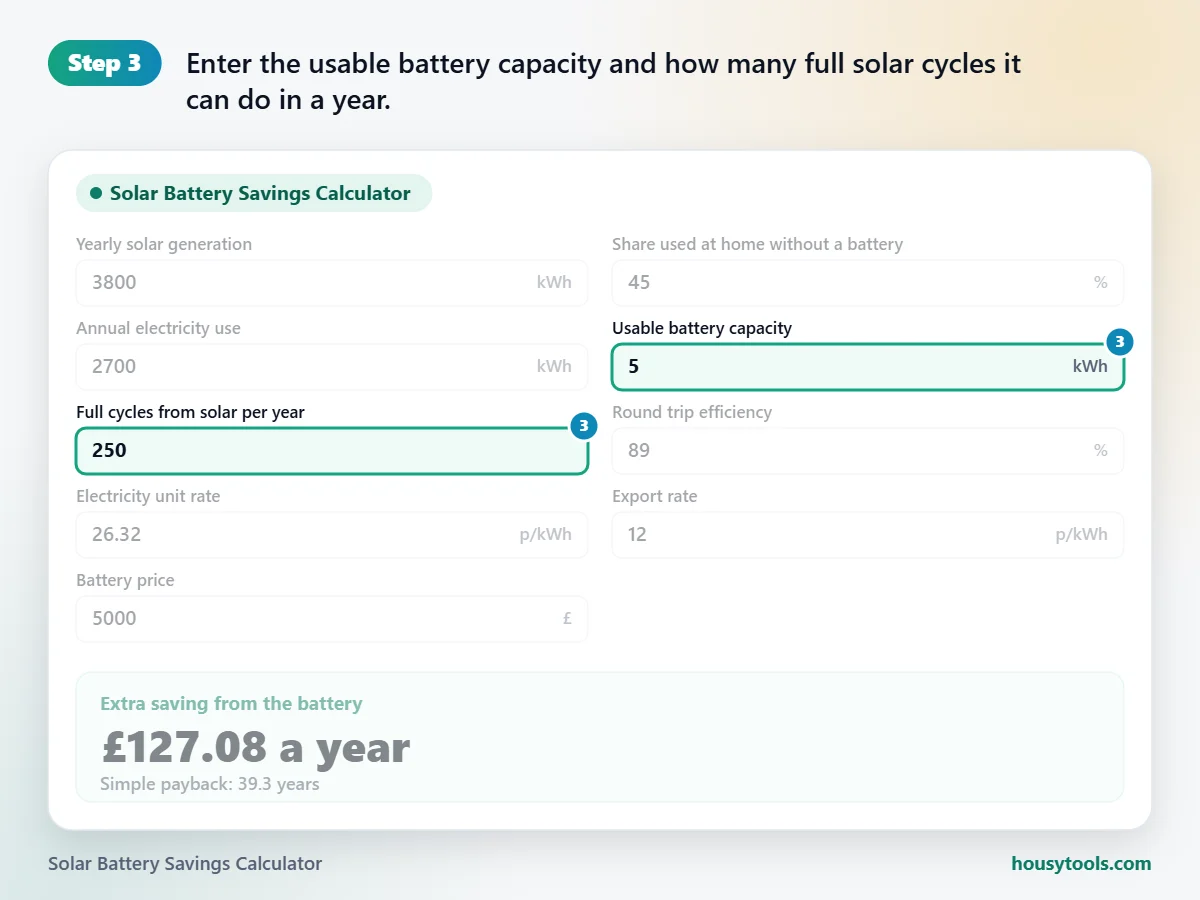
- Enter the usable battery capacity and how many full solar cycles it can do in a year.
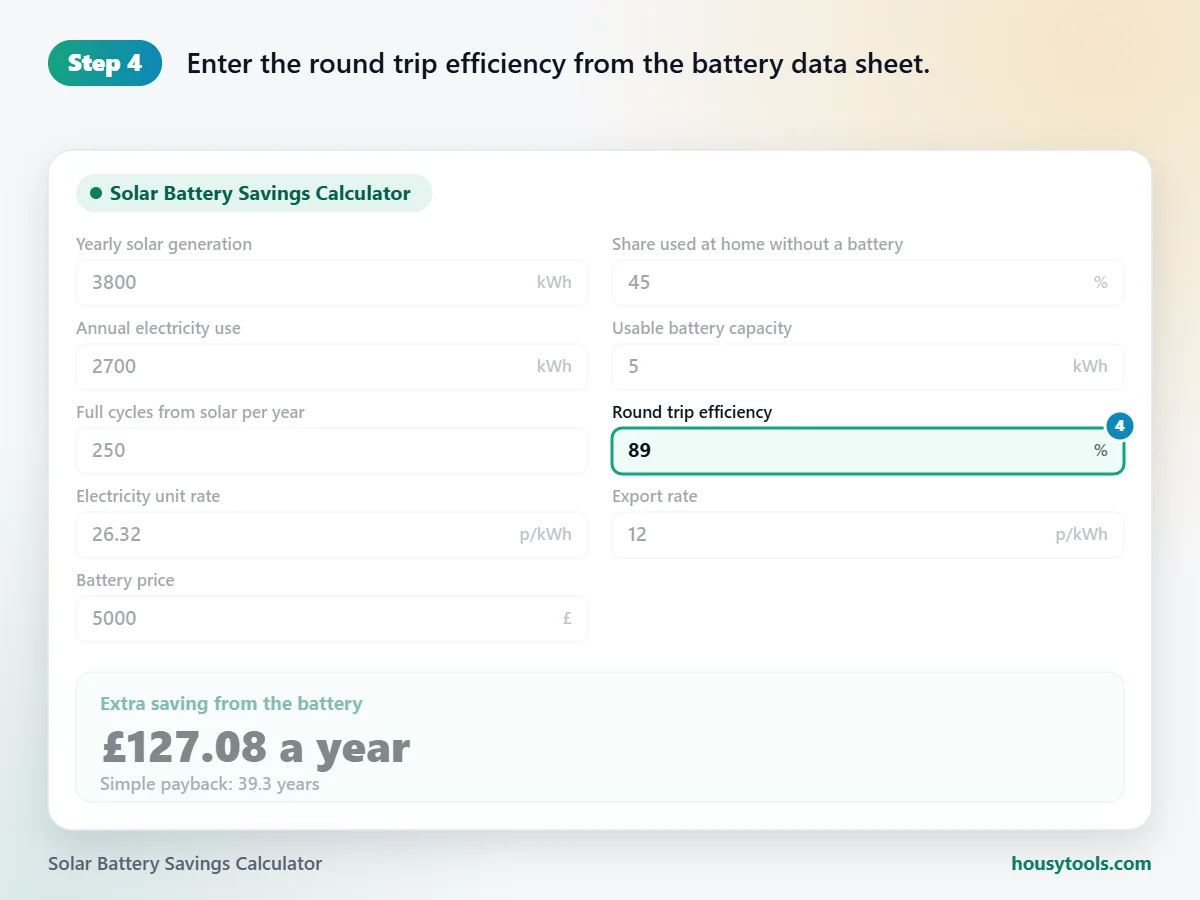
- Enter the round trip efficiency from the battery data sheet.
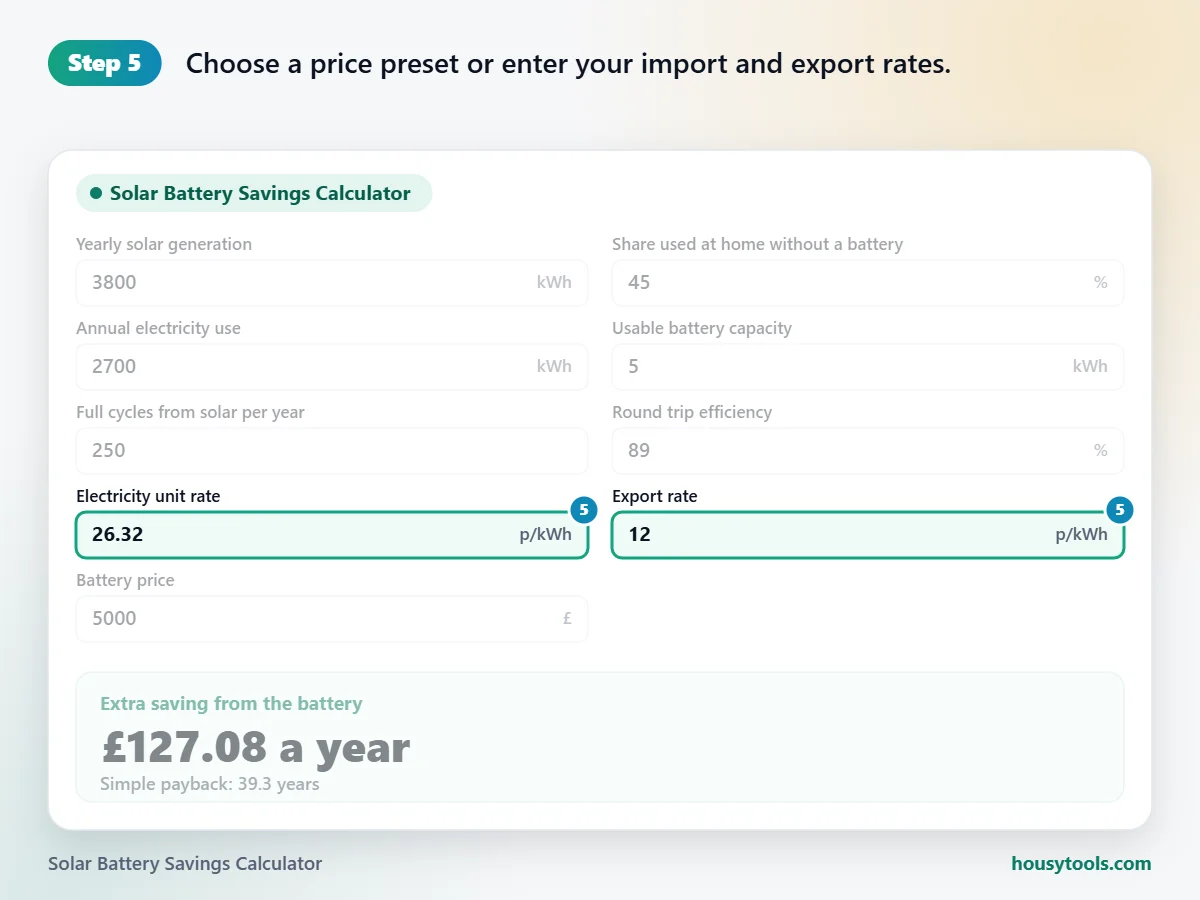
- Choose a price preset or enter your import and export rates.
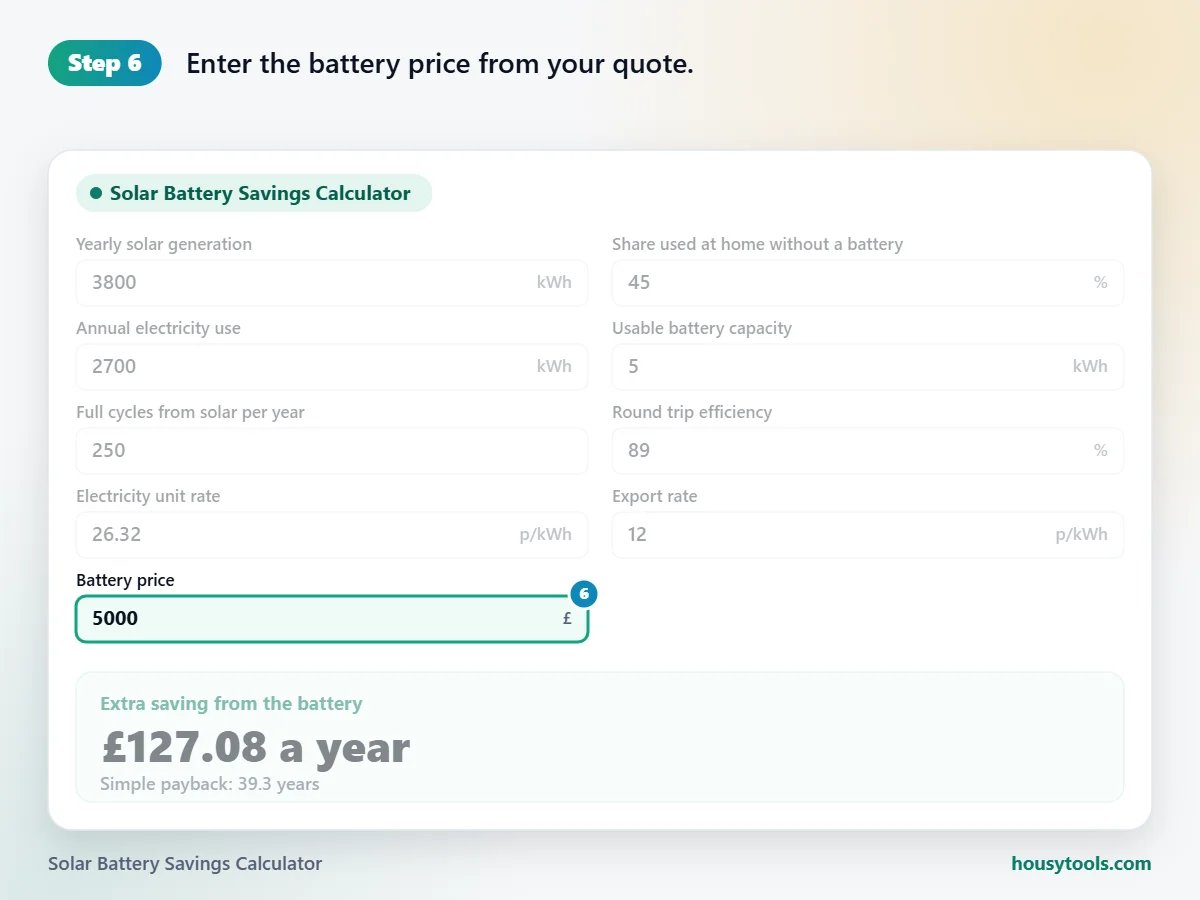
- Enter the battery price from your quote.
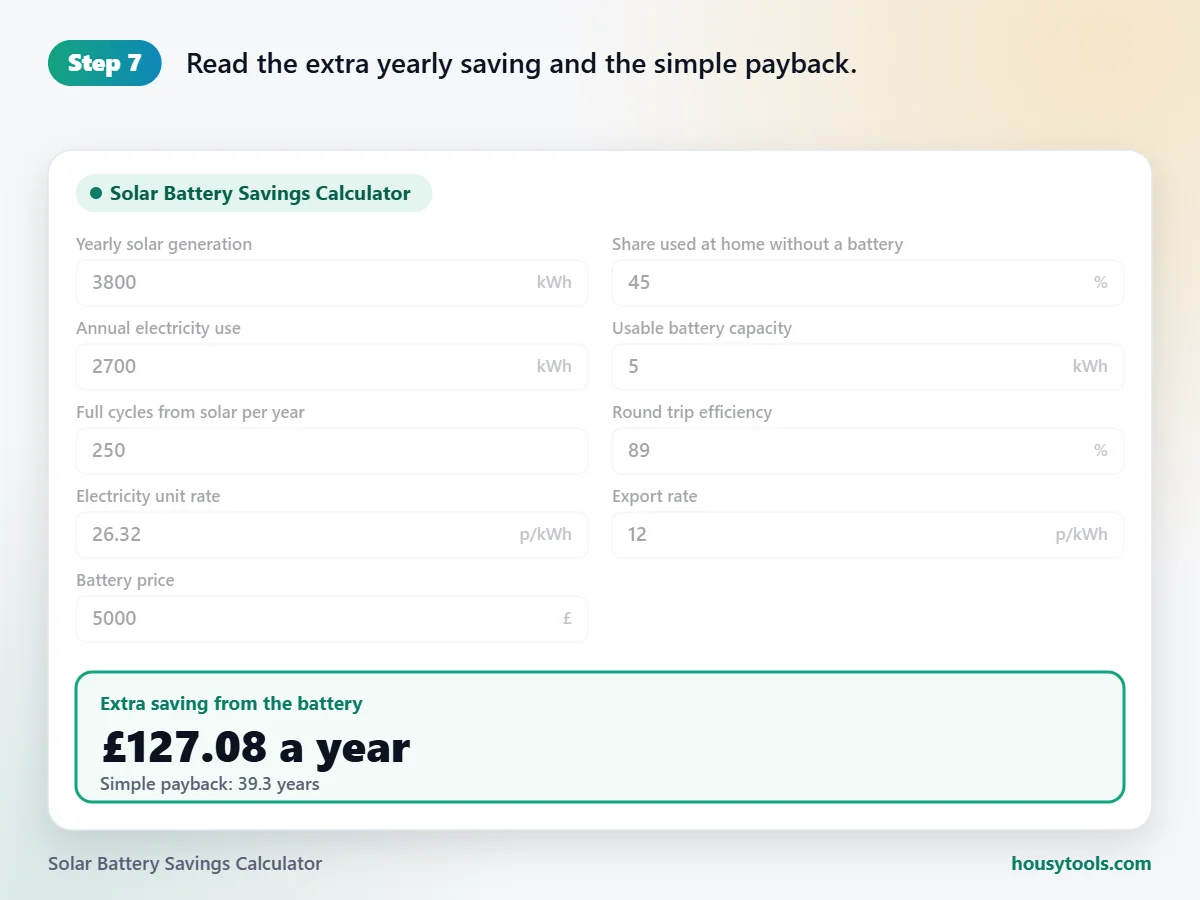
- Read the extra yearly saving and the simple payback.
Is a Solar Battery Worth It in the UK?
A battery used only to store solar is often slow to pay back in the UK, because the gap between the 26.32p price cap unit rate and a typical 12p export rate is only about 14p per kWh before losses.
The Energy Saving Trust puts battery storage at around £5,000 to £8,000. At £5,000 and a gain of around £130 to £240 a year, simple payback runs to decades, which can be longer than the battery’s working life. A battery looks better when your export rate is low, your evening use is high, or you also charge it on a cheap overnight tariff, which this calculator does not include. The Economy 7 calculator helps you compare two rate tariffs.
| Export rate | Value of each stored kWh | Yearly gain | Payback on £5,000 |
|---|---|---|---|
| 4.1p | 21.71p | £214.96 | 23.3 years |
| 8p | 17.33p | £171.58 | 29.1 years |
| 12p | 12.84p | £127.08 | 39.3 years |
| 15p | 9.47p | £93.71 | 53.4 years |
| 20p | 3.85p | £38.10 | 131.2 years |
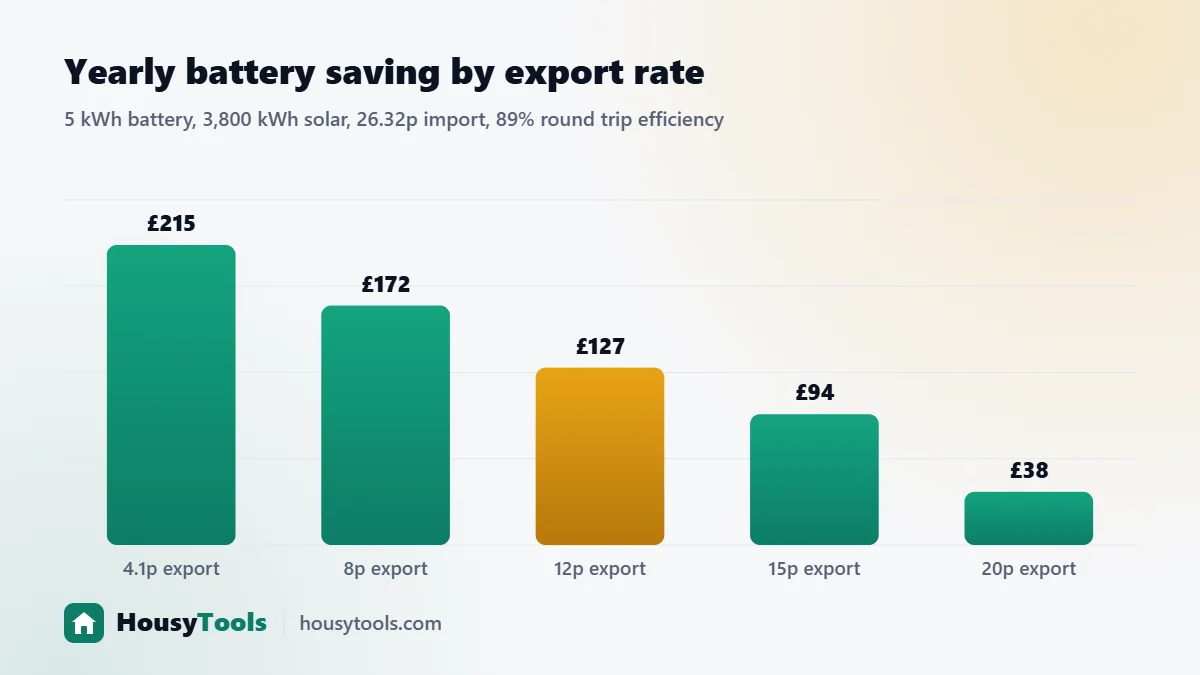
The higher your export rate, the less a battery adds, because every kWh you store is a kWh you are not paid for. At a 20p export rate the battery adds almost nothing.
Why Does a Bigger Battery Not Always Save More?
A bigger battery only saves more if you have enough spare solar to fill it and enough evening use to empty it, so beyond that point extra capacity sits idle.
In the default example the battery is limited by the home’s use: with 1,710 kWh of solar already used and 2,700 kWh used in total, only 990 kWh a year is left for the battery to cover, so 5 kWh and 13.5 kWh batteries give the same result. A home using 4,200 kWh with a 10 kWh battery can store all 2,090 kWh of surplus and saves £238.78 a year. Winter matters too: in December there is little or no spare solar, which is why the cycles box defaults to 250 rather than 365. Our solar battery size calculator suggests a size month by month.
Worked Example: A 10 kWh Battery for a 4,200 kWh Home
Example: a household with solar making 3,800 kWh a year uses 45% of it directly and 4,200 kWh in total. It is quoted £5,000 for a 10 kWh usable battery with 89% round trip efficiency, on 26.32p import and 12p export.
- Exported without a battery: 3,800 x 55% = 2,090 kWh
- Stored: all 2,090 kWh, as the battery and evening use can take it
- Battery output used at home: 2,090 x 89% = 1,860 kWh
- Gain: 1,860 x 26.32p minus 2,090 x 12p = £238.78 a year
- Simple payback: £5,000 / £238.78 = 20.9 years
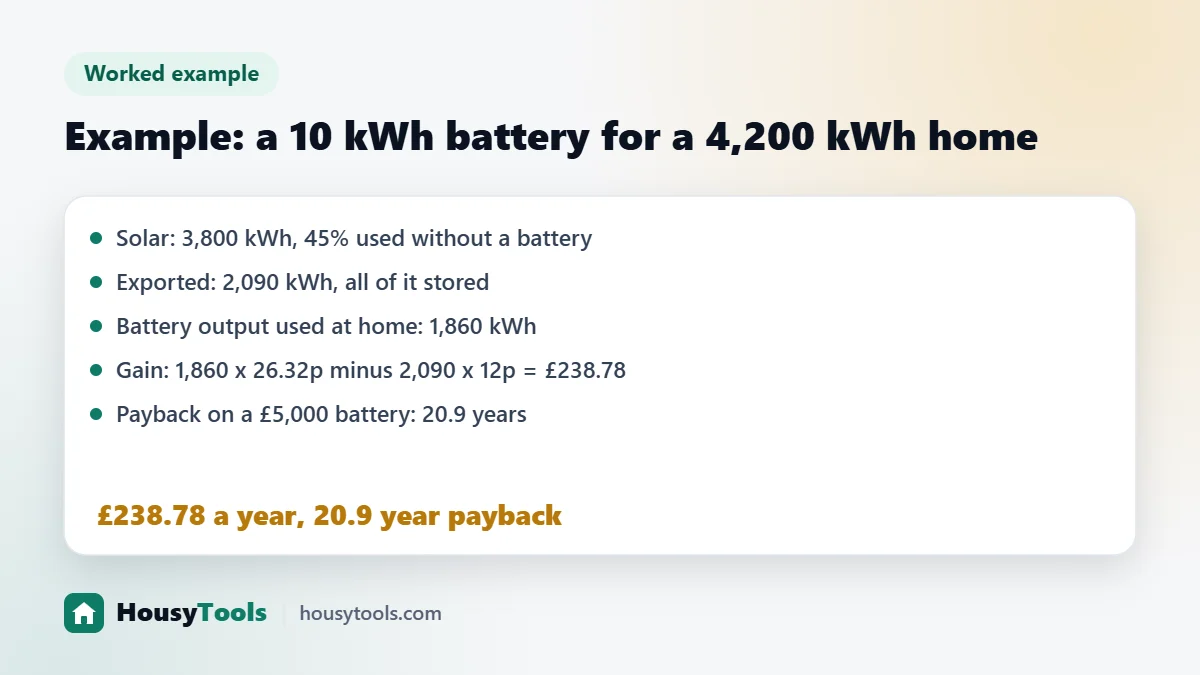
Self use rises from 45% to 100% of the solar output, yet the payback is still about 21 years, because each stored kWh is worth only about 12.8p after losses. If the same household switched to a 4.1p export tariff, the gain would rise because exporting would be worth less.
What Affects Solar Battery Savings?
The gap between your import and export rates matters most, followed by how much of your solar you already use and how much you use in the evening.
- Import rate: higher import prices make each stored kWh worth more.
- Export rate: higher export rates make storing less worthwhile.
- Round trip efficiency: around 89% means about 11% of stored energy is lost.
- Daytime use: if you are home all day, you already use more solar directly and need the battery less.
- Battery price and warranty: a cheaper battery or longer warranty improves the case.
For the full solar picture, the solar panel calculator shows yearly savings with and without higher self use.
Solar Battery Savings Calculator FAQs
How much can a solar battery save per year?
In the default example a 5 kWh battery adds about £127 a year at 26.32p import and 12p export. Savings rise with a lower export rate, higher evening use or a larger battery that you can actually fill.
How long does a solar battery take to pay back?
At £5,000 and £127 to £240 a year of extra saving, simple payback is roughly 21 to 39 years in these examples. Cheaper batteries, low export rates and off peak charging shorten it.
Is it better to export or store solar power?
Store it when your import rate, times the battery’s round trip efficiency, is higher than your export rate. With 26.32p import and 89% efficiency, storing beats exporting whenever your export rate is below about 23.4p.
What size solar battery do I need?
Roughly the solar you export on a typical day or your evening use, whichever is smaller. Many homes find that 5 kWh covers most summer evenings, but check your own figures in the calculator.
Does a battery work in winter?
It works, but in December there is often little spare solar to store. That is why the calculator uses fewer full cycles than days in the year. Some households charge from the grid on a cheap overnight rate in winter.
Is there VAT on home batteries in the UK?
Batteries installed in homes in Great Britain are zero rated for VAT until 31 March 2027, according to HMRC VAT Notice 708/6, after which the reduced 5% rate applies.
Checked October 2026. Sources: Energy Saving Trust solar panel advice, Ofgem energy price cap, HMRC VAT Notice 708/6.