
Show the formula and working
This converter turns kWh to BTU and BTU back to kWh, and converts kW to BTU per hour for heaters, boilers and air conditioners, for anyone in the UK, Ireland and Europe comparing energy bills, appliance ratings or product specifications written in British thermal units. It uses the exact International Table definition of the BTU and also shows megajoules, therms, watts and tons of refrigeration.
Quick answer: One kilowatt hour equals 3,412.14 BTU, so to convert kWh to BTU multiply by 3,412.14, and to convert BTU to kWh divide by 3,412.14. The same factor links power: 1 kW is 3,412.14 BTU per hour, so a 9,000 BTU/h air conditioner is rated at about 2.64 kW.
What Is a kWh to BTU Converter?
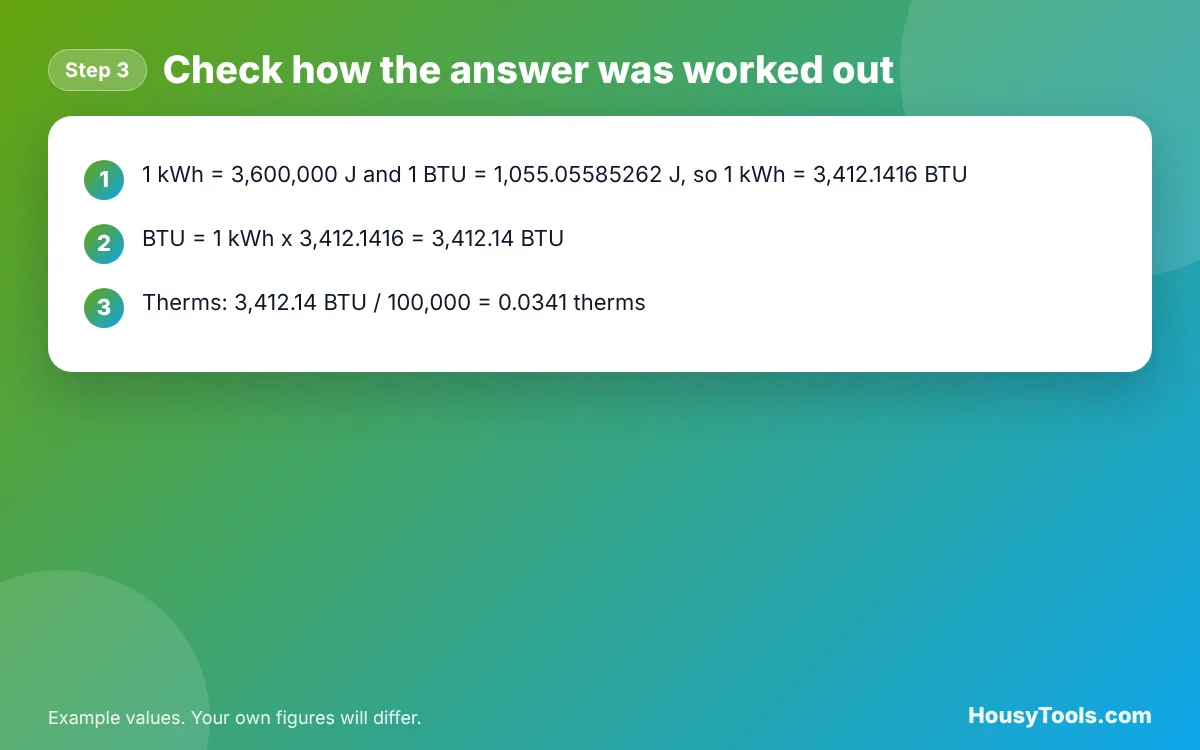
A kWh to BTU converter is a tool that changes an amount of energy in kilowatt hours into British thermal units, or the reverse. In plain words: 1 kWh is 3,600,000 joules and 1 BTU is 1,055.05585262 joules, so BTU = kWh x 3,412.14 and kWh = BTU / 3,412.14.
Kilowatt hours are the unit on UK and European electricity and gas bills. BTU is an older imperial unit still used for air conditioners, patio heaters, stoves, gas fires and many products sold from the United States, which is why people often need to switch between the two.
How Do You Use the kWh to BTU Converter?
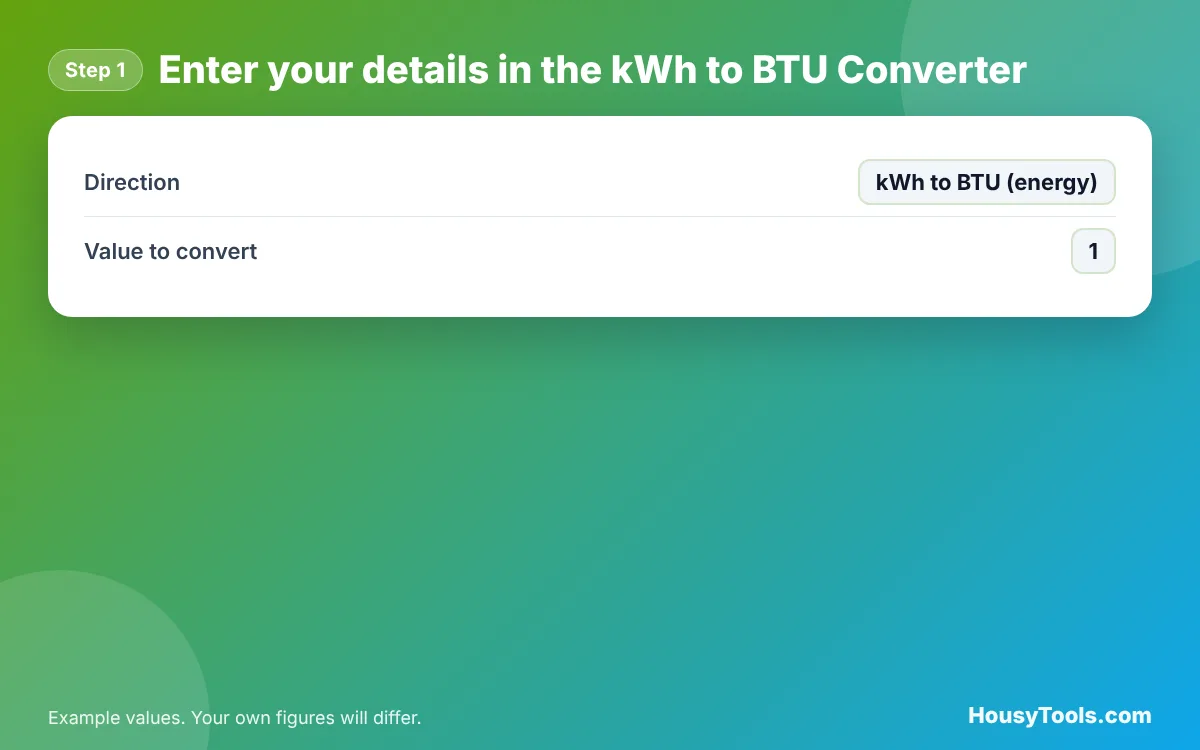
- Choose the Direction: kWh to BTU or BTU to kWh for energy, or kW to BTU per hour or BTU per hour to kW for a power rating.
- Type your figure into Value to convert, in the unit you are converting from.
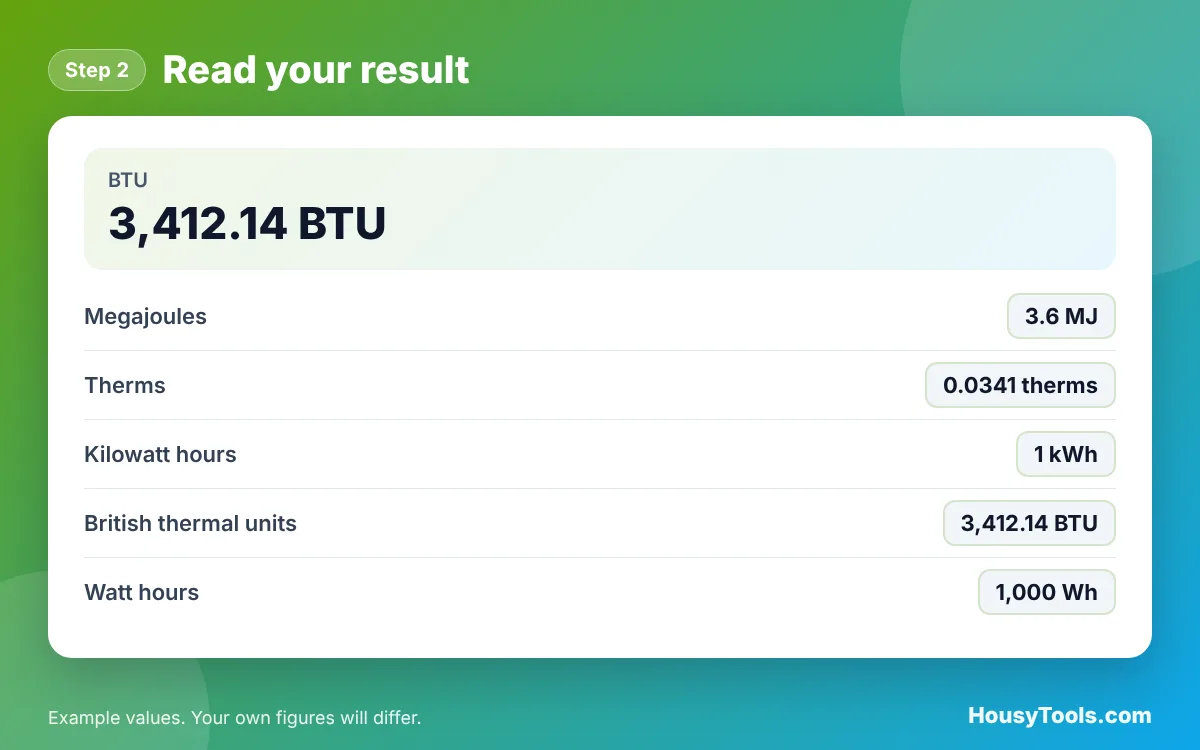
- Check the extra units in the breakdown, such as megajoules, therms, watts or tons of refrigeration.
- Read the result, then open “Show the formula and working” to see the conversion factor and the sum with your number.
How Many BTU Are in 1 kWh?
There are 3,412.14 BTU in 1 kWh, using the International Table BTU of 1,055.05585262 joules. The figure comes from dividing 3,600,000 joules by the joules in one BTU. The NIST guide to SI conversion factors lists the BTU at 1,055.056 joules and 1 BTU per hour at 0.2930711 watts, which matches.
Other BTU definitions exist, such as the thermochemical BTU, and they differ by a fraction of a percent. For home energy and appliance ratings the International Table BTU is the one in normal use, and the difference does not change any practical decision.
How Do You Convert BTU per Hour to kW?
Divide BTU per hour by 3,412.14 to get kilowatts, so 12,000 BTU/h is 3.52 kW and 18,000 BTU/h is 5.28 kW. Many air conditioners and heaters are labelled “BTU” when they mean BTU per hour, a rate of heat output or cooling, not an amount of energy.
A heat output in kW is what you compare with a room’s heat loss. If you are choosing heating for a room, the radiator size calculator works out the output you need in watts, and the boiler size calculator does the same for the whole home.
Does a 9,000 BTU Air Conditioner Use 2.6 kWh an Hour?
No, 9,000 BTU/h is the cooling output, which is 2.64 kW, and the electricity the unit draws is usually much lower because an air conditioner moves heat rather than making it. Check the rated power input in watts on the label or manual to estimate running costs.
The same applies to heat pumps: their heat output in kW or BTU/h is several times the electricity they use. For a plain electric heater, output and input are the same, so a 2 kW heater gives 6,824 BTU/h and uses 2 kWh in an hour of full power.
How Many kWh Is a Therm?
One therm is 100,000 BTU, which is 29.31 kWh. Therms still appear on some older gas paperwork and on American bills, while UK and European gas suppliers bill in kWh. Choose BTU to kWh and enter 100,000 to see it.
kWh to BTU and BTU per Hour to kW Table
| Energy | BTU | Power rating | kW |
|---|---|---|---|
| 1 kWh | 3,412.14 | 5,000 BTU/h | 1.47 |
| 2 kWh | 6,824.28 | 7,000 BTU/h | 2.05 |
| 3 kWh | 10,236.42 | 9,000 BTU/h | 2.64 |
| 5 kWh | 17,060.71 | 12,000 BTU/h | 3.52 |
| 10 kWh | 34,121.42 | 18,000 BTU/h | 5.28 |
| 100 kWh | 341,214.16 | 24,000 BTU/h | 7.03 |
Worked Example: Comparing Two Heaters
Example: a patio heater listed at 10,000 BTU per hour is being compared with an electric heater rated at 2.5 kW. Choose BTU per hour to kW and enter 10,000.
- Factor: 1 kW = 3,412.1416 BTU per hour.
- Patio heater: 10,000 BTU/h / 3,412.1416 = 2.9307 kW.
- Electric heater: choosing kW to BTU per hour and entering 2.5 gives 8,530.35 BTU/h.
The patio heater gives slightly more heat. Running cost is a separate question that depends on the fuel price, and the energy bill calculators help with that.
kWh to BTU FAQs
What is the formula to convert kWh to BTU?
Multiply kilowatt hours by 3,412.14 to get BTU. For example, 10 kWh x 3,412.14 = 34,121.42 BTU. The factor comes from 3,600,000 joules per kWh divided by 1,055.05585262 joules per BTU.
How many kWh is 1,000 BTU?
1,000 BTU is 0.2931 kWh, found by dividing 1,000 by 3,412.14. That is a little under a third of a kilowatt hour, roughly the energy a 1 kW heater uses in about 18 minutes.
Is BTU the same as BTU per hour?
No. BTU is an amount of energy, like kWh, while BTU per hour is a rate, like kW. Appliance labels often say “BTU” when they mean BTU per hour, so convert those with the kW options rather than the kWh ones.
How many BTU per hour is 1 watt?
One watt is 3.412 BTU per hour, and 1 kW is 3,412.14 BTU per hour. Going the other way, 1 BTU per hour is about 0.293 watts, the factor NIST gives for the International Table BTU.
What is a ton of cooling in kW?
One ton of refrigeration is 12,000 BTU per hour, which is about 3.52 kW. The unit is common on North American air conditioners. The converter shows tons in the breakdown whenever you convert a power rating.
Why do UK bills use kWh instead of BTU?
UK regulations replaced the therm with metric units from January 2000, and suppliers now bill gas and electricity in kWh. BTU survives mainly on air conditioners, heaters and imported appliances, which is when a conversion is needed.
Checked October 2026. Sources: NIST Special Publication 811, Appendix B9 conversion factors, Wikipedia: British thermal unit.