To read your energy bill, check four things in order: the billing period, the meter readings (actual or estimated), the energy you used in kilowatt hours, and the prices you were charged, which are a unit rate per kWh and a daily standing charge. This guide explains how to read your energy bill line by line, for households in the UK and across the EU, and how to check the maths yourself.
Quick answer: Find the billing period and meter readings, and check whether they are actual or estimated. Then find your usage in kWh, your unit rate and your standing charge. Your cost is kWh multiplied by the unit rate, plus the standing charge multiplied by the number of days, plus any VAT. If the readings are estimated, send your own.

How to Read Your Energy Bill: What Does a UK Bill Show?
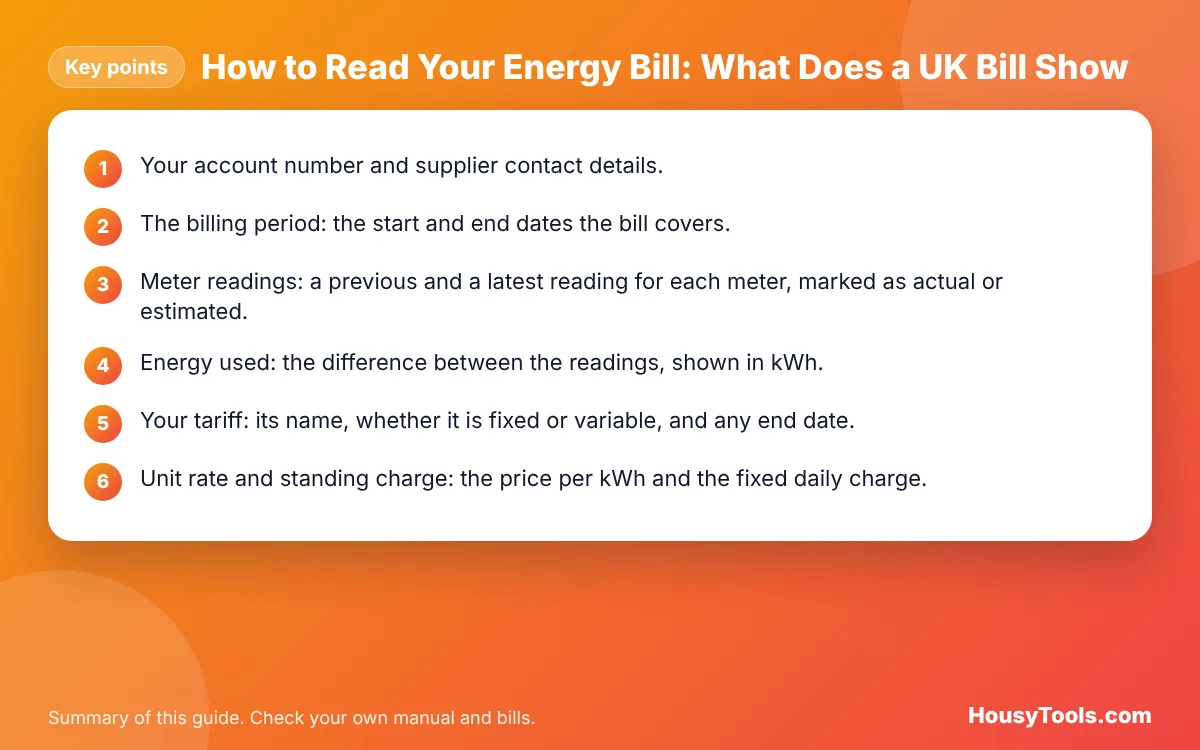
Most UK bills have about eight key items, usually split between a summary page and a detailed breakdown for each fuel. Layouts differ between suppliers, but you should be able to find:
- Your account number and supplier contact details. You need the account number whenever you contact the supplier.
- The billing period: the start and end dates the bill covers. The number of days matters for the standing charge.
- Meter readings: a previous and a latest reading for each meter, marked as actual or estimated.
- Energy used: the difference between the readings, shown in kWh. Gas may also be shown in cubic metres or cubic feet before conversion.
- Your tariff: its name, whether it is fixed or variable, and any end date.
- Unit rate and standing charge: the price per kWh and the fixed daily charge.
- VAT and any credits or discounts.
- Your balance: whether your account is in credit or debit, and your direct debit amount if you pay that way.
You will also find a meter point number for each supply. Citizens Advice explains that electricity supplies have an MPAN (Meter Point Administration Number) and gas supplies have an MPRN (Meter Point Reference Number). These identify your supply point, and are useful if you switch supplier or think you are being billed for the wrong meter.
What Do the Unit Rate and Standing Charge Mean?
The unit rate is the price you pay for each kWh you use, and the standing charge is a fixed amount you pay every day, even on days when you use no energy at all. Ofgem’s price cap rates page gives these averages for 1 October to 31 December 2026 for direct debit customers in England, Scotland and Wales:
- Electricity: 26.32p per kWh and 54.83p per day
- Gas: 7.97p per kWh and 29.68p per day
Ofgem points out that the price cap limits the unit rate and standing charge on default tariffs, but not your total bill: the more energy you use, the more you pay. Rates vary by region and payment method, and fixed tariffs can be higher or lower than the cap, so compare these figures with the rates on your own bill.
How Can You Tell if Your Bill Is Estimated?
Look at the meter readings section: each reading should be labelled as actual (or customer or smart reading) or estimated, often with a letter such as A or E next to it. Citizens Advice warns that if you do not give your supplier readings, it will send estimated bills which might not be accurate.
- Read your meter and take a dated photo of the display.
- Compare it with the latest reading on the bill.
- Check the meter serial number or meter point number on the bill matches your meter.
- If the bill was estimated, submit your actual reading and ask for a corrected bill.
Smart meters should send readings automatically, but it is still worth checking the display against the bill now and then, especially if your bills suddenly change.
How Is VAT Shown on Energy Bills From October 2026?
Domestic energy normally carries VAT at the reduced rate of 5%, but HMRC’s VAT on fuel and power guidance sets a temporary 0% rate for qualifying domestic electricity in Great Britain from 1 October 2026 to 31 March 2027. Gas stays at 5%, and electricity in Northern Ireland stays at 5%.
So a GB bill covering this period should show VAT on the gas section but not on electricity.
How Is Gas Usage Converted to kWh?
Gas meters measure volume, in cubic metres on newer meters or cubic feet on older imperial meters, but you pay per kWh, so your supplier converts the volume using the calorific value of the gas (its energy content in megajoules per cubic metre). Because one kWh equals 3.6 megajoules, the final step divides the energy in megajoules by 3.6.
Your bill should show the volume used and the resulting kWh. If you want to check the conversion from your own meter readings, our gas bill calculator takes metric or imperial readings and a calorific value, and works out the kWh and cost for you.
What Should EU Energy Bills Show?
Under EU rules, your bill must be clear, based on the energy you actually used, and sent often enough for you to manage your consumption. The European Commission’s Your Europe guide to energy contracts says bills should show the actual prices and how much energy you used, compare your use with the same period in the previous year, and give contact details for energy saving advice.
Layouts, terms and taxes differ between countries, so check your national energy regulator’s guidance for local details. The way to check the total is the same everywhere: energy used multiplied by the price per kWh, plus any fixed charges, plus taxes.
Energy Bill Terms Explained
| Bill item | What it means | What to check |
|---|---|---|
| Billing period | Dates the bill covers | Number of days matches the standing charge line |
| Meter readings | Previous and latest readings | Actual or estimated; latest matches your meter |
| Usage (kWh) | Latest reading minus previous reading | Subtraction is correct; gas conversion shown |
| Unit rate | Price per kWh | Matches your tariff; compare with the price cap |
| Standing charge | Fixed daily charge | Rate per day multiplied by days in the period |
| VAT | Tax on energy | 5% on gas; 0% on GB electricity from 1 Oct 2026 to 31 Mar 2027 |
| MPAN / MPRN | Electricity and gas meter point numbers | Match your supply and meter |
| Tariff and end date | Fixed or variable, and when a fix ends | Whether exit fees apply if you switch |
Worked Example: Checking an Electricity Bill
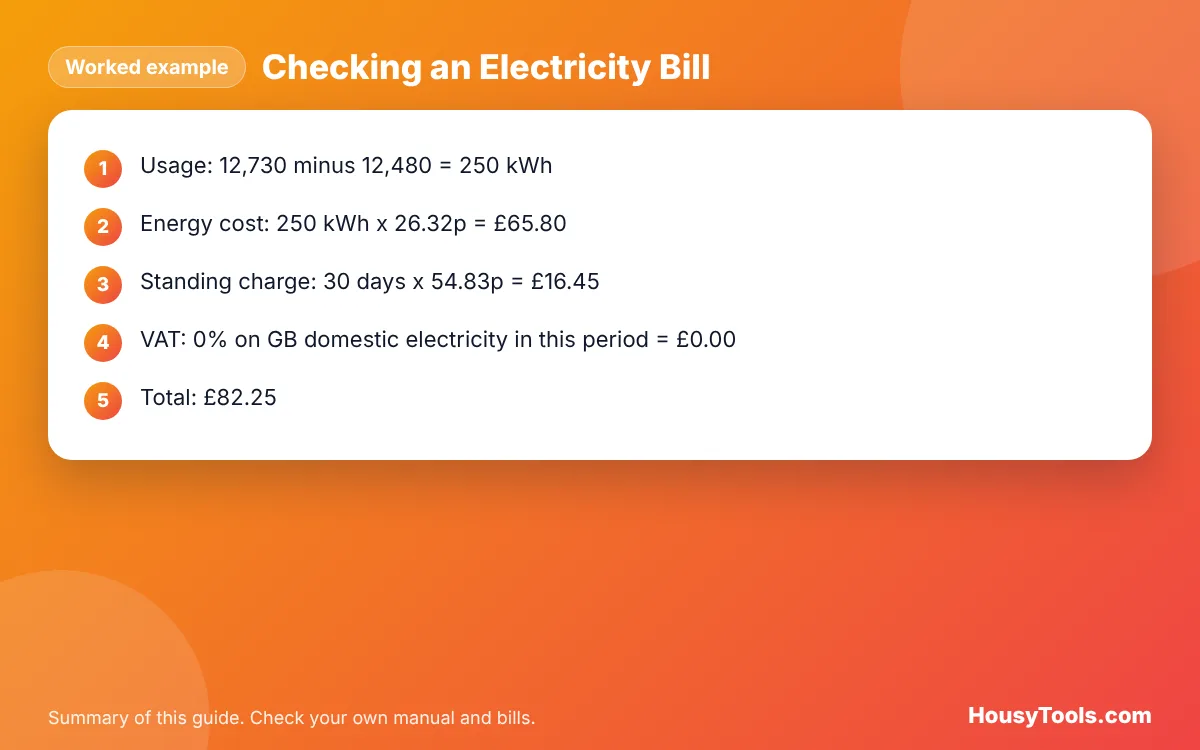
Example: a hypothetical customer in England receives a 30 day electricity bill. The previous reading was 12,480 and the latest actual reading is 12,730. The customer pays the price cap rates by direct debit: 26.32p per kWh and 54.83p per day, with 0% VAT on electricity.
- Usage: 12,730 minus 12,480 = 250 kWh
- Energy cost: 250 kWh x 26.32p = £65.80
- Standing charge: 30 days x 54.83p = £16.45
- VAT: 0% on GB domestic electricity in this period = £0.00
- Total: £82.25
If the bill shows a different total, the customer can check each line to find the difference: a wrong reading, an estimated reading, a different rate or extra days. You can reproduce this example in our electricity bill calculator by entering the two readings, 30 days and the UK price cap preset with 0% VAT. To see which appliances drive the usage figure, try the electricity cost calculator.
What Should You Do if Your Bill Looks Wrong?
Start by sending an actual meter reading with a photo, then contact your supplier in writing and keep a record of everything. Citizens Advice says that if the problem is not resolved, you can take your complaint to the Energy Ombudsman, an independent body that looks at both sides.
Citizens Advice also explains that your supplier usually cannot charge you for energy you used more than a year ago if it failed to bill you correctly at the time. And if you are on a fixed tariff and want to switch, you can usually do so without an exit fee when you have 49 days or less left on the deal.
Energy Bill FAQs
What does E mean on my energy bill?
An E next to a meter reading usually means it is estimated, so the supplier has guessed your usage. Submit an actual reading, ideally with a dated photo, and ask for a corrected bill. Check your supplier’s key, because labels vary.
Why do I pay a standing charge if I use no energy?
Ofgem describes the standing charge as an amount you pay every day, even if you do not use any energy on that day. It is part of your tariff alongside the unit rate. Under the October to December 2026 price cap, the average is 54.83p a day for electricity and 29.68p for gas.
Where do I find my MPAN or MPRN?
Both are printed on your energy bill, usually in the section with your meter details or on the back page. The MPAN identifies your electricity supply and the MPRN identifies your gas supply. Your supplier can also give them to you.
Is there VAT on electricity bills in 2026?
In Great Britain, qualifying domestic electricity has a temporary 0% VAT rate from 1 October 2026 to 31 March 2027, according to HMRC guidance. Gas, and electricity in Northern Ireland, remain at the reduced rate of 5%.
Can my supplier back bill me for old usage?
Usually only for the last 12 months. Citizens Advice explains that suppliers usually cannot charge for energy you used more than a year ago if they failed to bill you correctly.
How do I check my energy bill is correct?
Take a meter reading and compare it with the bill. Then multiply your kWh by the unit rate, add the standing charge multiplied by the days, and add VAT. If your total differs, contact your supplier with your reading and a photo.
Checked October 2026. Sources: Ofgem: Energy price cap unit rates and standing charges, Ofgem: Energy price cap and standing charges explained, GOV.UK: VAT on fuel and power, Citizens Advice: If you think you’ve been charged too much for your energy, Citizens Advice: Choosing an energy tariff, Your Europe: Contracts and energy consumption.