
8 tools
Home Calculators
Every free HousyTools calculator, grouped by job.
These home calculators help homeowners and renters in the UK, Ireland and the rest of Europe plan decorating, flooring, heating and energy jobs with real numbers instead of guesses. There are 30 free tools in four categories, each one showing its formula and working, with metric and imperial units and current UK and EU energy prices built in.
Quick answer: home calculators turn measurements and rates into quantities and costs. Our 30 tools cover paint and decorating, flooring and tiling, energy bills, and heating and insulation. For example, a 4 m by 3.5 m bedroom needs 5.5 litres of paint for two coats, and a 2,000 W heater costs 52.64p an hour.
Our Four Categories of Home Calculators
The home calculators are grouped into four hubs with 8, 8, 8 and 6 tools. Each hub page lists every tool in that category, explains which one to use, and answers the common questions for that type of job.
Paint and decorating
The paint and decorating hub covers paint, wallpaper, masonry paint, fence paint and deck stain, plus paint cost and painting time. Most popular: the paint calculator for litres and tins, the wallpaper calculator for rolls with pattern repeat, and the masonry paint calculator for render and pebbledash.
Flooring and tiling
The flooring and tiling hub covers tiles, grout, adhesive, laminate, sheet vinyl, carpet, skirting and levelling compound, with wastage built in. Most popular: the tile calculator, the laminate flooring calculator and the carpet calculator.
Energy and bills
The energy and bills hub covers electricity and gas bills, appliance, shower and EV running costs, Economy 7, solar panels and heat pump running costs. Most popular: the electricity cost calculator, the electricity bill calculator and the gas bill calculator.
Heating and insulation
The heating and insulation hub covers radiator size and output, boiler and heat pump sizing, underfloor heating and loft insulation. Most popular: the radiator size calculator, the boiler size calculator and the heat pump size calculator.
Most Popular Home Calculators
Three home calculators answer the questions people ask most often before a job. The paint calculator works out litres from room size, doors, windows and coats, then rounds up to real tin sizes. A 4 m by 3.5 m room with 2.4 m walls needs 5.5 litres for two coats at 12 m² per litre.
The tile calculator adds the grout joint to every tile, adds wastage for the layout, and rounds up to whole boxes. A 2.4 m by 1.8 m bathroom floor in 600 by 300 mm tiles, brick bond, needs 27 tiles, or 5 boxes of 6.
The electricity cost calculator prices any appliance from its watts and hours. At the UK cap rate of 26.32p per kWh, a 3,000 W kettle costs about 79p for every hour it boils, while a 50 W laptop costs 1.32p an hour.
For heating, the radiator size calculator is the favourite of our home calculators. It adds heat lost through walls, windows, ceiling and floor to ventilation loss, so you can see where the heat goes. A 4.5 m by 3.8 m living room with filled cavity walls needs about 912 W, but about 1,581 W with solid brick walls, which is why insulation changes the radiator you need.
Which Home Calculator Do I Need?
Pick the category from the job, then the tool from what you are buying: paint or paper, floor covering, energy, or heating equipment. Most projects use two or three home calculators together, for example tiles, adhesive and grout for one floor.
- Redecorating a room: paint calculator, ceiling paint calculator, then the paint cost and painting time calculators.
- New floor: tile calculator or laminate flooring calculator, plus the skirting board calculator and self levelling compound calculator where needed.
- Checking a bill: electricity bill calculator or gas bill calculator with two meter readings.
- Cutting running costs: electricity cost calculator, electric shower cost calculator or Economy 7 calculator.
- Planning a heat pump: heat pump size calculator, radiator output calculator and heat pump running cost calculator.
- Making a home warmer for less: loft insulation calculator, then the radiator size calculator room by room.
How Do Our Home Calculators Work?
Every one of our home calculators uses a published formula, shows each step under the result, and starts with realistic example inputs you can replace with your own figures.
Quantities are rounded up to what you can actually buy: whole tins, boxes, packs, rolls and bags. Energy tools are pre-filled with official rates and show the date they were checked. Inputs that vary by product, such as paint coverage or roll size, are labelled as examples, because the figure on your own tin or label is always more accurate.
Read the full method on the how our calculators work page, and see our editorial policy for how we choose sources and update pages when rates or standards change.
How Much Does Electricity Cost in the UK and EU?
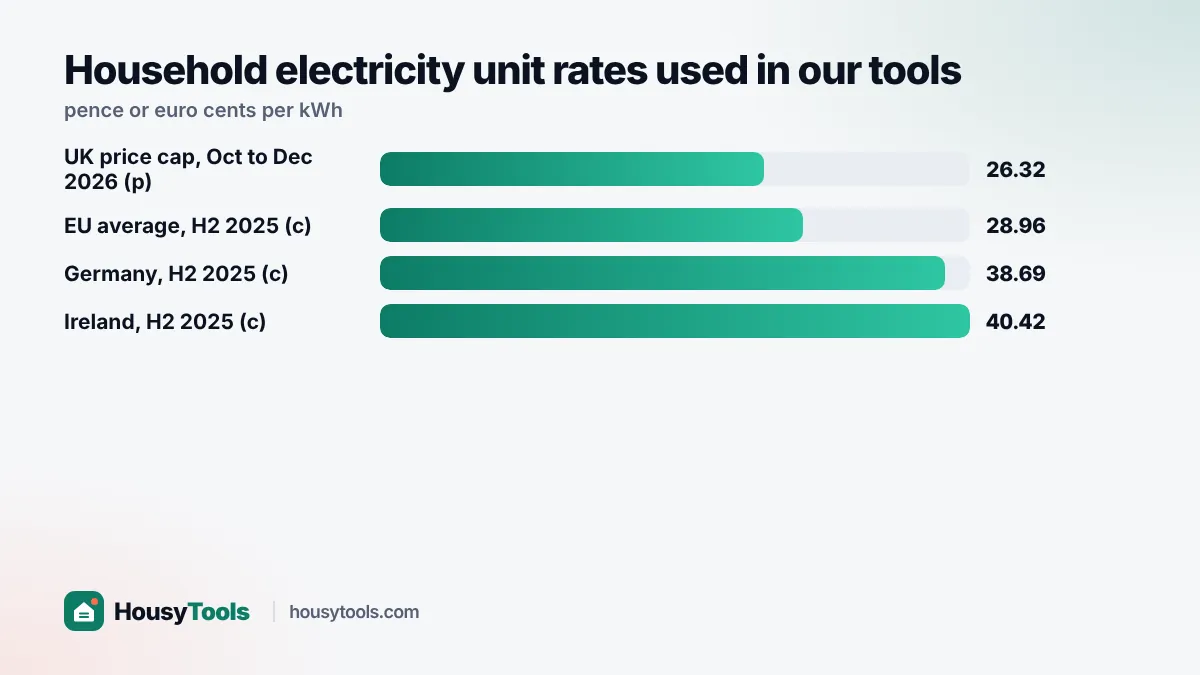
Under the UK price cap from 1 October to 31 December 2026, electricity costs 26.32p per kWh plus 54.83p a day, while the EU household average for the second half of 2025 was €28.96 per 100 kWh including taxes.
| Region | Period | Electricity unit rate | Source |
|---|---|---|---|
| UK (Great Britain price cap) | 1 Oct to 31 Dec 2026 | 26.32p per kWh, plus 54.83p a day | Ofgem |
| EU average | Second half of 2025 | €28.96 per 100 kWh | Eurostat |
| Germany | Second half of 2025 | €38.69 per 100 kWh | Eurostat |
| Ireland | Second half of 2025 | €40.42 per 100 kWh | Eurostat |
The UK figures come from Ofgem’s price cap rates, which vary by region and payment method. The EU figures come from Eurostat’s electricity price statistics. If you are on a fixed tariff, type your own rate into the home calculators instead of the presets.
How Should You Measure a Room for Any Calculator?
Measure in metres to two decimal places, at floor level and wall to wall at the widest points, and split L shaped rooms into rectangles you add together.
- Walls: measure the height from the top of the skirting to the ceiling. Most UK rooms are around 2.4 m, older houses often 2.7 m or more.
- Doors and windows: measure the real openings. A standard UK internal door removes about 1.5 to 1.6 m² of wall.
- Floors: include doorways to the middle of the door where the threshold strip will sit.
- Imperial: every measuring tool accepts feet and inches, so you can switch units instead of converting by hand.
Write the measurements down once and reuse them. The same length and width feed the paint, flooring, skirting and radiator home calculators, so one careful measure saves time across the whole job.
When Should You Call a Professional Instead?
Call a qualified professional for any work on gas, fixed wiring or a heating system, and use home calculators only to plan the job and check a quote.
In the UK, only a Gas Safe registered engineer can legally install, replace or service a gas boiler, and new electrical circuits in England and Wales fall under Part P of the Building Regulations. Simple jobs such as painting and topping up loft insulation are fine for most people: the Energy Saving Trust recommends at least 270 mm of loft insulation. See our disclaimer for the limits of any online estimate.
Home Calculators FAQs
Are your home calculators free?
Yes. All 30 home calculators are free to use, with no sign up or download. They work on phones and computers, update as you type, and show the full working under each result so you can check every step yourself.
Do the calculators work outside the UK?
Yes. The tools work in metric by default with a switch to feet and inches, and the energy tools include EU average, German and Irish electricity prices in euros. You can also type your own local tariff into any energy calculator.
How accurate are online home calculators?
They are as accurate as the figures you enter. The formulas are published and every step is shown, but product figures such as paint coverage, pack size and tariff rates vary, so always use the numbers on your own tin, label or bill.
How often are the energy prices updated?
The energy tools are checked against the Ofgem price cap, which changes every quarter, and against the latest Eurostat figures for the EU. Each page shows the month it was last checked, and October 2026 is the current check.
Which calculator should I use for a whole room makeover?
Start with the paint calculator for the walls and the ceiling paint calculator for the ceiling, then the tile or laminate flooring calculator for the floor and the skirting board calculator for the edges. Finish with the paint cost and painting time calculators.
Can a calculator replace a heating engineer?
No. The heating tools give a sensible estimate of radiator, boiler and heat pump sizes, but a new boiler or heat pump should be designed by a qualified installer with a full room by room heat loss survey. Use the results to check the quote.
Checked October 2026. Sources: Ofgem energy price cap (1 October to 31 December 2026), Eurostat electricity price statistics, Energy Saving Trust, results from each HousyTools tool page.