
Show the formula and working
This free light bulb base converter identifies a bulb cap from its code or from a quick measurement and tells you the matching bulb to buy in the UK and Ireland, mainland Europe or North America. It covers the screw, bayonet and pin bases found in homes, with the voltage and the size that matters for each one.
Quick answer: A light bulb base converter reads the cap code: the letter gives the type and the number gives the size in millimetres. E27 is a 27 mm screw, B22 a 22 mm bayonet and GU10 a twist-lock base with pins 10 mm apart. UK homes mainly use B22, mainland Europe E27 and North America E26.
What Is a Light Bulb Base Converter?
A light bulb base converter is a tool that decodes a bulb cap designation, or matches a measurement to the nearest standard cap, and lists its equivalents in other regions. The codes come from the international cap standard IEC 60061, so an E14 bulb bought in Dublin fits an E14 holder in Berlin.
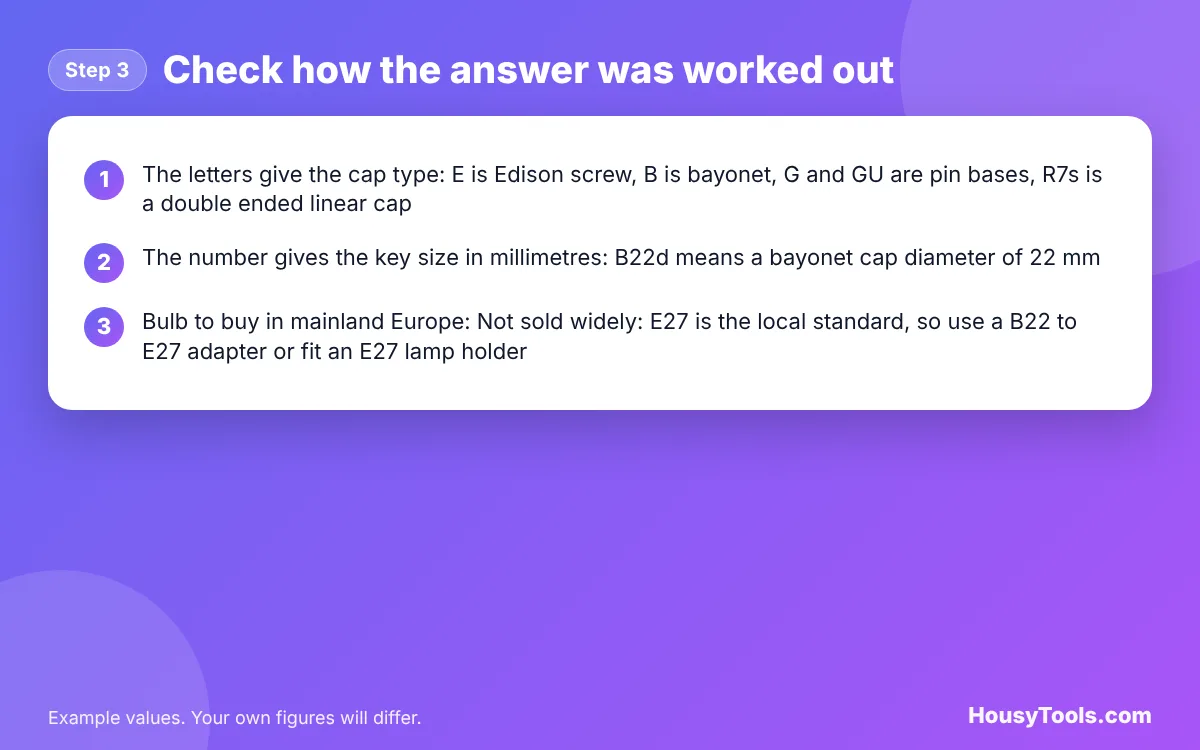
The rule in plain words: the first letter is the family (E for Edison screw, B for bayonet, G or GU for pins), and the number is the key size in millimetres. For screws that is the outside diameter of the thread, for bayonets the diameter of the cap, and for pin bases the distance between the centres of the two pins. A small letter at the end, as in B22d, gives the number of contacts: d means two.
How Do You Use the Light Bulb Base Converter?
- Choose a Direction: “Look up a base by its code” if the code is printed on the bulb, or “Identify a base from a measurement” if it has worn off.
- To look up a code, pick it from Bulb base.
- To identify a base, choose What you measured, then type the size in millimetres into Measurement.
- Set Where you will buy the bulb to the UK and Ireland, mainland Europe or North America.
- Read the result and open “Show the formula and working” to see how the code was decoded and why that base was matched.


What Is the Difference Between E27 and B22?
E27 is a 27 mm screw cap and B22 is a 22 mm push and twist bayonet cap, and they do not fit each other’s holders. Both are the standard size for 230 V household lamps: B22 is the traditional fitting in the UK and Ireland, while E27 is standard in mainland Europe and is now common in UK lamps too. The bayonet mount is also standard in Australia, India and New Zealand.
Can You Use an E26 Bulb in an E27 Socket?
An E26 bulb usually screws into an E27 holder, because the threads differ by only 1 mm, but the voltage must still be right. E26 bulbs are made for 120 V in North America, while UK and European homes run at 230 V. A 120 V bulb on 230 V can fail quickly or overheat, so only use one marked for 230 V or a wide range such as 100 to 240 V.
How Do You Measure a Light Bulb Base?
Measure across the outside of the screw thread or the bayonet cap with a ruler or calipers, or measure between the centres of the two pins on a pin base. A screw of about 27 mm is E27, about 14 mm is E14, and a bayonet of about 15 mm is B15. Pins 10 mm apart with chunky ends mean GU10 mains spotlights, while thin pins about 5.3 mm apart mean GU5.3 low voltage spotlights. Switch off and let a bulb cool before removing it.
Are Light Bulb Adapters Safe?
A plug-in base adapter, such as B22 to E27, is safe when it carries a recognised safety mark and the bulb stays within the maximum wattage printed on the fitting. Adapters make the bulb sit lower, which can bring it closer to a shade. A table lamp’s BS 1363 plug is rated at 13 A, and the BS 1363 standard prefers 3 A or 13 A fuses, so fit the rating the lamp maker gives. Changing a ceiling lamp holder or any fixed wiring is a job for a qualified electrician.
Light Bulb Base Chart: UK, EU and US
| Base | Type and key size | Voltage | UK and Ireland | Mainland Europe | North America |
|---|---|---|---|---|---|
| B22d (BC) | Bayonet, 22 mm | 230 V | Standard | Rare, E27 instead | Not used, E26 instead |
| E27 (ES) | Screw, 27 mm | 230 V | Common | Standard | E26 (120 V) |
| E14 (SES) | Screw, 14 mm | 230 V | Common | Common | E12 (smaller, not compatible) |
| B15d (SBC) | Bayonet, 15 mm | 230 V | Common | Rare, E14 instead | Not used |
| GU10 | Twist-lock pins, 10 mm | 230 V | Common | Common | 120 V version |
| GU5.3 (MR16) | Pins, 5.33 mm | 12 V | Common | Common | Common |
| G9 | Loop pins, 9 mm | 230 V | Common | Common | 120 V version |
| G4 | Pins, 4 mm | 12 V | Common | Common | Common |
| E40 (GES) | Screw, 40 mm | 230 V | Industrial | Industrial | E39 (120 V) |
| G13 | Tube pins, 12.7 mm | Via fitting | T8 tubes | T8 tubes | T8 tubes |
Worked Example: Taking a UK Lamp to France
Example: a household moving from Manchester to Lyon is taking a favourite table lamp. The old bulb says B22 on the cap. Choose “Look up a base by its code”, pick B22d (bayonet cap, BC) and set where the bulb will be bought to mainland Europe.
- Result: B22d, a bayonet cap 22 mm across, for 230 V mains.
- Buying in mainland Europe: B22 bulbs are not sold widely because E27 is the local standard.
- The options: stock up on B22 bulbs before the move, use a safety marked B22 to E27 adapter, or have the lamp holder changed to E27.
- Voltage: France also runs at 230 V, so UK bulbs work there. Only the plug needs an adapter or a change.
Swapping old halogen or incandescent bulbs for LED versions of the same base cuts running costs a lot. The electricity cost calculator shows the yearly saving for any wattage, and the energy bill calculators cover the rest of the home.
Light Bulb Base Converter FAQs
What does ES, SES, BC and SBC mean on a bulb?
These are the UK shop names for common caps. ES is Edison screw (E27), SES is small Edison screw (E14), BC is bayonet cap (B22d) and SBC is small bayonet cap (B15d). The letters and numbers mean the same thing everywhere.
Is GU10 the same as MR16?
No. GU10 is a 230 V twist-lock spotlight with pins 10 mm apart. MR16 spotlights usually have a GU5.3 base with thin pins 5.33 mm apart and run at 12 V from a transformer. The bulbs look similar from the front but are not interchangeable.
Can I put an E14 bulb in an E27 socket?
Not directly: E14 is 14 mm across and E27 is 27 mm, so it will not screw in. An E27 to E14 adapter lets you fit a smaller bulb, as long as the adapter is safety marked and the bulb stays within the fitting’s maximum wattage.
Which bulb base is standard in the UK?
The B22 bayonet cap is the traditional standard for UK ceiling pendants and lamps, with B15 for smaller fittings. E27 and E14 screw caps are now also very common in UK lamps, and GU10 is the usual base for mains downlights.
Can I use an American bulb in the UK?
Only if the bulb is rated for 230 V. An American E26 bulb fits a UK or European E27 holder, but most are made for 120 V and can fail or overheat on 230 V. Wide range LED bulbs marked 100 to 240 V are the exception.
What is an R7s bulb?
R7s is a double ended linear bulb with a contact at each end, used in floodlights and uplighters. It comes in 78 mm and 118 mm lengths, so measure the old bulb end to end and buy the same length.
Checked October 2026. Sources: Wikipedia, Edison screw, Wikipedia, Bayonet mount, Wikipedia, Bi-pin lamp base, Wikipedia, BS 1363, Airam, R7s LED lamps.