
Show the formula and working
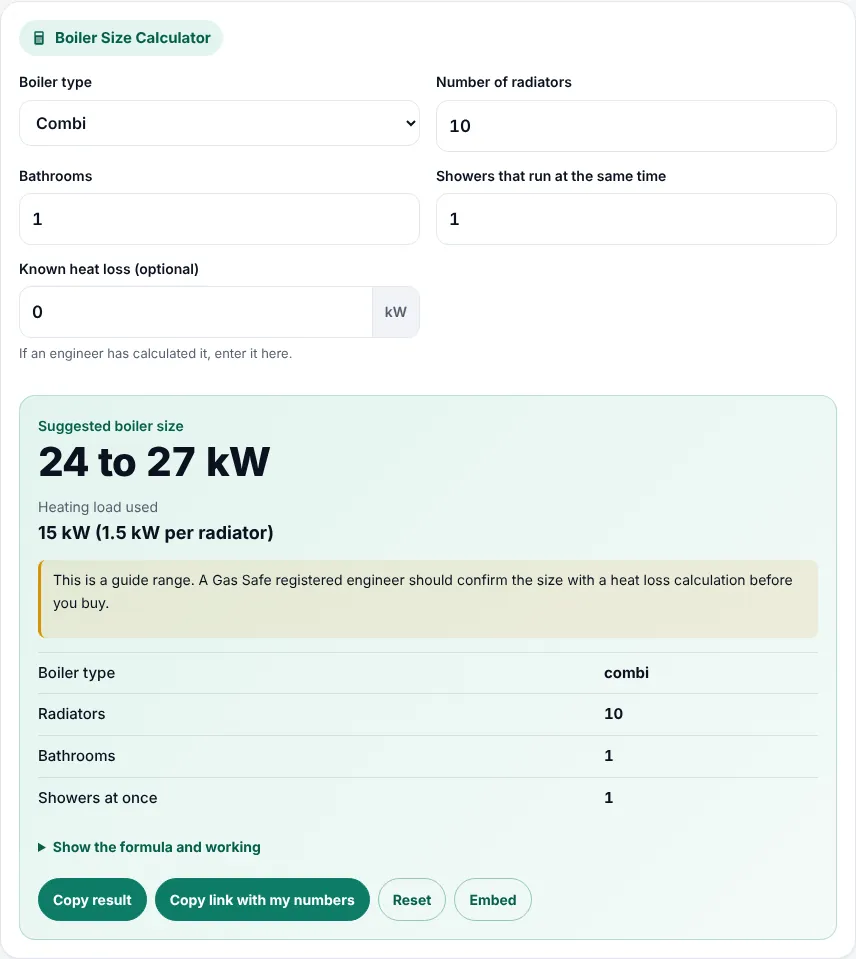
This boiler size calculator gives UK homeowners a guide kW range for a new combi, system or regular gas boiler, based on radiators, bathrooms and how many showers run at once. If an engineer has already measured your heat loss, enter it and the tool uses that instead of the radiator rule of thumb.
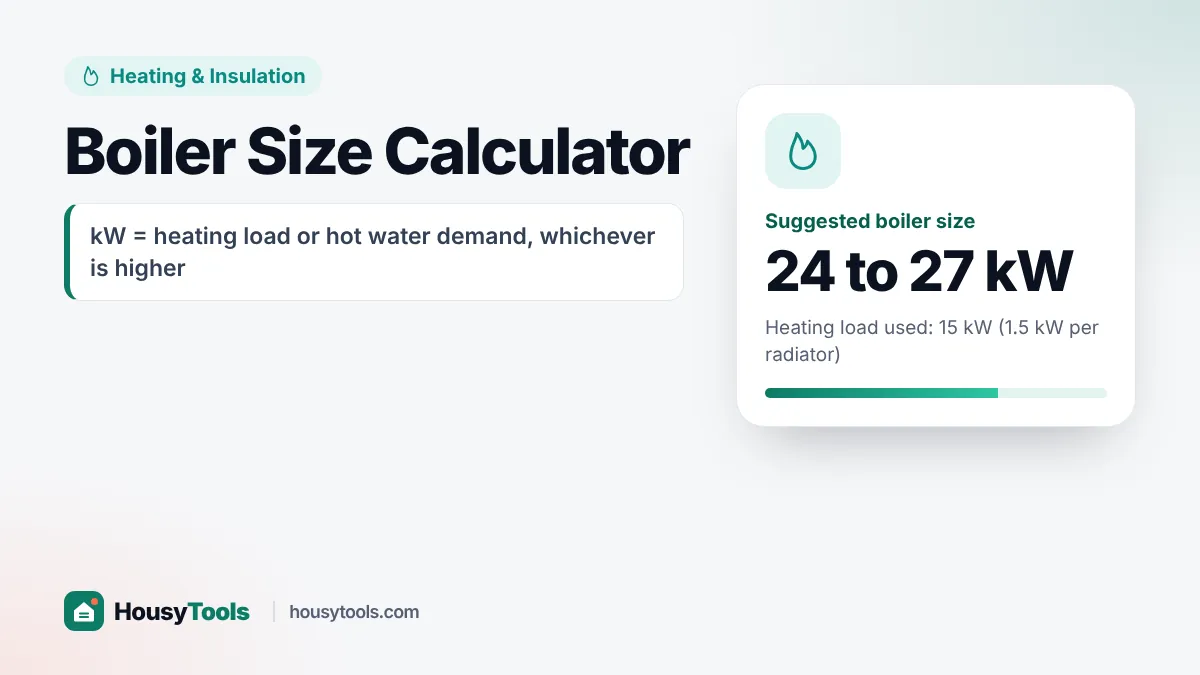
Quick answer: the boiler size calculator sizes a combi by hot water demand, typically 24 to 27 kW for one bathroom, 28 to 34 kW for two and 35 to 42 kW for three or more. System and regular boilers are sized on heating load, about 1.5 kW per radiator, plus about 3 kW for the cylinder.
What Is a Boiler Size Calculator?
A boiler size calculator suggests the output, in kilowatts, that a new boiler needs to heat your home and supply hot water without wasting money on a bigger unit than necessary.
The method is simple. Heating load is either your known heat loss figure or 1.5 kW per radiator. For a combi, the size is set mainly by hot water: the larger of the hot water band (24 to 27, 28 to 34 or 35 to 42 kW) and the heating load, with a 20% margin on the top figure. For a system or regular boiler, the boiler size calculator adds about 3 kW to reheat a hot water cylinder, then gives a range from that figure up to 20% more.
How Do You Use the Boiler Size Calculator?
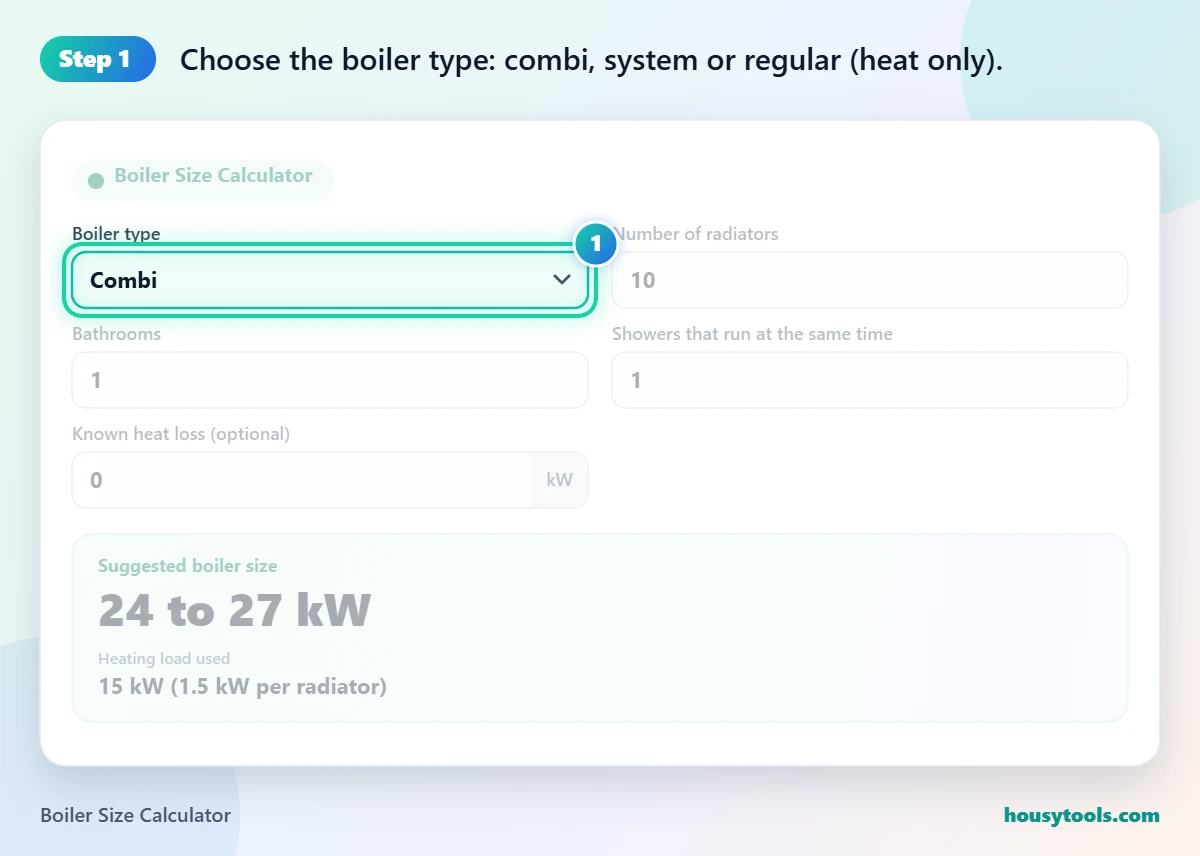
- Choose the boiler type: combi, system or regular (heat only).
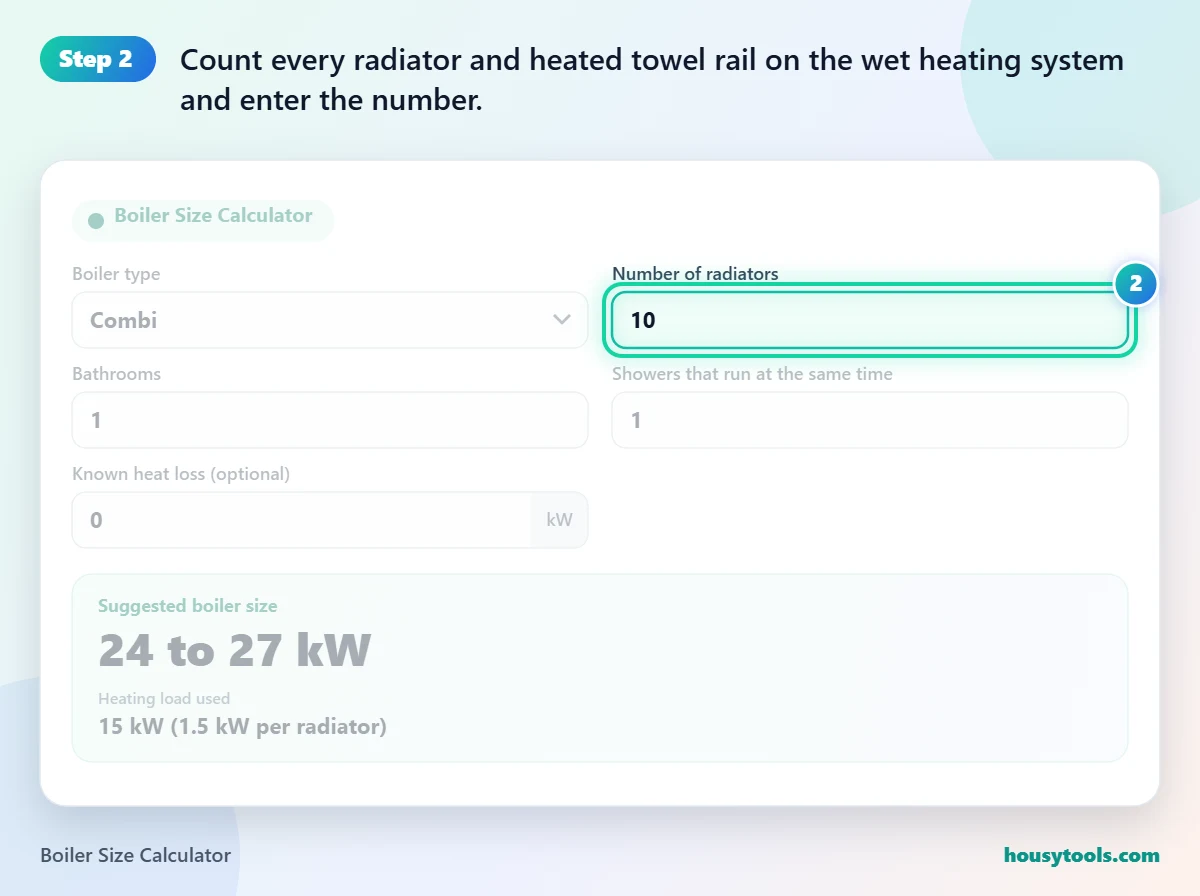
- Count every radiator and heated towel rail on the wet heating system and enter the number.
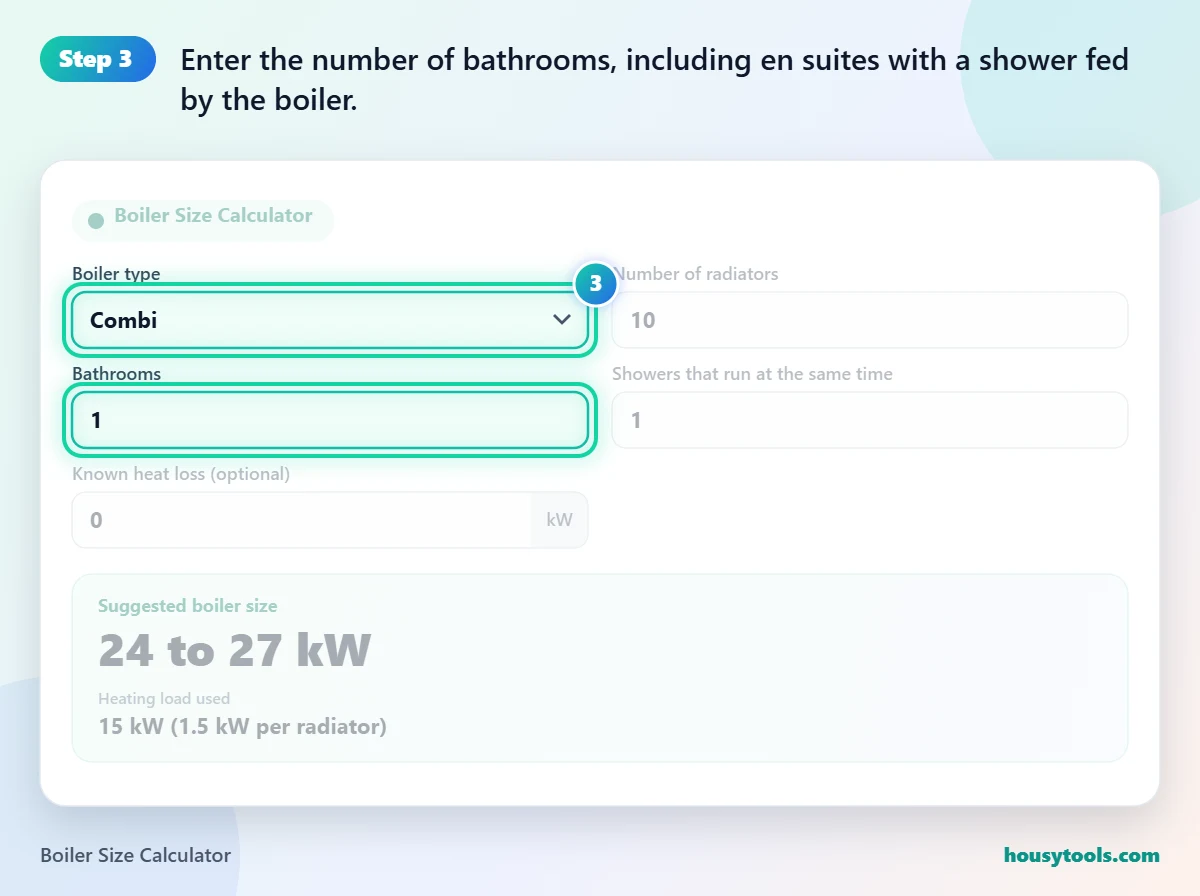
- Enter the number of bathrooms, including en suites with a shower fed by the boiler.
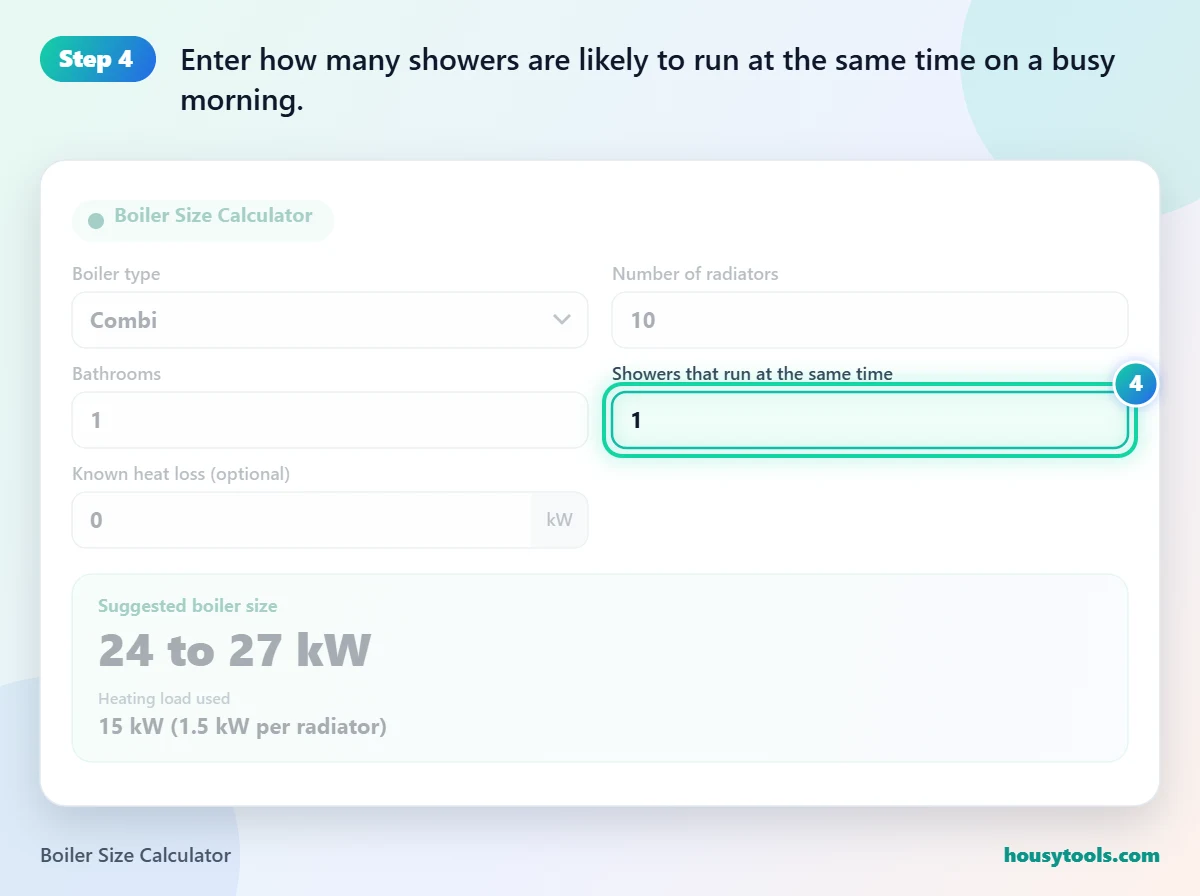
- Enter how many showers are likely to run at the same time on a busy morning.
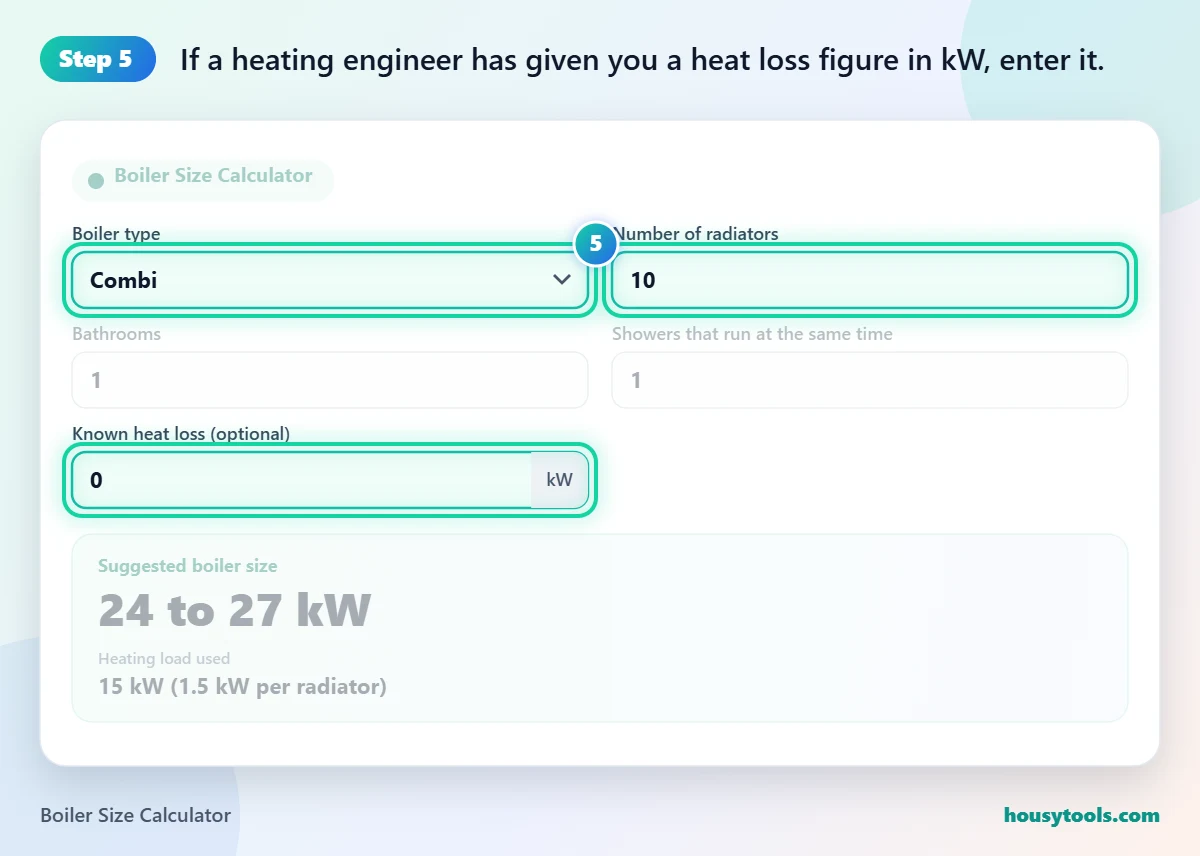
- If a heating engineer has given you a heat loss figure in kW, enter it. The boiler size calculator then uses it instead of 1.5 kW per radiator.
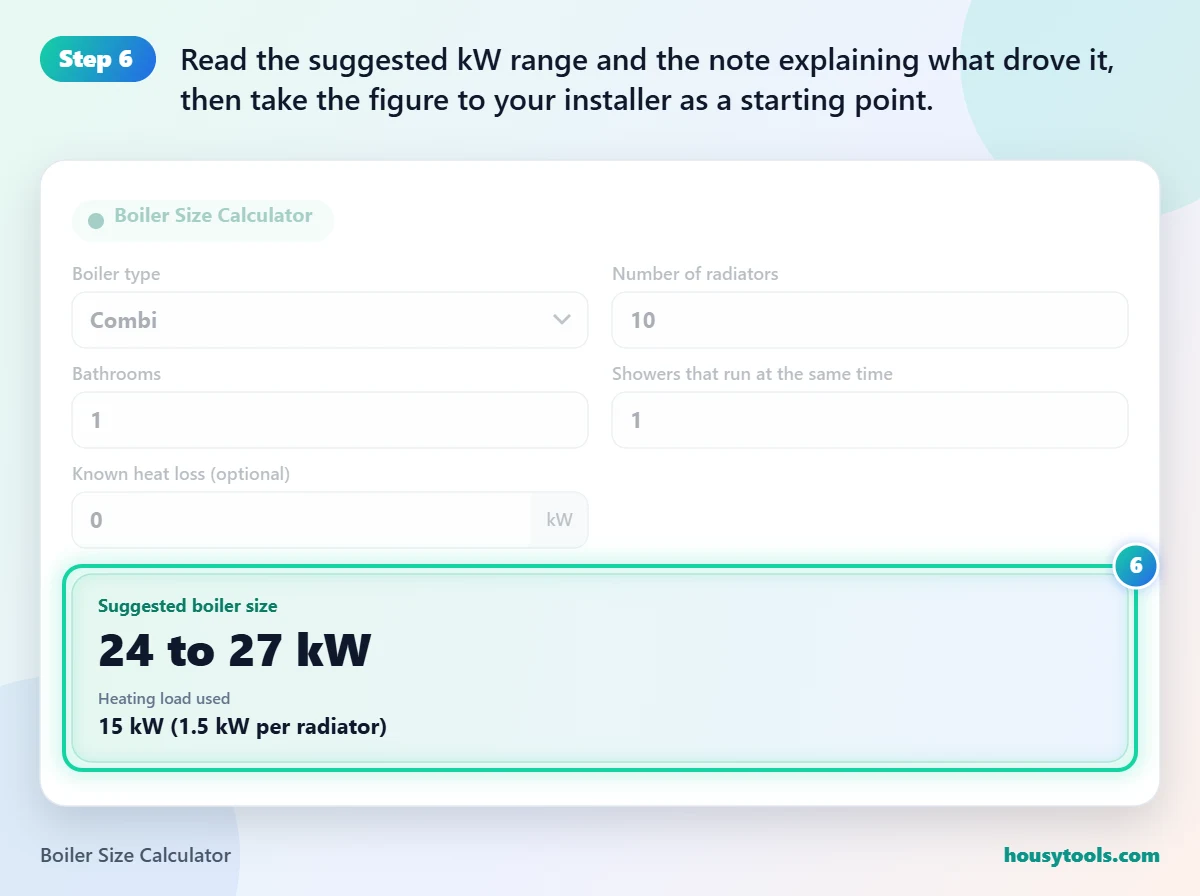
- Read the suggested kW range and the note explaining what drove it, then take the figure to your installer as a starting point.
What Size Boiler Do I Need?
Most UK homes need a 24 to 27 kW combi with one bathroom, a 28 to 34 kW combi with two bathrooms, or 35 to 42 kW for three or more; system and regular boilers are usually 12 to 26 kW for typical homes.
A boiler size calculator gives combis a higher figure than the heating alone because combis heat mains water instantly as it flows to the tap. Raising water by about 35°C at 10 litres per minute takes roughly 24 kW, which is why small combis start around that size. System and regular boilers store hot water in a cylinder, so they only need enough output for the radiators plus a few kilowatts to reheat the tank.
A modern condensing boiler modulates, so a 28 kW combi can run at a much lower output when only a few radiators are on. That is why an oversized combi wastes less than an oversized old boiler, although it still costs more to buy.
Combi, System or Regular: Which Boiler Type Should I Choose?
Choose a combi for one bathroom and good mains pressure, a system boiler with an unvented cylinder for two or more showers at once, and a regular boiler mainly when keeping existing tanks in the loft is simpler.
The boiler size calculator flags homes where two or more showers run at once, because a combi splits its flow between them and both can turn lukewarm. A cylinder stores a reserve of hot water and handles simultaneous use far better.
Check your mains flow rate before acting on any combi figure from the boiler size calculator. A combi cannot deliver more hot water than the cold main supplies. Fill a bucket from the kitchen cold tap for 10 seconds and multiply the litres by 6 to get litres per minute.
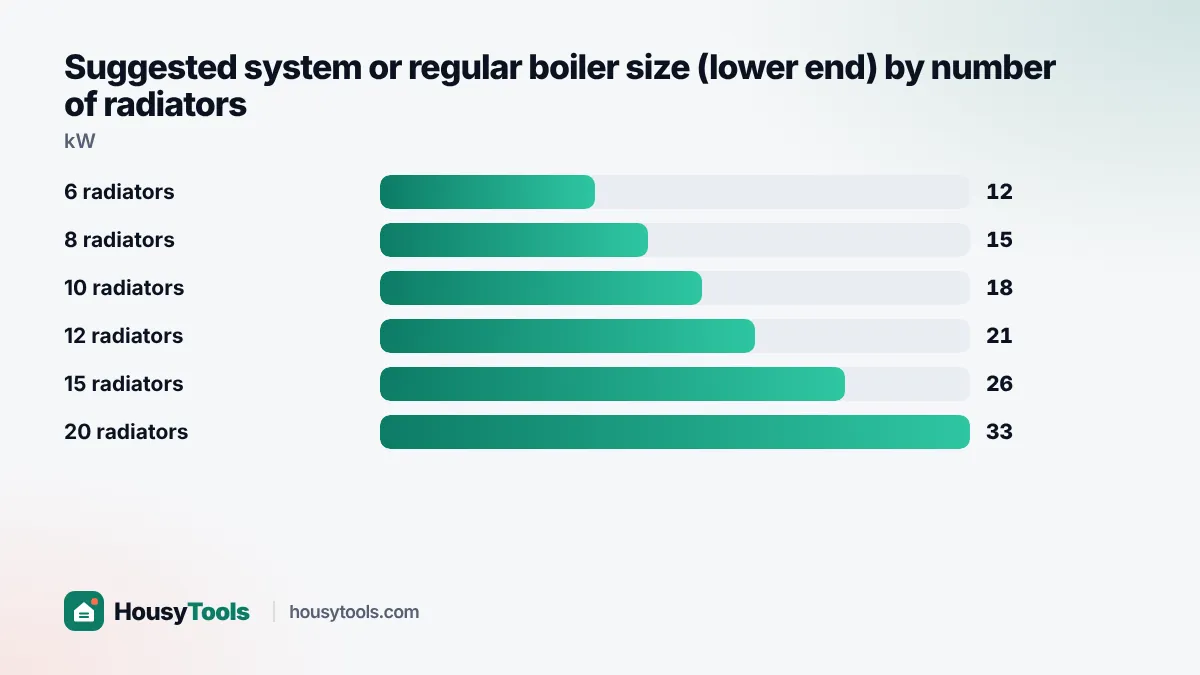
Suggested System Boiler Size by Number of Radiators
The table shows what the boiler size calculator suggests for a system or regular boiler at 1.5 kW per radiator, including about 3 kW for the cylinder and a 20% upper margin.
| Radiators | Heating load | Suggested system or regular boiler | Typical combi with 1 bathroom |
|---|---|---|---|
| 6 | 9 kW | 12 to 15 kW | 24 to 27 kW |
| 8 | 12 kW | 15 to 18 kW | 24 to 27 kW |
| 10 | 15 kW | 18 to 22 kW | 24 to 27 kW |
| 12 | 18 kW | 21 to 26 kW | 24 to 27 kW |
| 15 | 22.5 kW | 26 to 31 kW | 24 to 27 kW |
| 20 | 30 kW | 33 to 40 kW | 30 to 36 kW |
Worked Example: Helen’s Three Bedroom Semi
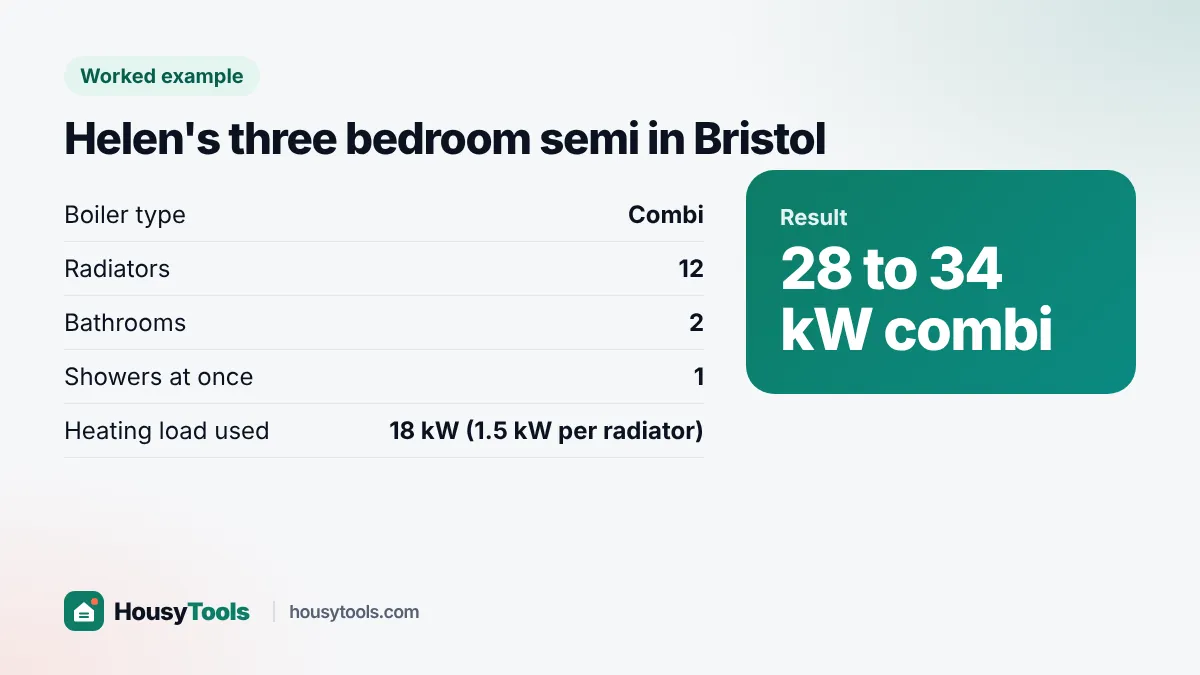
Helen owns a 1970s three bedroom semi in Bristol. Her 15 year old combi is failing, and she wants a figure to check quotes against. The house has 12 radiators including a towel rail, a family bathroom and an en suite, and usually only one shower runs at a time.
- Heating load: 12 radiators x 1.5 kW = 18 kW.
- Hot water band for 2 bathrooms and 1 shower at once: 28 to 34 kW.
- Lower figure: the larger of 28 kW and 18 kW = 28 kW.
- Upper figure: the larger of 34 kW and 18 x 1.2 = 21.6, rounded up to 22 kW = 34 kW.
- Suggested size: 28 to 34 kW combi.
Helen later gets a heat loss survey showing 9.5 kW. Entering it does not change the combi range, because hot water still sets the size. If she switched to a system boiler with a cylinder, the boiler size calculator would suggest 13 to 15 kW, close to her real heat loss plus the cylinder.
Why Is a Heat Loss Survey Better Than Counting Radiators?
A heat loss survey is better because it measures what your house actually loses through walls, windows, roof, floor and air leaks, while 1.5 kW per radiator is only an average that can overstate the load in well insulated homes by half or more.
Before trusting any boiler size calculator result, you can estimate each room with the radiator size calculator and add the results together. If you are considering low carbon heating, compare the figure with the heat pump size calculator, which uses your yearly gas use as a second check.
Who Can Fit a New Gas Boiler?
Only a Gas Safe registered engineer can legally install, replace or service a gas boiler in a UK home, under the Gas Safety (Installation and Use) Regulations 1998.
The Health and Safety Executive also advises annual servicing by a Gas Safe registered engineer. Ask to see the engineer’s ID card and check it covers the work. Use the boiler size calculator as a sense check on quotes, never as a replacement for the engineer’s own assessment. For running costs at the current price cap, try the gas bill calculator.
What Are Common Boiler Sizing Mistakes?
- Copying the old boiler’s size instead of running a boiler size calculator. Homes often have better insulation and glazing now than when the old one was fitted.
- Picking a combi for a busy household with two showers at once.
- Ignoring low mains flow, which limits any combi whatever its kW.
- Assuming a bigger boiler heats rooms faster. Radiator size limits that, not boiler size.
- Forgetting planned extensions or a loft conversion. Add those radiators in the boiler size calculator now.
Boiler Size Calculator FAQs
What size combi boiler do I need for a 3 bedroom house?
Most 3 bedroom houses with one bathroom suit a 24 to 27 kW combi, rising to 28 to 34 kW with an en suite as well. The boiler size calculator adjusts for showers that run at the same time.
Is a 30 kW boiler too big for a small house?
Not necessarily for a combi, because hot water demand sets its size and modern boilers modulate down for heating. For a system or regular boiler, 30 kW is usually far larger than a small house needs.
How many radiators can a 24 kW boiler run?
Using the rule of thumb of 1.5 kW per radiator, a 24 kW boiler can run about 16 radiators for heating alone. Real capacity depends on radiator sizes and the home’s heat loss, so ask an engineer to confirm.
Does a bigger boiler use more gas?
A correctly installed modern boiler only burns the gas it needs, but a heavily oversized boiler can cycle on and off more often in mild weather, which lowers efficiency and adds wear. Matching size to demand is the better choice.
What is the difference between a system and a regular boiler?
A system boiler has the pump and expansion vessel built in and works with a cylinder, usually unvented. A regular boiler also needs a cold water tank and a feed and expansion tank in the loft.
Can I install a boiler myself?
No. In the UK only a Gas Safe registered engineer may install, move or service gas appliances. Doing gas work yourself is illegal and dangerous, and it can also invalidate your home insurance and the boiler warranty.
Checked October 2026. Sources: Health and Safety Executive, legislation.gov.uk (Gas Safety (Installation and Use) Regulations 1998), manufacturer sizing guidance.