
Show the formula and working
This free concrete footing calculator works out how much concrete you need for pad footings, strip footings in a trench or round pier footings, for homeowners and DIY builders in the UK, Ireland and Europe planning a garden wall, shed base, deck, carport or extension. It gives the volume in cubic metres, the weight in tonnes, the number of bags and a ready mix order rounded to the nearest quarter cubic metre.
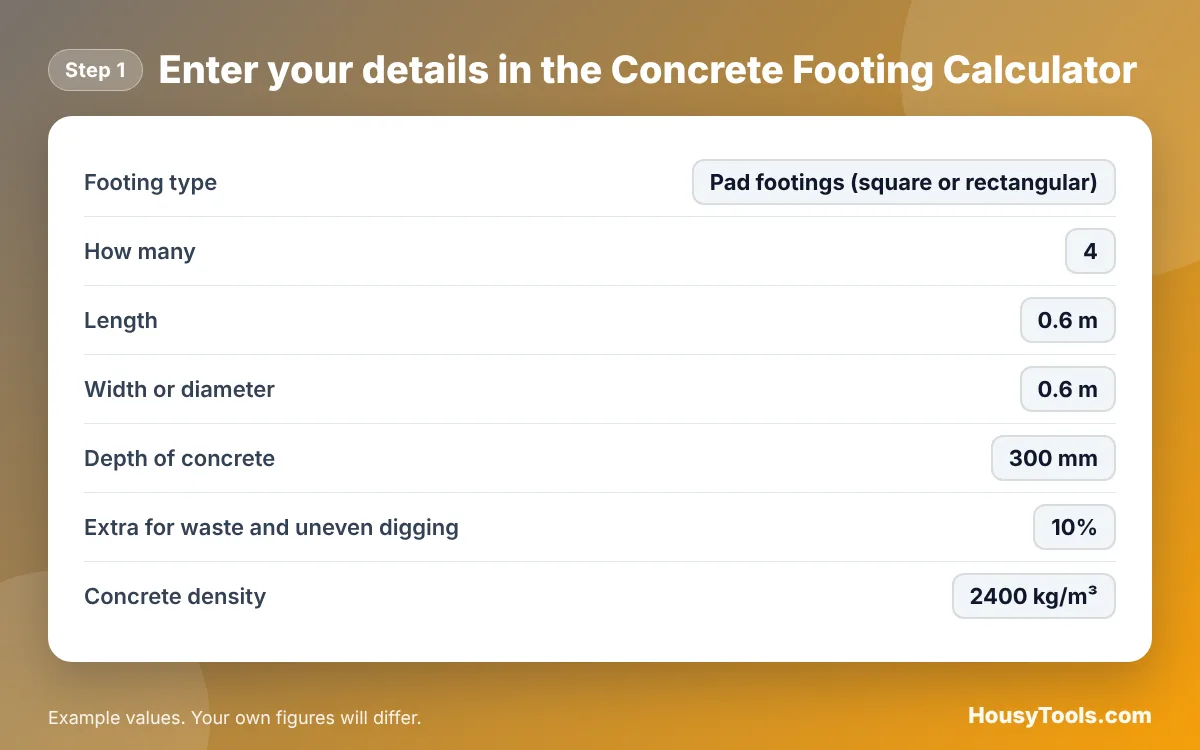
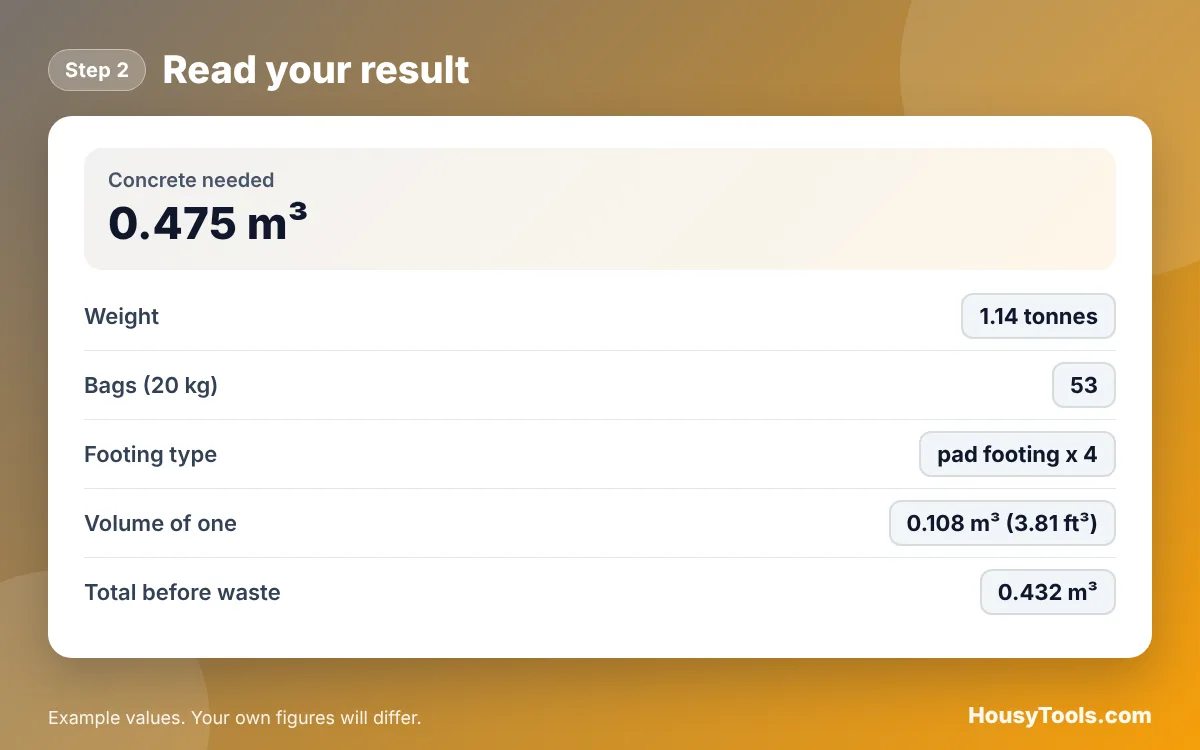
Quick answer: Multiply length x width x depth in metres for each footing, multiply by the number of footings and add about 10% for waste. Four 600 x 600 mm pads, 300 mm deep, need 0.475 m³ with waste, about 1.14 tonnes. The concrete footing calculator shows 53 bags at an example 9 litres per bag.

What Is a Concrete Footing Calculator?
A concrete footing calculator is a tool that finds the volume of concrete needed to fill footing holes or trenches. For a pad or strip footing, volume = length x width x depth. For a round footing, volume = 3.1416 x (diameter / 2) squared x depth. Multiply by the number of footings, add a waste allowance, then weight = volume x density, and bags = volume in litres / litres made per bag.
Normal concrete weighs around 2,400 kg per cubic metre, as described in the properties of concrete on Wikipedia. The size and depth of a footing depend on the load, the soil and nearby trees, so this tool calculates quantities only. For walls, extensions and anything structural, the footing design must satisfy building control or a structural engineer.
How Do You Use the Concrete Footing Calculator?
- Choose the Footing type: pads, a strip footing in a trench, or round piers.
- Enter How many footings or trench runs of the same size.
- Enter the Length and Width or diameter. For a strip footing, the length is the total trench length.
- Enter the Depth of concrete in mm and the Extra for waste and uneven digging.
- Check the Concrete density, the Bag weight and the Concrete made per bag (from the bag).
- Read the volume, tonnes and bags, then open “Show the formula and working” to see each step.

How Much Concrete Do I Need for a Footing?
A 600 x 600 mm pad footing 300 mm deep needs 0.108 m³ of concrete, about 0.26 tonnes, and a strip footing 600 mm wide and 225 mm deep needs 0.135 m³ for every metre of trench. Add about 10% for waste, over digging and spillage. The table shows common sizes before waste, with bags at an example yield of 9 litres per 20 kg bag.
| Footing | Concrete | Weight at 2,400 kg/m³ | Bags at 9 L each |
|---|---|---|---|
| Pad 400 x 400 mm, 300 mm deep | 0.048 m³ | 0.12 t | 6 |
| Pad 450 x 450 mm, 450 mm deep | 0.091 m³ | 0.22 t | 11 |
| Pad 600 x 600 mm, 300 mm deep | 0.108 m³ | 0.26 t | 12 |
| Pad 600 x 600 mm, 600 mm deep | 0.216 m³ | 0.52 t | 24 |
| Strip 450 mm wide, 225 mm deep, per metre | 0.101 m³ | 0.24 t | 12 |
| Strip 600 mm wide, 225 mm deep, per metre | 0.135 m³ | 0.32 t | 15 |
| Strip 600 mm wide, 300 mm deep, per metre | 0.180 m³ | 0.43 t | 20 |
| Round 300 mm diameter, 600 mm deep | 0.042 m³ | 0.10 t | 5 |
Should I Use Bags or Ready Mixed Concrete for Footings?
Bags suit small jobs up to about half a cubic metre, while ready mixed concrete delivered by truck is usually easier for anything over about 1 m³. An 8 m strip footing 450 mm wide and 225 mm deep needs 0.891 m³ with 10% waste, which is 99 bags of 20 kg at 9 litres each. Mixing that by hand is a long day, and footings are best poured in one go. For slabs, paths and bases, use the concrete calculator, and for fence and gate posts, the concrete post hole calculator.
Do I Need Building Regulations Approval for Footings?
Footings for extensions and other building work covered by the regulations need building regulations approval, and building control usually inspects the trench before you pour. Small garden structures such as sheds and low walls often do not, but they still need footings sized for the soil. Clay soils, trees and drains can all call for deeper footings, so ask building control or a structural engineer when in doubt.
Worked Example: Four Pad Footings for a Deck or Carport
Example: four pad footings, each 600 mm by 600 mm with 300 mm of concrete. One pad holds 0.6 x 0.6 x 0.3 = 0.108 m³, so four hold 0.432 m³. Adding 10% for waste gives 0.432 x 1.1 = 0.475 m³. At 2,400 kg/m³, that weighs 0.475 x 2,400 = 1.14 tonnes. With bags that make an example 9 litres each, you need 475 / 9 = 52.8, rounded up to 53 bags of 20 kg. A ready mix order would be 0.5 m³.
The bags weigh 1,060 kg in total, less than the finished concrete, because you add water when mixing. Always use the yield printed on your bag. More building tools are on the building and DIY calculators page.
Concrete Footing Calculator FAQs
How do I calculate concrete for a footing?
Multiply the length, width and depth in metres to get cubic metres, then multiply by the number of footings and add about 10% for waste. For round footings, use 3.1416 x radius x radius x depth instead of length x width.
How many bags of concrete do I need for a footing?
Divide the volume in litres by the litres each bag makes, which is printed on the bag. A 0.108 m³ pad is 108 litres, so at an example 9 litres per bag it needs 12 bags before waste.
How much does a cubic metre of concrete weigh?
About 2,400 kg, or 2.4 tonnes, for normal concrete. Lightweight concrete is less and heavily reinforced concrete slightly more. The calculator lets you change the density if your supplier gives a different figure.
How deep should a footing be?
It depends on the load and the ground, so there is no single answer. Footings must reach firm ground below frost and root action, and clay soils near trees may need to go much deeper. Building control or a structural engineer sets the depth for structural work.
How much extra concrete should I order?
Add about 5% to 10% to cover uneven trench sides, over digging and spillage. Hand dug holes are rarely perfectly square, so 10% is a sensible example. Running short halfway through a pour is worse than having a little left over.
How many cubic feet is a cubic metre of concrete?
One cubic metre is 35.31 cubic feet or 1.31 cubic yards. Switch the calculator to imperial units to enter feet and see the result in cubic feet, which helps when following American footing guides.
Checked October 2026. Sources: Properties of concrete (Wikipedia), Building regulations approval (GOV.UK).