
Show the formula and working
This block calculator works out how many concrete blocks you need for a wall, garage, extension leaf, retaining planter or garden building, together with the total weight and the mortar in the joints. It is set up for the UK and Irish standard 440 x 215 mm block and metric measurements, with a feet and inches switch, and every size can be changed to match the blocks you buy.
Quick answer: A standard 440 x 215 mm block with 10 mm joints covers 0.45 x 0.225 m, so you need 9.88 blocks per square metre, usually rounded to 10. Multiply by the wall area and add 5% for cuts. The block calculator gives 100 blocks for a 4 m by 2.4 m wall.
What Is a Block Calculator?
A block calculator is a tool that turns the area of a wall into the number of concrete blocks needed to build it. Each block plus its share of the joint covers (block length + joint) x (block height + joint). One square metre divided by that face gives blocks per square metre for one leaf. Multiply by the net wall area, the number of leaves and 1 plus the waste allowance, then round up.
In Ireland and the UK, blocks are usually 440 x 215 x 100 mm before the mortar joints, according to the Wikipedia article on concrete masonry units. Weight is block volume x density, and the joint mortar is the wall volume minus the volume of the blocks.
How Do You Use the Block Calculator?
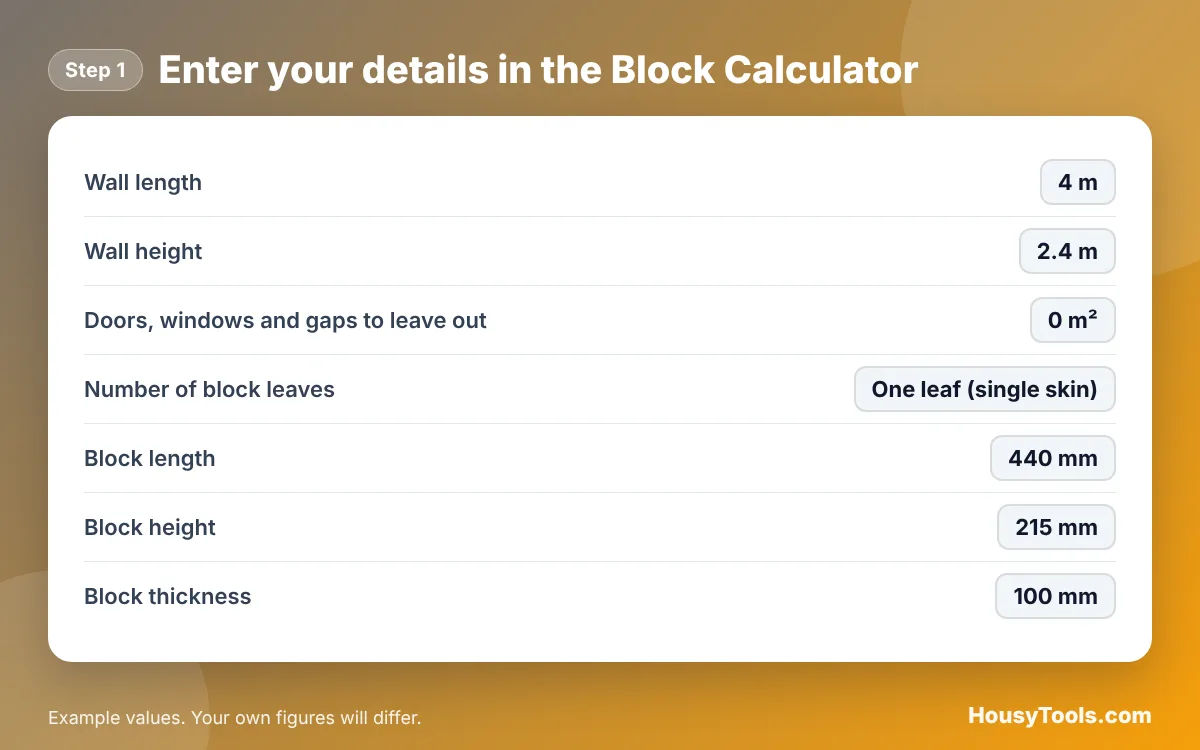
- Enter the Wall length and Wall height.
- Enter the total area of Doors, windows and gaps to leave out, or 0 for a solid wall.
- Choose the Number of block leaves: one leaf, or two leaves if both skins are blockwork.
- Check the Block length, Block height, Block thickness and Mortar joint.
- Set the Extra for cuts and breakages and enter the Block density (from data sheet) for your block.
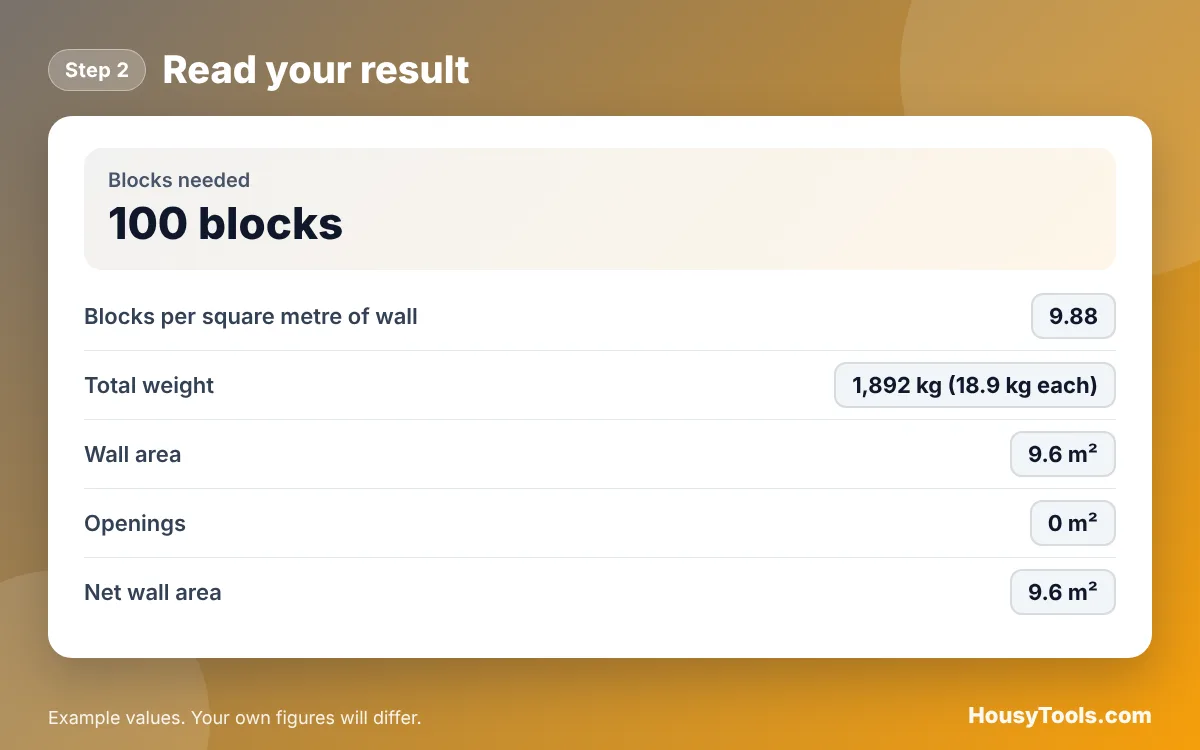
- Read the number of blocks, blocks per square metre and weight, then open “Show the formula and working” to see each step.
How Many Blocks Are in a Square Metre?
There are 9.88 standard 440 x 215 mm blocks in one square metre of wall with 10 mm joints, which builders round to 10. The thickness of the block does not change this figure, because only the face size counts. A two leaf wall of blockwork needs twice as many, 19.75 per square metre.
If you lay a 100 mm block flat, its face becomes 440 x 100 mm. Enter 100 as the Block height and 215 as the Block thickness, and the count rises to about 20.2 blocks per square metre for a 215 mm thick wall.
| Block (440 x 215 mm face) | Blocks per m² | Joint mortar per m² (no waste) | Weight each at 2,000 kg/m³ (example) |
|---|---|---|---|
| 100 mm thick | 9.88 | 6.6 litres | 18.9 kg |
| 140 mm thick | 9.88 | 9.2 litres | 26.5 kg |
| 215 mm thick | 9.88 | 14.1 litres | 40.7 kg |
The 2,000 kg/m³ density is an example only. Dense, lightweight and aircrete blocks weigh very different amounts, so take the density or block weight from the manufacturer’s data sheet.
How Heavy Is a Concrete Block?
A 440 x 215 x 100 mm block has a volume of 9.46 litres, so at 2,000 kg/m³ it weighs about 18.9 kg. Aircrete blocks of the same size weigh far less. The UK Health and Safety Executive warns of injury risk from repeatedly laying masonry units over 20 kg by hand, and its construction manual handling FAQs advise choosing the lightest block that meets the design. The calculator warns you when a block is over 20 kg.
How Many Blocks Do I Need for a Garage or Extension Wall?
Multiply the wall length by the height, take away doors and windows, then multiply by 9.88 per leaf and add 5%. A 6 m wall 2.4 m high with a 2.1 m by 2.4 m garage door opening has 9.36 m² of blockwork and needs 98 blocks for one leaf. Structural walls must follow the Building Regulations and your engineer’s or designer’s drawings, so use the calculator for quantities, not for choosing the block.
Worked Example: A Blockwork Partition
Example: a single leaf block wall in a garage is 4 m long and 2.4 m high, with no openings, using 440 x 215 x 100 mm blocks and 10 mm joints. Add 5% for cuts and use the example density of 2,000 kg/m³ until you have the data sheet.
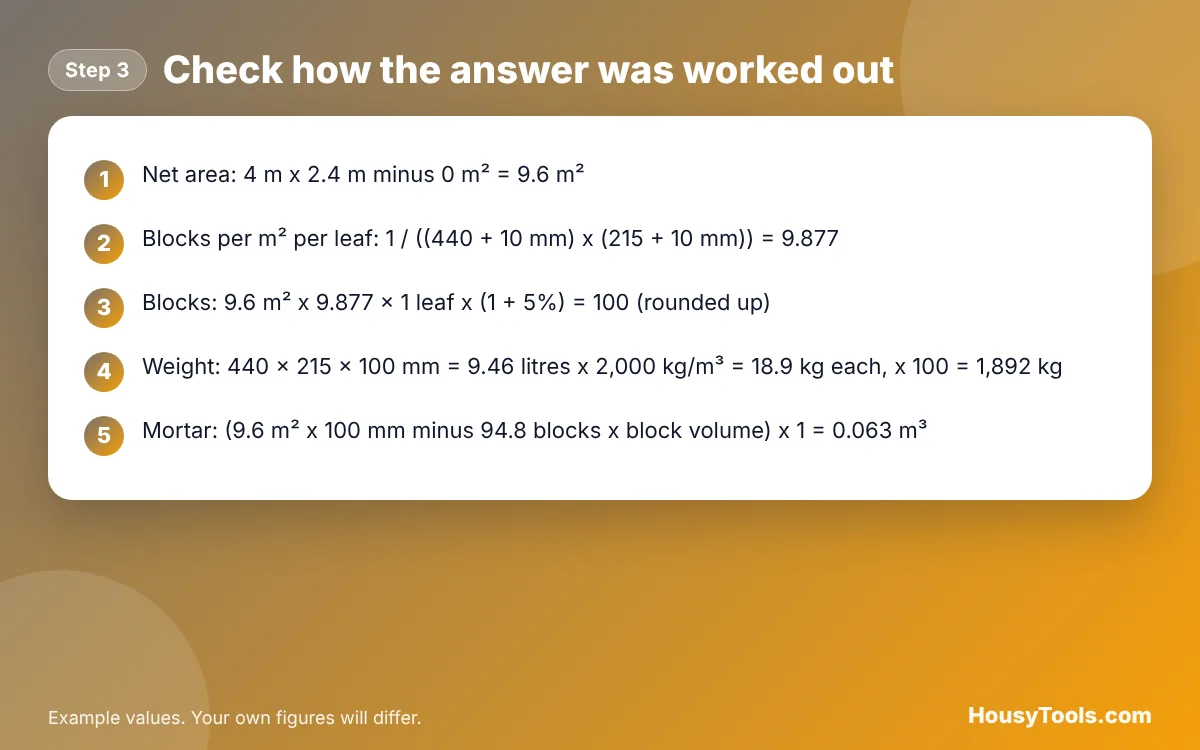
- Net area: 4 m x 2.4 m = 9.6 m².
- Blocks per m²: 1 / (0.45 m x 0.225 m) = 9.877.
- Blocks: 9.6 m² x 9.877 x 1.05 = 99.6, rounded up to 100 blocks.
- Weight: 9.46 litres x 2,000 kg/m³ = 18.9 kg each, about 1,892 kg in total.
- Mortar in the joints: 0.063 m³ before waste.
At nearly 1.9 tonnes, a merchant delivery makes more sense than collecting the blocks yourself. Once the wall is plastered, the paint calculator works out the emulsion, or the masonry paint calculator if you leave the blocks bare and paint them.
Block Calculator FAQs
How many blocks are in 1 m²?
A wall of standard 440 x 215 mm blocks with 10 mm joints has 9.88 blocks per square metre, normally rounded to 10. Block thickness does not change the count. Add about 5% for cuts and breakages when you order.
What size is a standard concrete block in the UK?
A standard UK and Irish concrete block is 440 mm long and 215 mm high, the same face as two bricks by three courses with joints. Common thicknesses include 100 mm, 140 mm and 215 mm, chosen by the designer for the wall.
How much does a 100 mm concrete block weigh?
It depends on the density. A 440 x 215 x 100 mm block holds 9.46 litres of material, so it weighs about 18.9 kg at 2,000 kg/m³ and far less as aircrete. Check the manufacturer’s data sheet for the exact weight.
How many blocks are in a pack?
Pack sizes vary with block type, thickness and supplier, so there is no single number. Ask your merchant how many blocks each pack holds, then divide the block count from this calculator by that number and round up.
How much mortar do I need for blockwork?
The joints of a 100 mm wall of standard blocks hold about 6.6 litres of mortar per square metre before waste. The calculator shows the joint volume for your wall. Add a generous allowance for droppings and uneven bed joints when you buy mortar.
Can I build a wall with blocks without planning permission?
Many garden walls and small outbuildings need no planning permission, but height, position and use all matter, and extensions must meet the Building Regulations. Check your local planning authority’s guidance before you start building.
Checked October 2026. Sources: Wikipedia: Concrete masonry unit (UK and Irish 440 x 215 x 100 mm block), HSE: Construction manual handling FAQs, HSE: Manual handling of blocks and masonry units.